Aug 6, 2017
Reading time 6 min.
Vintage Eye for the Modern Guy: RGM 151-COE “Corps of Engineers”
FEATURE
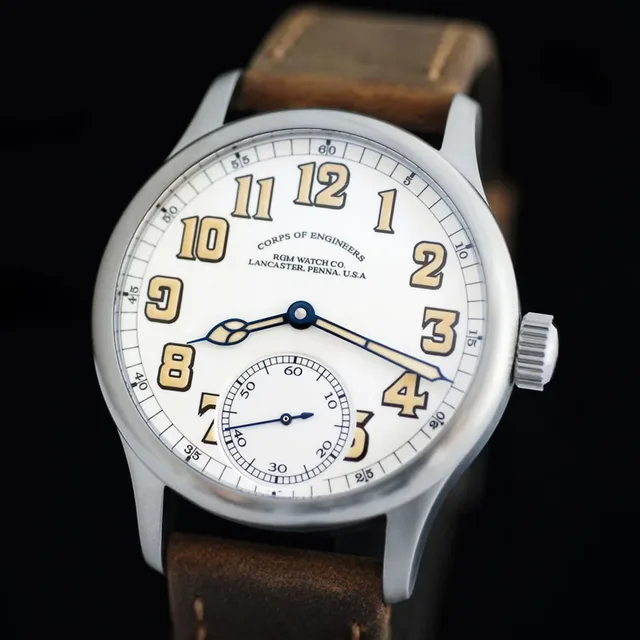
RGM makes some very interesting watches in the U.S.A. — two of which have a clear historical connection to the U.S. Army Corps of Engineers pocketwatches from the World War I era: the 801-COE and 151-COE “Corps of Engineers,” the latter of which will be this article’s focus.
August has always been, for me, a reflective month — a time for heat, humidity, and vacation, of traveling up and down the East Coast from beach to beach, café to café, and from friend to friend, until I finally settle down for a week in Massachusetts with my family before heading back to everyday life.
As I have gotten older, and particularly since I’ve started writing professionally, a new facet has beed added to my August thoughts: a look back at the articles I have written, the friends I've made, the watches I've discovered, the events I've attended. And mulling all this over, my thoughts kept returning to last year’s WatchTime New York event, and more specifically to RGM and its American-made timepieces.
RGM 801-COE watch
PR
RGM is bringing American watchmaking back to one of its historical hubs, in Lancaster County, PA.
RGM distinguished itself at the show in two ways. First, the brand brought an old-fashioned guilloché engine-turning machine (also known as a rose engine) and hooked a camera up to it so attendees could turn the machine themselves to create different designs while also seeing the metal being slowly carved away. For me, the exercise reminded me of how incredibly intricate that guilloché and many other made-by-hand design processes are, and also gave me a renewed perspective on the expert craftsmanship and artistry watchmakers need to possess to become successful in today’s luxury market. The brand also stood out to me because of its courtesy. Sure, to some extent the rose engine was a gimmick, but it wasn’t just there to sell watches; it was also meant to spark conversations. For me, and many others, it did. In my initial conversation with the brand’s founder, Roland G. Murphy (for whom the company is named), and his chief watchmakers, I remember asking about some design choice on a watch, to which one of them responded, “Well, when I was making this watch —” I cut him off: “I’m sorry, you made this watch? This one right here?” “Well, yes, that one right there," he clarified. "And as I was making it, I…” and he went on to explain the piece. To this day, I can’t remember exactly what he said, but I do remember being astonished at how casual he was about the beautiful piece he developed over so many hours, and how willing and excited he was to speak with me about such a minute design choice that he himself, in the moment of building the watch, decided upon. After a long while, as I began to take my leave of the RGM stand to visit other brands, Murphy and his team invited me to come visit their Mount Joy, Pennsylvania workshop — a visit which I still plan to make.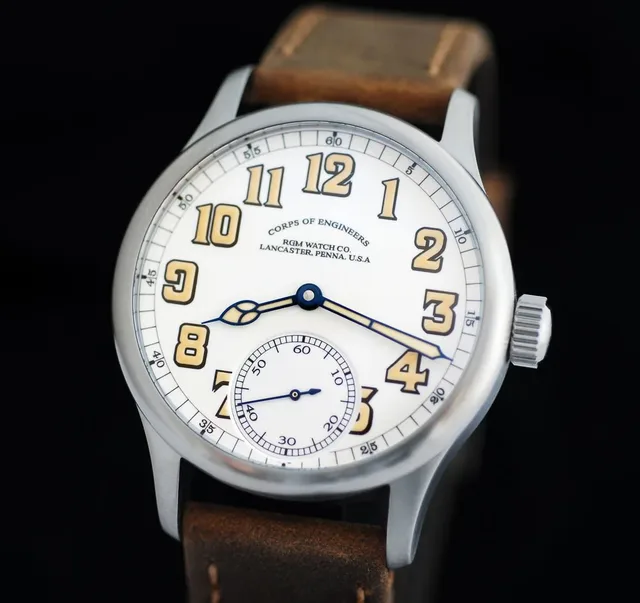
RGM 801-COE - soldier
PR
RGM's watchmakers not only use neat machines and make great conversations: they also make some very interesting watches — two of which have a clear historical connection to the U.S. Corps of Engineers pocketwatches from the World War I era: the 801-COE and 151-COE “Corps of Engineers,” the latter of which will be this article’s focus.
The 151-COE is meant to be a smaller, automatic version of the successful 801-COE model (pictured above). Both designs are derived from the designs of early 20th century pocketwatches used by railroad conductors, and the Army Corps of Engineers, for whom the watches are named. They derive their unique traits from a few different watches of the era, particularly from brands like Keystone Howard Watch Company, Hamilton, and Illinoi Watch Company. However, many of the design choices are more era-specific than brand-specific.
RGM 151-COE watch - front
PR
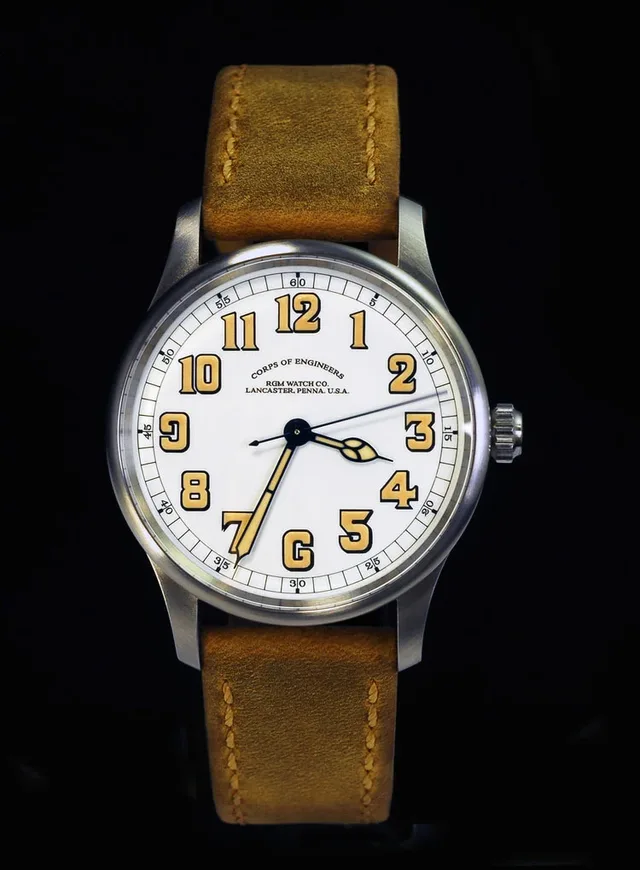
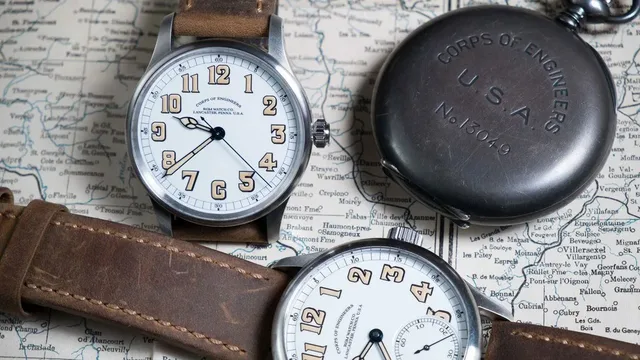
The 151-COE watch has a grand feu enamel dial with vintage-style Arabic numerals and cathedral hands.
The 151-COE uses a 38.5-mm steel or titanium case, with a thin bezel and curvy lugs. Its enamel dial — developed through the “grand feu” technique of slowly baking layers of powdered glass to a metal baseplate through repeated exposure of the dial to extreme heat — features many details in line with the General Railroad Timepiece Standards of 1893, which were used as inspiration for the first 801-COE. Notice the soft, white enamel background with its black railroad-track outer minute ring; the enlarged, vintage-style Arabic numerals and cathedral hands with their faux-patina coloring; and, finally, the “Corps of Engineers” mark for which the watch is named toward the 12 o’clock position, with the brand and production location just below it. Within the piece is the RGM-finished automatic ETA 2892-A2 movement, capable of a 42-hour power reserve — a standard workhorse movement, but one that comes on the heels of the in-house-made, manually-wound RGM 801 used for the previous 801-COE. Pricing for the steel model is $4,950, while the titanium version sells for $5,950, and both can be found by making a direct contact to the brand here.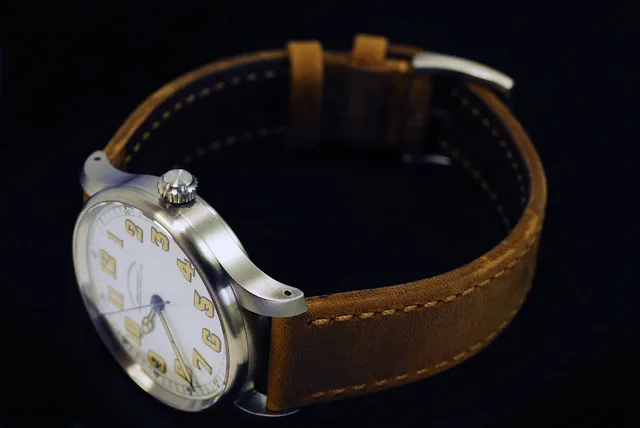
RGM 151-CoE - side
PR
Among the historical similarities to the watches that inspired it, you’ll notice on the modern version the white enamel dial with its outer minute track, the large vintage-style numerals, and the cathedral hands. Besides these details— arguably the most important details of all on this rather straightforward piece — the manufacturing being almost completely American-made in Lancaster County (more specifically Mount Joy, Pennsylvania) is also an homage in itself. Many years ago, the United States had a robust watch-manufacturing industry, with one of its most important hubs in Lancaster, namely the Hamilton Watch Company. RGM, by the very uniqueness of its brand and location, is doing its part to resurrect American watchmaking by paying homage to some of the same pieces that brought it success over a hundred years ago.
The exhibition caseback displays the RGM-modified, automatic ETA 2892-A2 movement.
On to the differences: of course, the small, self-winding wristwatch version of the 151-COE is certainly different from the large, manually-wound pocketwatches of years past. Additionally, the modern watch has opted to use a sapphire caseback to display the movement (below), which is actually the only non-Lancaster-produced item within the piece. Yet these changes come purposely after the more historically-oriented 801-COE, which is both a larger piece and has an American-made RGM manual movement, although the 801-COE also features an exhibition caseback.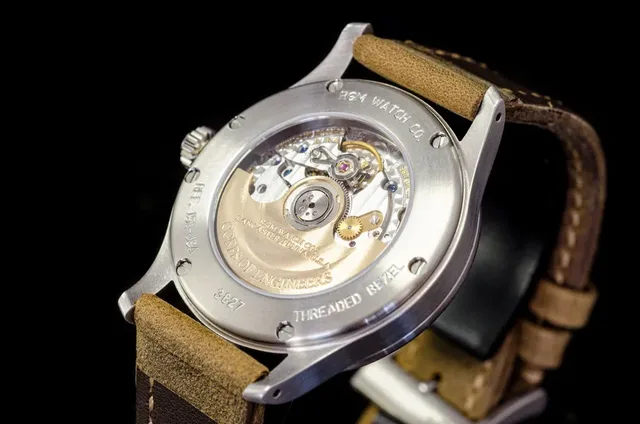
RGM 151-COE - back
PR
This will likely come as little surprise, but I am a fan of RGM and its budding heritage collection. In my view, not only is the brand preserving some of the oldest traditions from 19th and 20th century watchmaking, but it is doing so in a place with a proud history of horological production. More than this, the brand is producing some beautiful pieces, and seems bent not on becoming the biggest and most profitable watch company in the land, but more becoming a brand renowned for its expertise and goodwill — not to mention, for the conversations that its watches will inevitably spark.
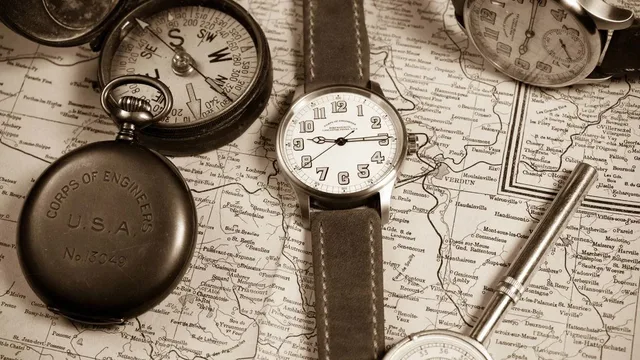
RGM 151 COE watches - map
PR
For last week’s article on the Rolex Air-King and its vintage predecessors, click here.
Caleb Anderson is a freelance writer with a primary focus on vintage watches. Since first learning about horology, he has garnered extensive knowledge in the field, and spends much of his time sharing his opinions among other writers, collectors, and dealers. Currently located near New York City, he is a persistent student in all things historical, a writer on many topics, and a casual runner.
Save