

A few years ago, TAG Heuer introduced a new version of its racing-inspired Carrera watch with a brand-new movement. WatchTime took the watch, the TAG Heuer Carrera 1887, for a spin. Click here for the results of our comprehensive watch test, originally published in our print edition, along with exclusive photos by Nik Schölzel.
TAG Heuer celebrated the 50th birthday of its most important watch model, the TAG Heuer Carrera chronograph, in 2013. The watch is the brainchild of Jack W. Heuer, then managing director at Heuer (which became TAG Heuer after it changed hands in 1985), designed a simple dial and then used the tension ring that presses the Plexiglas against the case from the inside as a design element by printing on it the graduations for the chronograph. (Click here for our 2013 interview with Jack Heuer to learn more about the creation of the Carrera from the man himself.)
Thus, a classic watch with excellent legibility was born. Heuer, a fan of automobile racing, named the watch after the Carrera Panamericana, or “Pan Am,” Of the 1950s. The Pan Am was a challenging road race through Mexico over 3,000 kilometers of the newly finished Mexican section of the Pan American Highway. Porsche’s Carrera cars are also named for this race. (For more on the Carrera Panamericana race and how it and other 1960s modernist ideas influenced the design of the original Carrera, click here.)
(Click on watch photos for larger images.)
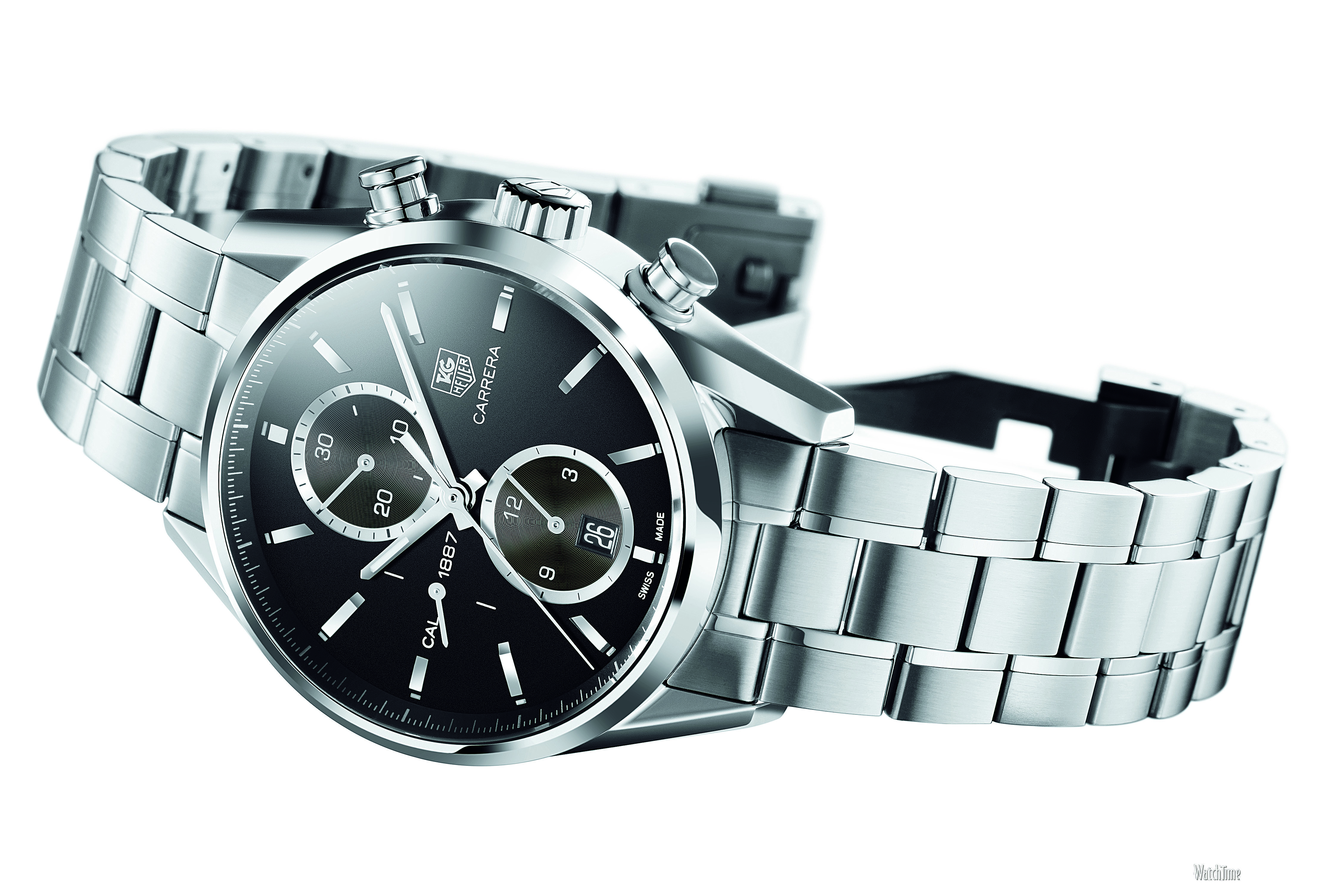
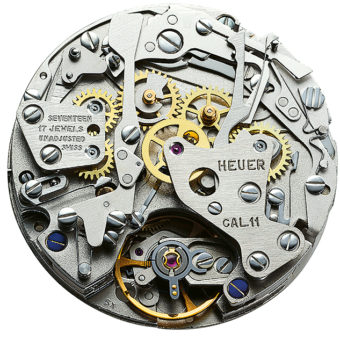
The Carrera watch was initially equipped with the manually wound Venus Caliber 72 but was later replaced by the now-famous Caliber 11, developed by Heuer in 1969, in collaboration with Breitling, Büren and Dubois Dépraz, as one of the first automatic chronograph movements. In the 1970s, the design of the Carrera underwent a series of changes until the quartz crisis caused the model to fall by the wayside.
Since its re-introduction in 1996, the Carrera has become TAG Heuer’s most successful model. The first watches were very similar to the original, but in 2004 their design was updated with a wide, black tachymeter track. In 2008, a new line extension, called Grand Carrera, was added.
The TAG Heuer Carrera 1887 is a return to a simpler form. Its designers omitted the tachymeter track and graduation markers on the dial and placed them instead, like its predecessor’s, on the inner flange. Otherwise, the hands, markers and understated ripple pattern on the chronograph counters recall the original. The silver rings for the minute and hour counters, first seen on the black-dialed 2002 model, have become a characteristic feature of the Carrera. One change: the date is now placed within the hour counter at 6 o’clock. The design is not as distinctive as one would like for a watch of this status; it probably won’t turn heads from far away. The small-seconds subdial at 9 o’clock has four cross-hair markers with the horizontal lines replaced by the words “Cal. 1887.”
The exclusive movement in the new TAG Heuer Carrera, Calibre 1887, has an interesting back-story. The brand obtained the rights to a complete and finished movement from Seiko and now produces it with a few minor technical changes and several design modifications. (TAG Heuer’s initial claim that it was a manufacture movement initially drew some criticism from watch industry insiders.) Caliber 1887 is based on Seiko’s Caliber 6S78, which debuted in 1998 and has been used mostly in the Japanese brand’s high-end Credor mechanical watches, available only in Japan.
When TAG Heuer set out to develop its own chronograph movement, it determined that this Seiko movement met many of its requirements: it is thinner than the Valjoux 7750, has a column wheel and most importantly, a rocking pinion. This type of chronograph clutch is an excellent fit for TAG Heuer, since it was company founder Edouard Heuer who invented and patented it in 1887 (hence, the caliber’s name).
TAG Heuer and Seiko came to an agreement that the Swiss brand would be permitted to use the movement design, which allowed TAG Heuer to save at least two years’ worth of development work, even though the movement still had to be reworked for mass production in order to meet the brand’s goal of making 50,000 pieces annually.
From a design point of view, TAG Heuer left most things unchanged, though it added a few new details, like an eccentric setting screw for adjusting the rocking pinion. The entire escapement, with its balance, hairspring, fine regulator and shock absorber, was replaced with components from the Swiss manufacturers Nivarox and Kif. Even the shapes of the mainplate, bridges and rotor were changed. TAG Heuer manufactures these parts in the town of Cornol at its subsidiary, Cortech. The company expanded its movement production capacity in 2012 and now also makes Caliber 1887 in a new facility in Chevenez in the Swiss Jura.
Milling machines from another company, Fleury, use a rather uncommon process to dry-machine brass parts like mainplates and bridges. The omission of oil as a coolant in the process means that the parts do not need to be cleaned between the various processing stages, thus saving time. Cortech uses a robot that places the 39 jewels in the mainplate and bridges. Final assembly takes place in a TAG Heuer facility in La Chaux-de-Fonds on a semi-automatic assembly line with both manual and fully automatic stations. Seiko is the only non-Swiss company among the 22 suppliers for the movement. Seiko also supplies stamped parts, which it makes sure meet the Swiss standards for the “Swiss made” designation.
Download the full review, including specs, price, and final scores, here. And click here to see how a more recent version of the TAG Heuer Carrera 1887, the Carrera 1887 Jack Heuer Edition, fared in a head-to-head comparison test with another vintage-inspired chronograph watch, the Tudor Heritage Chrono Blue.
Click below for a video of the TAG Heuer Carrera 1887…
For more watch videos, including original videos shot exclusively for WatchTime, click here to visit our YouTube page.
This article was originally published in 2012 and has been updated with new material.
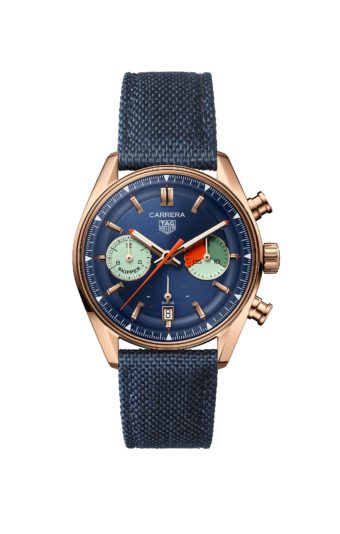
This is a very nice watch.I bought last year one for my father by Q1Watches
http://q1-watches.com/collections/tag-heuer-men/products/tag-heuer-men-car2110-ba0720
I think it is a special one from TAG Heuer.
You can tell the the shock absorber is actually KIF, not Incabloc. Icabloc is an ETA product which is not used in this movement. I read an interesting article about this movement reviewed by a Breguet engineer. He said that every part of the movement had been remade except for one part which was ordered directly from seiko and that all other parts were swiss. He even commented that TAG had done so much to the movement that they legitimately could call it in-house. Of course this will never be enough for psycho purists but many of those people evaluate a product with their heart and not their brain. The engineer had high praise for this watch and I can honestly say that it is on my list of watches to purchase. Basel 2013 saw the release of a blue-faced version, that sold it for me.
I love the design and complication of this timepiece. However, I have seen TAG Heuer say that this is an in-house movement and that’s a little misleading.
I love it in the black strap version!
See no problem with using part of Seiko’s design in the movement. Smart to use the best from the best.
Very true. Seiko is the best. That’s why I own a Seiko Ananta Spring Drive GMT. Not that accuracy is everything, but there is nothing yet mechanical that can match it.
Nice and simple but nothing to special of a watch design. Still essentially a Seiko movement no matter what! Love the see-through sapphire crystal caseback and the classy design of the rotor.
Chulada de Reloj !!!!!