Military History: Testing the Sinn Model 158
This article is from the WatchTime Archives and was originally published in July 2022.
With Model 158, Sinn has revived a little-known facet of its history: the Bundeswehr Chronograph. Presented in a refreshed, limited edition, how well does this retro chronograph perform?
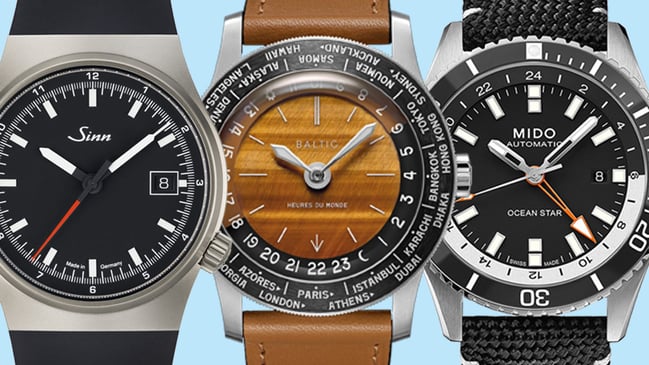
Sinn is known for making watches for police and military forces. The EZM 1, for example, was the first mission timer Sinn designed in 1997 for special units of Germany’s customs authority. Sinn had the German special police unit GSG 9 in mind when it developed the UX divers’ watch, which is also worn by members of the German Navy’s Special Forces Command. And the 212 KSK meets the requirements of the German Army’s Special Forces Command.
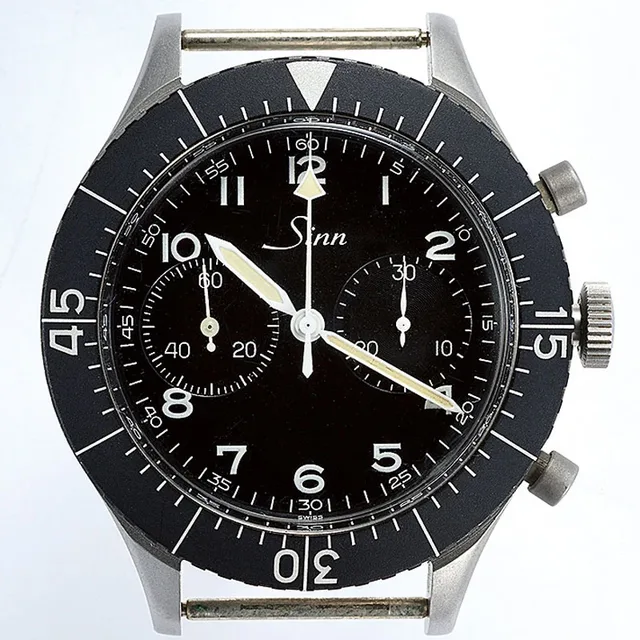
But fewer watch fans may know about the points of contact between Sinn and the Bundeswehr, Germany’s armed forces, in the past. In the 1980s and early 1990s, the company’s founder, Helmut Sinn, purchased the German Army’s stock of decommissioned Bundeswehr chronographs, which were made by Heuer (Ref. 1550 SG). Helmut Sinn reworked these watches and afterward sold them as Sinn Model 155 Bw, with Sinn lettering on their dials designating “Heuer/Sinn Bunderswehr-Chronograph für Piloten” (German for Heuer/Sinn German Armed Forces Chronograph for Pilots).
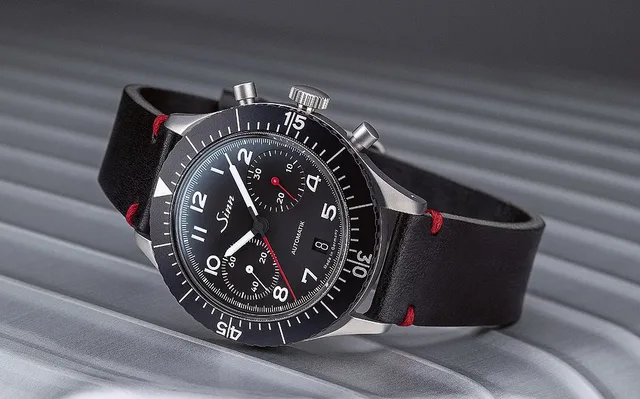
Now Sinn pays tribute to this watch with its Model 158, our test watch, which is released in a limited edition of 500 timepieces. The lion’s share of this watch’s design has been adopted unchanged from its ancestor. Anyone familiar with the original model will immediately notice that the new watch is almost the spitting image of the Bundeswehr Chronograph, but a few details have been altered. The case corresponds almost 100 percent to the original. Fidelity to detail is evident in the shape of the push-pieces, as well as in the crown, which has no lettering for better usability, and above all in the bidirectional rotatable bezel of black anodized aluminum, which honors its ancestry in its minutes scale and in the typography of its numerals. The family resemblances even include subtleties such as the fluting on the rotatable bezel, the fully pierced strap lugs and a rather unusual snap-on case with four set screws. The bead-blasted surface of the case, its diameter of 43 mm, its opaque metal back and its domed acrylic crystal likewise match their counterparts on the original 155.
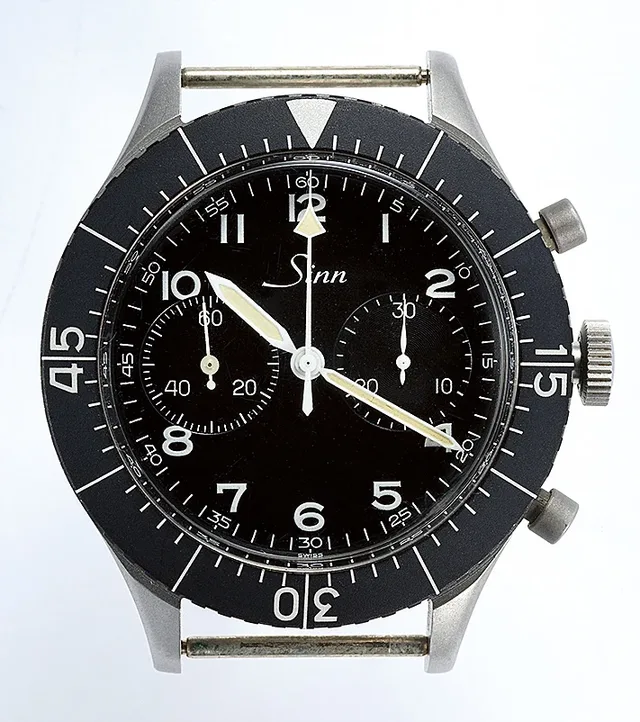
The new watch’s dial, on the other hand, looks somewhat different from that of its forebear. The bicompax arrangement of subdials (with seconds on the left and elapsed minutes on the right) and the typography of the hour numerals correspond to the original, but some modifications have been made. For example, the chronograph’s elapsed-time hands are highlighted in red, the hands have a more modern shape, a date display has been added at 6 o’clock and a scale with split-second markers at 5-minute increments has replaced the original scale, which marked every fifth minute with a number. The new face makes a harmonious impression and follows Sinn’s characteristic color scheme. Furthermore, the updated design scarcely detracts from the excellent legibility, which naturally topped the list of specs for the original Bundeswehr Chronograph.
Simple operation was another crucial item on the military’s list of requirements. As is usual with this caliber, the push-pieces demand authoritative force, especially when starting the chronograph. Controlling the stopwatch function isn’t made any easier by the authentic shape of the push-pieces, which offer a rather small area on their circular tops. The functionality is better with the low-rise but large-diameter crown, which — like its ancestor on the historical model — protrudes unusually far from the side of the case, thus ensuring that this fluted button can be easily turned and readily pulled outward. A stop-seconds mechanism halts the balance and thus also stops the hands: this makes it convenient to set the time with to-the-second precision. Although the bidirectional rotatable bezel doesn’t snap into place in specific increments, it’s nonetheless a pleasure to operate: it runs smoothly, but not so easily that it could inadvertently shift position.
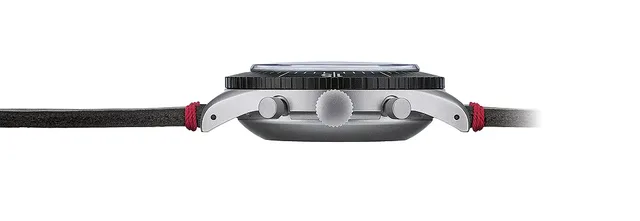
Robustness was the third important requirement for the military. At first glance, the operating elements could be a potential cause for concern here. Fortunately, closer inspection finds that the lengthy push-pieces and the protruding crown fit in their guides very firmly and without play, thus making an extremely sturdy impression. The flat bezel doesn’t protrude beyond the case, so even without Sinn’s frequently used technology of a screwed and therefore impossible-to-lose bezel, there’s little reason to fear that this rotatable ring might snag on something and get pried off. The acrylic crystal over the dial doesn’t resist scratches as effectively as a sapphire crystal, but it’s made of the same material as its ancestor — and at least it won’t splinter if it suffers a sharp impact. The case’s water resistance to a depth of 100 meters is more than adequate for a pilots’ watch.
Despite the watch's high resistance to pressure, Sinn has succeeded in keeping it fairly slim. The 158 encases a taller self-winding movement than the original model with a hand-wound caliber, so it can’t have a height that’s quite as slim as the 13 mm of its predecessor, but its 15 mm height and outwardly sloping bezel give it a sufficiently low-rise profile. A curved back and recesses in the case’s middle piece further help this chronograph make a slim impression.
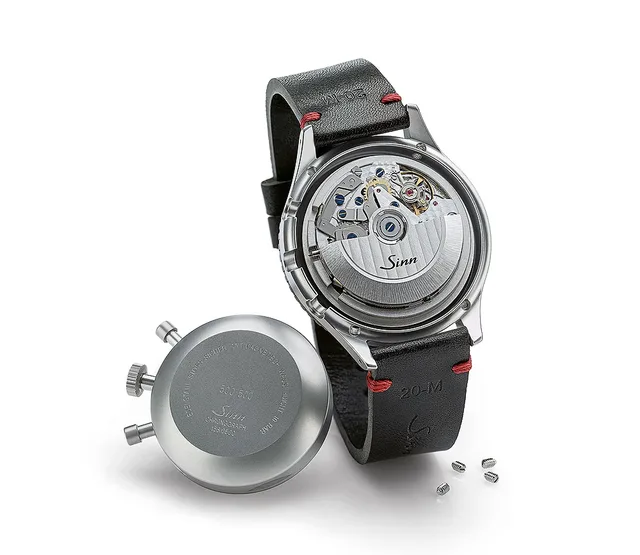
Most of the original Heuer/Sinn Bundeswehr Chronographs encased Valjoux’s hand-wound Caliber 230 with column wheel and flyback function. The new 158 relies on Sellita’s self-winding Caliber 510. Critics allege that Sellita only imitates ETA’s movements. (Copying them would not be prohibited because their patent protection has expired.) This allegation may be true in most instances, but Sellita has achieved something here with Caliber 510 that ETA has not yet accomplished with its Valjoux 7750: namely, a symmetrical dial arrangement (tricompax or bicompax) combined with a rapid-reset function for the date mechanism via the crown. The ETA Valjoux 7753 needs a corrector button at the 10 and this extra button requires an additional aperture in the case. We prefer Sellita’s more elegant solution.
Apart from this detail, the Sellita movement corresponds to its robust progenitor with cam switching and a unidirectional effective winding rotor, whose clearly perceptible and audible idling is liable to annoy connoisseurs with sensitive hearing. The maximum power reserve of 48 hours is also similar to that amassed by the ETA Valjoux movement. Sinn encases the better “Premium” quality variation with a Glucydur balance, decorative finishing and blued screws. The case’s authentic and consequently opaque back conceals the movement, but you shouldn’t lament the absence of a transparent caseback because this watch’s concept and its caliber were developed to prioritize functionality.
The German Air Force stipulated that the watch must not deviate from perfect timekeeping by more than 10 seconds per day while its chronograph mechanism is running. Our Witschi timing machine confirmed that the contemporary 158 keeps time with significantly greater accuracy than that. With its stopwatch function switched off, it kept very nearly perfect time, gaining an average of less than 1 second per day. And with the chronograph mechanism switched on, its rate posted an acceptable daily loss of 4 seconds. However, according to our strict evaluation scheme, the difference of 10 or 12 seconds among the several positions compels us to deny it a very high rating in this category.
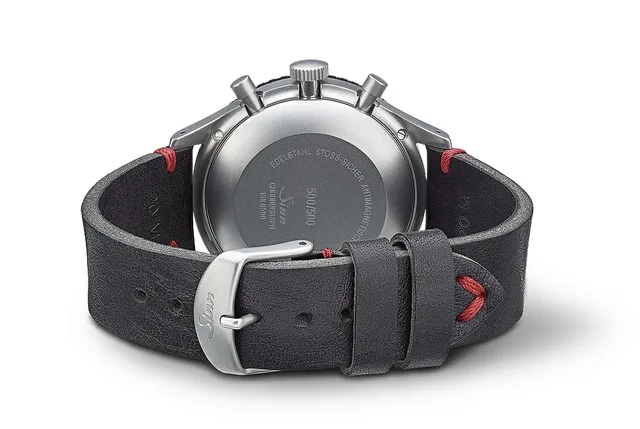
For the German soldiers who wore the original model, this watch was a purely functional instrument, a dyed-in-the-wool tool watch. The finer points of its workmanship played a subordinate role as long as they didn’t detract from the watch’s durability. Things are naturally different for a watch worn by civilians. It’s noteworthy to see that Sinn has paid careful attention to the quality of the finishing on the case, dial and hands. The aged leather strap with red decorative stitching likewise fits neatly into the overall picture. Only the simple off-the-rack buckle with a bent (rather than milled) pin reminds us that straps and clasps used to be items that were expected to wear out and need replacement.
The Sinn 158 is priced at $2,660, which seems reasonable when one bears in mind that it’s launched in a limited edition of 500 pieces. Other Sinn models (for example, the 103 St Acrylic on Strap priced at $1,890) are less expensive alternatives for wearers who are interested solely in functionality. But compared with other brands, and in view of its exciting history and successful design, we think it’s worthwhile to call up the reserves and put the Sinn 158 into active duty.
SPECS:
Manufacturer: Sinn Spezialuhren GmbH, Wilhelm-Fay-Strasse 21, 65936 Frankfurt am Main, Germany
Reference number: 158.010
Functions: Central hours and minutes, seconds on a subdial, date display, chronograph with a central seconds hand and a counter for up to 30 elapsed minutes
Movement: Sellita 510 “Premium,” automatic, 28,800 vph, 27 jewels, stop-seconds function, rapid-reset function for the date display, Incabloc shock absorption, fine adjustment via index, Glucydur balance, 48-hour power reserve, diameter = 30 mm, height = 7.9 mm
Case: Stainless-steel case, domed acrylic crystal above the dial, screw-less crown, four screws hold the snap-on case in place, stainless-steel caseback, pressure resistant to 100 m and secured against low pressure
Strap and clasp: Cowhide strap with stainless-steel pin buckle
Rate results (deviation in seconds per 24 hours, with chronograph switched off/on):
Dial up +3 / 0
Dial down +5 / +1
Crown up -3 / -11
Crown down +1 / -3
Crown left +4 / -6
Crown right -5 / -7
Greatest deviation 10 / 12
Average deviation +0.8 / -4.3
Average amplitude:
Flat positions 292° / 269°
Hanging positions 264° / 232°
Dimensions: Diameter = 43 mm, height = 15.15 mm, weight = 110 grams
Limited edition of 500 pieces
Price: $2,660
SCORES:
Strap and clasp (max. 10 points): Handsome aged leather strap with red decorative stitching; simple buckle 7
Operation (5): The crown is easy to operate and also triggers a quick-reset function for the date, but more than a little force is needed to activate the chronograph’s start button. 4
Case (10): The well-crafted case is secured against low pressure and also resists high pressure up to 10 bar; the acrylic crystal is an authentic retro detail, but it isn’t scratch resistant. 8
Design (15): A very handsome classic with tasteful new color accents 14
Legibility (5): The time can be read very quickly both day and night, but the elapsed-time hands with no luminous coating offer less contrast. 4
Wearing comfort (10): The supple cowhide strap makes this watch very comfortable on the wrist. 10
Movement (20): Sinn adds attractive decorative finishing to the top-quality
“Premium” variation of Sellita’s robust caliber. 13
Rate results (10): The average gain is very slight, but the maximum difference among the several positions is quite large. The timekeeping strays into the loss column when the chronograph is switched on. 7
Overall value (15): A good value for the money and the limited series is likely to enhance value retention. 13
Total: 80 POINTS