Jul 25, 2012
Reading time 6 min.
100 Points of Time: Reviewing TAG Heuer's Carrera Mikrograph 1/100
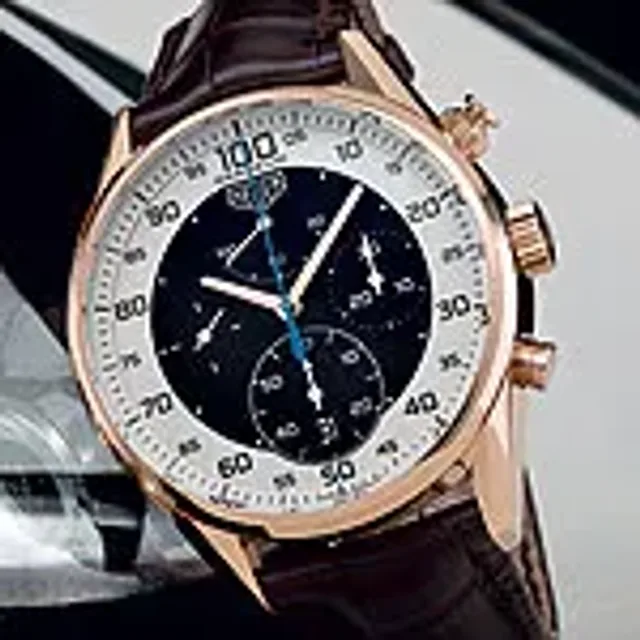
Last year, TAG Heuer introduced the Carrera Mikrograph 1/100, the first mechanical wristwatch with a central sweep-seconds hand that measures 1/100-second increments. Click here to read WatchTime's comprehensive look at this groundbreaking timepiece, part of the TAG Heuer triple feature in our July-August 2012 issue.
In 1916, Heuer Watch Co. introduced a hand-held stopwatch that represented a quantum leap in mechanical watch accuracy. At a time when the most precise chronograph measured 1/5 seconds, the Heuer Mikrograph measured intervals of 1/100 seconds. The Mikrograph established Heuer as the world’s leading producer of chronograph watches. Heuer’s Mikrograph stopwatches were the official timekeeper for the Olympic Games from 1920 to 1928. These stopwatches, which had 57-mm-diameter cases, continued to be built nearly unchanged, with or without split-seconds hands, until the mid-1960s.
Last year TAG Heuer introduced a fitting successor to the original Mikrograph. The new Carrera Mikrograph 1/100 is the first mechanical wristwatch that uses a central sweep-seconds hand to measure 1/100-second increments. The Mikrograph is not the first mechanical watch to time to the 1/100-second. That honor belongs to TAG’s Calibre 360 watch, introduced in 2006. For all its innovation (its chronograph module was made by La Joux-Perret and then added to an ETA 2892-2 movement), the rap on the Calibre 360 was that it was difficult to use due to the size of the display: 1/100s of a second are hard to read on the approximately 8-mm-wide subdial at 6 o’clock. Although this model was not designed for practical use, such as timing sporting events, it proved that a mechanical chronograph could measure 1/100s of a second. It was only a matter of time before TAG Heuer made a more practical model. The search for the Calibre 360’s successor led to an entirely new construction that took five years to develop.
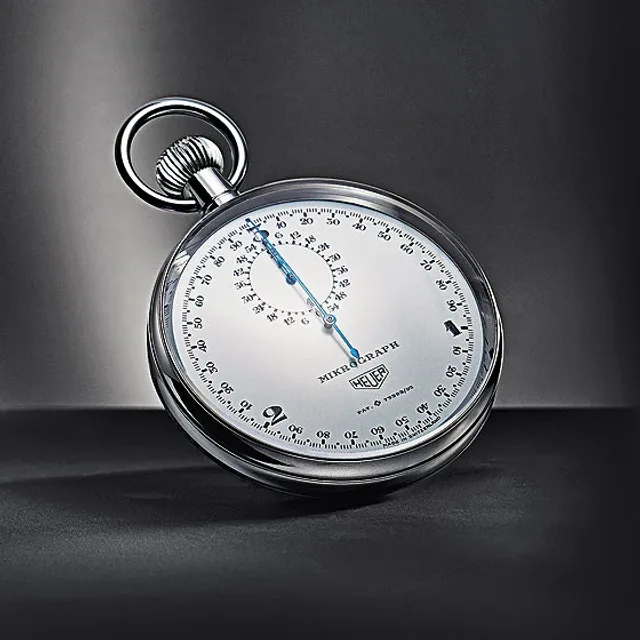
Heuer's Mikrograph of 1916
PR
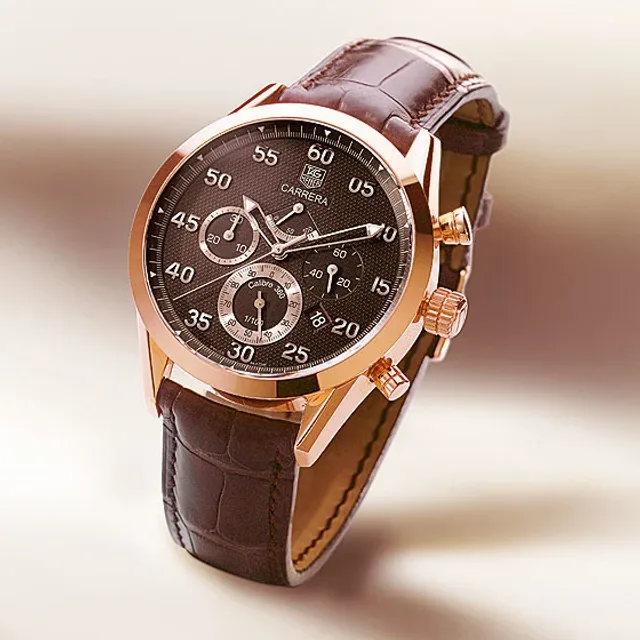
TAG Heuer's Carrera Calibre 360 was the first mechanical wristwatch to time the 1/100-second.
PR
The man behind the watch is the physicist Guy Sémon. Formerly employed in the aerospace industry, Sémon is currently vice president of Sciences & Engineering at TAG Heuer and the director of its research division in La Chaux-de-Fonds, Switzerland. Together with watchmaker Denis Badin and engineer Janick Chatelain, Sémon constructed an integrated chronograph. This new movement powers the Mikrograph 1/100. A major feature of this watch is its two different balance wheels, with separate escapements and transmission systems that allow you to run the chronograph without interfering with the watch movement. One balance, which oscillates at a speed of 4 hertz (28,800 vph), regulates the timekeeping movement, which has a 42-hour power reserve. The second balance, manufactured by Atokalpa, beats at a rate of 50 hertz (360,000 vph), and is responsible for the accuracy of the chronograph movement, which will run for a maximum of 90 minutes before needing additional energy. An arc-shaped scale, calibrated from 100 to 0 and positioned below 12 o’clock on the dial, shows the percentage of power remaining in the chronograph’s barrel. The movement has two separate barrels, assuring that both the time display and the chronograph have enough energy.
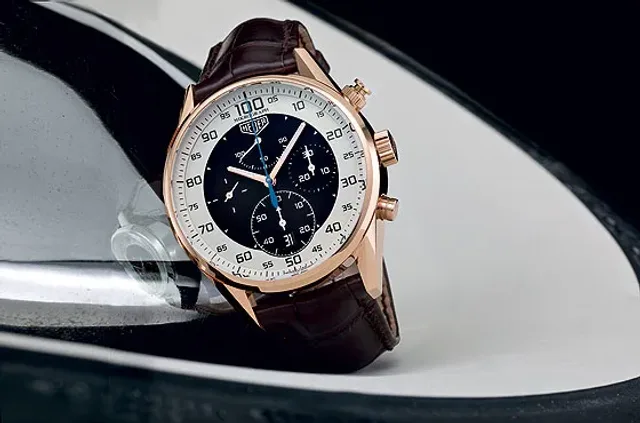
The arc-shaped scale below 12 o'clock shows the percentage of power remaining in the chronograph barrel.
PR
The timekeeping movement and the stopwatch are integrated into a single caliber, but they work independently of each other. Each draws its energy from its own barrel, and the power from each barrel is transferred along a separate pathway. The barrel that keeps the watch running is replenished through the conversion of kinetic energy from the blackened rotor of the self-winding movement. The chronograph’s barrel requires manual energy input, which is accomplished by turning the crown after it has been pulled out to its first position. The power-reserve display and a resistance that can be felt indicate that the device has been fully wound. The automatic movement can also be manually rewound by turning the crown counterclockwise. This means that the chronograph can continue to run after the watch has stopped and vice versa. This construction was necessary because even if the chronograph’s balance were designed to beat at a slower pace, coupling the stopwatch with the same energy flow that powers the watch would always cause the amplitude of the balance to decline abruptly and would detract from the accuracy of the watch.
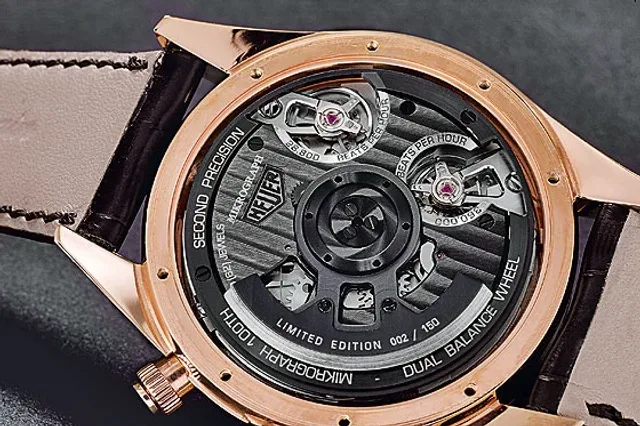
The balance for the watch and the balance for the chronograph are labeled with their specific frequencies. The blackened rotor is engraved with each watch's number in the limited series.
PR
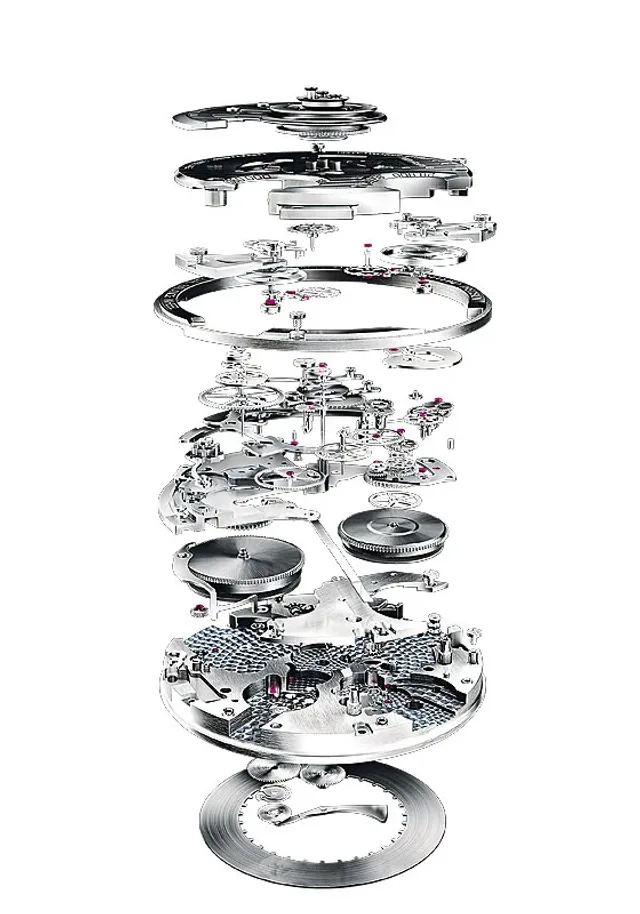
An exploded view of the Mikrograph movement shows its 396 components.
PR
To start the chronograph, you must first release the threading on the start-stop pusher. Even after speaking with the creators of the watch, it still isn’t clear why they added threading to this pusher. One reason cited was aesthetics; the desire to protect the starting mechanism was another. Oddly enough, everyone agreed that water resistance was not a factor; the watch does not need the threading to achieve a water-resistance level of 100 meters.
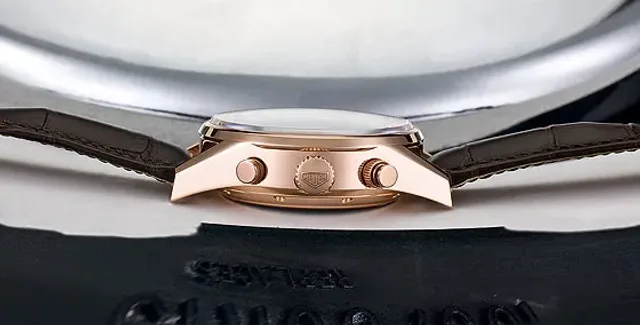
The large rose-gold case is water-resistant to 100 meters.
PR
As you would expect from a column-wheel chronograph, the elapsed-time measurement begins very smoothly and gently. The chronograph’s actual start is nothing short of spectacular. The pressure point is quick and precise, minimizing the time between the decision to trigger the mechanism and its actual start. The slender, blued 1/100-second hand instantly begins racing around the dial, creating an audible hum, completing one full circuit every second. To the naked eye, this motion looks absolutely smooth and without any shudder. The seconds hand circles its subdial at 6 o’clock with similarly shudder-free regularity, although it requires a leisurely 60 seconds to complete each round. Only the counter for 30 elapsed minutes at 3 o’clock makes a little jump once each minute.
The chronograph stops instantly when the pusher is depressed a second time. The elapsed 1/100s of a second are easy to read thanks to the calibrations around the dial. Large double-digit numerals mark each increment of 10 1/100s of a second and smaller two-digit numbers show five 1/100s. The elapsed seconds and minutes are also easy to read on their subdials. Of course, it’s difficult for a mechanical watch to measure 1/100 of a second with extreme accuracy due to the time it takes to push the button. One way to measure the quickness of the wearer’s reaction time is to try to stop the chronograph after it has been allowed to run for exactly 1 second.
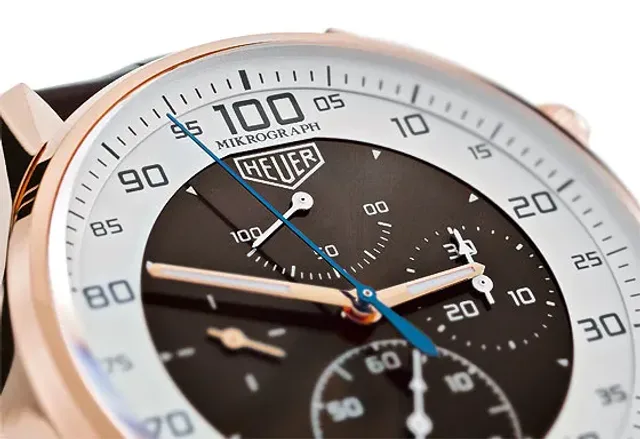
A retro version of the Heuer logo is at the top of the dial. The chronograph's blued hand sweeps the dial to indicate 1/100s of a second.
PR
The historical Heuer logo adds to the retro look of the dial. Two rose-gold hands, each coated with Super-LumiNova, show the time clearly, day or night. The continually running seconds hand, however, serves little purpose other than to show that the watch is still running. The large rose-gold case can be comfortably strapped to the wearer’s wrist. The brown alligator strap, which matches the central dial, has a rose-gold pronged buckle engraved with the historical Heuer logo. The watch is produced in a limited edition of 150 pieces with a brown dial and strap and also in a limited edition of 150 with a gray dial and gray alligator strap. All the watches are COSC certified.
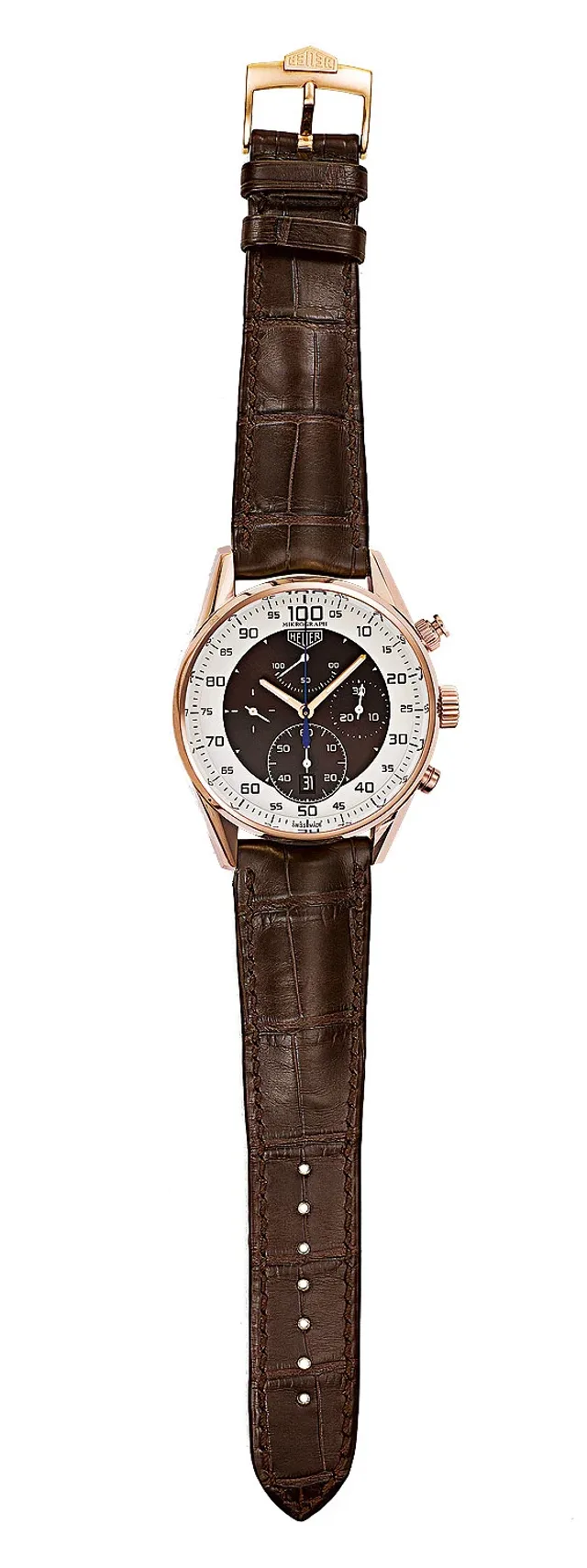
With a diameter of 43 mm, the TAG Heuer Carrera Mikrograph 1/100 is sized for today's tastes.
PR
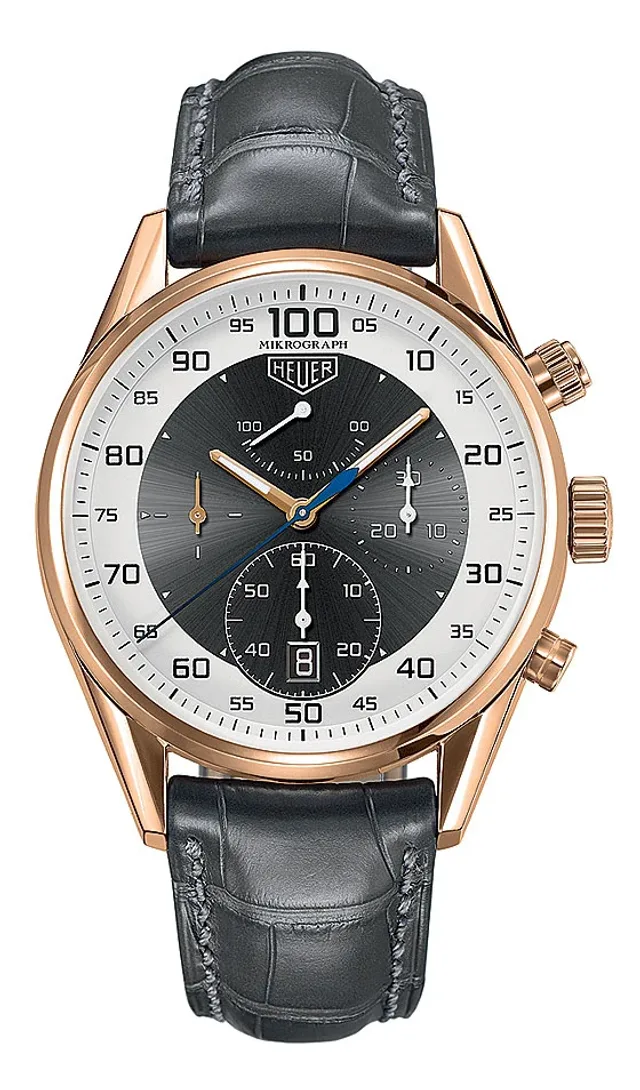
A second model with a gray dial is also produced in a limited series of 150 watches.
PR
SPECS:
Manufacturer: TAG Heuer SA, 6A rue Louis-Joseph Chevrolet, 2300 La Chaux de Fonds, Switzerland
Reference number: CAR5040.FC8177
Functions: Hours, minutes, small seconds, 1/100-second central chronograph, counters for 60 elapsed seconds and 30 elapsed minutes, power-reserve display for the chronograph, date display
Movement: In-house Mikrograph automatic movement; 28,800 vph (4 Hz) for the watch, 360,000 vph (50 Hz) for the chronograph; 62 jewels; Incabloc shock absorber; flat Nivarox hairspring, Glucydur balance for the watch, Atokalpa balance for the chronograph; 42-hour power reserve for the watch, 90-minute power reserve for the chronograph; COSC-certified chronometer; diameter = 35.8 mm; height = 7.9 mm
Case: Rose-gold case; sapphire crystal; water resistant to 100 meters
Strap and clasp: Alligator strap with rose-gold pronged buckle
Dimensions: Diameter = 43 mm; height = 16.41 mm
Variations: Version with gray dial and gray leather strap, limited to 150 watches
Price: $50,000
Receive all the news, features and reviews from WatchTime for free! Sign up to our free weekly newsletter and get all the news delivered to your inbox.