Jan 8, 2020
Reading time 3 min.
In the Steel of the Moonlight: The New Omega Speedmaster Moonwatch Caliber 321
NEWS
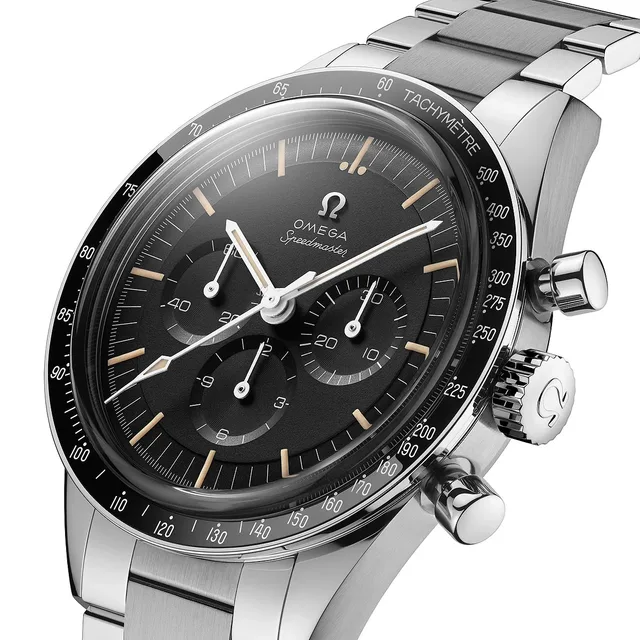
Omega capped off its 50th anniversary celebration as the first watch worn on the moon last July, with the release of a platinum-cased special edition of the iconic Speedmaster "Moonwatch" outfitted with the recently re-invented Caliber 321. The Swiss watchmaker rings in 2020 with a more accessible version of that timepiece, equipped with the same manually wound movement housed in a stainless steel case.
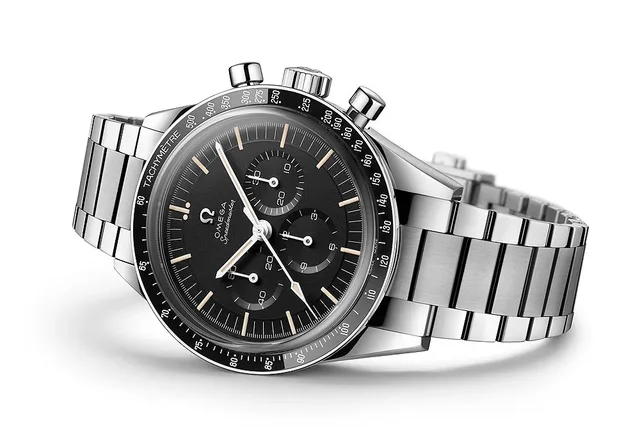
The Omega Speedmaster Moonwatch Caliber 321 re-creates the watch worn by Ed White on the 1965 Spacewalk.
PR
The Omega Speedmaster Moonwatch Caliber 321 Stainless Steel takes its primary aesthetic inspiration not from the famed Reference ST 105.012 model, which was the watch that Buzz Aldrin famously wore on the lunar surface in 1969, but from the earlier Reference ST 105.003, which astronaut Ed White wore in 1965 when he became the first American to walk in space. Its steel case is 39.7 mm in diameter, with the ring of its familiar tachymeter-scale bezel made of polished black ceramic (Zr02), accented by tachymeter markings in white enamel. (Collectors of vintage Speedies will also appreciate details like the "dot over 90" on the bezel, a subtle detail that identifies a Speedmaster model as being from pre-1970.) models This model's stepped, black dial is distinct from that of its precious-metal predecessor (which was modeled on the 1969 Moonwatch reference, and used black onyx for its dial and actual moon meteorite for its three subdials), in that it uses standard tone-on-tone subdials with white markings in the classical tricompax arrangement — elapsed minutes, elapsed hours, and running seconds at 3, 6, and 9 o'clock, respectively — along with the emblematic Moonwatch hands and vintage-style Omega logo.
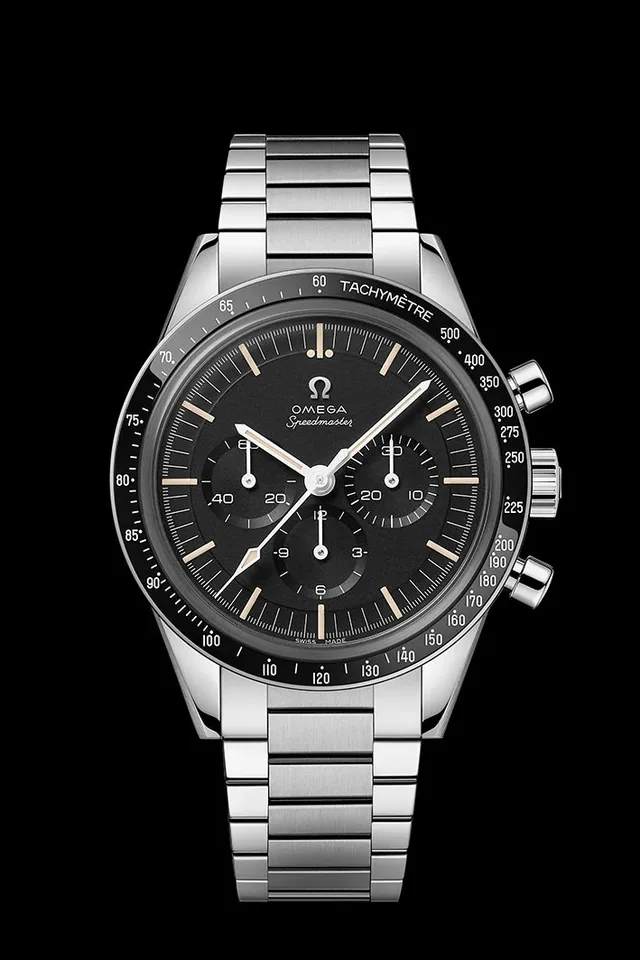
The tachymeter bezel ring is made of black ceramic.
PR
Of course, what's inside the watch is at least as much of a draw as what's outside. Brought back into production by Omega after an over 50-year hiatus, the newly revived Caliber 321 can be admired through the watch's sapphire caseback. A mainstay of many historical Omega watches since its debut in the 1940s, including some of the early Seamaster chronographs, the original Caliber 321 was the movement used in the first Omega Speedmaster from 1957, as well as in several historically significant Speedmaster models in subsequent years, including the now-legendary pieces worn by White on his Spacewalk and by Apollo 11 astronauts for the moon landing. It was notable, and remains prized by vintage-watch collectors to this day, for its use of a monobloc column wheel, machined from a single piece, and for its attractive architecture. As part of its two-year-long project to reconstruct this manual-winding chronograph movement as accurately as possible at its atelier in Bienne, Switzerland, Omega used a digital scanning technology called “tomography” to study the movement inside the ST 105.003 worn by Apollo 17 astronaut Gene Cernan in 1972, and use its design as a blueprint. This steel model becomes the second modern Omega watch to contain this historically significant caliber — whose distinctive Sedna gold finish replicates the original's copper finish while adding greater stability — after last year's platinum limited edition.

The modern version of the historical manual-winding Caliber 321 is on display through the caseback.
PR
The Omega Speedmaster Moonwatch Caliber 321 Stainless Steel — which some have already nicknamed the "Ed White" — is priced at $14,100 and, unlike the platinum Moonwatch with Caliber 321, is not a limited edition.