Mar 21, 2020
Reading time 4 min.
Greubel Forsey QP à Équation Debuts in Rose Gold with Chocolate Dial
NEWS
Greubel Forsey introduced its seventh "Invention Piece," the QP à Équation, in 2015, adding a rhodium-dialed Millésime edition in 2017. This year, the extraordinarily complex timepiece debuts in a new version with an 18k rose gold case and a chocolate-colored gold dial.
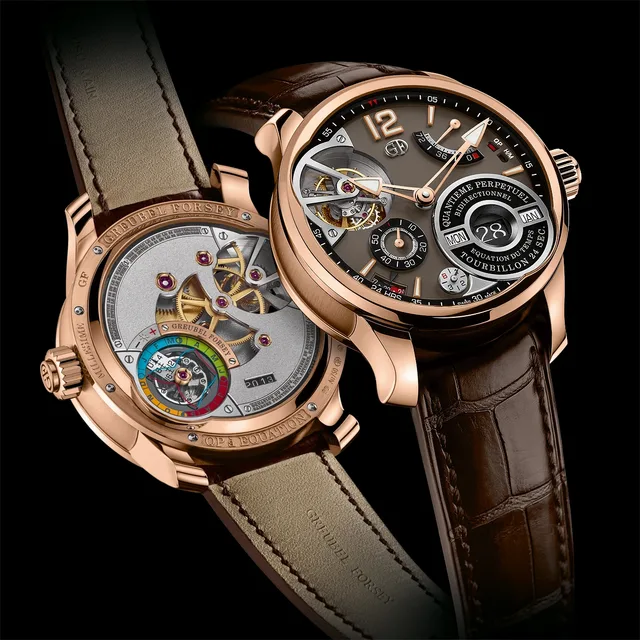
Greubel Forsey introduced its seventh "Invention Piece," the QP à Équation, in 2015, adding a rhodium-dialed Millésime edition in 2017. This year, the extraordinarily complex timepiece debuts in a new version with an 18k rose gold case and a chocolate-colored gold dial.
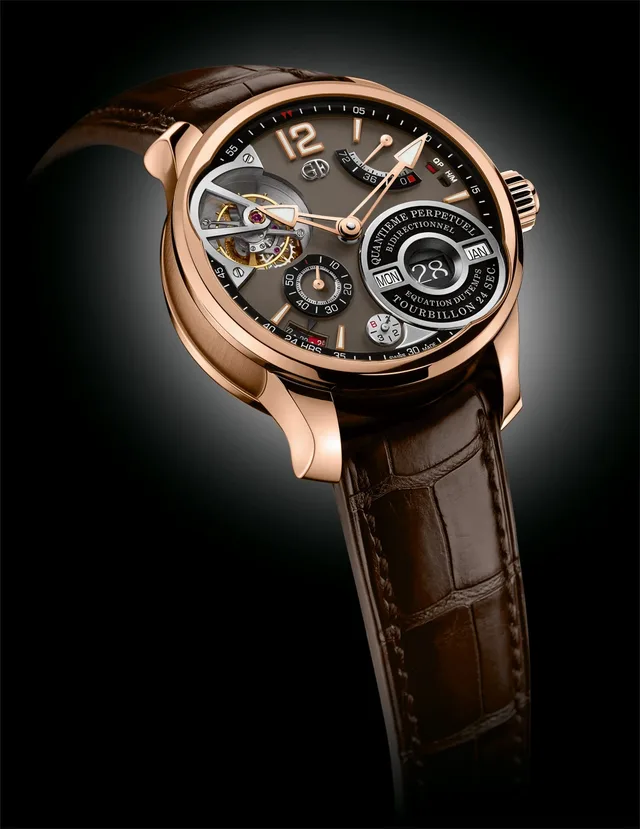
Greubel Forsey QP à Equation in rose gold with chocolate dial
PR
The QP à Équation Millésimé is driven by a movement equipped with an ingenious mechanism that Greubel Forsey calls a “Computeur Mécanique,” or mechanical computer. This device is a sub-assembly within the 624-part caliber, and partly inspired by the systems used in large astronomical clocks since the end of the 15th century, which managed the information that determined certain key dates in the ecclesiastical calendar in relation to astronomical data. Greubel Forsey has received four patents for the movement.
The mechanical “brain” at the center of this invention consists mainly of rotating, co-axial coded elements in an arrangement complemented by a system of programmed movable sections. Depending on its geometry and speed of rotation, each element generates its own indication in a cyclical, pre-programmed way. In this manner, the mechanical computer is able to automatically display all the indications of the watch, each generated by its own co-axial coded element. In the case of the QP à Equation, these consist of all the functions of a perpetual calendar, along with the equation of time: seasons, equinoxes, solstices, the equation of time, and the date, day, month and four-digit year. (One of the coded elements, for example, is specifically programmed to take into account and compensate for the differences of a leap year.)
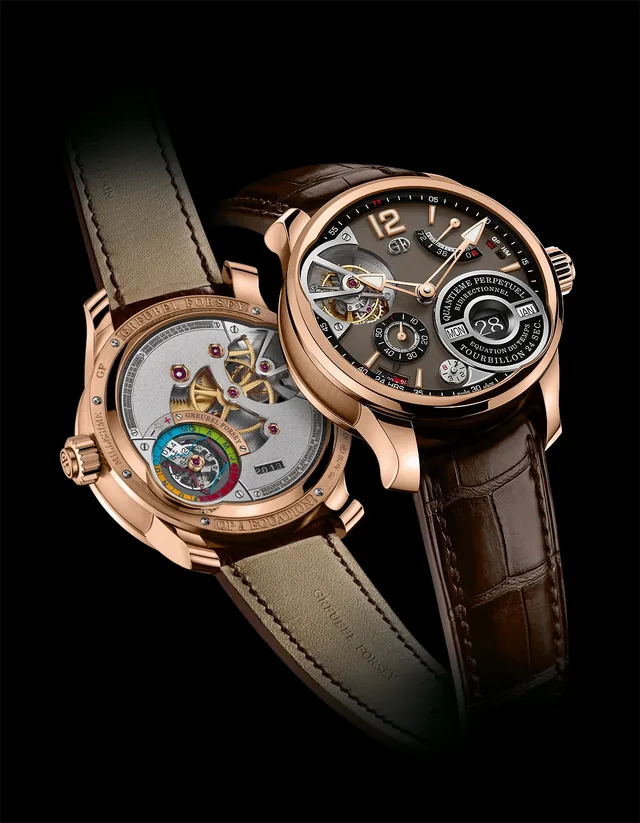
The watch's mechanical computer links the equation of time to a perpetual calendar.
PR
Despite the immense complexity of its mechanism, the watch is surprisingly simple to operate. All eight of its indications are controlled by a single selector set into the movement’s winding crown; the wearer can simply turn the crown in either direction to make adjustments without any risk of damage to the mechanism. An array of indications is displayed on the chocolate brown gold dial, including the hours, minutes, and seconds; the day, month, and large date; the 24-hour day-night indication and the indicator for the movement’s 72-hour power reserve.
The mechanical computer drives on one of the rarest (and, frankly, probably least understood) astronomical complications, the Equation of Time — which is directly linked to the perpetual calendar. Put simply, the equation of time measures the difference between “true” solar time and the more conventional “civil” or mean time, which is fixed at 24 hours per day, throughout the year. The length of a day in solar time varies according to the position of the earth on its elliptical orbit around the sun. For example, a solar day is about 16 minutes longer than a civil day in November, but about 14 minutes shorter in February. The unique display of the equation of time on the dial of the Greubel Forsey QP à Équation uses two sapphire crystal disks, driven by the mechanical computer, rotating independently to show the time difference as it changes throughout the year. The equinoxes and solstices, along with the four seasons, are also displayed in the equation of time indicator, located on the back side of the movement.
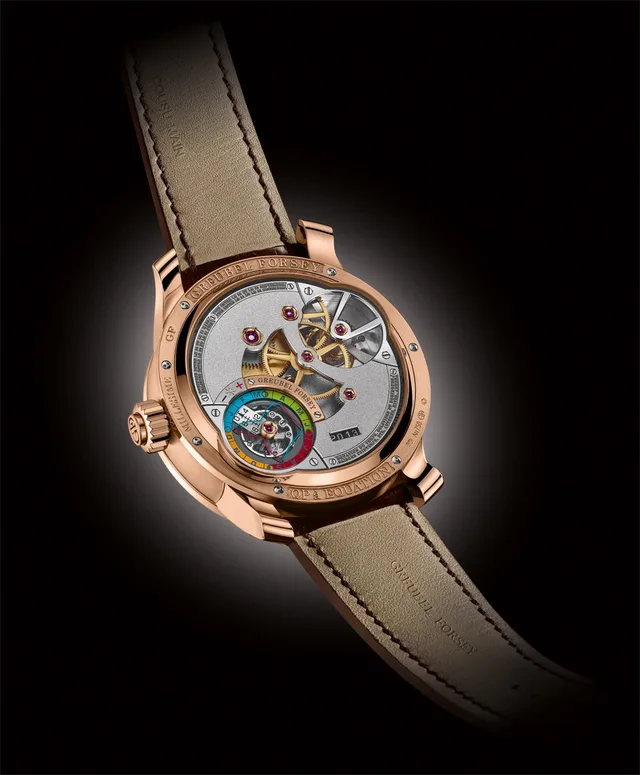
Equinox, solstice, and season indications are displayed on the back of the movement.
PR
Like many other Greubel Forsey timepieces, the QP à Équation models incorporate the brand’s Tourbillon 24 Secondes, its third invention, which uses a fast rotation speed and inclined 25-degree angle to significantly improve the chronometric performance. The watch’s rose gold case measures 43.5 mm in diameter and 16 mm thick. Pricing was unavailable at press time.