Dec 11, 2023
Reading time 7 min.
All Fired Up: Reviewing the IWC Pilot's Watch Automatic Spitfire
WATCH REVIEW
This article is from the WatchTime archives and was first published in 2020.
IWC launched a new Spitfire squadron in its collection of pilots’ watches at that debuted in 2019. A self-winding movement from the new 32000 family of manufacture calibers debuts inside the case of the Pilot's Watch Automatic Spitfire. We tested one in this feature from the WatchTime archives, with original photos by Olaf Köster.
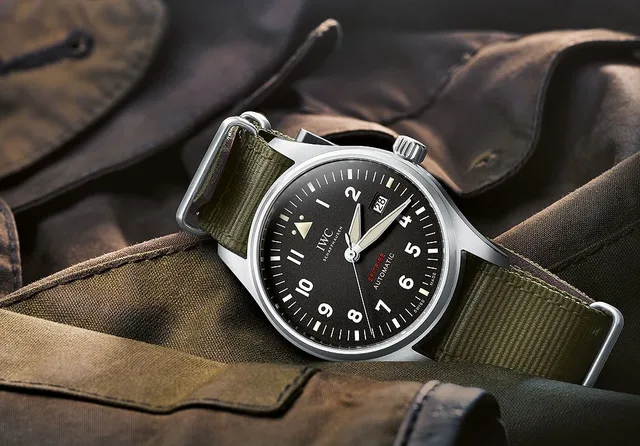
IWC Pilot's Watch Automatic Spitfire (Ref. IW326801)
PR
"Haven’t I seen this watch somewhere before?" You might be thinking this when you first set eyes on the classic Pilot’s Watch Automatic Spitfire. And you wouldn’t be mistaken because its design is inspired by the legendary Mark 11 from 1948.
In the late 1940s, IWC responded to an invitation from the British government by developing a special wristwatch for Royal Air Force pilots. Production began in 1948 and the first timepieces were developed in November 1949. The model remained in airborne service until 1981. It encased IWC’s equally popular hand-wound Caliber 89, which has a soft iron inner case to protect it against the adverse influences of magnetic fields. The boldly designed dial is clearly legible by day and by night. The Mark XII with automatic movement and date followed, but connoisseurs had to wait until 1994 before it finally debuted.
An Elegant Pilots’ Watch
The name “Spitfire” first appeared at the turn of the millennium with a limited series of 1,000 watches. IWC began manufacturing a series of pilots’ watches named after the legendary aircraft in 2003. With its pale dial, it was regarded as “the more elegant Mark,” but it was somewhat overshadowed by the 14th incarnation of the classic pilots’ watch, which was named Mark XV. Ten years later, the old Spitfire – now a large pilots’ watch with perpetual calendar and a dark dial – approached the classic Mark line, but inconspicuously disappeared under its wearer’s shirt cuff as an elegant three-handed watch with a pale dial. After the Mark XVIII of 2016 and the Big Pilot’s Watch Spitfire of the same year, which were virtually indistinguishable, a symbiosis of the two seems almost logical, while the Mark leaves quietly. The Pilot’s Watch Mark XVIII can still be found in IWC’s digital catalogs, but only as the edition “Le Petit Prince.”
Caliber 79320 (based on ETA Valjoux 7750) is now ticking inside Le Petit Prince, which sells for $5,250. The new Pilot’s Watch Automatic Spitfire is equipped with new manufacture Caliber 32110. IWC presents two versions: our tested watch with stainless-steel case, black dial and green textile strap for $4,350; and a version with a bronze case, green dial and dark brown calfskin strap for $4,900. These are not only the base models in the Spitfire collection, but they also embody the entry-level timepieces leading into the world of the IWC manufacture.
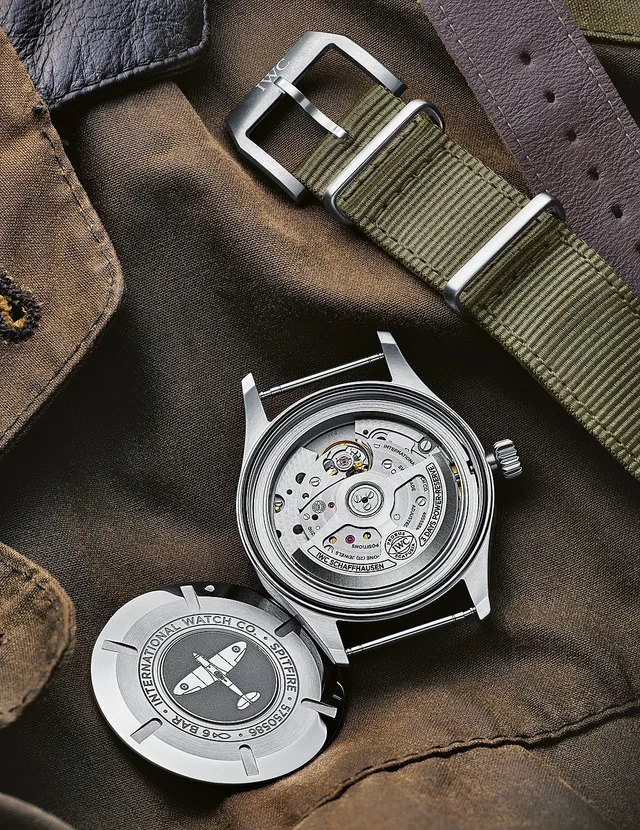
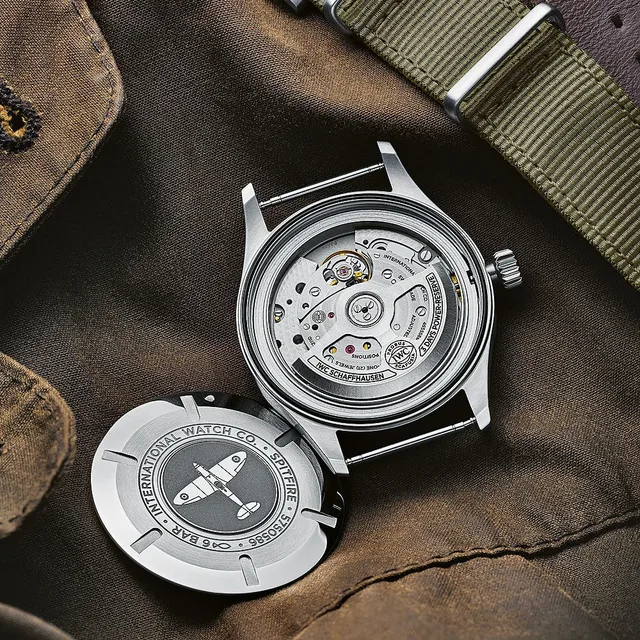
In typical IWC style, the self-winding movement ticks behind a double back that offers increased protection against magnetic fields.
PR
The matte stainless-steel case with its narrow, steep bezel and massive screw-in back has a moderate diameter of 39 mm and is therefore one mm smaller than the case of the Mark XVIII. The height is 10.86 mm, which gives it a sporty look and is also an appropriate thickness for a classic pilots’ watch. Manufacture Caliber 32110 contributes to the case’s height: the movement is 4.2 mm thick. Its diameter is 28.2 mm. Furthermore, Caliber 32110 is equipped with increased protection against magnetic fields thanks to a soft iron inner case and an additional inner back, a detail that was already included in the Mark 11.
The Elegant Spitfire Became a Typical Pilots’ Watch
The striking pilots’ watch dial is also adapted from this watch – and almost even more so from the Mark XV. It “speaks” with the design vocabulary of a classic pilots’ watch: pure instrument design, strong black-and-white contrasts, a tidy minutes scale, easy-to-read hour numerals, large lanceolate hands and a triangle instead of a numeral 12.
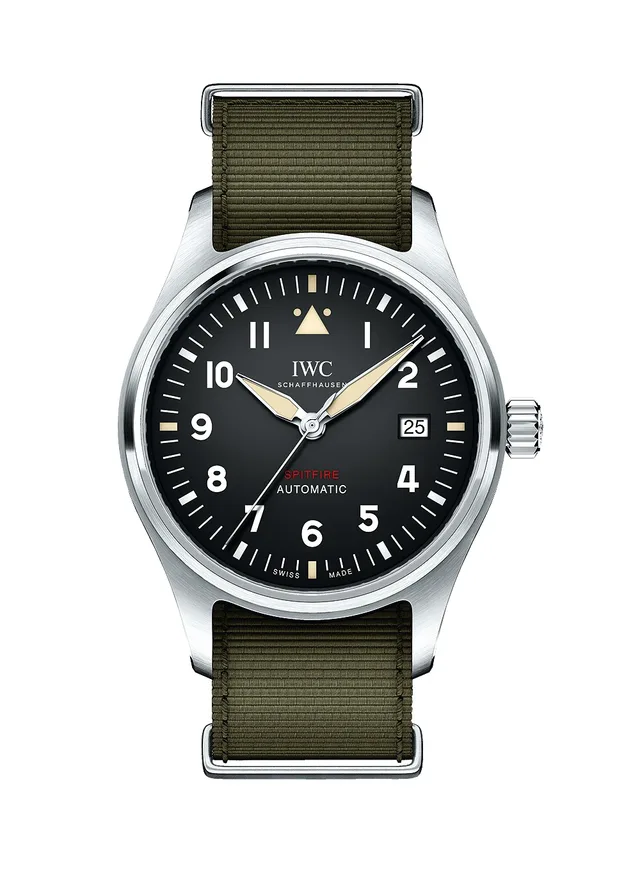
The modern Spitfire features elements of the classical Mark 11.
PR
A Smooth Landing in IWC’s Collection
The triangle flanked by two dots is borrowed from historical pilots’ watches. It assured – and continues to assure – better orientation with regard to the position of the watch’s hands in a dark cockpit. The beige coating of this triangle is a nostalgic touch on the dial. The same beige hue – and the same nostalgic feeling – recurs on the two main hands and on the three index lines for the quarter, half and three-quarters hour. On the other hand, the bright green luminosity of the coating on the hour hand and minutes hand, as well on the four indices, is a characteristic feature of IWC’s pilot watches and can trace its ancestry at least as far back as the Mark 11.
IWC’s self-winding manufacture Caliber 32110 is a new addition to this functional pilots’ watch. The 32000 family was designed as a base caliber line with a focus on robustness and reliability. Like the basic chronograph movement 69000 before it, this newcomer was designed to replace externally sourced calibers from ETA and Sellita. As the price of this watch shows, the new in-house caliber could be included almost without a price increase. The movement is rock solid and up to date. Similar to the Pellaton winding mechanism, which is IWC’s own invention, the new caliber includes a bidirectionally effective click-winding system. However, this innovation is simpler and is a joint development within the Richemont Group. The winding system is also available for other Richemont-owned manufacturers to use in their calibers. It winds efficiently and builds up a considerable power reserve of 72 hours, three days, inside a single barrel.
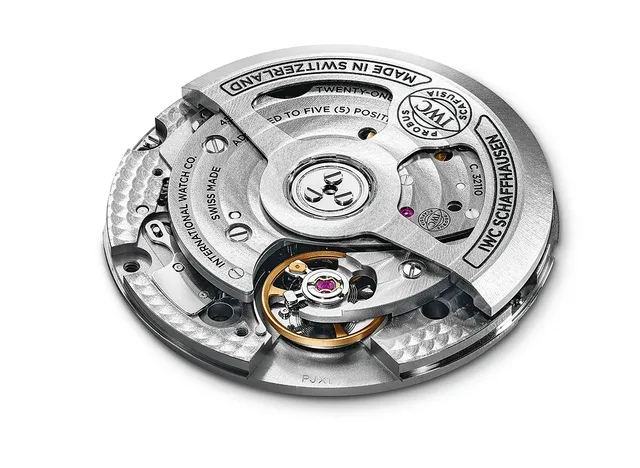
Caliber 32110, IWC’s new basic movement with silicon components, runs for 70 hours without a fill-up and is destined to replace technology from ETA and Sellita.
PR
The long-lasting running autonomy is made possible by advanced movement technology. Among other new features here, silicon components are used for the first time in an IWC caliber. The escape wheel and anchor are made of this wear-resistant and non-magnetic material, but unfortunately not the hairspring, so a soft iron inner case is still needed to provide increased protection against magnetic fields. Newly developed lubricants extend the longevity of the components.
The movement cannot be seen through the opaque double back, but it’s nonetheless designed in the characteristic IWC manner. Typical details are robust bridges adorned with circular Geneva waves, various circular graining patterns and, above all, the openwork rotor with IWC’s logo. In all situations, the movement’s rate values remain within a 5-second span of perfect timekeeping – not outstanding accuracy, but – like the entire movement – still solid and eminently satisfactory.
A Timeless Pilots’ Watch with A Modern Power System
To sum it all up, the watchmakers in Schaffhausen have put a modern movement that’s suitable for everyday use into a timeless watch that has simultaneously undergone an unobtrusive change. As if the Spitfire had never existed in its original format, this newcomer ably continues the Mark’s legacy. That’s a pretty cool move and it’s certainly related to a carefully restored Spitfire’s round-the-world flight from London in early August 2019, which IWC supported. The aircraft, built in 1943, covered over 43,000 kilometers (26,719 miles) over several months, visiting some 30 countries on its way. The green textile band, which is lined with leather, seems to refer to this globe-girdling airborne adventure. The strap is inspired by the color codes of the old fighter plane and keeps the watch attached to its wearer’s wrist – reliably, stylishly and idiosyncratically.
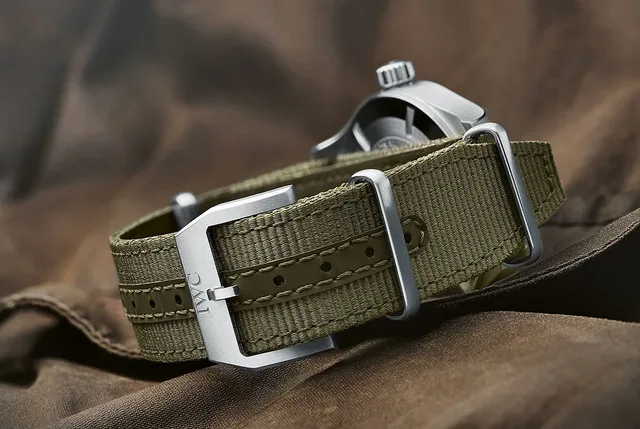
The Spitfire’s textile and leather strap is inspired by the aircraft that gave its name to this pilots’ watch.
PR
SPECS:
Manufacturer: IWC Schaffhausen, Baumgartenstrasse 15, 8200 Schaffhausen, Switzerland
Reference number: IW326801
Functions: Hours, minutes, central seconds, date, soft iron inner case for increased protection against magnetic fields, secured against low pressure
Movement: IWC manufacture Caliber 32110, automatic, 28,800 vph, 21 jewels, Glucydur balance, Nivarox hairspring, Incabloc shock absorber, Bipartite index fine adjustment, 72-hour (3-day) power reserve, diameter = 28.2 mm, height = 4.20 mm
Case: Stainless steel, domed sapphire crystal above dial, water resistant to 60 m
Strap and clasp: Black calfskin with stainless-steel pronged buckle
Rate results (Deviation in seconds per 24 hour, fully wound/after 24 hours):
On the wrist +5.3
Dial up +8.5 / +9.8
Dial down +8.3 / +4.8
Crown up +5.5 / +5.7
Crown down +1.3 / +1.2
Crown left +1.9 / +3.4
Greatest deviation 7.2 / 8.6
Average deviation +5.1 / +5.0
Average amplitude:
Flat positions 334° / 320°
Hanging positions 287° / 277°
Dimensions: Diameter = 38.97 mm, height = 10.86 mm, weight = 80.5 g
Variations: With bronze case and calfskin strap (Ref. IW326802; $4,900)
Price: $4,350