Oct 30, 2016
Reading time 5 min.
Vintage Eye for the Modern Guy: Casio G-Shock
The original Casio G-Shock broke some serious ground in the watch market, so we take a week off from our usual focus on iconic mechanical watches to explore a modern G-Shock reference to see how it stacks up to the original game-changing piece from the 1980s.
When we talk about vintage watches in this series, the topic of conversation is almost always one of the most iconic mechanical timepieces from the past hundred or so years. The reasons for this focus ranges from reader interest, to availability and reliability of information, to continuity of production, to my own personal preferences. However, it is easy to forget that there are also a few no-less-iconic quartz watches that have come to shape the modern market. Probably the most influential of these is the piece we’ll be covering today: the Casio G-Shock.
Casio G-Shock - original
PR
In the eyes of many hardcore horological purists, the G-Shock series has come to represent some of the vices of modern watchmaking — mass production, quartz technology, huge case sizes, and the list goes on. But this model's impact on the market is comparable to that of some of the biggest names in the industry. Similar to the way the Audemars Piguet Royal Oak Offshore ushered larger watches into the luxury market in 1993, the G-Shock had a similar effect on the entry-level market in 1983. Like the automatic chronograph race between Seiko, Zenith, and the Chronomatic Group in the late 1960s attracted many new consumers, the G-Shock similarly garnered quartz sports watches mass appeal among a previously unexplored market. The G-Shock broke some serious ground, and so, naturally I wanted to explore a more modern reference to see how it stacks up to the original game-changing piece from the 1980s.
Casio G-Shock reclining on rock
PR
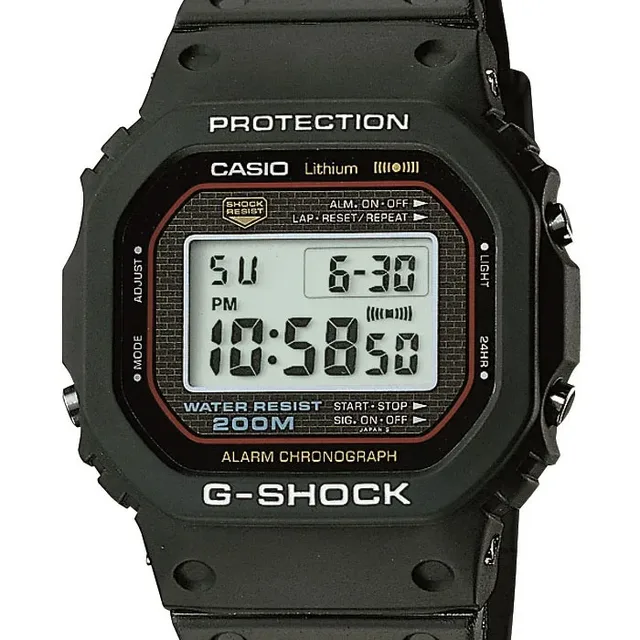
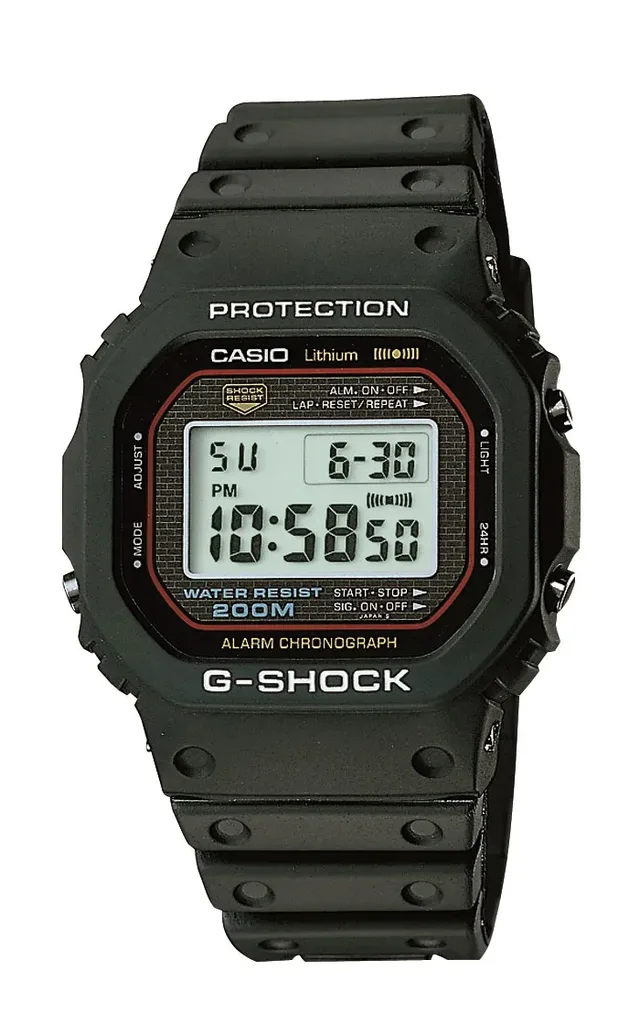
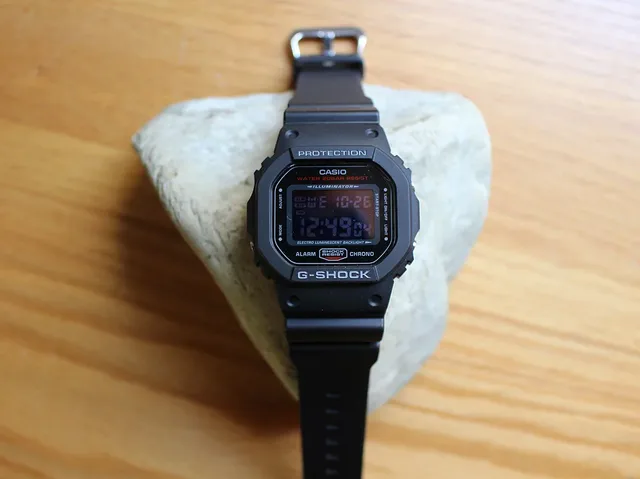
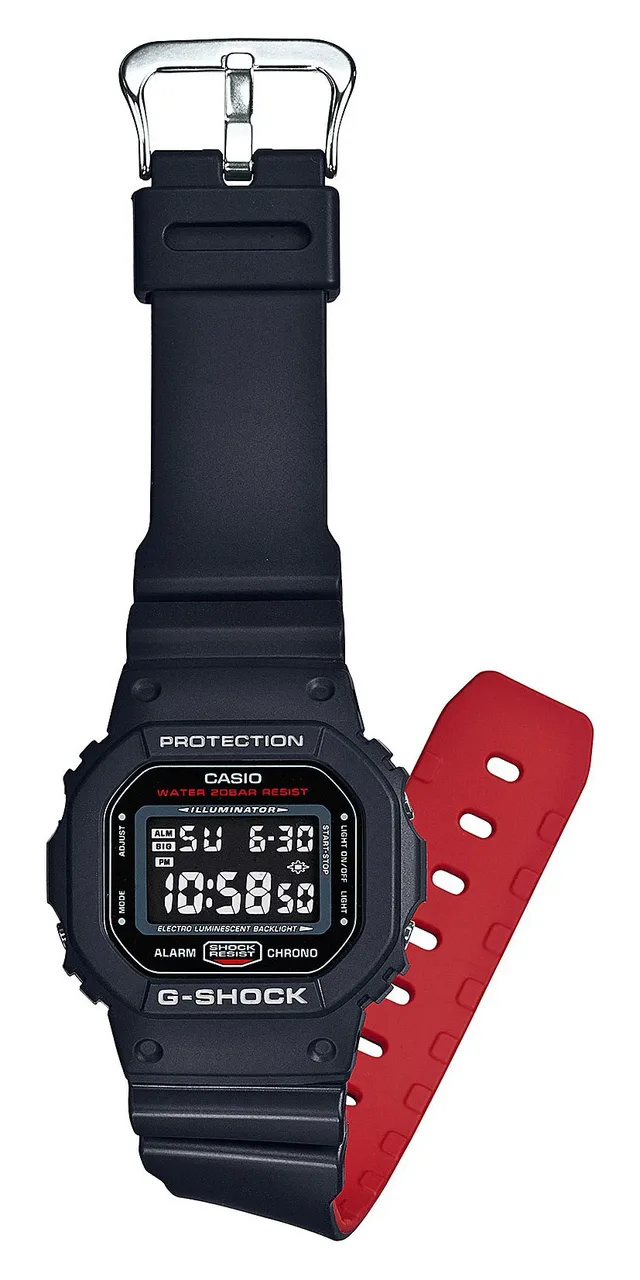
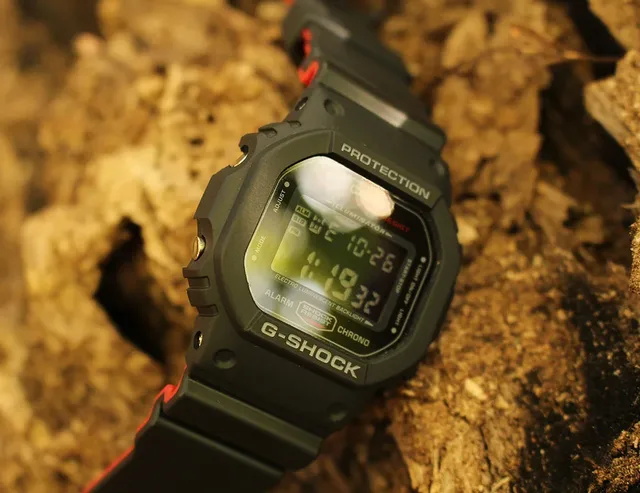
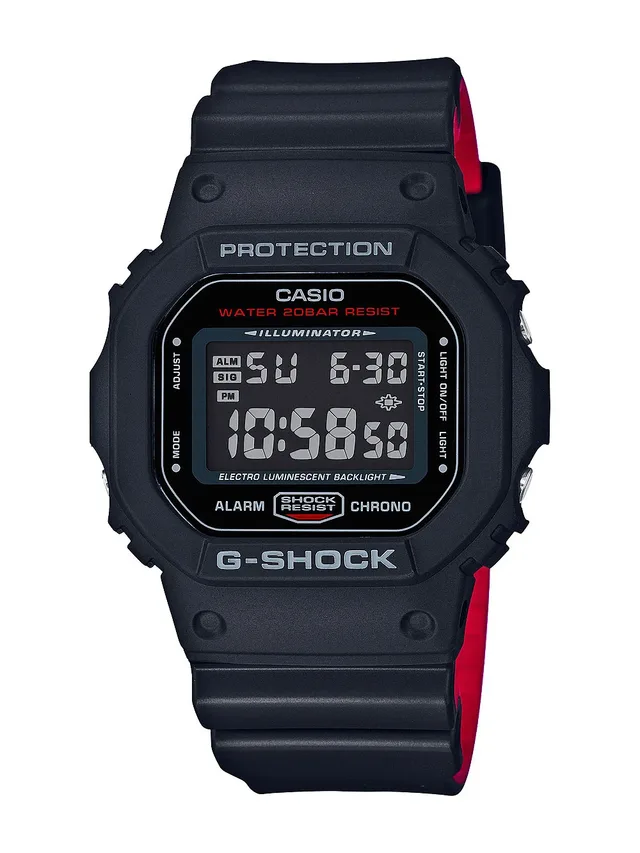
Coincidentally, as I began researching for this article, I received a press release from Casio on a watch planned for an early November release, the DW5600HR-1. This piece (above) is an homage to the original G-Shock reference DW-5000C of 1983 (at top), and was developed specifically to retain the original proportions of that watch. With a thick, 42.8-mm black rubber case, its iconic octagonal bezel, and its integrated bracelet, there’s no mistaking this piece for anything other than a G-Shock. The bezel has the series’ flagship “Protection/G-Shock” engraved text, while the bracelet is reminiscent of the red accents seen on the original DW-5000C, with dual black and red coloring. The dial lists all of the watch’s functions, from chronograph to countdown timer to multiple alarms, all of which are operated by the four pushers on the sides of the piece. Also on the dial is the trademark “Shock Resist” G-Shock logo seen on all watches in the series. The digital display uses a nontraditional black background, with white readouts for the day of the week, the date, and the time (in either 12- or 24-hour format). Available at various retailers in the next few days, the watch will be priced at the relatively accessible price of $99.
Casio G-Shock - folded
PR
When the G-Shock first began its developmental phase in 1981, Casio’s head of design, Kikuo Ibe and his team of three researchers had set out to create a virtually unbreakable timepiece. They sought to reach a target they dubbed the “Triple 10” — the idea that the watch should be able to withstand a 10-meter drop, have up to 10 bars of water resistance, and offer a battery life of 10 years. Luckily, after years of trial and error, the team was eventually able to reach this goal and bring to market the first G-Shock, the DW-5000C.
The modern reference we’re covering today is not much different than that original model. While this specific piece doesn’t happen to carry with it a 10-year battery life, it does have a 20 bar (200 meter) water resistance, and can withstand drops much higher than 10 meters. The design, credited to the original blueprint from the 1980s, is more or less the same: a thick, matte rubber case protecting the inner workings; a simple and easily readable dial; and a comfortable, wide rubber strap to secure the watch to the wrist.
The differences between the models are also not incredibly noticeable. Today’s reference uses a black background for the dial instead of white, the modern piece uses many more red accents than the vintage, and some of the dial features have been moved around from the top to bottom or vice-versa. The only major change is that the modern piece uses a mostly plastic inner framework to protect the movement compared to the vintage model’s steel — but this of course is a reason Casio is able to price the watch at less than $100. And for those searching for an even more historically accurate modern variation of the G-Shock, some models, still developed in Japan, use the slightly more expensive steel inner structuring, such as the Ref. GW-5000-1JF.
Casio G-Shock - reclining
PR
Overall, while many of the modern pieces in Casio’s G-Shock lineup have proved controversial to many watch lovers — largely for their increasingly massive cases and sometimes gaudy color schemes — I’ve found the DW5600-HR1 to be a much more classical-looking watch. Its proportions remain true to the original ethos of the series, and its look is not only playful and sporty but retains much of the original character that made this model so important to the history of watches. The Casio G-Shock has become a favorite among military personnel and pop stars for a reason, and this modern reference shows once again why it’s been able to maintain its popularity for more than 30 years.
Casio G-Shock - modern - front
PR
Caleb Anderson is a freelance writer with a primary focus on vintage watches. Since first learning about horology, he has garnered extensive knowledge in the field, and spends much of his time sharing his opinions among other writers, collectors, and dealers, alike. Currently located near New York City, he is a persistent student in all things historical, a writer on many topics, and a casual runner.
Save
Save
Save
Save