Royal Chaos: When a Swatch Drop Becomes a Global State of Emergency

Remember the MoonSwatch chaos? The Royal Pop follows the same playbook, but escalates it on a global scale. New York was no exception. In Paris, too, fans — and obvious resellers — had already pitched their tents days before the sales launch, as they did in London, Amsterdam and Berlin. In Dubai, police shut down the launch event before it had really begun. In Delhi, sales were suspended because of the crowds. Videos circulated from Thailand showing mass gatherings that far exceeded the scale of the MoonSwatch queues. A store in Singapore also reportedly interrupted the event. Geneva and Zurich reported lines stretching over several blocks. And in Germany, too, some hardcore fans had been camping out since Wednesday evening. On Thursday evening, around 20 to 30 people were waiting under erected tents, braving the rain. On Friday, the line continued to double; by the early hours of Saturday morning, hundreds of people had joined it. In Düsseldorf, there was also reportedly an altercation. Our own WatchTime editor was at the King of Prussia Mall outside of Philadelphia on Saturday morning where the entire mall was closed for safety concerns.
Queuing for a plastic pocket watch at $400: the Swatch x AP drop
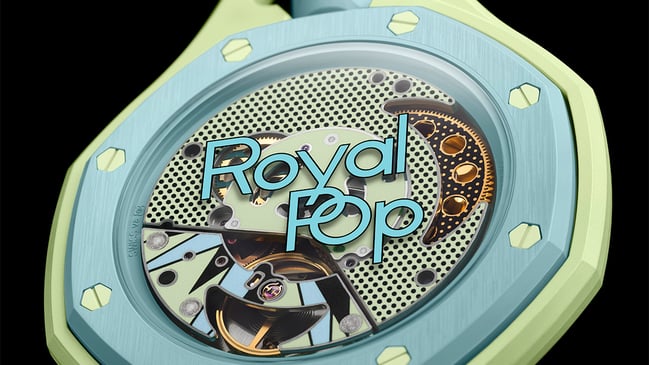
Outside the Swatch flagship store in Times Square, the smell is unmistakable. Some people haven't moved for days. A few have collapsed. Give up your spot in the queue and you lose it — or you pay thousands to buy it back. What looks, at first glance, like an unhinged streetwear line is in fact a stress test for the entire model of democratised luxury. The object of desire: the Swatch x Audemars Piguet Royal Pop Collection — eight mechanical pocket watches priced at $400. Inside each one beats Swatch's proprietary Sistem51 calibre, a fully automated assembly movement comprising 51 components, launched in 2013 as proof that mechanical watchmaking could be delivered at quartz price points. For this collaboration, it appears for the first time manual-wond. The case draws directly from the Royal Oak playbook: octagonal bezel with exposed screws, tapisserie dial in AP's signature chequerboard engraving. The visual language is unmistakable. So is the message behind it.
What sets this collaboration apart
Swatch has been here before. The MoonSwatch series of 2022 — a partnership with Omega — generated comparable scenes: crowds pressing against store facades, resale markups running to multiples of retail, fans bedding down on cobblestones. The Royal Pop follows the same script, but the scale has shifted. New York is no outlier. In Paris, fans and resellers pitched tents days ahead of the on-sale date. The same scenes played out in London, Amsterdam, and Berlin. In Dubai, police shut down the event before it had properly begun. In Delhi, sales were suspended mid-drop due to the crush. Videos from Thailand showed crowds that dwarfed anything seen during the MoonSwatch launch. A store in Singapore reportedly halted its event as well.
In Geneva and Zurich, queues stretched around entire city blocks. Germany was no exception. Hardcore fans had been camping since Wednesday evening. By Thursday night, twenty to thirty people were holding their positions in the rain, sheltering under erected tents. By Friday, the queue had doubled, and by the early hours of Saturday, hundreds stood in line. In Düsseldorf, reports emerged of physical fights on the morning of the drop.
For Germany — across eleven retail locations — industry sources suggest the initial allocation amounted to just 300 units. From position 28 onwards, the mathematics were already brutal. The situation was no more forgiving stateside: even major U.S. stores are believed to have received around 100-200 units, meaning the vast majority of people willing to sleep on concrete for days would always leave empty-handed. Most of them knew the odds. Many queued anyway.
Resellers as market indicator
Before the collection had officially gone on sale, listings were already appearing on Chrono24 at prices of up to $8,000. Known resellers were posting offers online before a single watch had reached a buyer's hands. The implied resale margin — fourteen to seventeen times the retail price — is unusual even by the speculative standards of the sneaker and streetwear secondary market. The implications cut both ways.
For AP, the collaboration demonstrates brand equity at a price point that sits far outside its traditional customer base; the Royal Oak, the manufacture's best-selling reference, opens at around $25,000. Association with Swatch's mass-market mechanics does not dilute AP's prestige — paradoxically, it reinforces the perception of the originals as permanently out of reach. For Swatch, the collaboration strategy serves as a growth engine in a segment that has been under sustained pressure from quartz competition and the continued expansion of smartwatches.
The fault line: collectors versus resellers
Not everyone in the queue intends to wear what they're buying. Some genuine enthusiasts plan to carry the piece as a pendant, or are waiting to see whether Chinese manufacturers flood the market with clip-on strap adapters. Others have paid someone to hold their place while they sleep peacefully at home, running the numbers on the optimal moment to sell. This is not a fringe dynamic. For this particular collection, the primary market is, in practical terms, a pre-market for the secondary. It is a familiar tension within the watch industry — one that takes on a sharper edge when Swatch enters the equation. The mechanism of artificial scarcity, deployed by houses like AP and Rolex for decades to govern access to their manufacture references, operates according to identical economic logic when applied by a mass-market manufacturer with an entirely different production infrastructure.
The scarcity here is not a function of capacity. It is a strategic choice. Whether the Royal Pop constitutes a horologicaly meaningful object is a question with a straightforward answer. The Sistem51 is a dependable, if technically unambitious, movement — no regulation possible, though now, for the first time, equipped with manual winding. The tapisserie is licensed aesthetics, not manufacture heritage. Buying a Royal Pop is not buying an AP. But that is precisely not the point. The Royal Pop is an access artefact — an entry token into a brand world that otherwise stays firmly closed — and a speculative asset for those who identified it as such early enough. That explains the queues. It also explains the smell.
This articles was published first on WatchTime Germany.