Bye Bye Labubu and Hermès Charms: The Royal Pop Is the New It-Object for Your Bag

Fashion thrives on breaking rules. Objects are no longer worn exclusively where they were originally intended. Rihanna wears a $700,000 watch as a choker around her neck, designer pochettes migrate to belt loops, and Labubu plush figures dangle from bags whose price tags could cover a studio apartment. And now comes what could be described as the revival of the pocket watch. More precisely: the new Swatch x Audemars Piguet collaboration, the Royal Pop. Everything suggests this timepiece will rarely be worn on the wrist. Instead, expect to see it clipped to bags, belt loops, backpacks, worn around the neck, or dangling from a Stanley mug or golf bag. What makes this genuinely interesting: the idea itself is anything but new.
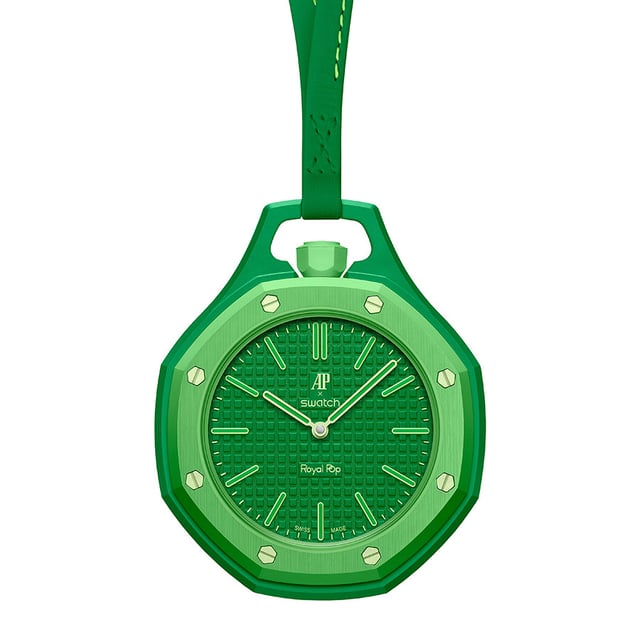
Swatch x Audemars Piguet – Royal Pop
Swatch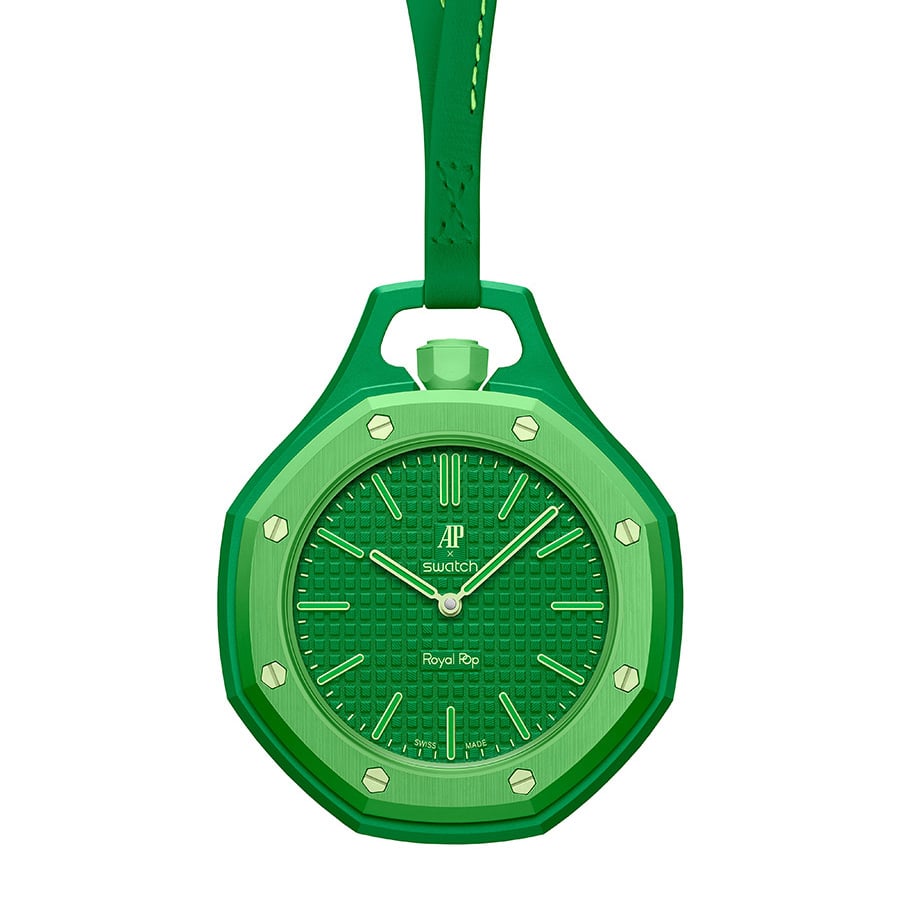
The Return of the Pop Idea
Anyone who has spent time with Swatch's history will remember the Pop collection of the late 1980s — watches whose case could be detached from the strap and clipped onto clothing or accessories. At the time, it was primarily a practical concept. Today, that same mix of function, irony, and fashionable excess describes how luxury accessories work in 2026. A watch is no longer simply worn. It has to be staged.
Bag Charm
After Prada quietly established the bag charm as a status signal in the early 2000s, the trend faded into eccentric footnote territory for the better part of two decades. Then Hermès brought it back with architectural precision, vintage aesthetics found a second life through Gen Z, and Labubu turned the whole thing into a cultural phenomenon — a small plush figure sitting somewhere between collectible toy, anime reference, and luxury flex. By 2025, the bag charm wasn't an accessory anymore. It was the point. The result: bags today often resemble personal moodboards, loaded with carabiners, accessories, and dangling objects that feel closer to Christmas tree decoration than traditional styling.
The Royal Pop fits into this world with surprising precision, not least because the object itself already plays on contradictions. Luxury reference meets plastic, haute horlogerie meets pop culture, application process meets Swatch store queue. It seems almost inevitable that at the next fashion week, somewhere between oversized sunglasses and deliberately creased designer shirts, a Royal Pop will appear clipped to a bag — not primarily to tell the time, but because that is simply how luxury works today.
Desk Watch
For those who find the traditional pocket watch concept impractical, the playful interpretation of the Pop system offers a compelling alternative. A small additional stand transforms the timepiece into a desktop clock, injecting a burst of color into even the most boring office setup. One word of caution: given the current hype, leaving your desk unattended during a coffee break may require more trust in your colleagues than most workplaces can guarantee.
For Racing Drivers
Those who have long lamented the absence of a mechanical watch in their sports car can now look ahead with optimism. Once the air freshener has been retired, the rearview mirror is free. Depending on the car's color, there is likely a matching Royal Pop variant — and if not, a vinyl wrap in the right shade is always an option. One caveat: with longer lanyards and aggressive cornering, the risk of Gérald Genta's iconic design leaving an impression on your forehead should not be entirely dismissed.
Conversion Project
For those who had quietly hoped for a Royal Oak-style wristwatch and left yesterday's reveal slightly underwhelmed: there is no need to wait for the next MoonSwatch. It would hardly be the first time in horological history that a pocket watch was converted into a wristwatch. In the early 20th century, pocket watches were regularly fitted with wire lugs, a leather strap mounted, and worn on the wrist. Such conversions still appear regularly on the vintage market today. Few ways exist to put genuine manufacture craftsmanship on your wrist more affordably — a thought that carries obvious parallels to the current release. Tellingly, the first leather strap adaptors and 3D-printed conversion solutions are already circulating online, designed to make the Royal Pop wearable in exactly the traditional sense.
Why This Actually Makes Perfect Sense for Audemars Piguet
As absurd as the concept might initially seem, this kind of cultural repositioning is not entirely foreign to Audemars Piguet. The Royal Oak was itself an act of rule-breaking in 1972 — a luxury watch in steel, with exposed screws and an industrial aesthetic that was considered a provocation at the time. The Swatch collaboration simply translates that principle into a new generation of consumer codes. Less reverence, more ease. Less safe, more street. Perhaps that is the collaboration's greatest strength. It takes the watch seriously enough to respect its history, but not so seriously that it forgets to have fun with it.
While other luxury brands continue constructing artificial distance, Swatch has accepted something the fashion world understood long ago: people today don't just want to own objects — they want to integrate them visibly and creatively into their everyday lives. Put differently: the next Royal Oak may no longer peek out from beneath a shirt cuff. It may be dangling from a Birkin. Or hanging off a safe key. Either way, it will be seen.
This article was published first on WatchTime Germany.