Celebrating a Legacy: Close-Up on the Piaget Polo 150th Anniversary Edition
How Piaget reinterprets its iconic Polo to celebrate 150 years of watchmaking.
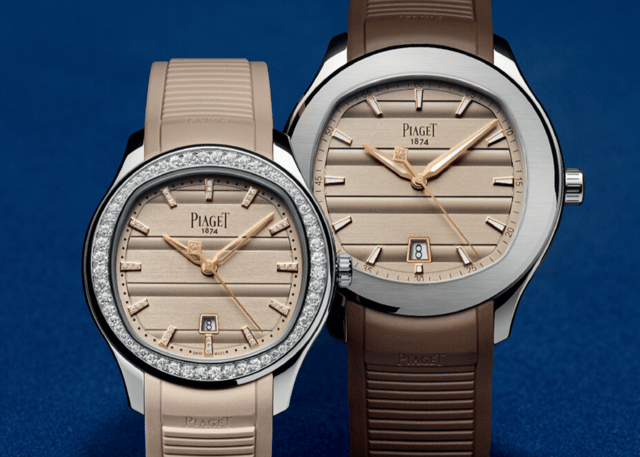
When Piaget’s Polo first made its debut in 1979, it was not like Jaeger-LeCoultre’s Reverso, meant to be worn by the players, but rather by the spectators who enjoyed watching this demanding sport. This distinction made perfect sense. Polo had long been associated with the rich and famous, and that was precisely Piaget’s clientele.
By the late 1970s, Piaget was already enjoying widespread acclaim not only for its legendary ultra-slim movements — the hand-wound Caliber 9P and automatic Caliber 12P — but also for its bold design language. Those slender calibers allowed Piaget’s designers to create jewelry-driven watches crafted exclusively from precious metals, aligning perfectly with the tastes of the era’s global elite.
Through Yves Piaget, the brand had already established deep ties to the sport before the Polo’s launch. Sponsorship of championship polo teams in the United States and Europe evolved into a deeper commitment in 1976, when Piaget lent its name to the prestigious Polo World Cup in Palm Beach. When the Polo was finally introduced in 1979, it arrived at a moment when perceptions of luxury were shifting. Formality was giving way to versatility, and the demand was growing for watches that blended refinement with a more relaxed, dynamic elegance.
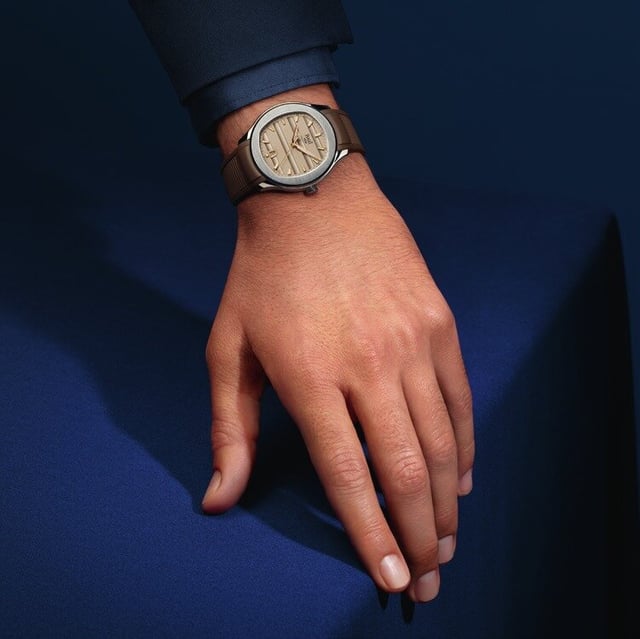
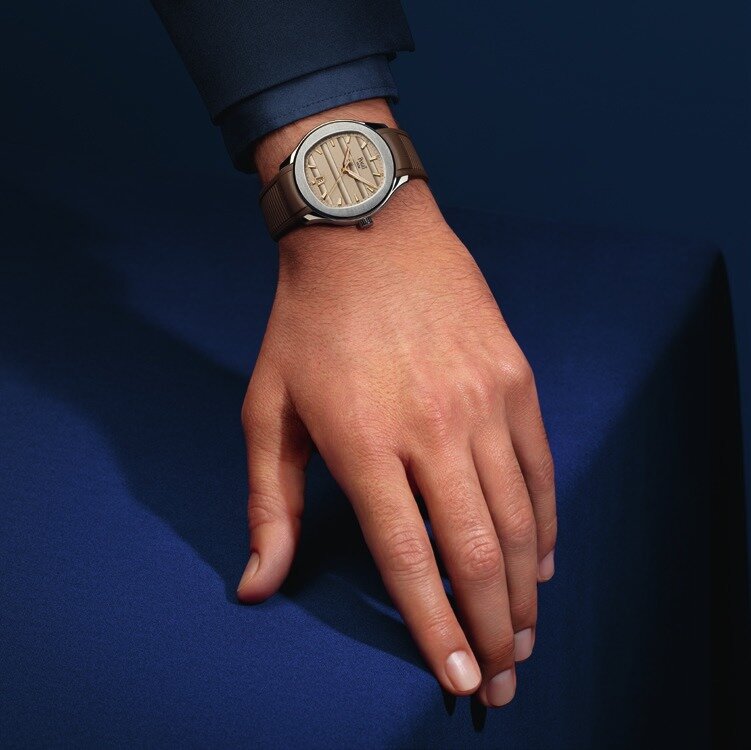
The original Polo answered that call with its unmistakable integrated design. The bracelet flowed seamlessly into the dial, while brushed gold segments were separated by polished gadroons that added just enough contrast and visual rhythm. It was immediately embraced by tastemakers and celebrities, and for a decade it defined Piaget’s vision of sporty luxury. As tastes evolved, so did the Polo, with successive generations adapting the design while preserving its core identity.
The current generation of the Piaget Polo — and especially the 150th Anniversary Edition — can be viewed as a carefully curated greatest-hits album. Multiple historical references are brought together into a single, cohesive design. The cushion-shaped case recalls the Emperador Coussin, another emblematic Piaget creation, lending the Polo a powerful yet refined presence on the wrist.
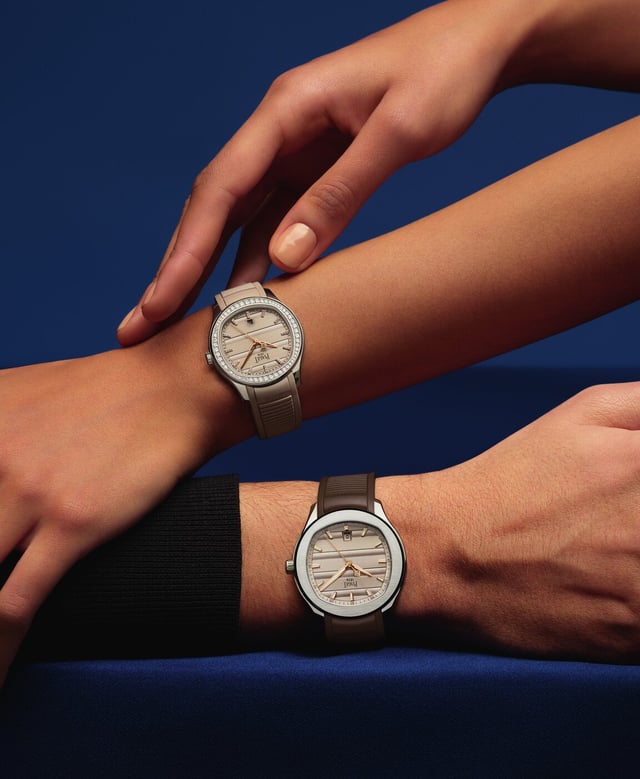
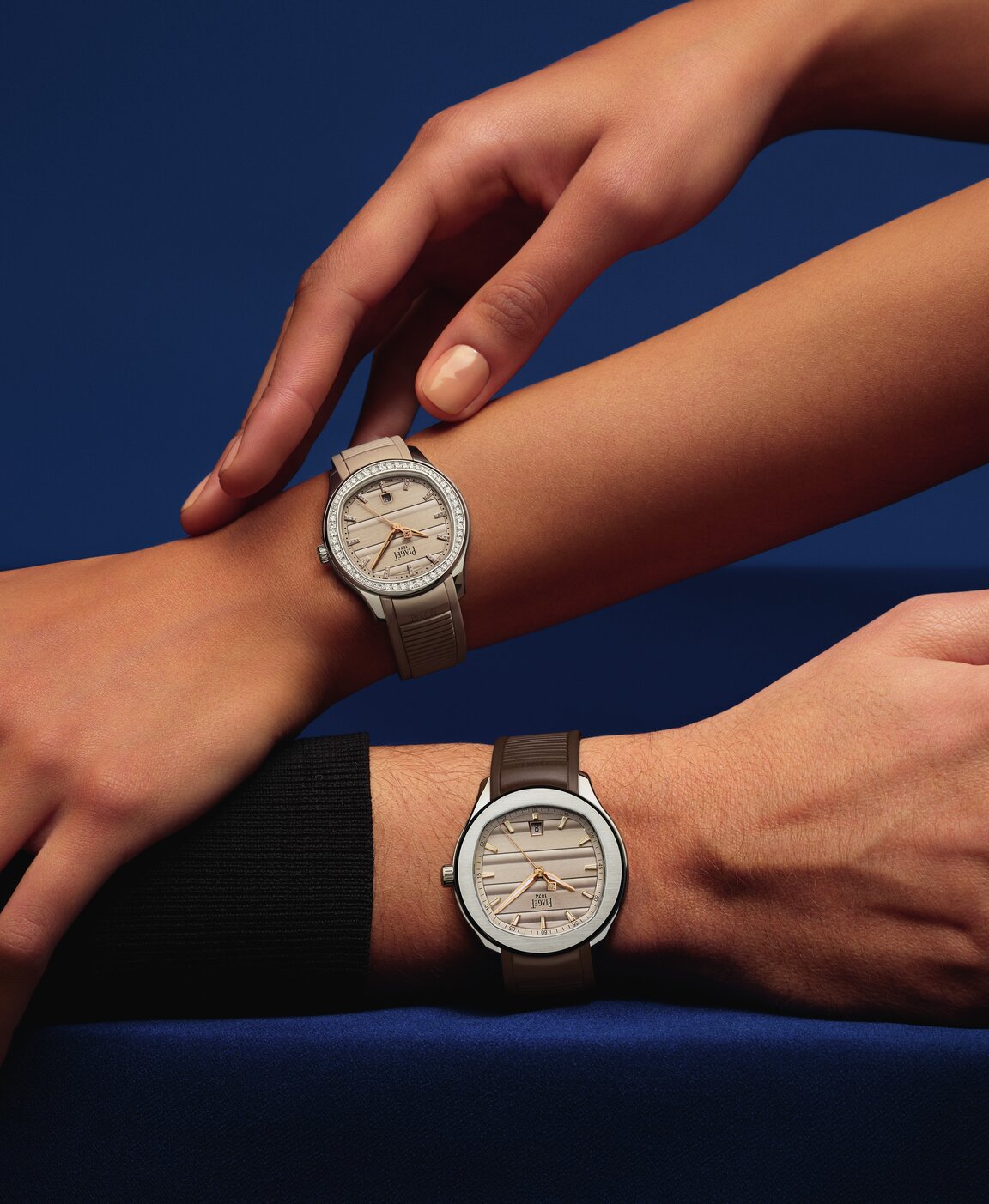
For the anniversary edition, Piaget offers two sizes: a 42-mm version and a 36-mm model that leans more clearly toward the brand’s female clientele. The smaller version features a diamond-set bezel, showcasing Piaget’s expertise as a master jeweler. The cushion shape introduces an additional challenge, as the bezel narrows toward the corners. Piaget addressed this by subtly adjusting the size of the brilliant-cut diamonds, creating a fluid, organic transition that mirrors the tapered hour markers on the dial.
Red-gold hands and applied markers provide a warm contrast against the stainless-steel case, while even the date-window frame is executed in the same precious metal. The seconds hand includes a discreet but clever anniversary detail: its skeletonized counterweight forms the number “150.” Beneath the Piaget logo at 12 o’clock, the brand’s founding year is printed as another quiet nod to the milestone.
The two models differ subtly in functionality as well. The 42-mm version features Super-LumiNova-filled hands and markers, reinforcing its more overtly sporty character, while the 36-mm diamond-set model forgoes lume entirely, emphasizing elegance over utility.
The dial pattern itself references the historic Polo design language, though here it appears in warm “café latte” tones rather than precious metal or onyx. This gives the watch a relaxed, contemporary feel — luxury that feels effortless rather than formal. Piaget reinforces this mood with rubber straps tailored to each model: chestnut brown for the 42-mm version and a dial-matched tone for the 36-mm watch.
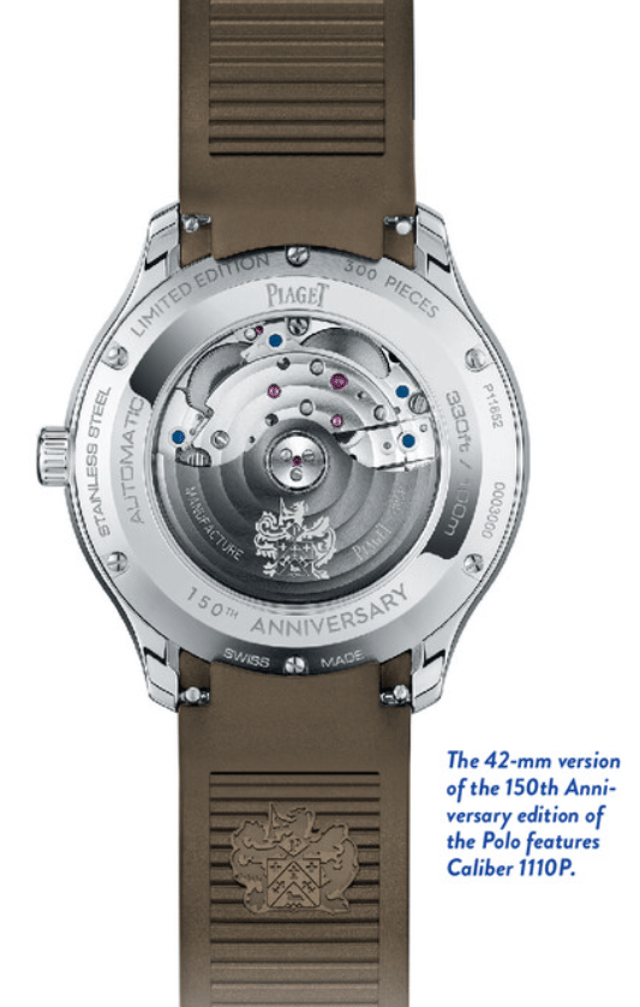
Inside, Piaget balances robustness with slim proportions. The 42-mm Polo houses the automatic Caliber 1110P, while the 36-mm model is powered by the Caliber 500P1. Though thinness alone is no longer the primary objective for modern sports watches, Piaget keeps proportions elegant at 9.4 mm and 8.8 mm thick, respectively. Through the sapphire caseback, the movements reveal traditional Piaget finishing — engine-turned plates, circular Côtes de Genève, blued screws, and an oscillating weight engraved with the Piaget coat of arms.
Each version of the Piaget Polo 150th Anniversary Edition is limited to 300 pieces and available exclusively through Piaget boutiques. Retail pricing is set at $14,700 for the 42-mm model and $21,600 for the diamond-set 36-mm version — a fitting tribute to one of the brand’s most enduring icons.
This article was originally published in the January / February 2025 issue. To subscribe to the print edition of WatchTime Magazine, click here.