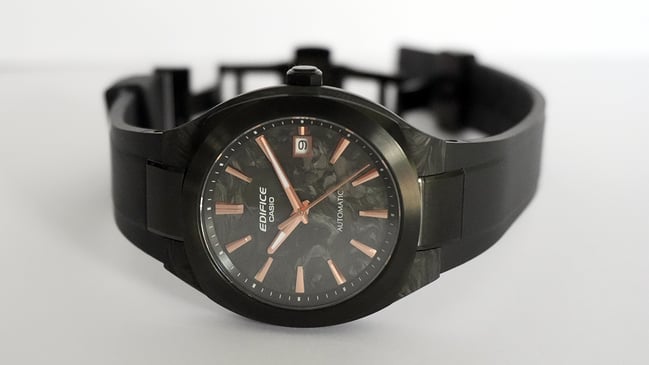
An Interview with the Inventor of G-SHOCK, Kikuo Ibe: “I knew it wasn’t going to be an easy path.”
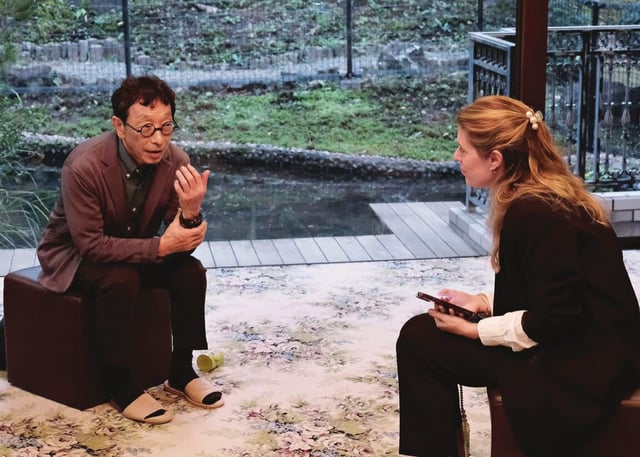
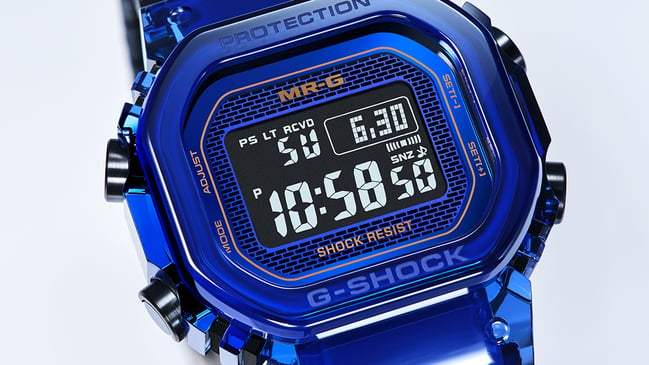
When Kikuo Ibe started working in Casio’s design department in 1976, he had no idea what a lasting impression he would make on the world of watches. He initially focused on developing digital watches before pursuing his idea of a shock-resistant watch in 1981. Despite initial skepticism within the company, the G-Shock not only became a worldwide success, it also revolutionized and inspired the watch industry as a whole. Today, at the age of 72, Ibe continues to be involved in the development, and he has also become an ambassador for the brand. In addition, he is heavily involved in product planning for luxury models such as the metal-cased MR-G series and the “Dream Project Pure Gold,” the 18k-gold G-Shock.
In our conversation, the “father of G-Shock” shared defining moments of his career, the challenges of developing the first models and his ambitious dream of creating watches that could withstand even the extreme conditions of space. One thing he wasn’t talking about was retirement — on the contrary: His inexhaustible passion for innovation continues to drive him.


Legend has it that you got the idea for the G-Shock after dropping a watch given to you by your father. How did that event motivate you?
It was actually a gift from my father that I received when I moved to high school. That was a significant moment, and that watch had special meaning for me. I cherished it very much, but when I accidentally dropped it, it broke, and I was devastated. I thought a watch that was so valuable shouldn’t break. That was the inspiration — I wanted to create a watch that was unbreakable. That was where the idea came from.
Were there moments when you thought you wouldn’t reach your goal?
I knew it wasn’t going to be an easy path, but it was that passion, that “aha” moment, that drove me. But I hadn’t done any in-depth research before starting this project.
When I finally started working and researching the basics, I ran into one barrier after another. I kept thinking, “I can’t do this.” It was a constant struggle.
“If I could develop a G-Shock that could withstand the temperatures and environmental conditions in space, that would be great.” —Kikuo Ibe, inventor of the G-Shock
It is also mentioned that a rubber ball on a playground played a crucial role in developing the shockproof properties.
There were many trials and failures. At first, we could not find a solution that would make the watch shockproof. There is a park right next to our technical center. One day I was sitting on a bench there and thought, “This is not going to work. What should I do?” A child came by and started playing with a ball. When he bounced the ball on the ground, I had an inspiration: “If we have the movement like in a ball, it can absorb the shock.” That was the “aha” moment. I thought, “This has to be it! If I can protect the movement in a small space, I will achieve my goal.” That’s how the idea was born.
Were aesthetics a conscious decision factor from the beginning or did it evolve with functionality?
Robustness was the main feature of the G-Shock. Because it was a digital watch, I didn’t think much about aesthetics at first, but rather about the display. It was important to me that the time was clearly legible for the wearer. In other words, functionality dictated aesthetics, and that’s how the design came about.
Many extreme sports enthusiasts, emergency workers and the military use G-Shock watches. Did you have these target groups in mind, or did that come later?
When I developed G-Shock, I had construction workers in mind. We heard that they couldn’t wear watches while they were working, because they would often break. G-Shock was designed to solve this problem. But thanks to the media, the watch became known in other areas and appealed to various target groups, including athletes and astronauts. This allowed us to gain a wider fan base.
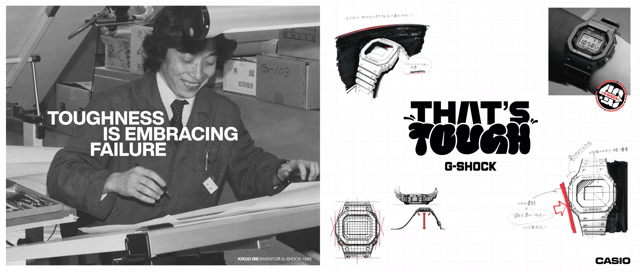
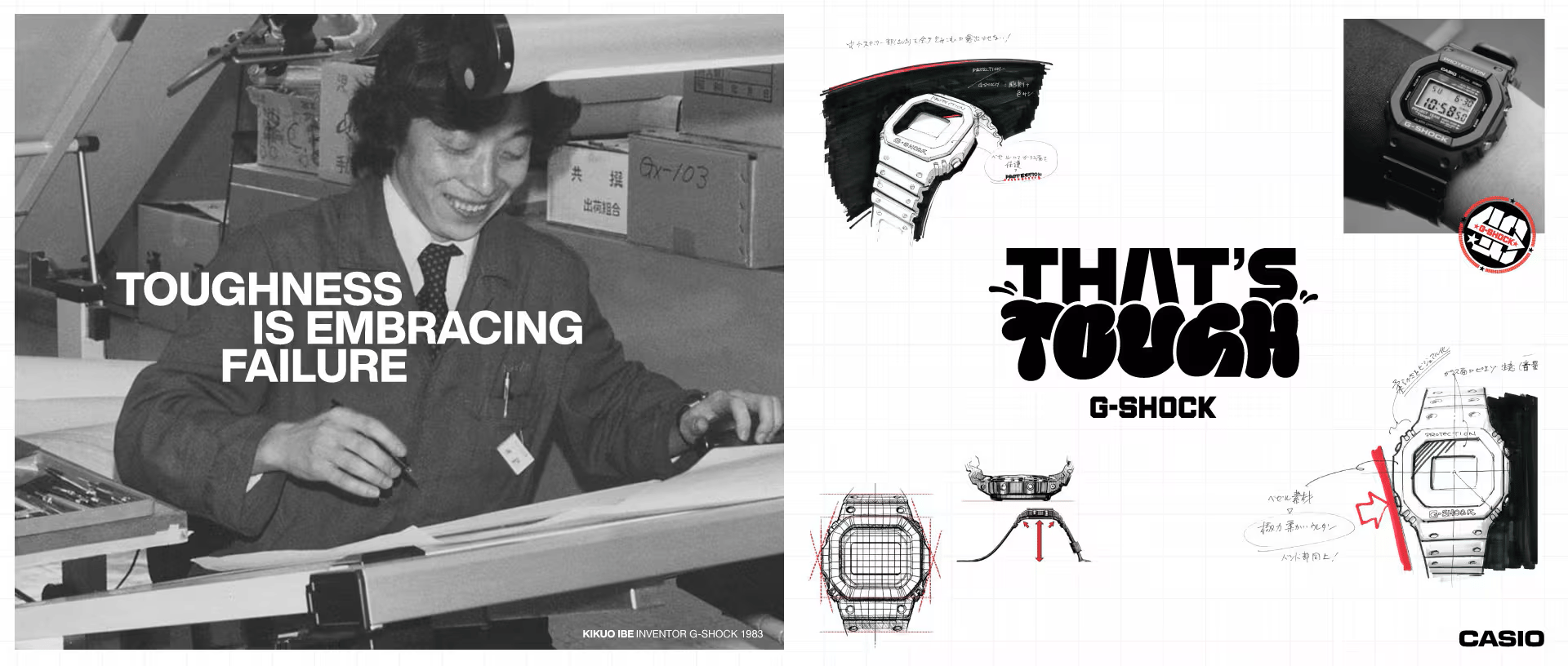
How did the company initially react to G-Shock, and what impresses you most about its development?
At first, the reaction was rather negative. At the time, thin, slim watches were in fashion, and G-Shock was the opposite: big and bulky. It wasn’t until about 10 years later that things changed. One day, I saw young people on the train wearing G-Shocks and I thought, “Wow, times have changed.” I was very happy.
How do you see the future of G-Shock in light of current trends such as slimmer watches and smartwatches?
It is a challenge to keep up with these trends, but G-Shock remains true to its core principles: robustness and functionality. We will continue to try to integrate new technologies while preserving the iconic design and philosophy of G-Shock.
Is there a model or range that you are particularly proud of?
My favorite is the Origin, the 5000/5600 series. This is the model that I have the most affection for because it was very difficult to get to this point.
What advice would you give to young engineers and designers working on new innovations today?
No challenge is too small. Every challenge is something to be taken on. When you do new things, you always come across obstacles. Breaking through these barriers opens up new possibilities and new horizons, so never give up. That’s the message I would give. And besides, that’s also something I always tell myself: "Never give up."
What do you want for G-Shock in the future?
G-Shock has evolved to meet different needs — extreme conditions, very high and very low temperatures, great depths in water and so on. We cover the extreme conditions on Earth. In my wild imagination, I look into space. It’s a completely different environment: The temperatures are extremely high and extremely low, so it’s a completely different challenge. If I could develop a G-Shock that could withstand the temperatures and environmental conditions in space, that would be great — or a model whose materials cool down in the summer and heat up in the winter. And in terms of materials, I can tell you that we are working on prototypes made entirely of sapphire glass.
This article was originally published in the March / April 2025 issue. To subscribe to the print edition of WatchTime Magazine, click here.
- Legend has it that you got the idea for the G-Shock after dropping a watch given to you by your father. How did that event motivate you?
- Were there moments when you thought you wouldn’t reach your goal?
- It is also mentioned that a rubber ball on a playground played a crucial role in developing the shockproof properties.
- Were aesthetics a conscious decision factor from the beginning or did it evolve with functionality?
- Many extreme sports enthusiasts, emergency workers and the military use G-Shock watches. Did you have these target groups in mind, or did that come later?
- How did the company initially react to G-Shock, and what impresses you most about its development?
- How do you see the future of G-Shock in light of current trends such as slimmer watches and smartwatches?
- Is there a model or range that you are particularly proud of?
- What advice would you give to young engineers and designers working on new innovations today?
- What do you want for G-Shock in the future?