Louis Vuitton: Five New Directions for the Spin Time Complication
Round and round and round
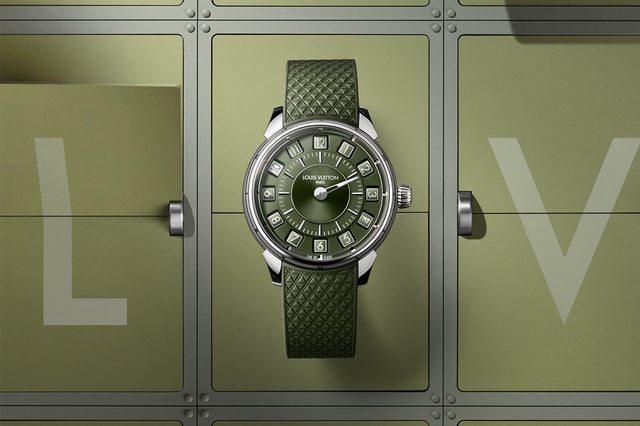
Twelve rotating cubes that flip the hour like the numbers on an old airport departure board — that's the Spin Time complication in a sentence. What began in 2009 as a special complication for Louis Vuitton is now a permanent fixture: five references of the Tambour Spin Time are joining the regular collection, following the 2025 launch of six limited editions built around an entirely new case and a new generation of movements.
From Departure Board to Complication
The idea originated with Michel Navas and Enrico Barbasini, founders of La Fabrique du Temps, who in 2007 developed a jumping-hour display inspired by the mechanical boards found in airport terminals. They translated the two-dimensional logic of those boards into a three-dimensional element for the wrist: the cube. Two years later, the Tambour Spin Time debuted as the first caliber La Fabrique du Temps built specifically for Louis Vuitton, featuring twelve cubes that orbit the dial, with one — set apart in a lighter shade — indicating the current hour. Patented and instantly recognizable, the complication became a signature of the house, even though Louis Vuitton did not yet operate its own manufacture. That changed in 2011, when Louis Vuitton acquired La Fabrique du Temps, bringing movement, case, and dial production together under one roof in Geneva. For the complication's tenth anniversary in 2019, Louis Vuitton introduced the Spin Time Air, which opened up the dial to let the cubes appear to float in space. With the Tambour Spin Time 2025, the brand redesigned the case, dial, and caliber entirely from scratch and fully in-house for the first time — a significant statement of manufacturing commitment for a complication that had already been on the market for a decade and a half. The new case is slimmer than its predecessor, with a sandblasted bezel, three-dimensional polished relief lettering, and separately milled lugs with laser-frosted concave flanks — details that carry over into all five new references.
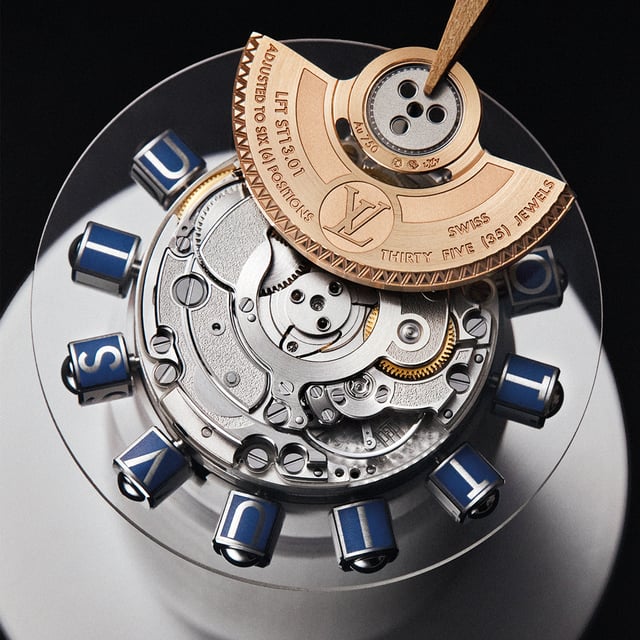
2025 läutete die Tambour Spin Time eine neue Ära ein: mit komplett neuem Gehäuse und neuer Manufakturkaliber-Familie. Erstmals entstanden Gehäuse, Zifferblatt und Werk vollständig bei La Fabrique du Temps Louis Vuitton.
Louis Vuitton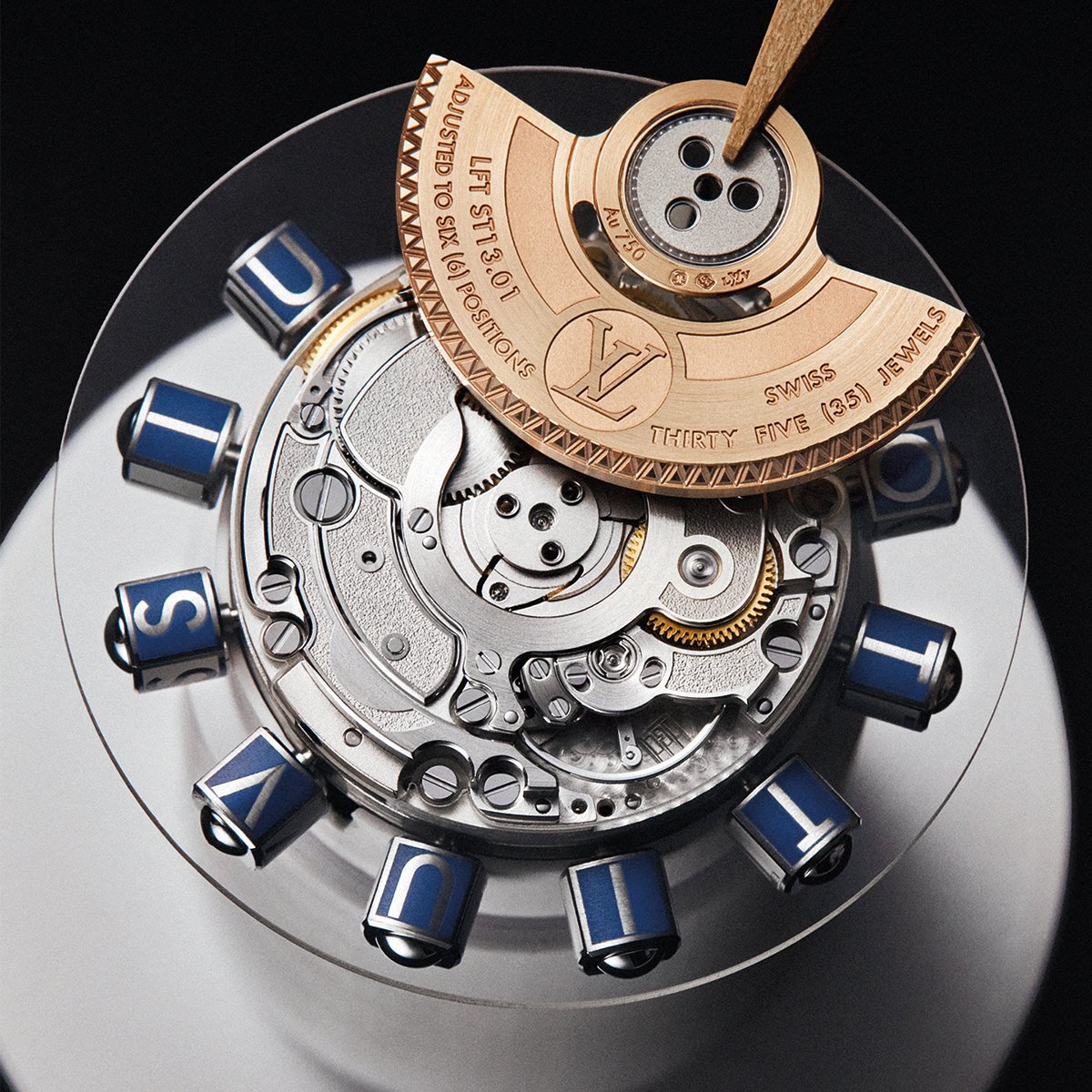
Two Caliber Families, Three Case Sizes
The backbone of the permanent collection is the LFT ST13.01, a mechanical self-winding movement with 246 components, a 45-hour power reserve, and a frequency of 28,800 vibrations per hour (4 Hz). It appears in three of the five references, but housed in two different case concepts. In the Tambour Spin Time Green (ref. W9WGA2) and the Tambour Spin Time Opal (ref. W9PG42), it sits inside a 39.5mm case with a screw-down crown and 100 meters of water resistance.
In the larger, 42.5mm Air case of the Tambour Spin Time Air Blue (ref. W9WG81), which features the skeletonized dial construction, water resistance drops to 50 meters — a familiar trade-off in this type of complication, where the openworked cube display comes at the expense of sealing. The Green reference, with its sandblasted dial in an earthy green and a satin-finished dial center, is the most understated of the five. It's paired with a green rubber strap featuring a quilted pattern that echoes the V-motif on the 18k rose gold oscillating weight visible through the display back. Price: $85,500.
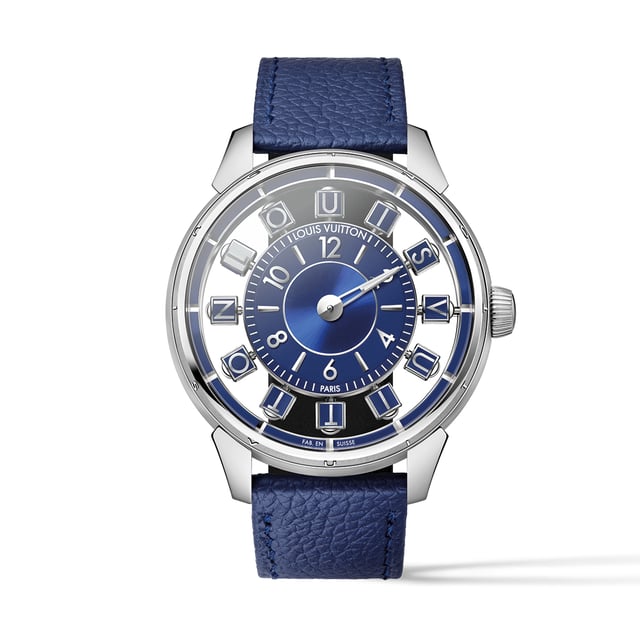
Louis Vuitton Tambour Spin Time Air, Ref. W9WG81
Louis Vuitton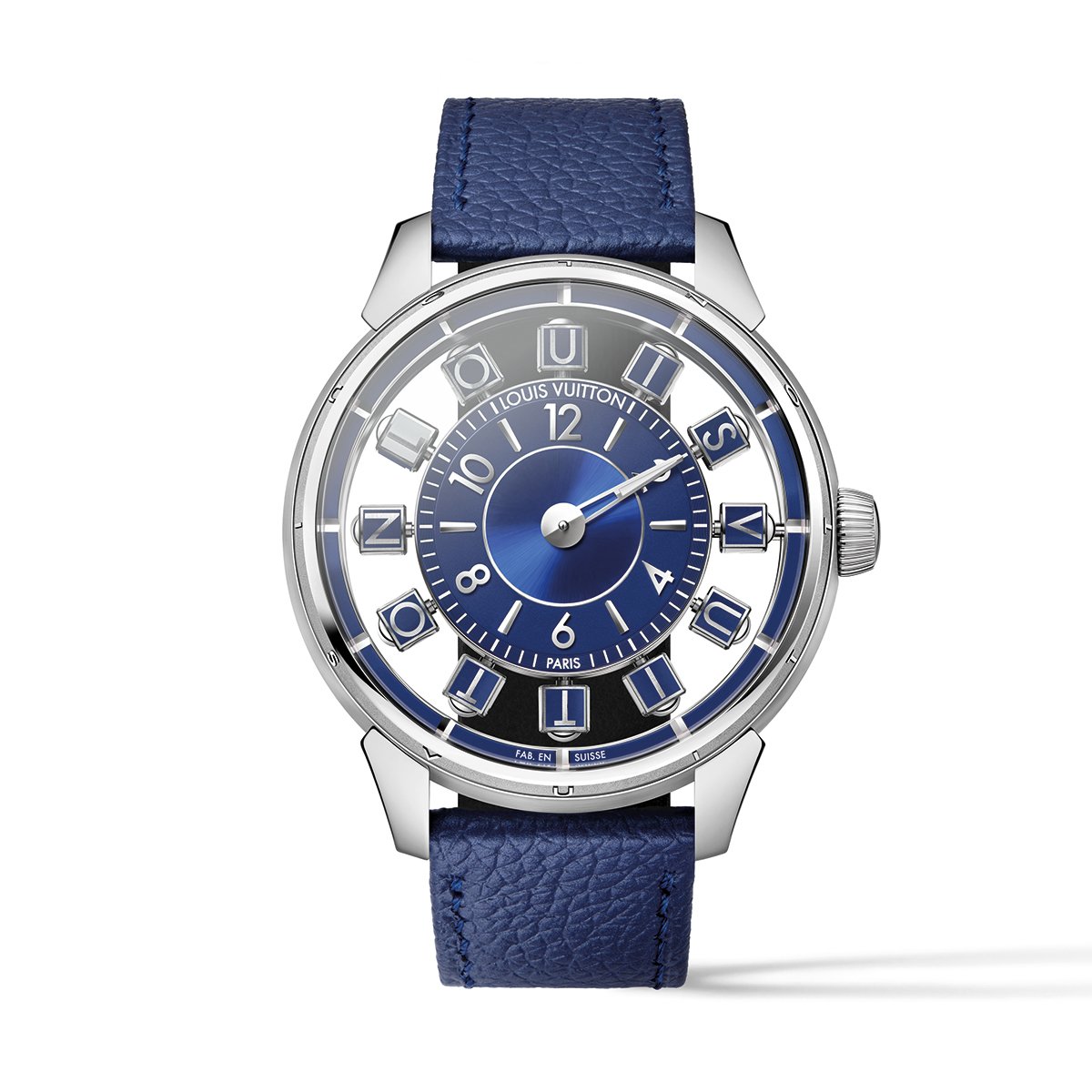
The Air Blue takes a more playful approach: instead of numerals, the twelve cubes spell out "Louis Vuitton." The hour is still legible through color contrast between the active and inactive cubes — silver text on white marks the current hour, silver text on blue marks the remaining eleven. It's priced at $94,500.
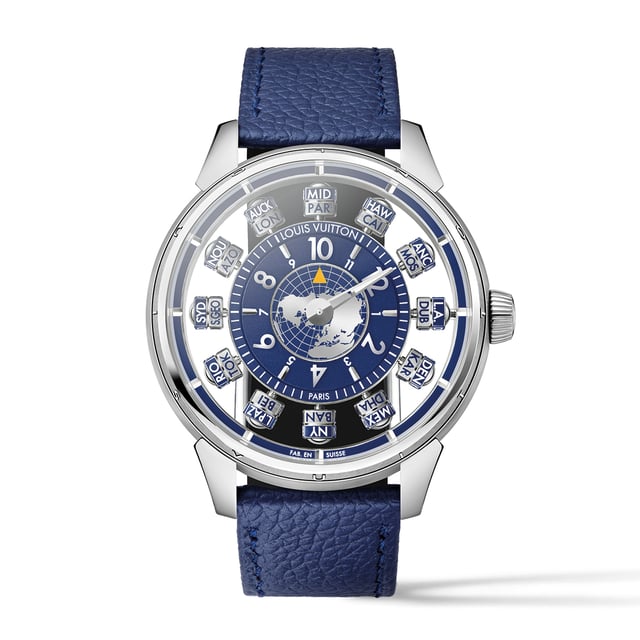
Louis Vuitton Tambour Spin Time Air Antipode, Ref. W9WG91
Louis Vuitton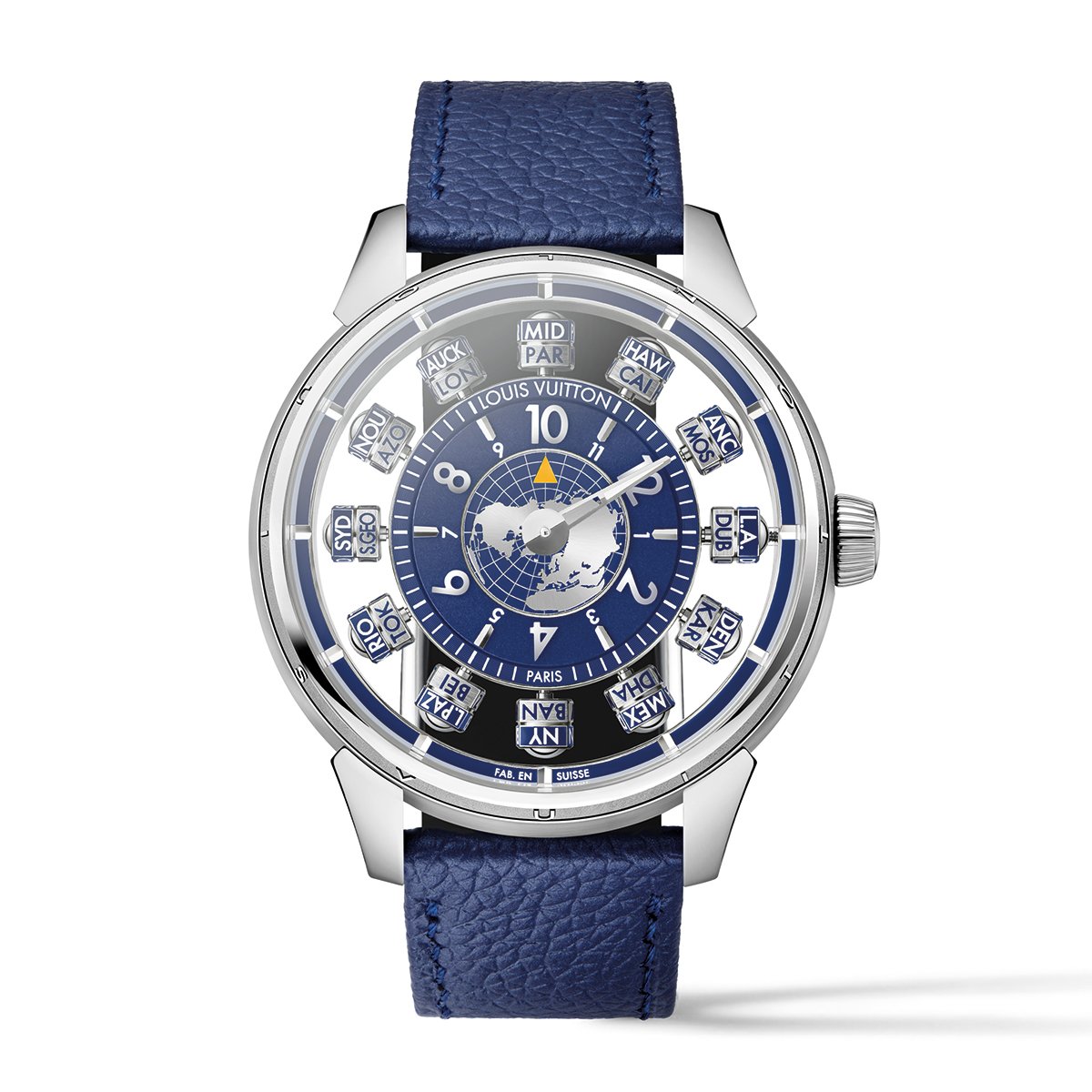
World Time and a Flying Tourbillon as Special Cases
The remaining two references depart from the base complication, pairing the cube display with additional functions. The Tambour Spin Time Air Antipode (ref. W9WG91) runs on the LFT ST12.01, with 271 components and 36 jewels (versus 35 in the base caliber), to display world time across the twelve cubes — not as a conventional city list, but through what Louis Vuitton calls antipodal logic. Each cube carries the names of two cities exactly twelve hours apart (Los Angeles/Dubai, New York/Bangkok, Paris/Midway Islands), along with a background color that flips between day and night as each city pair crosses the day-night boundary. Local time is indicated by a yellow-painted hand, a nod to the yellow stitching found on Louis Vuitton leather goods.
What's notable from a construction standpoint is that despite the complexity of the world-time display, every adjustment is still handled through the crown alone. This model is priced at $119,000.
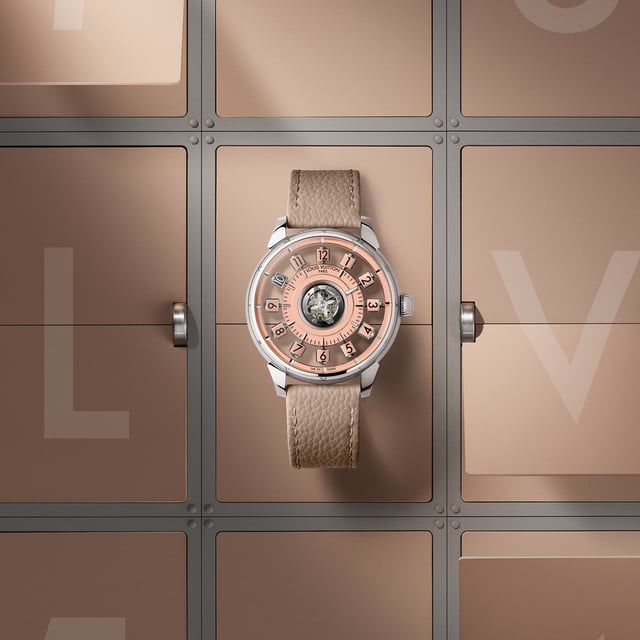
Louis Vuitton Tambour Spin Time Air Flying Tourbillon, Ref. W9PT21
Louis Vuitton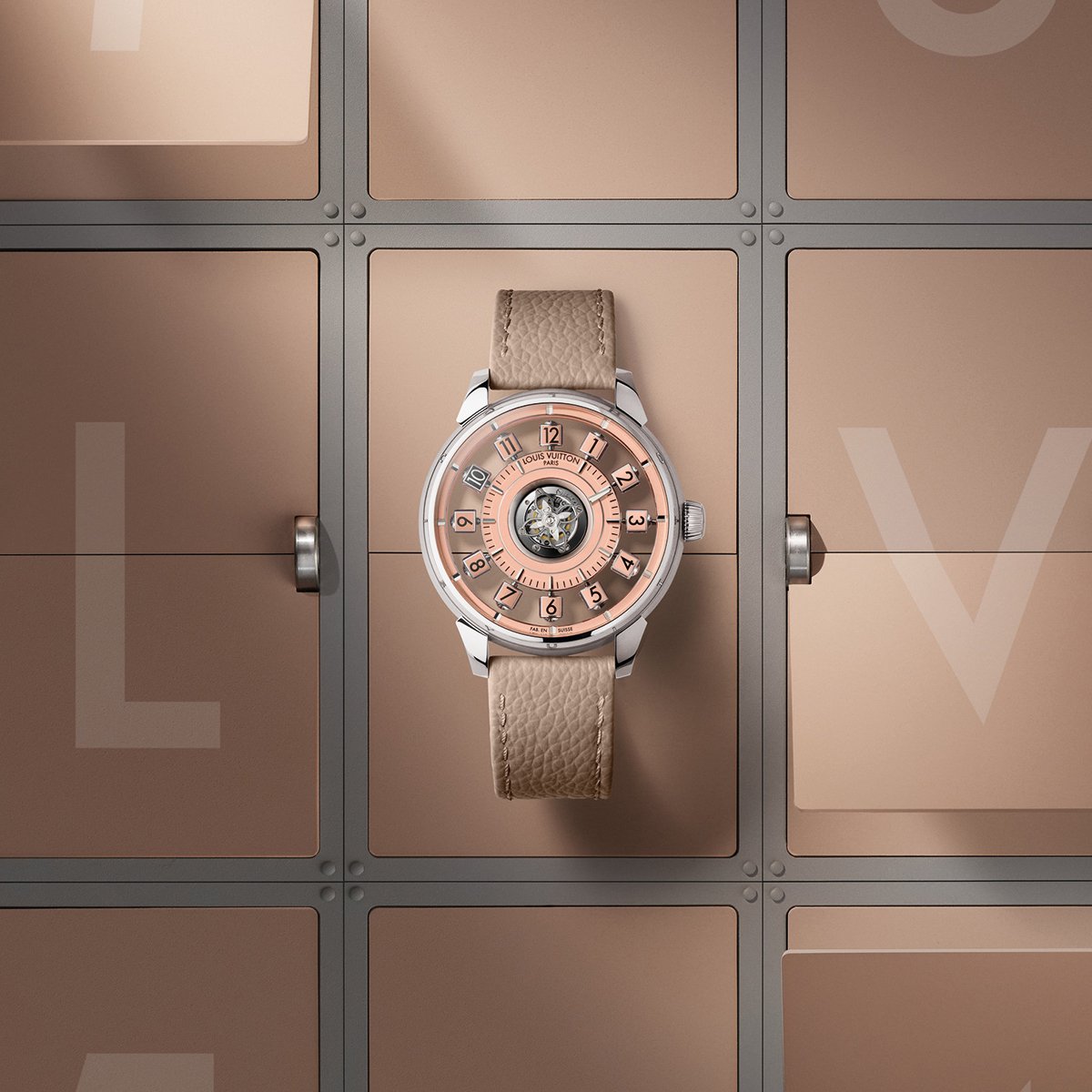
The Tambour Spin Time Air Flying Tourbillon is the technical flagship of the lineup. Its LFT ST05.01 caliber, with 283 components, combines the openworked cube display of the Air case with a central flying tourbillon — its cage deliberately shaped like the Monogram flower, as Enrico Barbasini points out. At 50 hours of assembly time, this caliber takes more than twice as long to build as any other movement in the collection, which makes sense given that both the flying tourbillon and the jumping-hour cube mechanism compete for space at the center of the movement, requiring careful allocation between the two.
The 950 platinum case, paired with a salmon dial — a color historically closely tied to platinum and high-end watchmaking — reinforces the special status of this reference; the display back is set with a single brilliant-cut yellow sapphire. The W9PT21 is priced at $199,000.
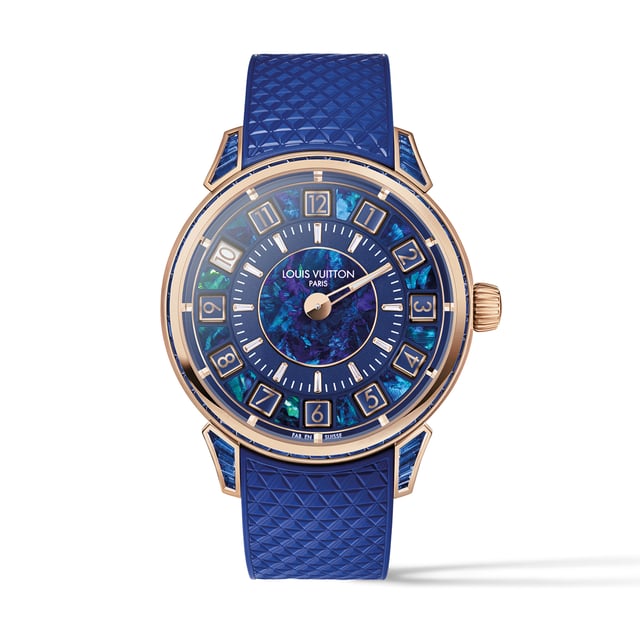
Louis Vuitton Tambour Spin Time, Ref. W9PG42
Louis Vuitton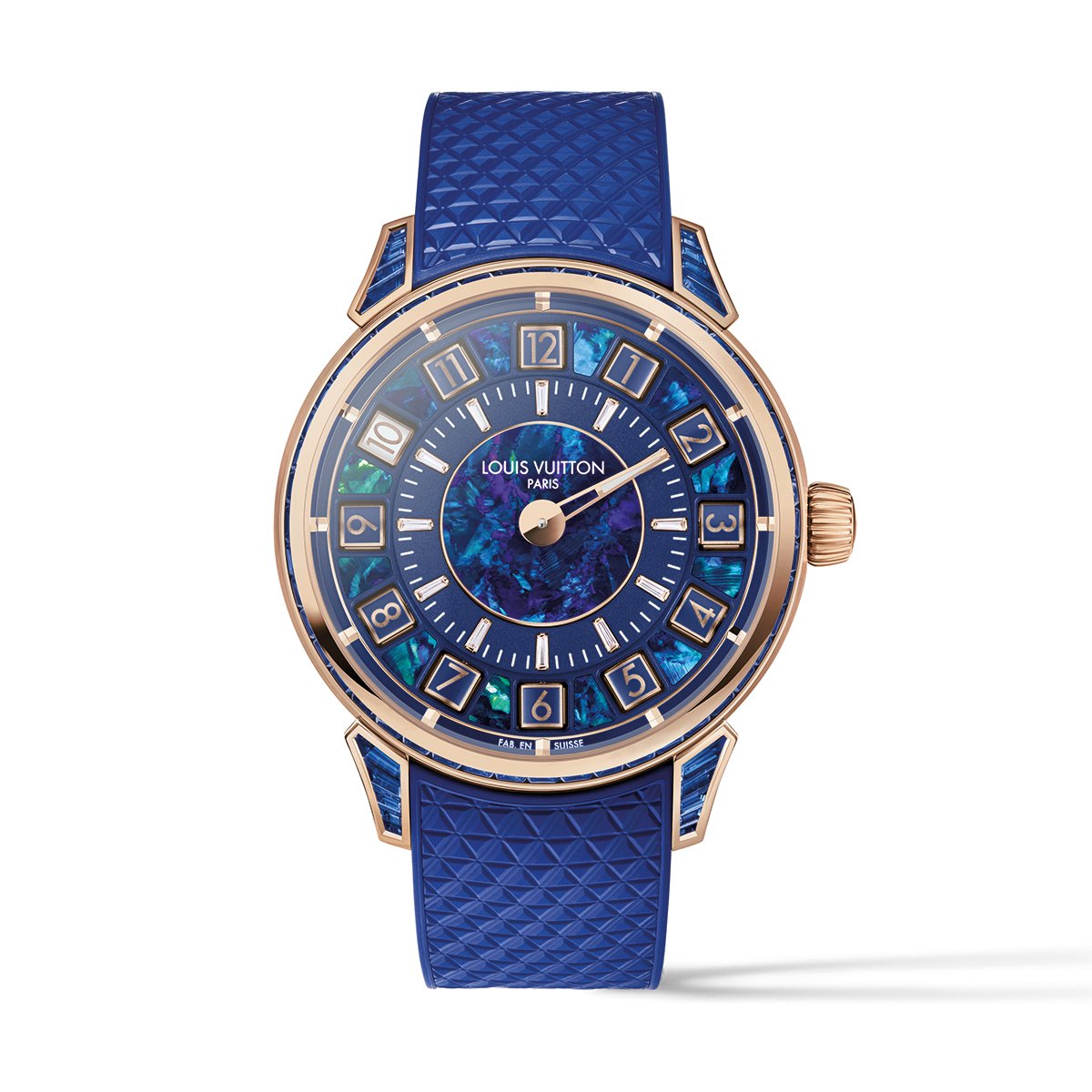
The Opal reference takes yet another direction: it's the first Tambour to be cast in rose gold, with the bezel set with 48 baguette-cut sapphires (roughly 2.76 carats total) and the lugs set with another 20 stones (roughly 0.94 carats). The indexes carry twelve baguette-cut diamonds. The dial center and the spaces between the cubes are filled with Australian blue opal — bringing the total gem-setting to roughly 4.71 carats and, according to Louis Vuitton, three full days of work for the stone-setting alone. The rarity of the material and the intensive craftsmanship involved are reflected in the $189,000 price tag.
Taken together, the five references show just how broadly Louis Vuitton is now interpreting the Spin Time concept. The Green model, at 39.5mm with a screw-down crown, remains the most restrained entry point into the complication, while the Opal reference — in rose gold, set with baguette sapphires and Australian opal — serves as its decorative counterpart. The Air Blue leans into a playful touch with its cube-spelled logo, while the Air Antipode reinterprets the display as a world-time function built on day-night logic across twelve city pairs. Capping the lineup is the platinum Flying Tourbillon, whose 283-component movement and 50-hour assembly time make it the most technically demanding piece in the collection. What unites all five is the shared Tambour case architecture and the same in-house manufacturing depth at La Fabrique du Temps — regardless of finish or complication, Spin Time remains clearly recognizable as an established signature complication in every variant.