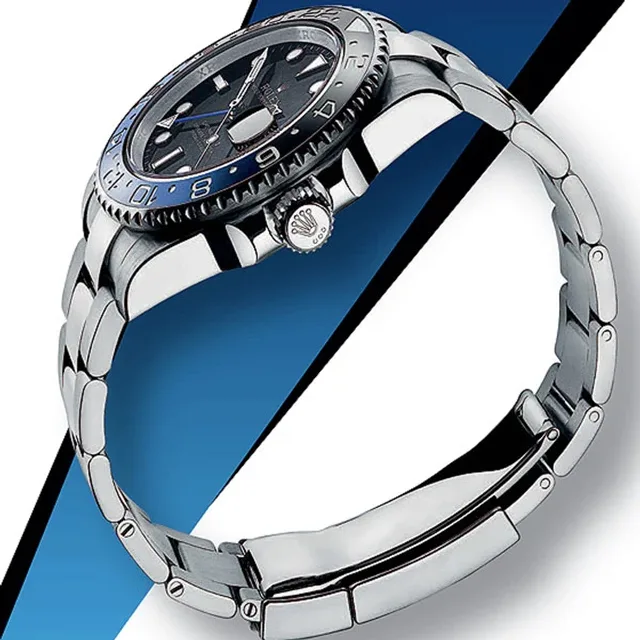
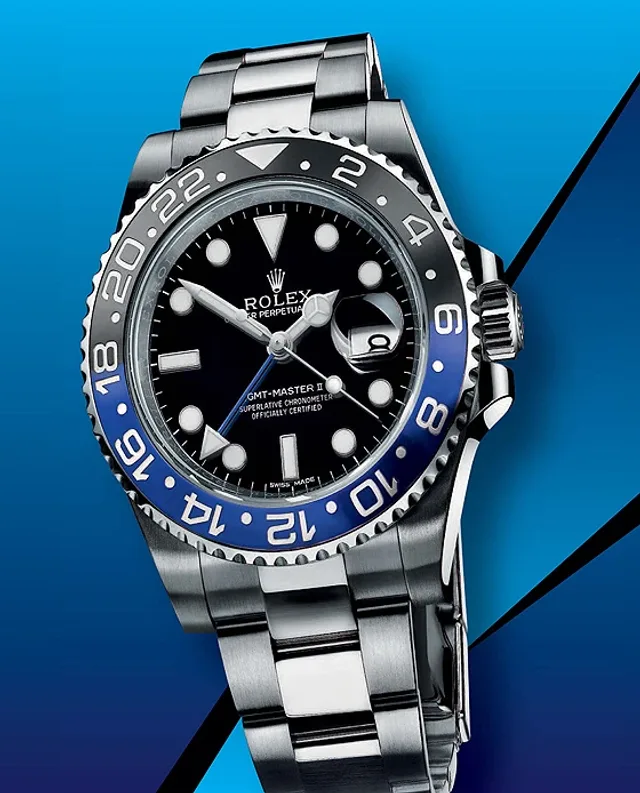
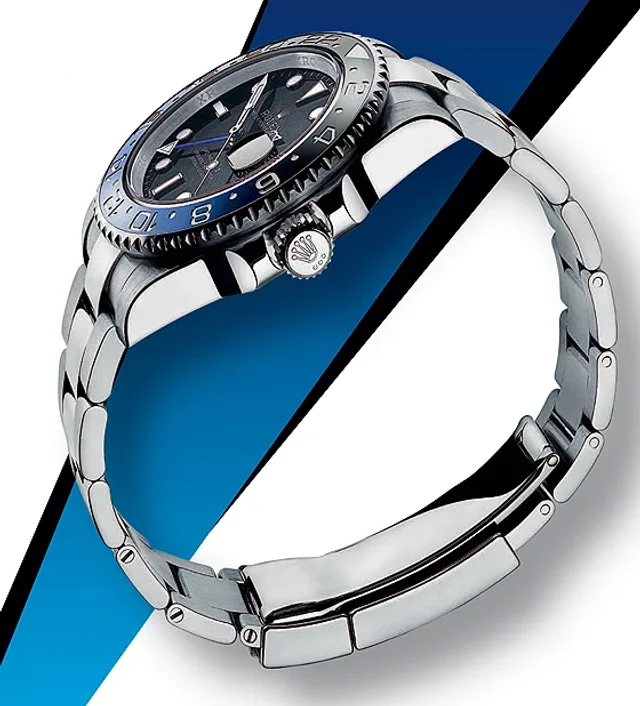
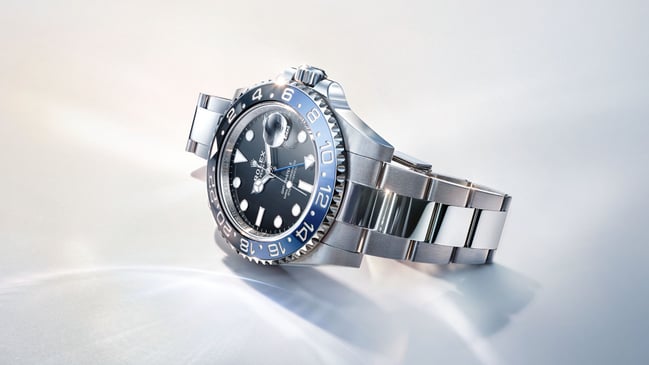
Often referred to as the "Batman", because of its notable black and blue bezel, we test here the first version of the Rolex GMT-Master II ever to sport this color combo.
Some call it the "Batman" in honor of its black-and-blue bezel. For more than half a century, Rolex fans associated Rolex GMT watches with two bezel-color combinations, red/blue and red/black. In this feature from the WatchTime archives, we test the first version of the Rolex GMT-Master II ever to sport this color combo.
The Rolex GMT bezels are so well-known that they have nicknames: “Pepsi” and “Coke,” respectively, because they call to mind those brands’ trade dress. So when a new, unprecedented, black-and-blue version of the Rolex GMT-Master II showed up in Rolex’s window at Baselworld last year, buzz abounded. Interest in the watch was so keen that every few minutes the booth’s cleaning team had to wipe from the window the fingerprints left by fairgoers’ pointing at it. It wasn’t long before the watch had earned a nickname of its own. Or, rather, a pair of nicknames: “Bruiser” and “Batman.” The bezel was notable not just because it was black and blue, but because it was black and blue and made of ceramic. No one had ever succeeded in combining two colors of ceramic in a single-piece insert. As long as the GMT bezels were made of metal, as they were for decades, it was no trick to make them two colors. But in 2005, when Rolex began to shift to ceramic bezels with the launch of a special 50th-anniversary model of the GMT-Master II, those new bezels were of necessity just one color. The advantages of ceramic over metal are that it is more scratch-resistant and less likely to fade after years of exposure to light. In 2006 and 2007, Rolex brought out, respectively, steel- and-gold and all-steel versions of the GMT-Master II, both with all-black ceramic bezels.
What brought bi-color back was a new manufacturing method that Rolex itself invented and patented. It involves applying a metallic salt to half of the bezel before the component is fired in a kiln, where the color is created. In a GMT watch, a bi-color bezel serves a practical purpose: it makes it easy to distinguish the second time zone’s a.m. hours from its p.m. ones. Rolex’s new color combination is more than practical, it’s attractive. Furthermore, it makes sense: blue is a more logical choice to indicate the daytime hours than is red. (This year at Baselworld, Rolex did launch a classic, red-and-blue “Pepsi” GMT-Master II with a ceramic bezel.) The downside is that the difference between black and blue can be nearly impossible to detect in poor light, but the upside is that blue is much less flashy than red, so this watch can be worn with a business suit. To match the bezel, the 24-hour hand is now blue, rather than green as on the black-bezel model (which Rolex still makes). The lettering on the dial is all white; on the black-bezel version, the words “GMT-Master II” are green. All in all, this new version makes a very harmonious impression.
Circula expands its popular Facet collection with a new 41mm version. Four dial colors, a finely faceted stainless-steel case, and 68 hours of power reserve carry over into the larger format.
What’s really inside your watch and why does it matter? From manual-wind and automatic movements to quartz and manufacture calibers, we explain how the major movement types work, what sets them apart, and which one may be the best fit for you.
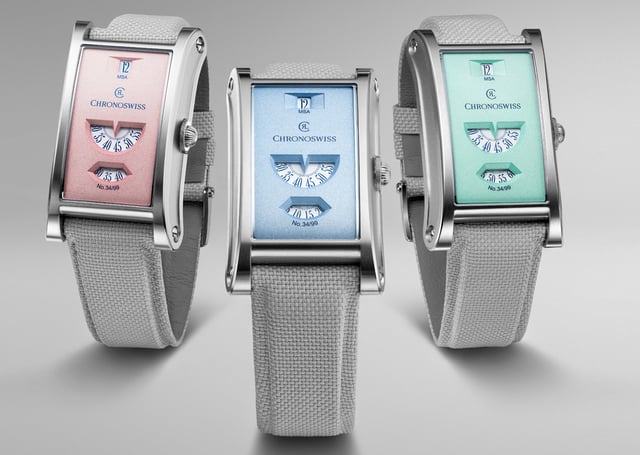
The Swiss brand adds three limited editions to its unconventional Neo Digiteur collection, pairing its mechanical-digital display with pastel shades of Mint, Sky and Rose.
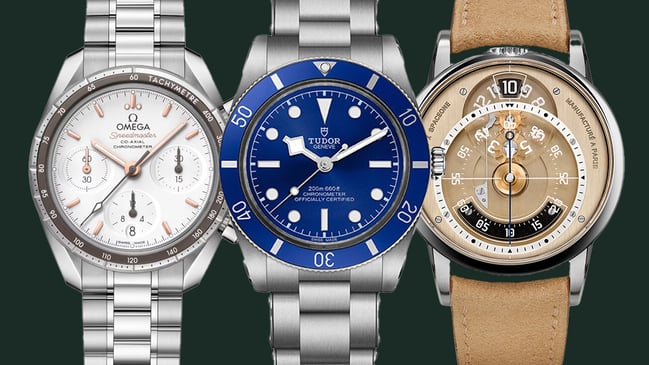
From Tudor and Jaeger-LeCoultre to Omega, Longines, and Baltic, these five watches prove a well-rounded luxury collection doesn’t need oversized cases.
From Citizen and Longines to Tudor, Omega, and Vacheron Constantin, these seven traveler-GMT watches offer compelling alternatives to the Rolex GMT-Master II.