The Dial as Light Source: Fortis Unveils the Novonaut N-42 Halo
Panda by day, negative by night
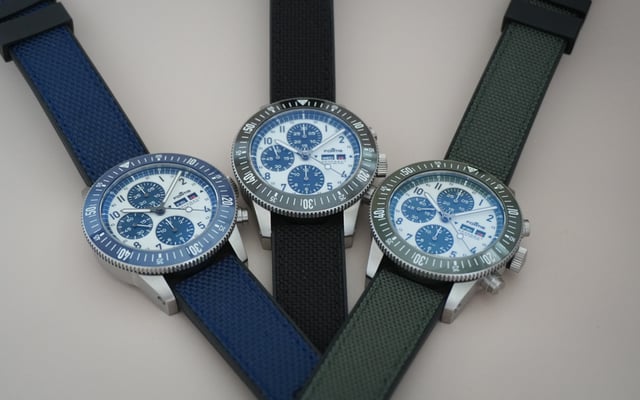
Fortis has introduced three new versions of its Novonaut chronograph. The N-42 Halo Editions, in black (Ref. F2040021), blue (F2040022), and green (F2040023), are the first Fortis watches with a base dial made entirely of Lumicast X1. Just as compelling is what lies beneath it: the brand’s new Werk 17 TR caliber.
Panda by Day, Negative by Night
Luminous material usually goes only where it is needed: on the indices, on the hands, and now and then on the numerals. Lumicast takes a different approach. It refers to components molded from solid Super-Lumiova, and Fortis has used it to form the entire base of the dial. The lume, in other words, is not applied to the dial; the dial is made of lume. Fortis calls the Novonaut Halo the brightest watch in its history.
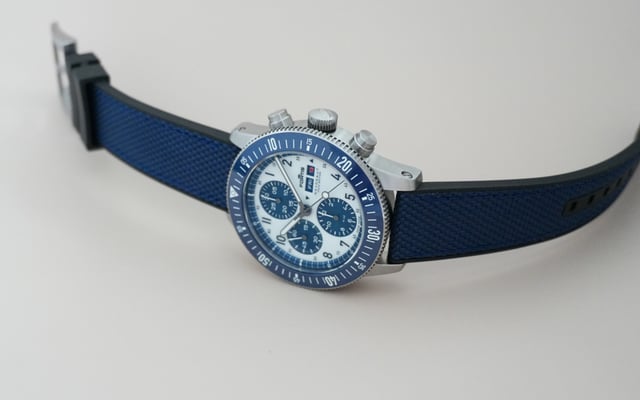
In daylight, the result is a pale surface set off by contrasting subdials and numerals. On the black edition, the counters are black; on the other two, they are blue or green. The same color carries through to the ceramic bezel, the day and date discs, and the strap. In the dark, nearly the entire dial glows blue, and the logic of the display reverses itself. Because the subdials are not made of luminous material, they appear at night as dark discs against a bright field. The hour and minute hands are metallic and filled with Super-LumiNova X1, and the seconds hand carries a luminous bull’s-eye dot. The subdial hands, however, are simply finished in white, which makes the chronograph counters harder to read in low light. The main hands, by contrast, have enough definition to hold their own against the glowing background.
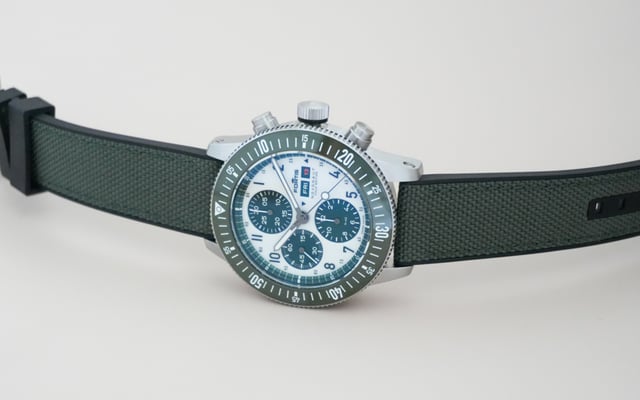
Fortis Novonaut N-42 Halo, green version
WatchTime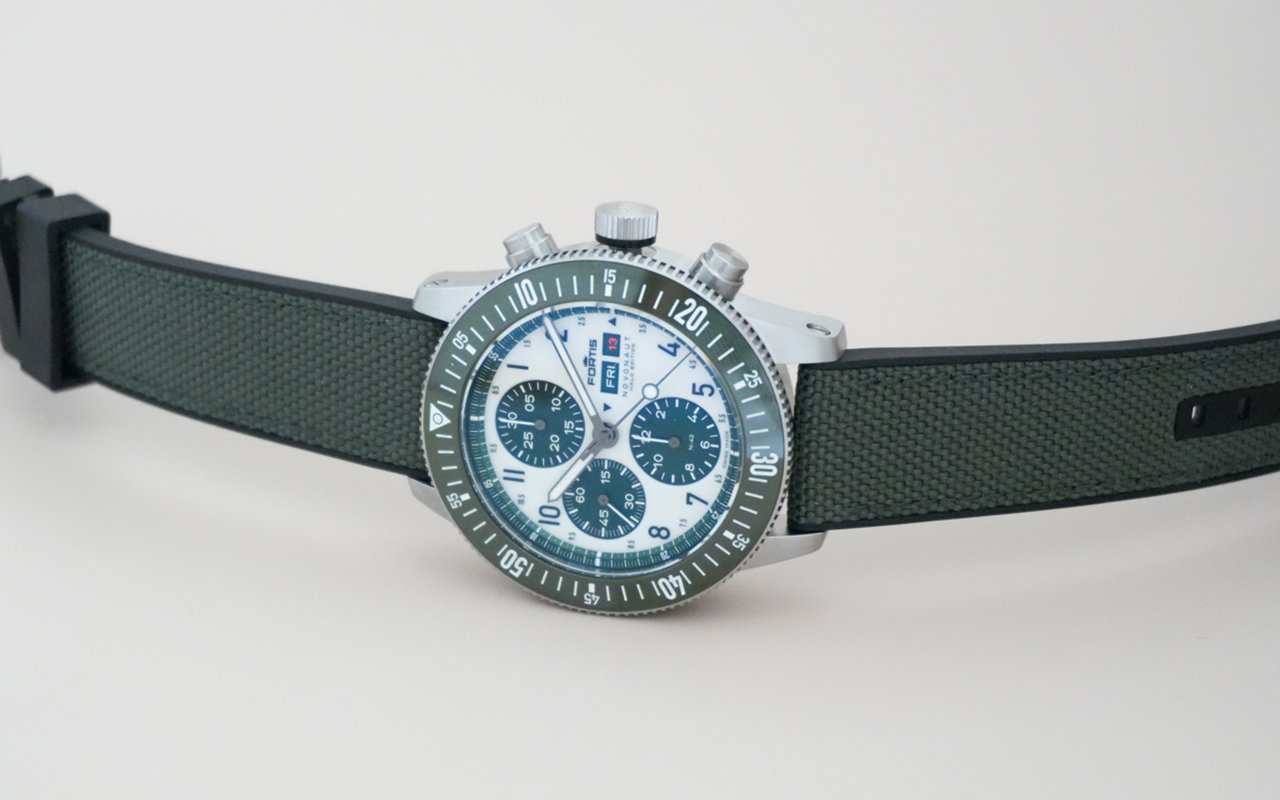
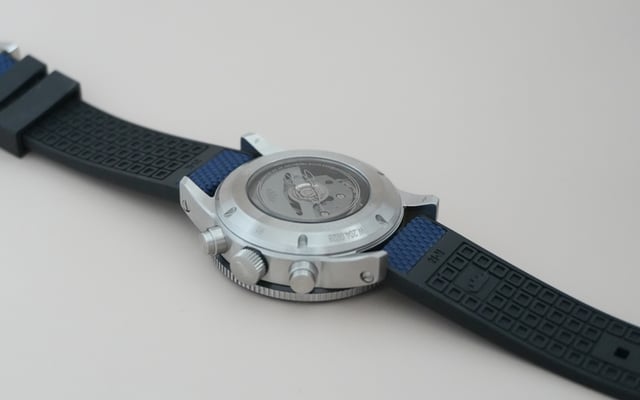
Fortis Novonaut N-42 Halo, blue version
WatchTime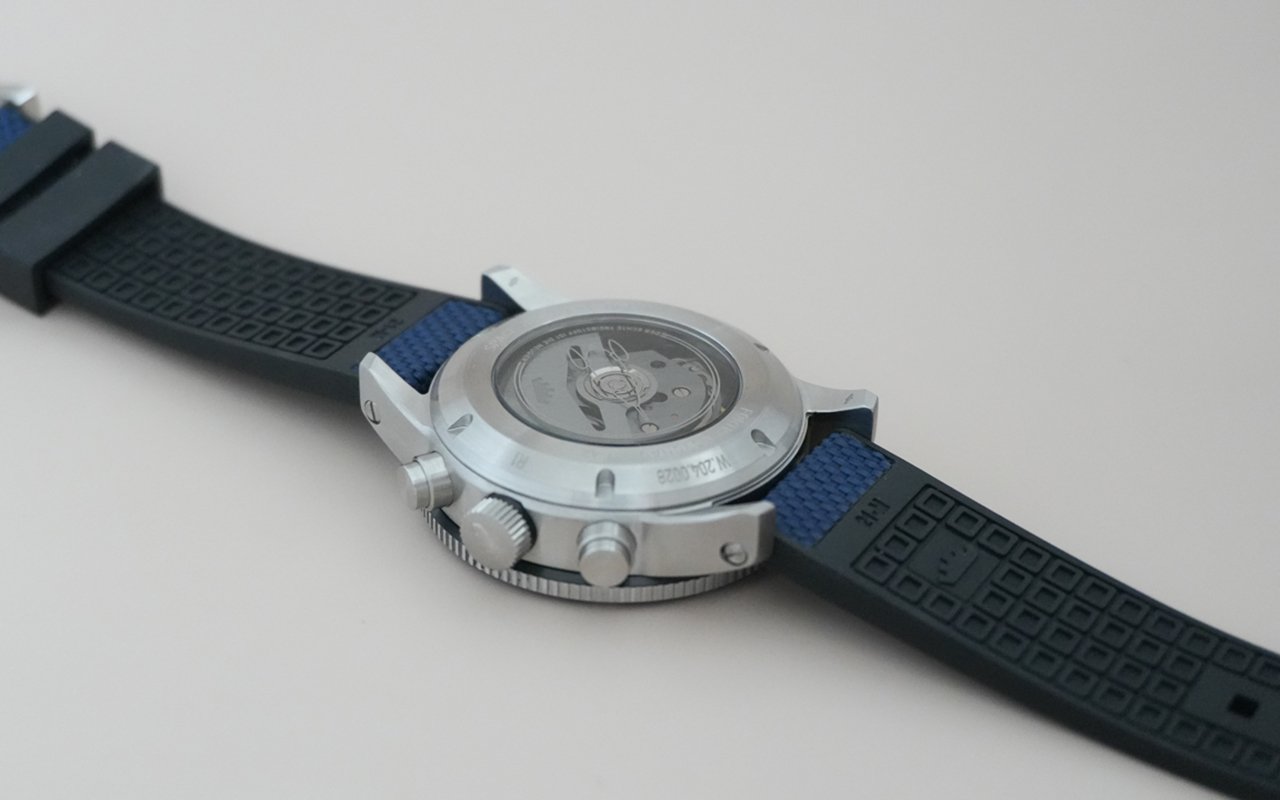
Calibre 17 TR: Regulation Without an Index
The most significant change is found in the movement. In a conventional regulator, two pins embrace the outer coil of the hairspring. Moving the index alters the active length of the spring, and with it the rate. The system is easy to adjust, but its weaknesses are well known. A sharp knock can shift the index, and the regulator pins themselves influence how the hairspring breathes. In the calibre 17 TR, the hairspring is free-sprung and its length never changes. The rate is instead adjusted with mass screws on the balance rim, which alter the balance’s moment of inertia. The principle is well established in haute horlogerie but remains rare in tool chronographs of this class, which is precisely how Fortis positions the caliber.
The advantage is long-term stability. Without an adjustable index, no component can quietly drift out of position in daily wear. The trade-off comes at service time. A free-sprung balance cannot be corrected with a quick nudge of the regulator, and adjusting the mass screws demands more time and a steadier hand. The balance is also mounted differently. Instead of a cock secured on one side, it is held by a bridge screwed down at two points, a design Fortis says improves resistance to vibration and external shocks. The column-wheel control of the chronograph, which governs start, stop, and reset, remains unchanged. Alongside the chronograph, the self-winding movement offers a day-date display. It beats at 4 Hz, or 28,800 vibrations per hour, and its power reserve has grown by ten hours to 70, enough to carry it comfortably through a weekend off the wrist. The movement is visible through a sapphire caseback.
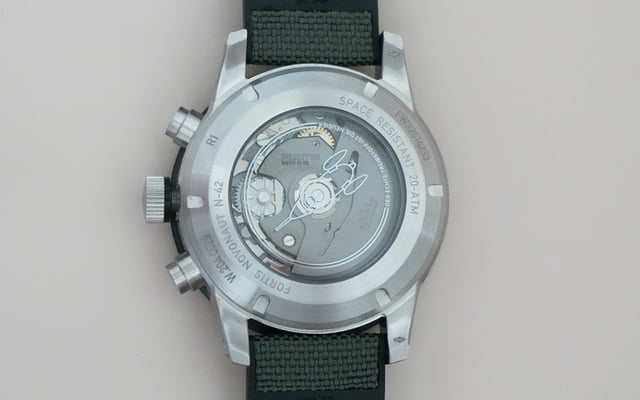
The new calibre 17 TR of the Fortis Novonaut N-42 Halo chronograph
WatchTime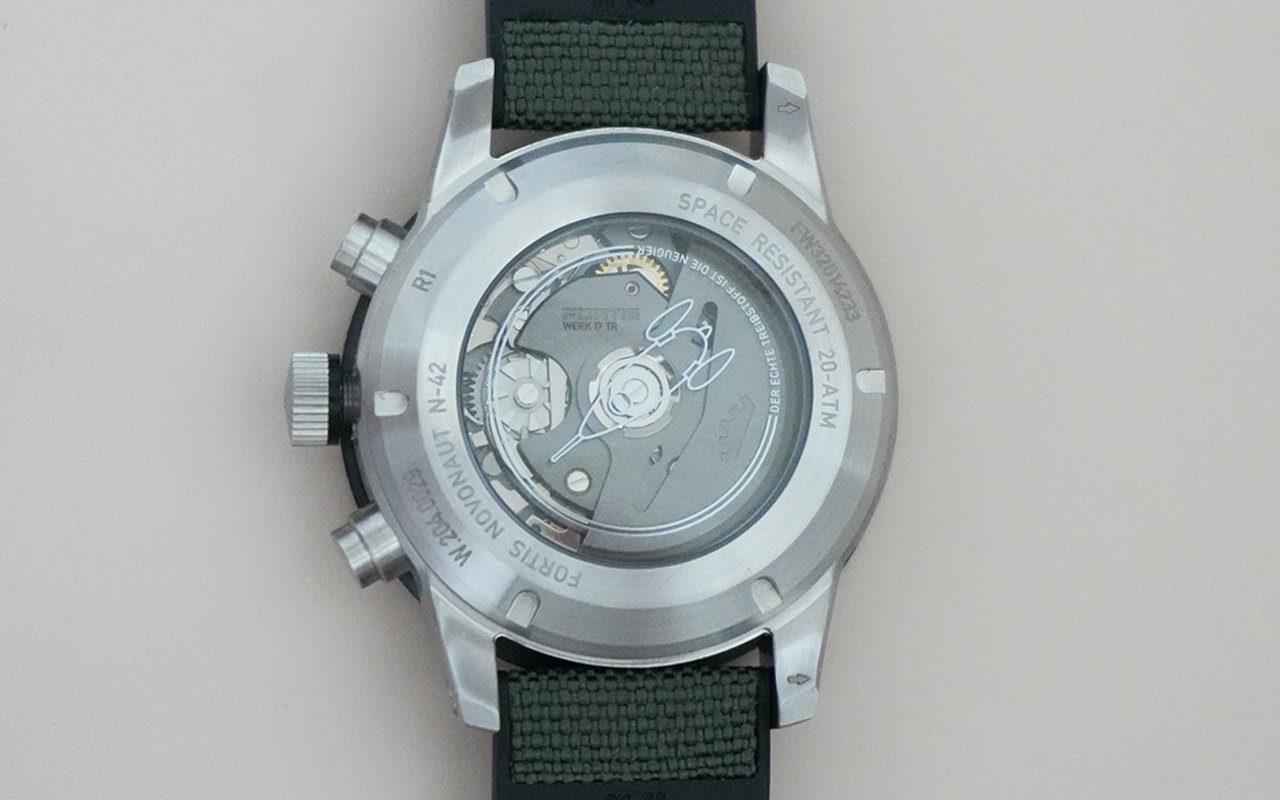
Fortis Novonaut N-42 Halo, blue version
WatchTime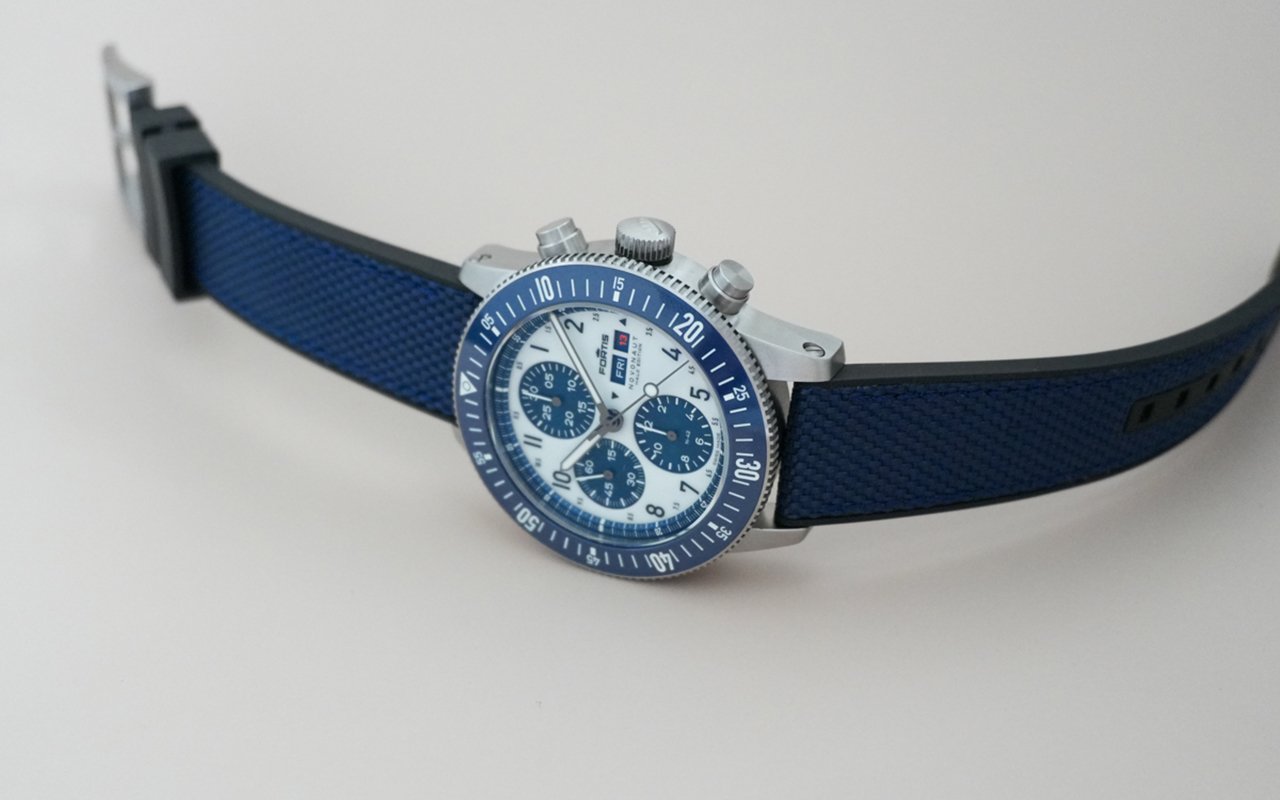
Stratosphere, Rocket, Moon
Fortis has a long history with spaceflight, having built watches for use beyond Earth’s atmosphere for more than thirty years. The base Werk 17 was tested in partnership with the Swedish Space Corporation. Several movements were mounted on a gondola and carried by a stratospheric balloon to the edge of the atmosphere. In 2022, a suborbital rocket followed. The aim was to demonstrate that the movements could withstand the acceleration, vibration, and mechanical stress of a launch. The Werk 17 TR builds directly on what those tests revealed.
The Case: Compact in Diameter, Substantial in Height
The case, made of recycled stainless steel, measures 42 millimeters in diameter and 51 millimeters from lug to lug. At 15 millimeters thick, it is not unusual for a self-winding column-wheel chronograph with a day-date and sapphire on both sides, though it makes its presence felt on the wrist. The watch head weighs 115 grams. Fortis rates the Novonaut Halo to 200 meters. The crown screws down and is fitted with a triple-gasket system, and the crystal is coated with anti-reflective treatment on both sides. The Sirius bezel turns in both directions. It is made of polished ceramic and filled with Super-LumiNova X1. Its bidirectional action makes its purpose clear: this is not a dive bezel but a tool for timing intervals, one that can be set without first returning to zero. The hybrid strap combines FKM rubber with textile and closes with a stainless steel pin buckle. It attaches with screw pins, and because Fortis includes a screwdriver with interchangeable blades, owners can change straps themselves.
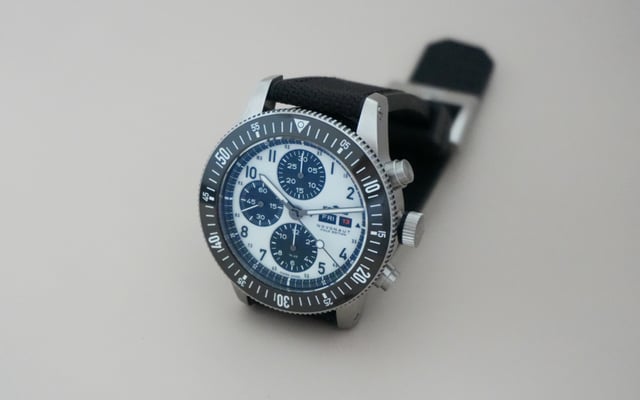
Three colors, one design: All versions feature a 42-mm case made of recycled stainless steel, a ceramic bezel, and a hybrid strap.
WatchTime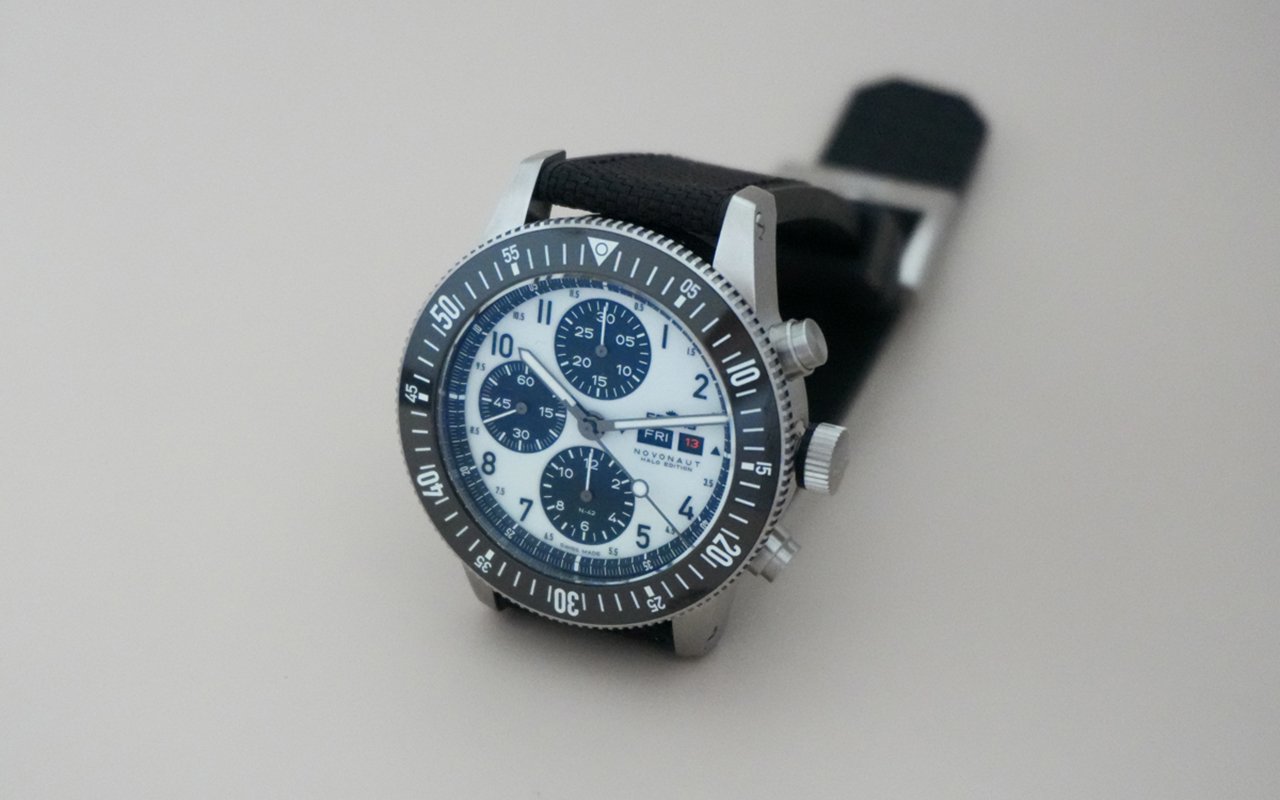
More Than a Lighting Effect
Visually, the luminous dial is the defining feature of the Halo Edition. For connoisseurs, though, the Werk 17 TR is the more meaningful step forward. Fortis has brought a method of regulation from the upper end of the market into a tool-watch movement and justified it on practical grounds: shock resistance and long-term stability. Nor is the movement reserved for the Halo models; it will also power the Legacy versions of the Novonaut. Price and availability: Each of the three versions is priced at $5,950 without VAT.
Technical Data
Fortis Novonaut N-42 Halo Edition
Reference Numbers: F2040021 (Black), F2040022 (Blue), F2040023 (Green)
Case: recycled stainless steel, 42 mm diameter, 15 mm height, 51 mm lug-to-lug, 115 g (case only)
Sapphire crystal with anti-reflective coating on both sides, sapphire crystal case back
Screw-down crown with triple sealing system, FKM gaskets, water-resistant to 200 m
Bezel: double-sided rotating Sirius bezel made of polished ceramic with Superluminova X1
Dial: Lumicast X1 base, counters and numerals in contrasting colors, blue luminescent
Movement: Fortis Caliber 17 TR, automatic in-house caliber, column-wheel chronograph, day-date, variable inertia regulation, 28,800 vph (4 Hz), 70-hour power reserve
Strap: Hybrid strap made of FKM rubber and fabric, stainless steel pin buckle
Price: $5,950 without VAT
Fortis will be participating in WatchTime New York 2026, October 16–18 at Gotham Hall, where visitors can meet the brand and explore its watches in person. Get your tickets here.