Deep Inside the Creative System of Swatch
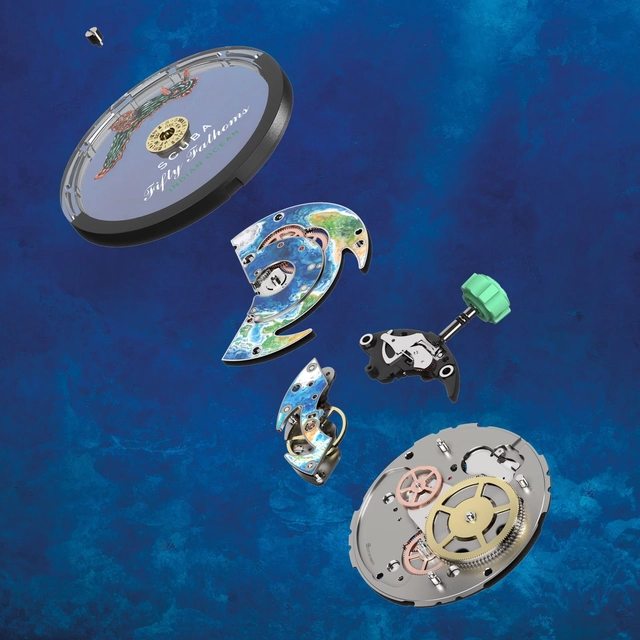
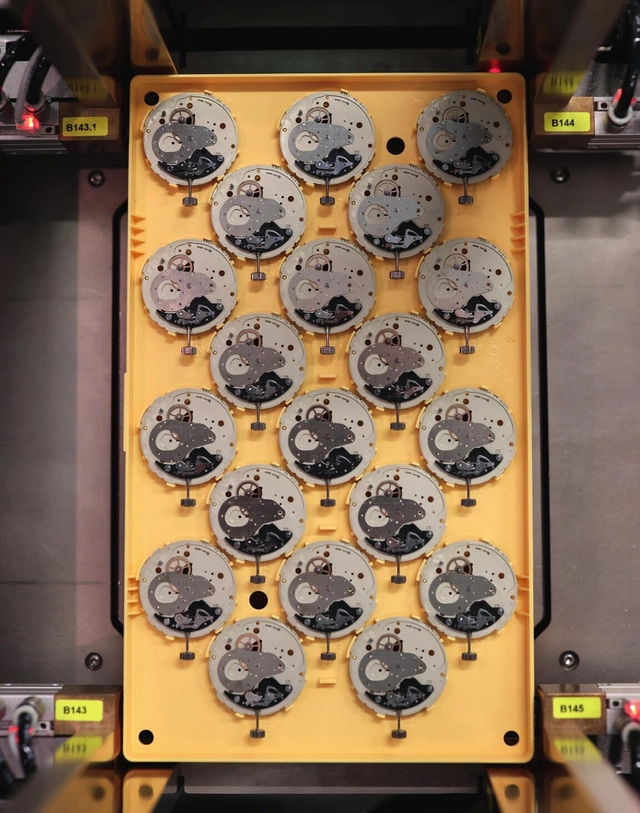
Sistem51 was introduced for Swatch’s 30th anniversary in 2013. The revolutionary self-winding mechanical movement is made from only 51 components (grouped in five modules), welded together to form a single assembly centered on a single screw, making the first and only mechanical movement whose assembly is 100-percent automated. While it can be wound manually (it takes about 81 rotations of the crown to fully wind the mainspring), there is no hacking second. In addition, the high-tech escapement used for the Sistem51 doesn’t come with a regulator; the rate is already tested and set at the factory in Boncourt with a laser, making the manual rate adjustments normally required by a mechanical watch unnecessary. In addition, the automatic movement features a 90-hour power reserve and is currently available with a central second hand or a second hand at 6 o’clock.
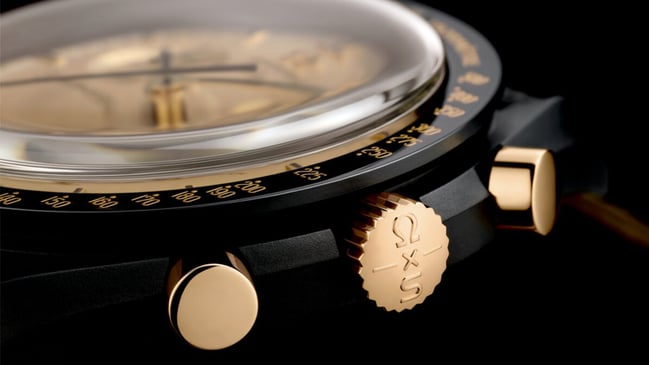
The Scuba Fifty Fathoms in Bioceramic (see WatchTime’s April 2024 issue). Swatch went with four dials with date and without, matching date dials, and put a true-to-date version for five of the six available variants (Ref. SO35N100 Antarctic Ocean) and Ref. SO35J500 Atlantic Ocean). The caseback’s sapphire crystal. The first Swatch watches ever to be powered by a mechanical movement (a non-hacking, 23-jewel, ETA 2842) were models like the Black Motion (Ref. SAA100) or Rubin (Ref. SAM100) back in 1991. While a Sistem51 movement used for a Scuba Fifty Fathoms cannot be repaired, it can be swapped if needed, and the remaining parts recycled.
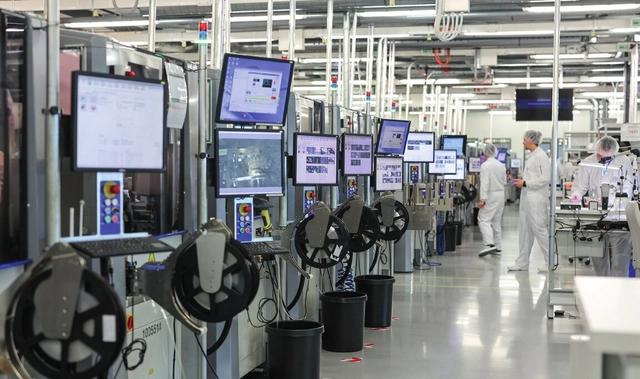
In February, WatchTime was able to visit the Sistem51 factory in Boncourt, a municipality in the district of Porrentruy in the canton of Jura in Switzerland, right next to the French border. In 2010, Swatch Group finalized the acquisition of a 750,000-square-foot plot of industrial land to build a factory for several of its companies, one of them being Comadur and the other one, the future production site for Sistem51. Today, several hundred machines required to build the radically simplified and industrialized movement step by step are in operation 24 hours a day, seven days a week to meet the huge demand for the latest mechanical Swatch watches. Around 800 people work in Boncourt; those required for the production of the ultra-modern Sistem51 work in three 8-hour shifts.
The production is not only set up to be completely automated, but it is also modular, which means it can be further expanded, should, for example, a new module like a chronograph be required in the future. The site’s current output is about five to six movements per minute, which means Sistem51 is also Swatch’s number one mechanical watch movement by volume. In addition to the automated production of the movement modules, the ETA plant in Boncourt provides digital printing on the dials as well, allowing Swatch to individually customize the watch’s oscillating mass or other parts (like the rudimentary printing on the Scuba Fifty Fathoms’ rotor). Final assembly for the Scuba Fifty Fathoms is done in Sion, the capital of the canton of Valais, which is then also followed by the mounting of NATO straps and putting the watch into the box must be done manually.
Thanks to the success of the recent Scuba Fifty Fathoms, which also comes with two dial variants, among other things, that impact the collab on the one hand, as well as innovation at Swatch, Alain Villard, CEO of Swatch since 2021, said, “Will we have more mechanical movements? Most likely. You’ve seen the first mechanical Swatch in the ’90s, Sistem51 from 2013 is a revolution, but if we want more, so we will definitely produce more high quality automatic watches.”
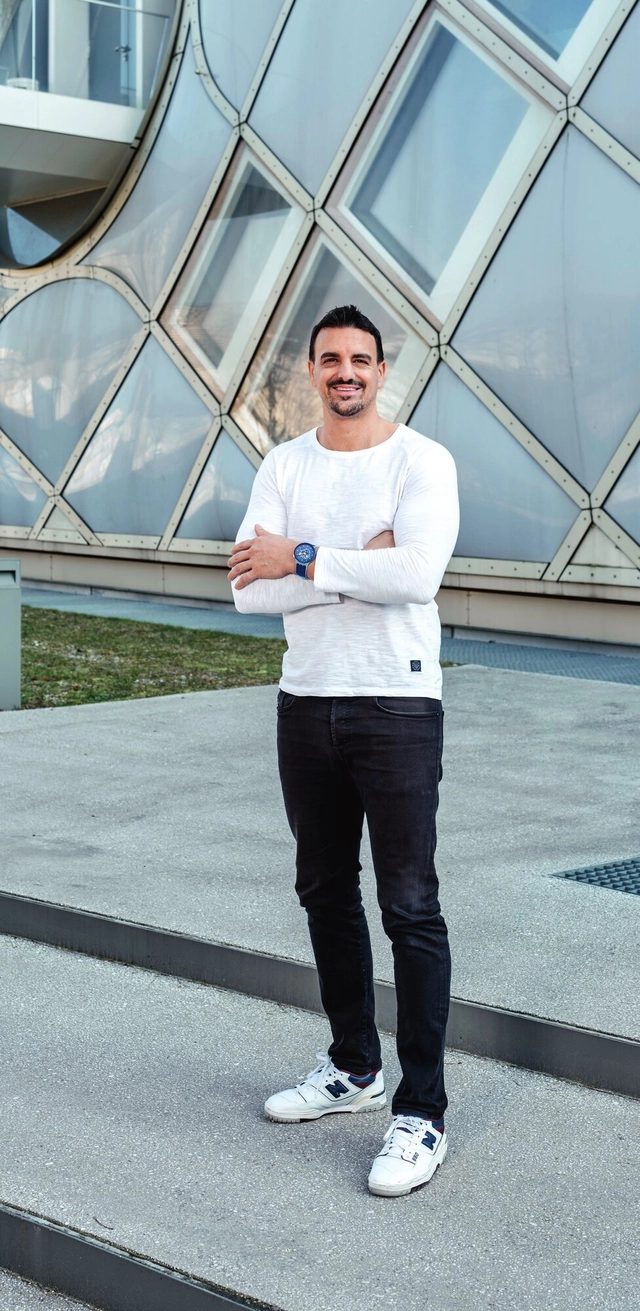
Interview with Alain Villard, CEO of Swatch
Even though Swatch has repeatedly been a disruptor and creative force, the MoonSwatch that was introduced in March 2022 has undeniably set a new benchmark in the watch industry. For 2023, Swatch reported a record growth of more than 60 percent. How much pressure has this put on the team to immediately come up with “the next big thing”?
I believe the pressure on Swatch brand has always been there. Let’s not forget, the group is called “Swatch Group,” and that means people automatically have more expectations of a brand that saved the entire watch industry in the ’80s. In short, this situation is nothing new for us; we aim to be the most innovative brand, to constantly reinvent ourselves and have new ideas, so the pressure for us didn’t just start in March 2022. But it is of course true that the expectations have grown again since then. We’ve also seen that we are able to reach larger target groups; the MoonSwatch launch also gave us the opportunity to open stores in even better locations around the world, and the brand’s reputation has increased.
But it is clear that after such a huge success, you have to continue to prove yourself, you have to come up with innovations on a regular basis.
For us, we don’t see it as pressure to reach a higher level again and make a statement, but rather as an opportunity and challenge. I would say that our customers expect even more innovations from us than before, which means we have to ensure the quality and we have to come up with new things, like the Scuba Fifty Fathoms from Blancpain, to which everyone says: “Wow, we didn’t expect it, this is the next level.” And, of course, it’s our turn to think about what’s happening — maybe something is happening at this moment (laughs). We have lots of ideas and we challenge ourselves each day.
Who comes up with ideas?
There are two different areas: the standard Swatch, for which we have a very talented design team at the headquarters in Biel, and collabs. We see each other every week, we brainstorm, and the team shows us what can be done based on trends, concepts, etc. Then we discuss these and make decisions. What is possible, what has more or no potential, what will quickly fade, developments? And there is also, of course, much more complex work with the big collaborations. For the MoonSwatch, there was a small committee that Nick Hayek put together himself, five, six people he trusts, including Gregory Kissling [Head of Product Management at Omega] in the product area who brings many years of experiences and has a vast knowledge. Here we discuss more what’s possible that the folks at Swatch couldn’t create right away on their own. This team also meets regularly, and we try to come up with nice surprises.
Swatch often speaks of “positive provocation” in this context. What do you mean by that?
This has been part of our DNA since day one, as has joie de vivre, innovation and Swiss Made. We always try to bring a certain provocation, to surprise our customers with a sense of humor that is not too harsh. There are certain things that we don’t touch, obviously, but we want to constantly reinvent ourselves. Sometimes that can be a campaign. A campaign that is perhaps bit crazy; in the ’90s we were called the “enfant terrible of the watch industry” and we remain that way to this day. But surprises can also happen in the area of technology: A product like the Sistem51, which we launched in 2013, is as much a positive provocation. An automatic movement with 51 parts? Nobody can do that but us. Ultimately, a collaboration with a brand like Omega or Blancpain is also a positive provocation. Here we chose a very aesthetic, product-oriented campaign, but for me the whole thing is a positive provocation. Another example for me would be last year’s “Bioceramic What If?” collection. In the ’80s we had a [square] prototype for the Swatch that never got made, which we launched last year, in a completely square world. Not just watches, but the entire world as square, including things like a football, a donut, glasses and a basketball. For us, if it’s something just as provocative that makes people say, “Wow! This is Swatch!” — something they can identify with, a beautiful product that we can use to make them smile. Anything is possible, and without positive provocation we would no longer be the same brand.
In the past, Swatch has repeatedly surprised with products that were comparably far away from watches: telephones and pagers, for example. Today, you almost exclusively see watches. A change of strategy?
Yes, we have new, not necessarily launched products that we were not 100-percent convinced of. Just like with Baignoire Juste un Clou at Cartier, we had Swatch and Flick Flack, both for children and so on. And we are DONE. We have expanded and optimized our product lines: Today, there are about 20 different product lines; today, there are significantly less. We are also focusing more on use elements that work for all functions. However, we can still diversify a lot and differentiate ourselves from other brands, but when I was last slightly fewer products than we did five or 10 years ago. We focus on the essentials and have become much more consistent over time.
More grown-up?
On the one hand, we have to maintain childlike curiosity, but on the other hand, the expectations placed on us have naturally increased in recent years. We therefore offer even more in quality, and the MoonSwatch and the Scuba Fifty Fathoms are high-quality products that we see on the wrists of proud customers who perhaps would not have worn a Swatch 10 years ago.
Swatch grew substantially in 2023 — mainly because of the MoonSwatch?
Of course, people mainly talk about the collabs, i.e. the MoonSwatch, but also the Mission to Moonshine Gold Editions that we launched every month, and we caused quite a stir with the Scuba Fifty Fathoms that we launched last September. But our traditional launches were also extremely successful: We were able to increase between 20 and 30 percent in all categories. The collabs helped us, of course, just as they boosted Omega and Blancpain. The MoonSwatch also opened doors for us: we were able to open new stores in locations where landlords had previously shown less interest in Swatch. This year has already started well for Swatch: even without collabs, we are seeing an incredibly high increase in sales, which means that the entire range of our products has benefited.
Last September we heard that 3 million MoonSwatches had been sold. Are the numbers out for the Scuba Fifty Fathoms?
The demand for the MoonSwatch is extremely high. With the Scuba Fifty Fathoms, we introduced a slightly different target group; it was an official partnership/collaboration: You cannot make a typical Swatch without a legal watch guru’s attack, and it’s in a different price segment. Let’s not forget that for the first two product reserves, both of which were introduced, it was only at our own boutiques. We then had to outsource production, therefore we had to produce more, which meant a distribution with higher price levels, which we could increase. At the moment, the demand is still too high at the moment in January. In the meantime, we have also been able to open up some new sales locations. In California, for example, we have gone from one store in San Francisco to three in the past two years; Chicago and other destinations that were previously missing from our portfolio will follow.
Both the MoonSwatch and the Scuba are not available in all Swatch stores, nor are they available online. Will that change in the future?
The MoonSwatch was developed and launched shortly after the pandemic, and we wanted to focus sales on the traditional points of sale. Of course, there are other people can experience and explain the product. In certain countries, including the USA, we admittedly didn’t have that many points of sale at the time, which is what our customers told us. We immediately responded to this with the “Rolling Planets” concept. All over the world, especially in the United States, we had vehicles serving all of America from the East Coast to the West Coast, and one after another. This gave people the opportunity to buy their favorite watch as early as November 2022. Today, demand for MoonSwatch and Scuba is still far too high for us to handle additional inventory for e-commerce. And if we did, it would be an insult to the people who stood in line to buy their favorite watch. Like I said, the demand is still too high at the moment in January. In the meantime, we have also been able to open up some new sales locations.
When is more challenging: working with a sister company like Omega or working with an external partner, such as an artist or a museum?
It’s very different. Let’s start with a museum or artist. It is clear that it is a long process that starts at least a year in advance. You meet, you build a relationship, it has to feel right for both parties, for the artist or the family, you have to respect certain aspects and you are in constant talks. It is a proud moment to be able to wear such a work of art on your wrist. And it’s more than just a partnership. I’m still in touch with the people at MoMA today; we talk about other things than watches. Those responsible at the Magritte Foundation come to Switzerland regularly and want to know what is happening at Swatch, regardless of the collaboration. It’s a relationship, a very professional one, but it is a relationship you build.
When you work together internally, you usually already know each other and the integration is completely different. You can give input every day, but the challenge is to preserve the DNA of the brand. The example with the Scuba Fifty Fathoms showed how well we have respected the DNA of Blancpain, nevertheless it is a Scuba, a Swatch. At the same time, we have to say that this form of collaboration is new for us, with incredible reactivity. Each brand knew the other group has its target group, its distribution, etc., and suddenly these two worlds met, which we have achieved wonderfully with both Raynald Aeschlimann’s [Omega] and Marc Hayek’s [Blancpain] teams. It was incredible, very reactive, both wanting to help and both benefiting from it — a great experience.
Blancpain itself advertises with the promise, “There is Eternity in Every Blancpain” and is extremely committed to protecting the oceans. How well does the Scuba Fifty Fathoms fit in?
First of all, sustainability has been a priority for us for a long time, when it comes to the material or the packaging. In 2020, we came with bio-sourced material; in 2021, with Bioceramic. But it started long before. In 2015, we started offering our customers battery replacements free of charge at our points of sale. This means that we can ensure that a watch can be kept and worn for as long as possible. That is very important to us. Bioceramic has opened up new possibilities for us, without which the MoonSwatch would not have been possible, and neither would have been the Blancpain Scuba Fifty Fathoms. Here we have a few combinations: Everything that is made of Bioceramic, the case, clasp and loops, can be recycled. As for the movement, I know many people who bought a Sistem51 in 2013 and still have them. The watches still work as well as they did on their first day. Concerning the Scuba Fifty Fathoms, if a customer really should have a problem with the movement, it can be brought into the store. When then analyzed it and can replace the movement if necessary. And we can reuse the parts of these exchanged movement.
Watch stores therefore play a central role in a product’s life cycle?
That’s the idea. We have several hundred stores and see this as our responsibility. As a brand and an international company, we have to ask ourselves these questions. We have already taken a lot of steps, battery, packaging recyclability, etc. and we need to take more steps. We don’t have specific numbers on how many can call better. Yes we’ve been able to achieve since 2015, but we have collectors who have come with 30, 40 and more watches. We see this as our task; we want to improve in every area.
Is there a project that is particularly close to your heart?
There are many. Let me name two first. SwatchPay! I was the managing director for the Swiss market at the time, and we were the first country in 2019, a pioneer. The Chinese project in 2017 with UnionPay can’t be repaired the same way. In Switzerland, it was a huge challenge. We had to organize a lot, and it was extremely exciting and super successful. The MoonSwatch is something different because all over you have people were lucky enough to have Nick Hayek’s words, and he said, “You guys are part of it.” Everything was highly confidential, we met regularly, and we knew something incredible was happening here. We saw early designs and were able to help develop the entire concept, marketing activities, distribution, production, make small adjustments to the design. We were able to participate in every area. We knew it would be successful, but it wasn’t until the night from March 25th to 26th that we understood how big it was going to be. In Zurich, in the store on Bahnhofstrasse, you could see when 2,000 people in front of the store, long before it opened, and you had to organize everything. At that moment, I knew that we what been doing for the last six months made perfect sense. That was incredible. And if you ask me which day I will never forget, then it was March 26, 2022, it was more than a project — all the effort, the sleepless nights were worth it.
How did you get started in the watch industry?
I was lucky. I was born in Biel, so I am a real Bieler. When I was a kid, I passed by the Omega and Swatch building every day, so I kind of had that in my head. It wasn’t necessarily a dream; I had also studied something else and was an athlete, but one day I had to make a decision and saw opportunities in the watch industry during the Expo [the 6th Swiss national exposition, which was held from May 15 to Oct. 20, 2002]. And that hasn’t changed since then. Step by step, I got to this position, and the dynamics of this brand are incredible, we have very talented people. Today, I couldn’t imagine doing anything else.
And finally, what was your first watch?
I can’t remember my first watch, but I can remember my first Swatch. That was back at Expo.02 when I started at the Swatch Group. We launched the 27th Canton back then, which was my first watch that I could officially wear. But what is more important to me is the current watch that I wear [next to a Scuba Fifty Fathoms he was wearing at the time of the interview, an Atlantic Ocean]. I’m very proud of the collaboration with Omega and Blancpain, but I’m also a big fan of SwatchPay! and almost always have one on my wrist; right now a Swatch Neon. The nice thing about Swatch is that you can regularly change your watch.
To learn more, visit Swatch, here.
This article was originally published in the May / June 2024 print issue. To subscribe to WatchTime Magazine, click here.- Interview with Alain Villard, CEO of Swatch
- Who comes up with ideas?
- Swatch often speaks of “positive provocation” in this context. What do you mean by that?
- In the past, Swatch has repeatedly surprised with products that were comparably far away from watches: telephones and pagers, for example. Today, you almost exclusively see watches. A change of strategy?
- More grown-up?
- Swatch grew substantially in 2023 — mainly because of the MoonSwatch?
- Last September we heard that 3 million MoonSwatches had been sold. Are the numbers out for the Scuba Fifty Fathoms?
- Both the MoonSwatch and the Scuba are not available in all Swatch stores, nor are they available online. Will that change in the future?
- When is more challenging: working with a sister company like Omega or working with an external partner, such as an artist or a museum?
- Blancpain itself advertises with the promise, “There is Eternity in Every Blancpain” and is extremely committed to protecting the oceans. How well does the Scuba Fifty Fathoms fit in?
- Watch stores therefore play a central role in a product’s life cycle?
- Is there a project that is particularly close to your heart?
- How did you get started in the watch industry?
- And finally, what was your first watch?