Mar 22, 2020
Reading time 5 min.
Vintage Eye for the Modern Guy: Hamilton PSR
FEATURE
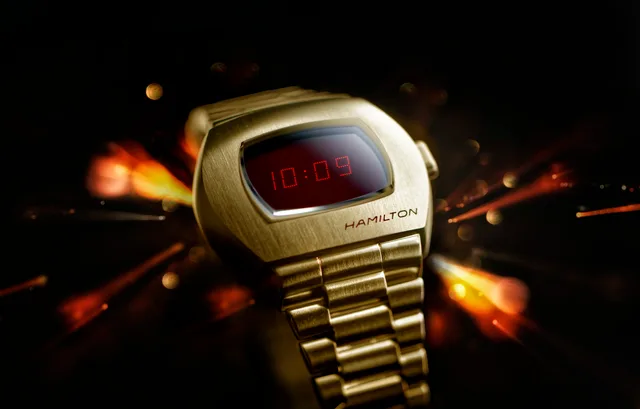
Hamilton this week unveiled the latest vintage-inspired PSR, a throwback model recalling the Pulsar digital watch of the 1970s. Longtime fans of Hamilton may fondly remember the Pulsar as a short-lived but significant part of the brand’s history, requiring at least two years of focused development to create, and then dominating the watch market during the early days of the quartz crisis, from about 1972 until its quieter demise a few years later.
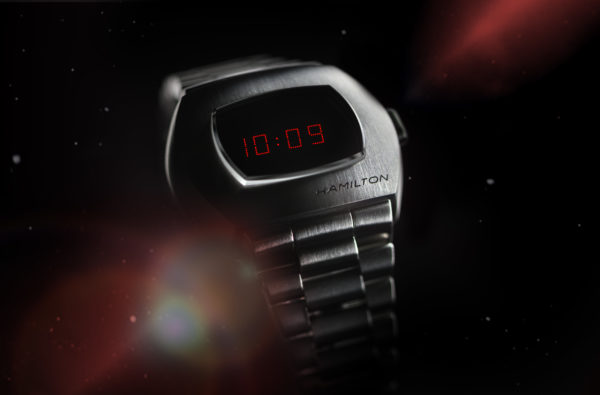 While commonplace and often considered cheap today, electronic digital wristwatches were a new and special invention in the 1970s, with the Pulsar leading the pack and even rising to a luxury status, commanding a price that was $150 more than a gold Rolex when it hit the market in 1972 in a solid gold variation (gold-filled and steel models, like the one pictured below, became available shortly thereafter).
While commonplace and often considered cheap today, electronic digital wristwatches were a new and special invention in the 1970s, with the Pulsar leading the pack and even rising to a luxury status, commanding a price that was $150 more than a gold Rolex when it hit the market in 1972 in a solid gold variation (gold-filled and steel models, like the one pictured below, became available shortly thereafter).
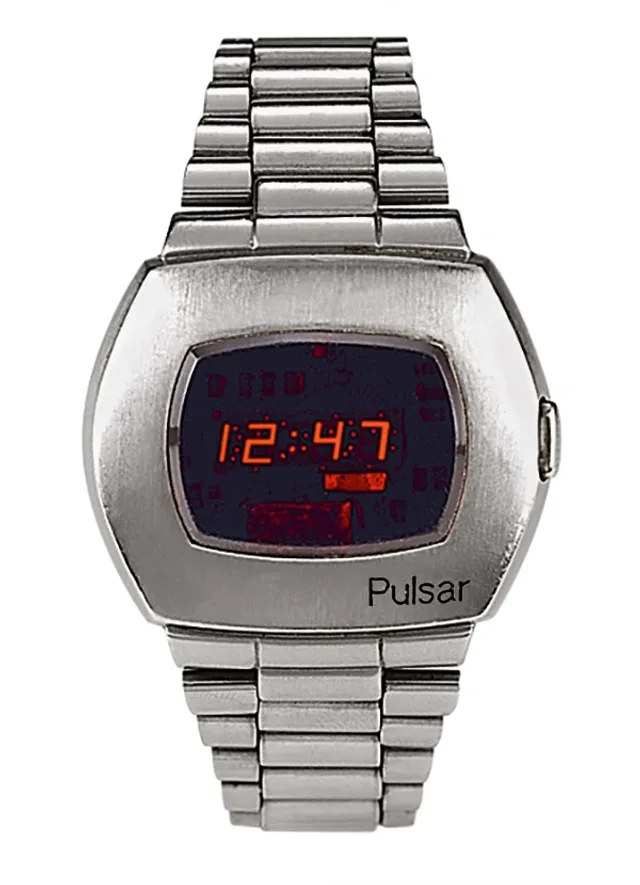
Hamilton Pulsar LED watch
PR
By the end of 1973, Pulsar was selling more than 10,000 watches per month. The next year, sales doubled, and the following year, sales increased again by almost 50% to their peak. Then, by 1976, sales began to rapidly decline as the market became saturated with ultra-cheap digital models, especially those produced by Texas Instruments. By 1977, HMW Industries (Pulsar and formerly Hamilton’s parent company) sold the brand to a company called Rhapsody Inc., which then sold it to Seiko in 1978 which continues to produce inexpensive analog quartz watches under the Pulsar name today. It was a rapid and striking decline after an equally lightning-like rise.
The new Hamilton PSR recalls this fascinating history, channeling the uncommon vintage design — if only for a moment and for a few interested collectors.
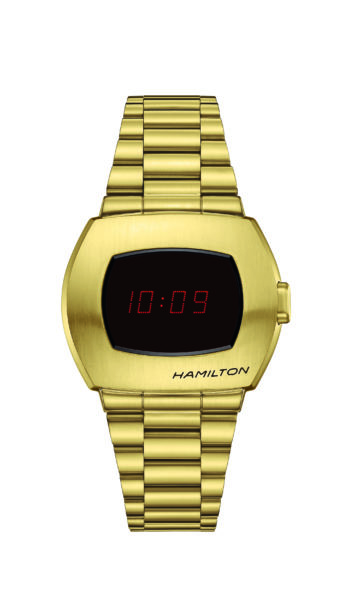
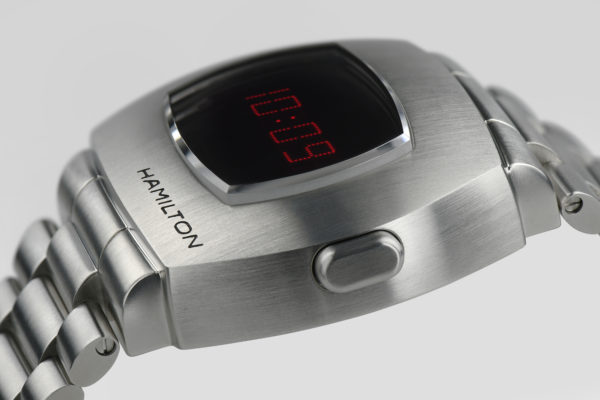
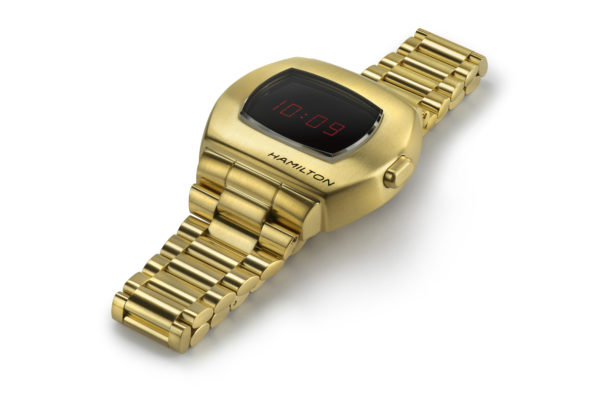 The new watch is relatively simple in its design, featuring a 40.8 x 34.7-mm cushion-style case, in brushed steel or gold PVD-coated steel, with a laser-engraved Hamilton logo on its lower right side. The case also features a side button to illuminate the display and presumably help adjust the time. On the black display of the model you can find a very simple presentation, with red digital numerals displayed using LEDs (light-emitting diodes) while idle and switching to the brighter OLEDs (organic light-emitting diodes) when the side button is pressed. The watch is strapped on an integrated, oyster-style bracelet via slightly hooded lugs, and is secured to the wrist via a double-folding clasp. Inside the watch is an unnamed, digital quartz movement which is protected behind a pulsar-engraved solid case back.
The new PSR will retail at $745 for the non-limited steel model, and $995 for the gold PVD watch which will be limited to 1,970 editions. They are both expected to be available for purchase sometime this summer.
The new watch is relatively simple in its design, featuring a 40.8 x 34.7-mm cushion-style case, in brushed steel or gold PVD-coated steel, with a laser-engraved Hamilton logo on its lower right side. The case also features a side button to illuminate the display and presumably help adjust the time. On the black display of the model you can find a very simple presentation, with red digital numerals displayed using LEDs (light-emitting diodes) while idle and switching to the brighter OLEDs (organic light-emitting diodes) when the side button is pressed. The watch is strapped on an integrated, oyster-style bracelet via slightly hooded lugs, and is secured to the wrist via a double-folding clasp. Inside the watch is an unnamed, digital quartz movement which is protected behind a pulsar-engraved solid case back.
The new PSR will retail at $745 for the non-limited steel model, and $995 for the gold PVD watch which will be limited to 1,970 editions. They are both expected to be available for purchase sometime this summer.
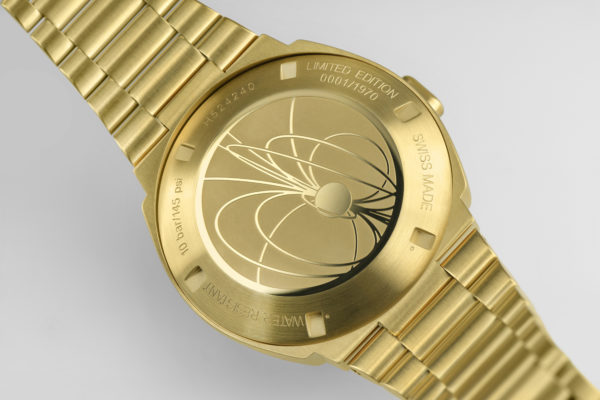 The new PSR is aesthetically a faithful re-issue of the original 1970s Pulsar Time Computer, reviving the Space Age model with few external updates beyond a new logo, modernized manufacturing, and a more reliable, “always on” digital display. The most noticeable difference is the watch’s use of a "Hamilton" logo on its bottom right side rather than the historical “Pulsar” — an unsurprising decision given that the Pulsar brand is still owned and in use by Seiko. Besides this, the model features a modern hybrid display, which differs from the older LCD and LED displays used in the 1970s — the LED which only displayed the time on demand when the side button was activated.
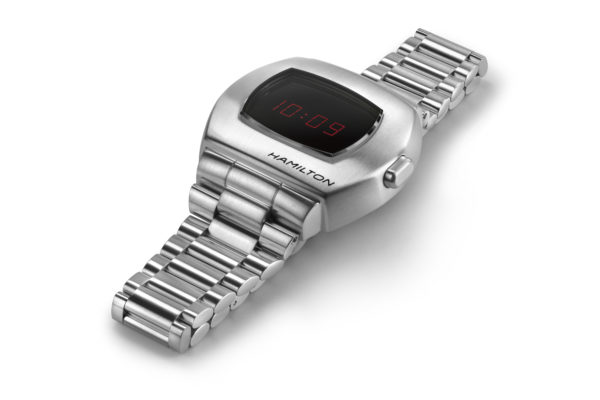 As for shared traits, the modern watch continues duplicates the original's moderately sized cushion case with its brushed finishing, integrated bracelet, and side button. Hamilton even opted to keep some more subtle nods to the historical watch, including the sharply shaped sapphire crystal that is similar to the acrylic one previously used. Even the Hamilton logo and red digital numerals, while updated to suit modern ownership rights and technology, still recall and channel the style exercised in the vintage model.
 At its historic unveiling, the Pulsar — the name refers to the blinking neutron stars far off from Earth — was completely unique, and as futuristic as the world had seen. The Space Age model wasn’t even officially referred to as a digital watch; the brand instead dubbed it a “Time Computer,” as it worked to push the market forward into the rapidly developing future.
 For fans of watch history, and especially fans of the Hamilton brand, the new PSR watch is a welcome addition to the collection. For onlookers, and those less interested in the brand and its history, the new watch will seem like an anomaly in the current market, saturated as it is with scores of inexpensive digital display watches and smartwatches with significantly more capabilities. In either case, the watch — just as it did in the 1970s — is reviving the conversation on the value of more luxury-focused digital time-only designs. Will the PSR revive the style for another fierce four-year run like it did almost fifty years ago? Probably not. But will it add to the diversity of the market and give a few interested collectors an excellent talking piece? Almost certainly.
The new watch is relatively simple in its design, featuring a 40.8 x 34.7-mm cushion-style case, in brushed steel or gold PVD-coated steel, with a laser-engraved Hamilton logo on its lower right side. The case also features a side button to illuminate the display and presumably help adjust the time. On the black display of the model you can find a very simple presentation, with red digital numerals displayed using LEDs (light-emitting diodes) while idle and switching to the brighter OLEDs (organic light-emitting diodes) when the side button is pressed. The watch is strapped on an integrated, oyster-style bracelet via slightly hooded lugs, and is secured to the wrist via a double-folding clasp. Inside the watch is an unnamed, digital quartz movement which is protected behind a pulsar-engraved solid case back.
The new PSR will retail at $745 for the non-limited steel model, and $995 for the gold PVD watch which will be limited to 1,970 editions. They are both expected to be available for purchase sometime this summer.
The new PSR is aesthetically a faithful re-issue of the original 1970s Pulsar Time Computer, reviving the Space Age model with few external updates beyond a new logo, modernized manufacturing, and a more reliable, “always on” digital display. The most noticeable difference is the watch’s use of a "Hamilton" logo on its bottom right side rather than the historical “Pulsar” — an unsurprising decision given that the Pulsar brand is still owned and in use by Seiko. Besides this, the model features a modern hybrid display, which differs from the older LCD and LED displays used in the 1970s — the LED which only displayed the time on demand when the side button was activated.
As for shared traits, the modern watch continues duplicates the original's moderately sized cushion case with its brushed finishing, integrated bracelet, and side button. Hamilton even opted to keep some more subtle nods to the historical watch, including the sharply shaped sapphire crystal that is similar to the acrylic one previously used. Even the Hamilton logo and red digital numerals, while updated to suit modern ownership rights and technology, still recall and channel the style exercised in the vintage model.
At its historic unveiling, the Pulsar — the name refers to the blinking neutron stars far off from Earth — was completely unique, and as futuristic as the world had seen. The Space Age model wasn’t even officially referred to as a digital watch; the brand instead dubbed it a “Time Computer,” as it worked to push the market forward into the rapidly developing future.
For fans of watch history, and especially fans of the Hamilton brand, the new PSR watch is a welcome addition to the collection. For onlookers, and those less interested in the brand and its history, the new watch will seem like an anomaly in the current market, saturated as it is with scores of inexpensive digital display watches and smartwatches with significantly more capabilities. In either case, the watch — just as it did in the 1970s — is reviving the conversation on the value of more luxury-focused digital time-only designs. Will the PSR revive the style for another fierce four-year run like it did almost fifty years ago? Probably not. But will it add to the diversity of the market and give a few interested collectors an excellent talking piece? Almost certainly.
Special thanks to former Editor-in-Chief of WatchTime Joe Thompson for his excellent research into the history of the Pulsar watch which contributed to this reporting.
For the most recent article in the “Vintage Eye” series, in which we discuss the Timor Heritage Field and the historic W.W.W. models that inspired it, click here.
Caleb Anderson is a freelance writer with a primary focus on vintage watches. Since first discovering horology, he has garnered extensive knowledge in the field and spends much of his time sharing his opinions among other writers, collectors, and dealers. Currently located near New York City, he is a persistent student in all things historical, a writer on many topics, and a casual runner.