Sinn EZM 19: A Mission Timer for the Crisis Room
Built to bring order to the chaos phase
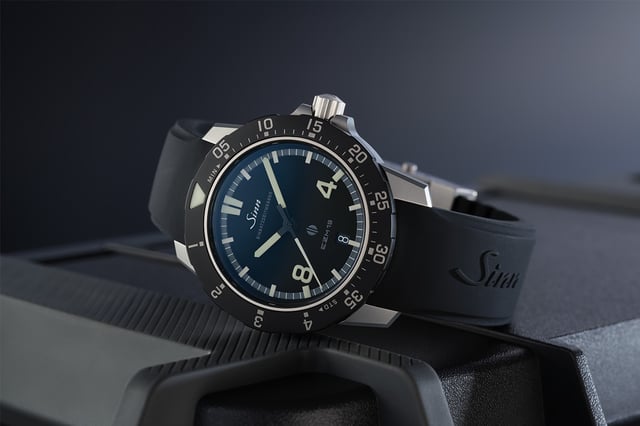
Sinn’s EZM 19 is designed for a different post than the brand’s other Einsatzzeitmesser, or mission timers: the table of a crisis management team. Sinn developed the watch together with Tomas Stanke, senior fire officer and chief of the fire department in Hattingen, Germany. Its purpose is narrow and deliberate: to give structure to the time between two situation briefings.
The result is a rotating bezel with two scales and a dial that breaks the day into four-hour blocks. For a brand celebrating its 65th anniversary this year, it is a remarkably specific watch, and a fitting one. Since its founding in Frankfurt, Germany, in 1961, Sinn has focused on navigational cockpit clocks and wristwatches built around function above all. The first mission timer, the EZM 1, arrived in 1997, developed for special operations units of German Customs and the German Federal Police.
From the Field to the Briefing Table
Why would someone working in a command center need a watch that is pressure-resistant to 20 bar? The answer has less to do with ruggedness than with the way crisis management actually works. A command staff is convened when a situation can no longer be handled through normal channels. Together with the teams on the ground, it forms what German emergency services call a Besondere Aufbauorganisation, or special response structure. Firefighters, police and military personnel sit alongside administrators and mayors, and many of them have little or no experience working in this kind of setting.
According to Stanke, it is during the first hours—known internally as the “chaos phase”—that discipline around time determines whether a command staff leads the situation or chases it. He puts it bluntly: “In situations like these, we don’t hold meetings. We establish a command staff.” Debate too long and you lose touch with what is happening outside. Sit in a briefing at 3 a.m. without knowing when the next team arrives, and sooner or later your decisions suffer. The watch’s first concept sketch, dated 2024/25, grew directly out of this experience. It still carries its working title: Stabsdienstzeitmesser SZM, or “Command Staff Timer.”
The captive rotating bezel reflects the rhythm of this work with two scales. A 35-minute scale allows the head of the command staff to limit the length of a situation briefing. Once that briefing ends, a four-hour scale can be used to track the period until the next briefing, handover or personnel change.
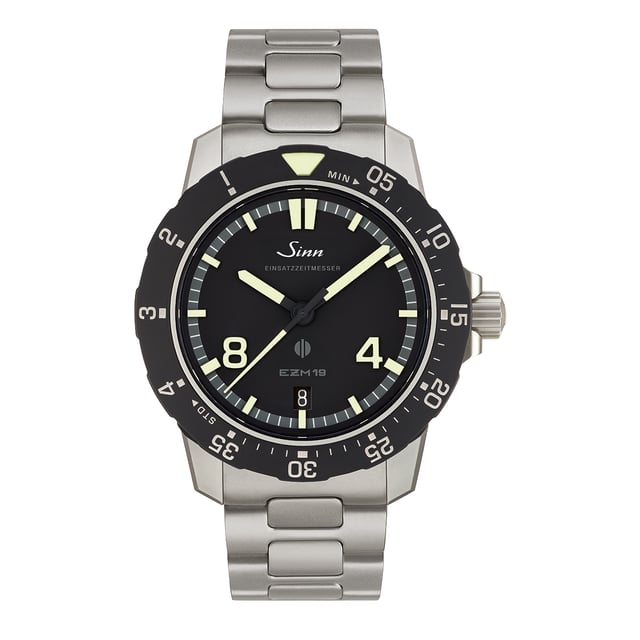
Sinn's EZM 19 is available now for $2,970 on a steel bracelet, $2,770 on a silicone strap and $2,490 on a nylon two-piece strap
Sinn Spezialuhren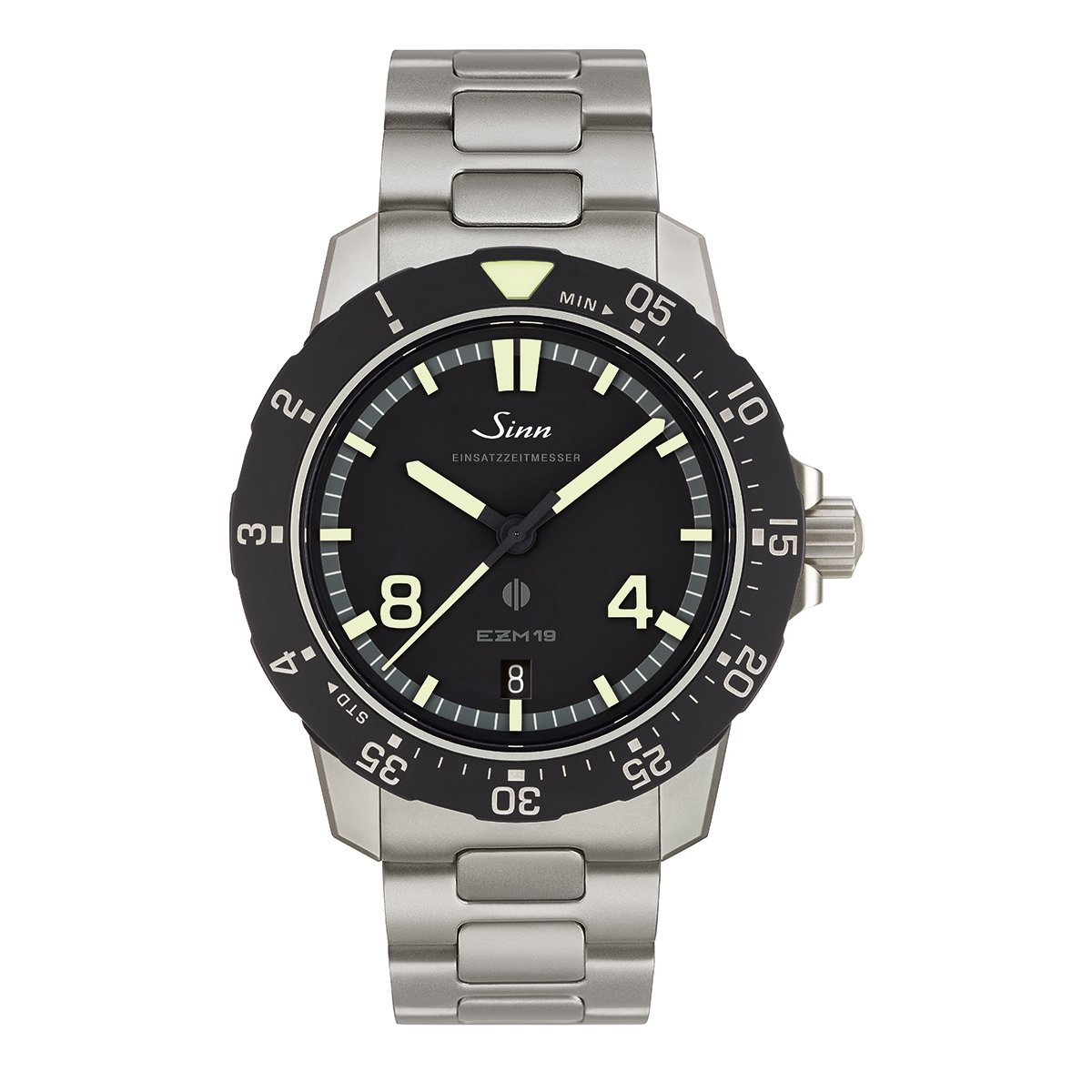
A Dial Built on Four-Hour Cycles
The dial follows the same shift logic. Instead of the familiar emphasis on 3, 6, 9 and 12, Sinn highlights large numerals at 4 and 8, with a double baton at 12. Visually, the dial divides into three four-hour segments, mirroring the four- and eight-hour cycles in which command teams rotate depending on the intensity of an operation. Stanke calls this “the normative power of the factual.” Multi-day operations inevitably follow the rhythm of day and night, and fixed shift patterns have grown out of that reality.
The hand-applied hybrid ceramic luminous elements are color-coded. The hour and minute hands, bezel triangle and four-hour markers glow in one shade, while the remaining indexes and seconds hand glow in another. In the dark, this reads as a blue-green primary layer and a yellow secondary one. It is more than decoration: in low light, it ranks the information by importance. Even the date window at 6 o’clock has a functional rationale. During prolonged operations, people quickly lose track of time and of when one day ends and the next begins. Justifying a date display as a tool is a little unusual, but every detail here appears to have been considered for a purpose.
Proven Sinn Technology, with a Reason
Technically, the EZM 19 draws on Sinn’s familiar toolkit. The bead-blasted stainless-steel case measures 41mm in diameter and 11.4mm thick. Sinn’s Ar-Dehumidifying Technology is designed to keep the crystal from fogging during sudden temperature changes. The watch remains functional from −45°C to +80°C (−49°F to 176°F), is water-resistant and pressure-resistant to 20 bar, or 200 meters, and is protected against low pressure. Its sapphire crystal has an antireflective coating on both sides.
Equally interesting is the magnetic-field protection to 100 millitesla. Sinn points to the permanent magnets found in tablets, smartphones and their cases. For a watch that spends its working life on a table next to laptops and radios, that is a compelling argument. Inside is the automatic SW 300-1 movement, which provides a power reserve of approximately 56 hours.
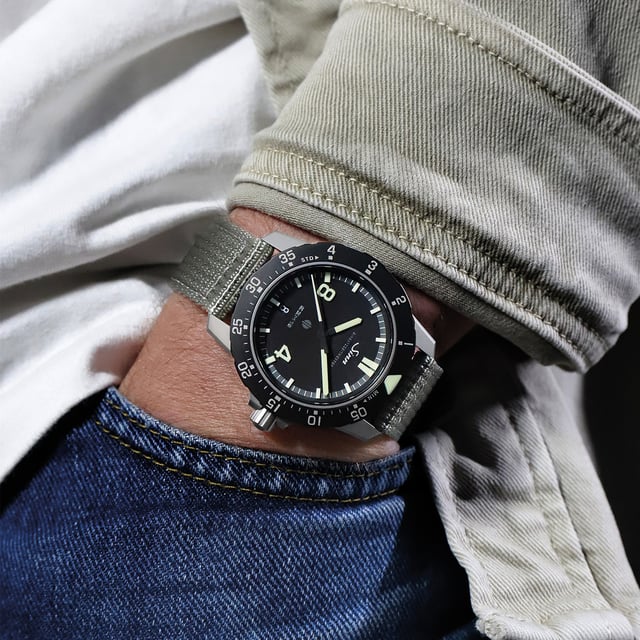
New from Sinn: The EZM 19 regulates the movement in four-hour cycles
Sinn Spezialuhren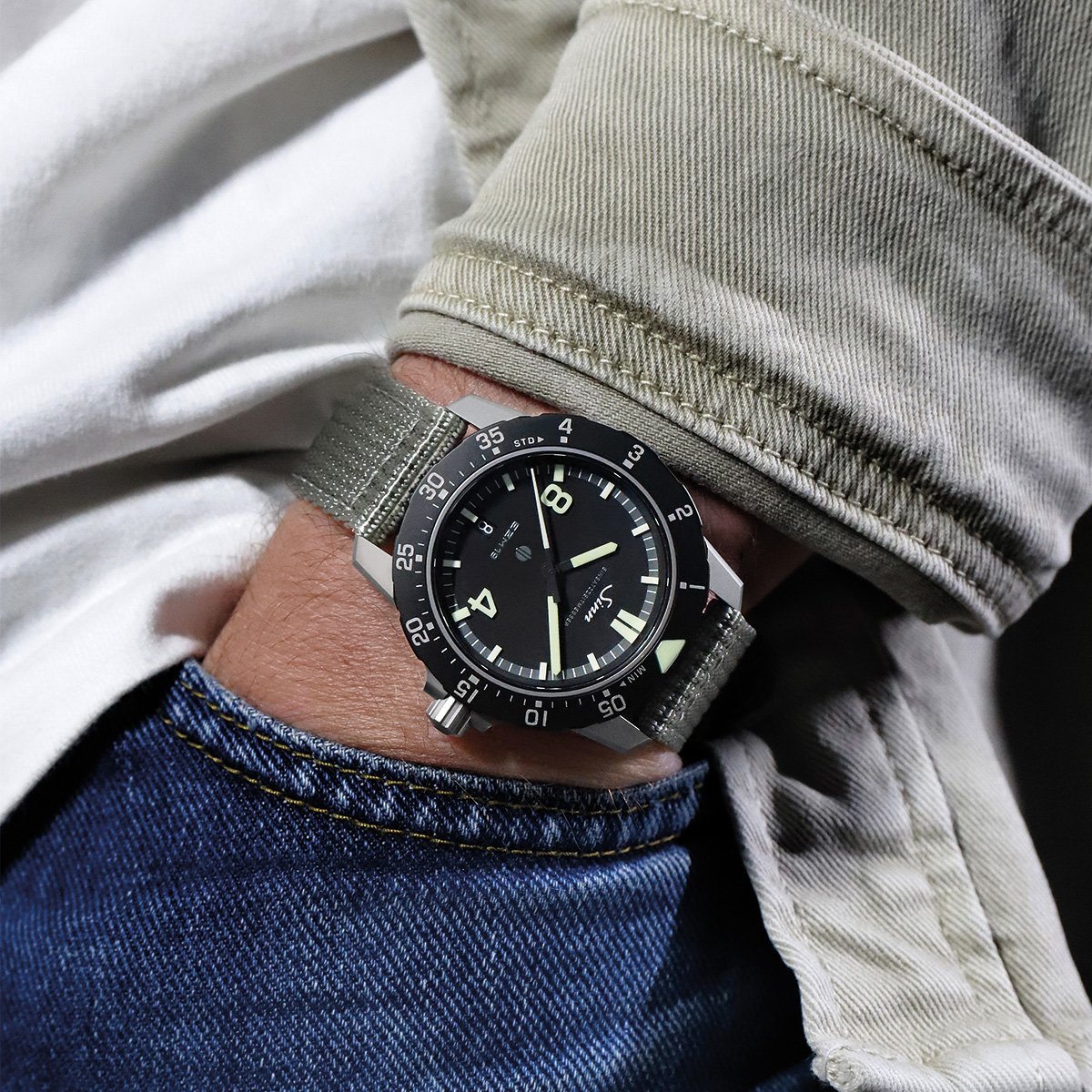
Does the Concept Work in Everyday Life?
Stanke sees uses beyond emergencies: meetings, exams and even keeping track of a parking meter. Anyone buying the EZM 19 for civilian life is really buying into an idea — the time-boxed briefing and the four-hour grid. That is perfectly legitimate. Sinn owners have always worn watches built for mission profiles they rarely experience themselves. Still, the EZM 19 is tailored to a much narrower group of users than the brand’s dive or pilot’s watches.
Versions and Pricing
The EZM 19 comes in four strap and bracelet configurations. It is priced at $2,970 on a stainless-steel bracelet, $2,770 on a silicone strap and $2,490 on either a leather or textile strap. The EZM 19 is a strong example of how hands-on user expertise can shape a watch with a genuine identity of its own.