Cartier Novelties: Prive Anniversary, Santos Chronograph and Roadster Comeback
Watches and Wonders 2026

Cartier uses the introduction of new products on the occasion of the Watches and Wonders 2026 fair to showcase its unusually broad program once again: The tenth Cartier Privé Opus closes a decade cycle and simultaneously establishes a new permanent collection. With the Santos Chronograph, an everyday model undergoes a technical upgrade. And the Roadster model returns after a long pause. Overall, the brand caters to multiple target groups simultaneously: the collector of historical references, the sportily oriented buyer, and the customer who does not want to separate jewelry from watchmaking art.
Cartier Privé: The Tenth Opus and the Beginning of a Collection
Since 2015, Cartier Privé has annually reinterpreted a historical case shape. For the tenth anniversary, the Maison takes on three icons at once: Tank Normale, Tortue Chronographe Monopoussoir, and Crash Squelette. The connecting element is platinum in combination with Bordeaux— a ruby cabochon on the winding crown, leather straps, and subtle details in this color are set against a silver opaline dial and blued steel hands.
Cartier Privé Crash Squelette
The most elaborate watchmaking novelty in this trio is the Crash Squelette. The specially developed caliber 1967 MC with manual winding had to be reduced to 142 components to fit into the asymmetrical case. The bridges are not only shaped as numerals, as in the well-known Cartier skeletonizing principle, but are completely hammered by hand: about two hours of work per piece. The deformation of the case interferes with the movement— the impression that the crown pulls the entire caliber downward is no coincidence. Limited to 150 numbered pieces.
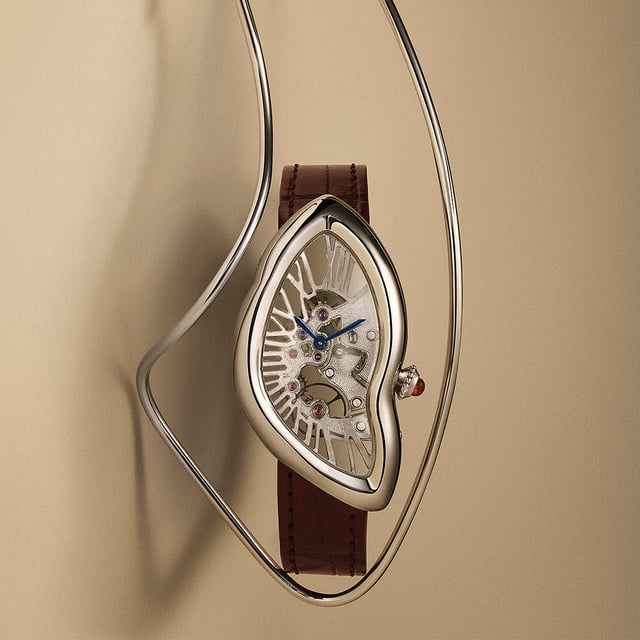
Cartier Crash Squelette
Cartier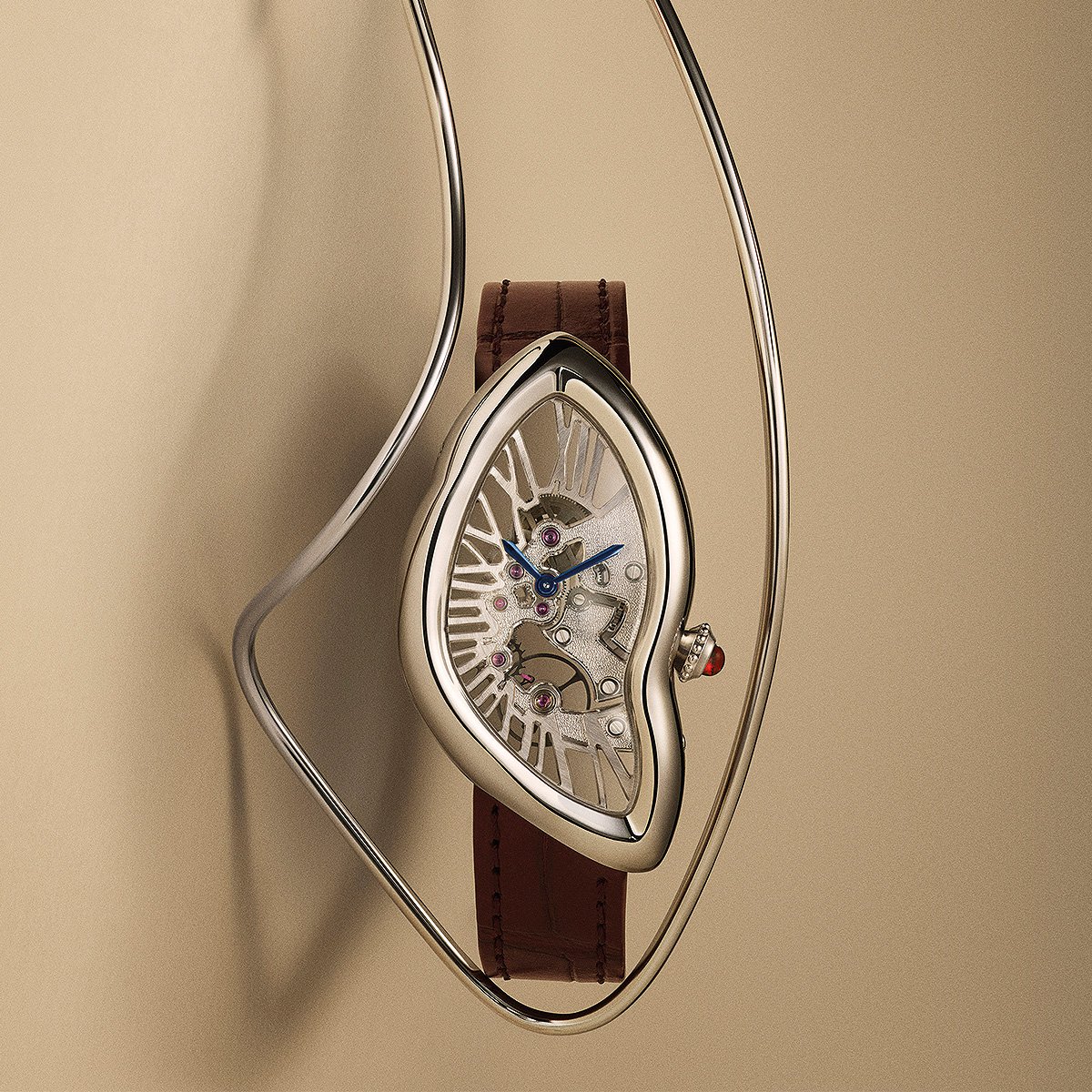
Tortue Chronographe Monopoussoir
The Tortue Chronographe Monopoussoir reactivates a reference from the Collection Privée Cartier Paris from 1998, now in XL instead of the previous size, and equipped with the 1928 MC manufacture caliber, which measures only 4.3 millimeters in height, making it one of the flattest Cartier chronographs. Start, stop, and reset are done via a single pusher integrated into the crown. Through the sapphire crystal case back, the finishing of the Côtes de Genève is visible, with its arcs following the shape of the case.
Tank Normale in Platinum
The Tank Normale revives a platinum reference from 1934— with a seven-line platinum bracelet, satin-finished surfaces contrasting with polished edges on the brancards. Inside is a mechanical manual-winding movement, no complication.
Cartier Privé – The Collection
In parallel, Cartier is launching for the first time a permanent collection that emerges from the Privé models of the past ten years. To start: Tank Normale, Tank Cintrée, and Cloche, all with unified codes— hour and minute hands, sleek lines, yellow gold, gold-plated dials, apple-shaped hands made of blued steel, and a manual-winding movement. The case back bears an engraved depiction of the respective case. In this way, Cartier elevates its design language from the logic of limitation and translates it into a permanent offering for the collector's market.

Cartier Santos Dumont Obsidian in yellow gold with 15-row bracelet
Cartier
Santos-Dumont: Obsidian, Gold, and a New Bracelet Dimension
The newly introduced large Santos-Dumont variant focuses on the dial: gold-plated obsidian from Mexico, 0.3 millimeters thin, with enclosed air bubbles that create the typical iridescence. This makes each piece unique but also creates manufacturing challenges— comparable to glass, the grinding work is accordingly demanding. The bracelet draws on flexible metal bands from the 1920s: 394 links in 15 rows, each individually made and assembled, with each link thickness measuring 1.15 millimeters. The result is a silk-soft fit on the wrist that bears little resemblance to rigid metal bands.
The watch is powered by the manufacture caliber 430 MC with manual winding. Additionally, Cartier introduces two new LM models of the Santos-Dumont in yellow gold and steel/gold with satin sunray-brushed dials. The parallel to the original Santos-Dumont from 1904, the first modern wristwatch, remains visible in all variants: Roman numerals, visible screws, round crown with blue cabochon.

Cartier Santos Dumont with new, fine mesh strap
Cartier
Santos de Cartier Chronograph
The Santos Chronograph from 2020 was a solid realignment of the sports line. The 2026 version refines the concept. The case, size LM, measures 47.5 × 39.8 millimeters with a height of 11.6 millimeters. The satin-finished, sunburst dial features three counters (seconds at 6, minutes at 3, hours at 9 o'clock), flanked by sword-shaped hands with green Super-LumiNova coating. The counters receive borders in yellow gold or rhodium, depending on the version. For the dial alone, more than 70 work steps are documented, from embossing to final protective lacquering. The contrast between the satin-finished center and the knurled edge requires precise transitions, and maintaining the guilloché structures at these dimensions is not trivial craftsmanship.

Santos de Cartier Chronograph
Cartier
The manufacture caliber 1904-CH MC with automatic winding and two-pusher chronograph provides a 47-hour power reserve, is water-resistant to 10 bar, and offers enhanced protection against magnetic fields, shocks, and temperature fluctuations. The so-called SmartLink bracelet allows for quick size adjustment, while the “QuickSwitch” system enables tool-free strap changes. A second strap, for example made of rubber or leather, is included in the set. The models are available in yellow gold, yellow gold/steel, and steel.

The Cartier Roadster is back.
Cartier
Roadster: Spectacular Comeback
Launched in 2002, discontinued in 2012: Now the Roadster is back. The reference is clear— tachymeter dial, conical crown, rivet-shaped appliqués, and date magnifier in headlight shape. What Cartier has now adjusted are proportions, lines, and ergonomics, without disrupting the recognizable image. Over a hundred specialists are said to have been involved in the redevelopment, from designers and watchmakers to polishers and dial makers. This is evident especially on the dial: The circular ribbed pattern and the railroad minute ring motif have been retained but enhanced with raised relief. Bezel and case are newly proportioned, the crown integrated. Four rivets on the bezel enhance the visual weight.
Two calibers are used: 1847 MC for the large model, 1899 MC for the medium one— both automatic manufacture movements. The bracelet has been shortened for better ergonomics and alternates between matte and polished surfaces; it is also equipped with the patented QuickSwitch system. The new Roadster variants are available in gold, gold/steel, and steel, each in two sizes.
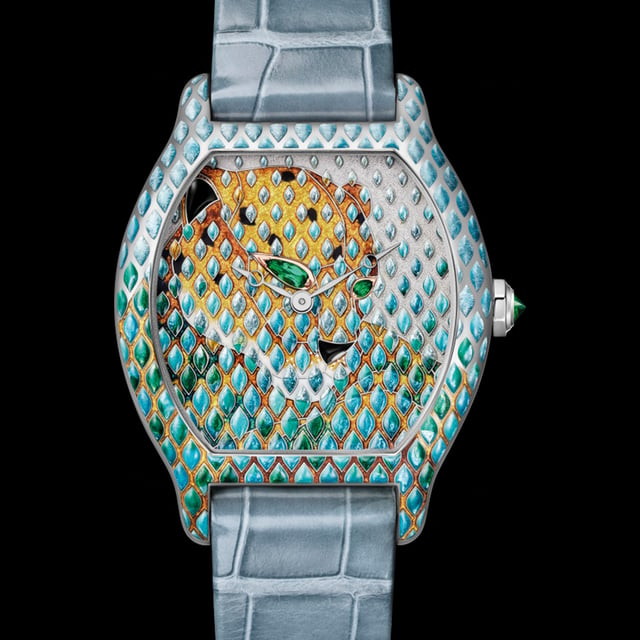
Cartier Tortue Panthère Métiers d'Art
Cartier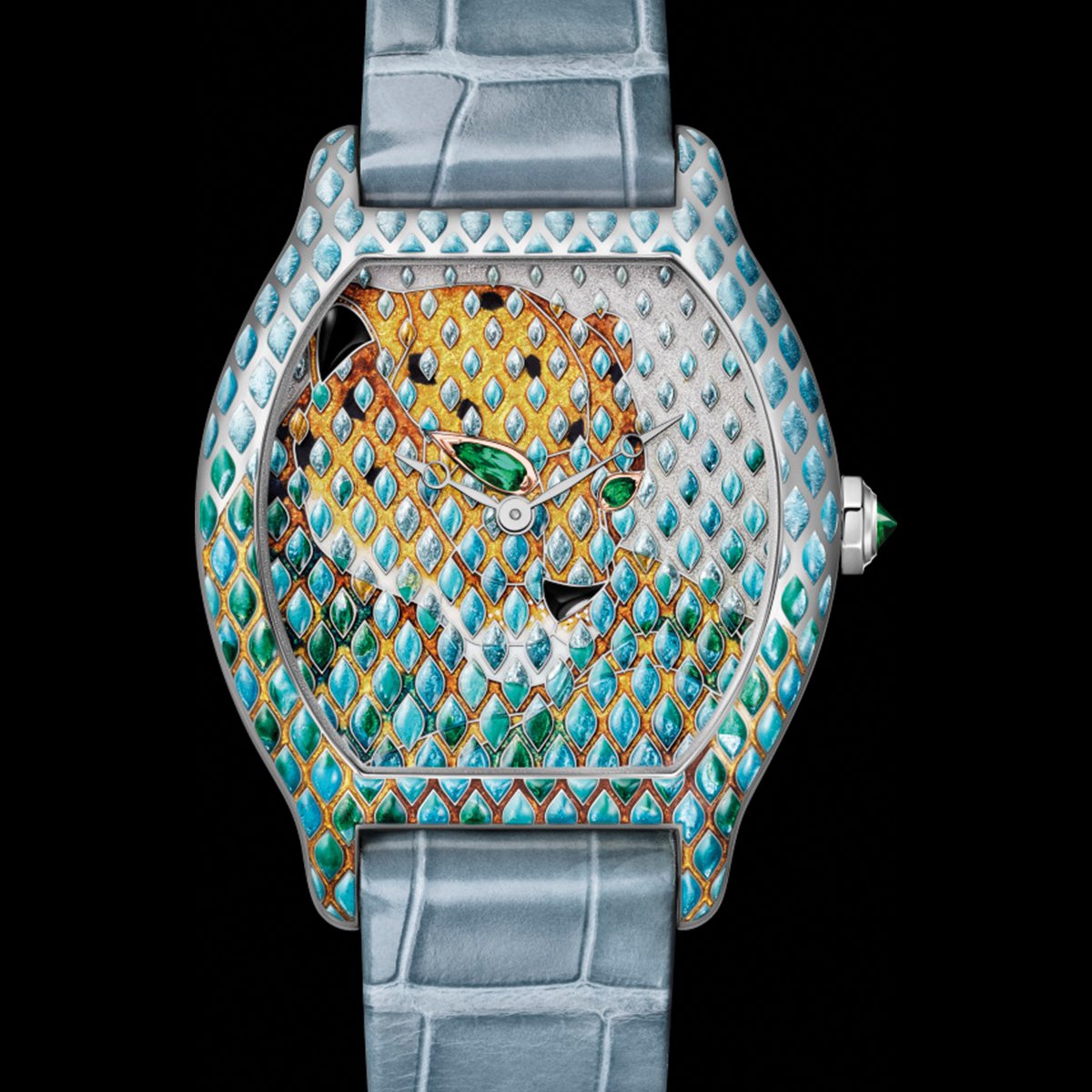
Tortue: New Collection and Métiers-d'Art Highlight
The Tortue has been one of the most collectible shaped watches since 1912. In 2026, Cartier presents it in a new collection setting: entirely newly proportioned, with rounder volumes and softer lines. The classic guilloché background gives way to an embossed motif with relief; the minute ring becomes a dotted line that cites a historical reference from 1922. The Roman numerals have been retained. The secret Cartier signature is found in the stroke of the numeral X.
Five new versions are available in combinations of polished yellow gold, rose gold, white gold, and diamond-set variants, available in both small form and as a mini model.
The yellow gold watch with a black lacquered leather strap features a winding crown set with a sapphire cabochon. In an elegant version that combines jewelry and watchmaking art, the brand introduces a model in rose gold and a model in white gold, each available in two sizes. For the pavé diamonds on the bezel, the design studio opted for a flat setting, which reduces the metal on the sides and maximizes the brilliance of the gemstones. The octagonal-shaped crown is set with an inverted brilliant-cut diamond.
The evening version in platinum LM carries 46 baguette-cut diamonds on the bezel, another 32 diamonds on the white gold clasp— 3.41 carats total, driven by the caliber 430 MC. The watchmaking highlight: the Tortue Panthère Métiers d'Art, in two versions of 100 pieces each. The champlevé enamel extends from the dial over the center of the case, which presents an additional difficulty in shaped watches of this geometry. Over 15 shades and more than 36 firing processes result in 80 hours of enameling work on the dial. This model is produced in two limited editions of 100 pieces each and is available in two different color variants: the first in white gold with emerald-green eyes, the other made of yellow gold with tsavorite eyes.
Baignoire : Clou de Paris as a structural principle
Cartier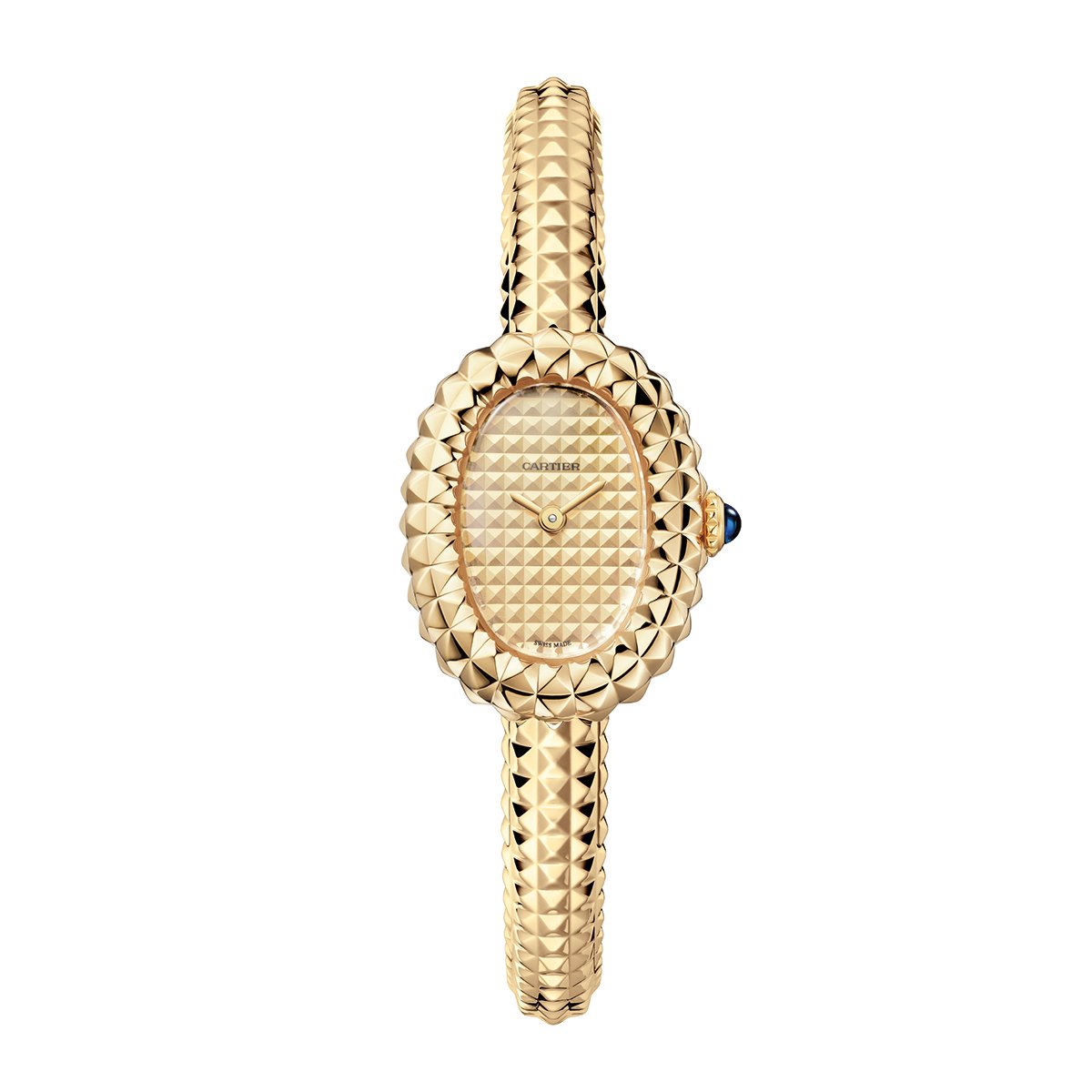
Baignoire: Nail of Paris
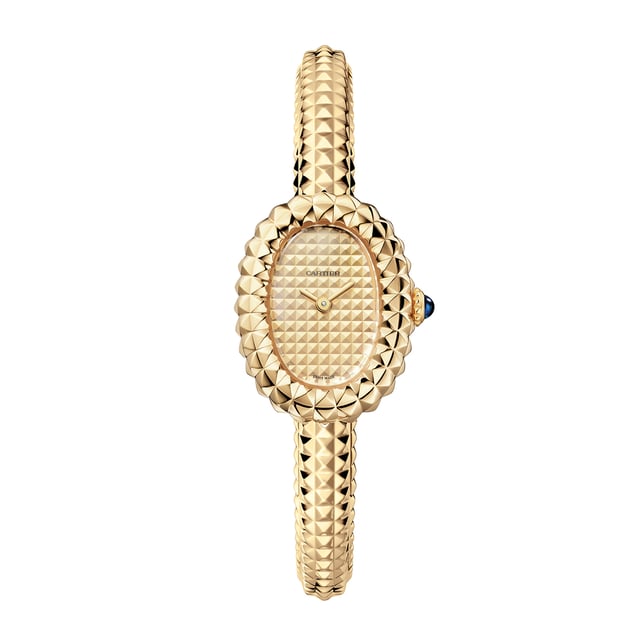
The Baignoire Bangle version of 2023 was an aesthetic addition. In the current version, the Clou de Paris motif, which has been part of Cartier's design repertoire since the early 1920s, extends from the bezel over the case to the dial and bracelet. The adaptation work lies in the proportions: The oval case requires a recalibration of the pattern for each curve segment. The yellow gold of the push-pieces on the folding clasp merges seamlessly into the bracelet.
In the diamond version, 100 brilliant-cut diamonds in a snow setting on the dial create an extra eye-catcher; on the case, inverted stones without a pronounced tip are used. Two different setting techniques for a special brilliance contrast are applied within the same piece. This is artisanally elaborate and one of the most consistent implementations of the Clou de Paris principle that Cartier has shown.

Cartier Myst
Cartier
- Cartier Privé: The Tenth Opus and the Beginning of a Collection
- Cartier Privé – The Collection
- Santos-Dumont: Obsidian, Gold, and a New Bracelet Dimension
- Santos de Cartier Chronograph
- Roadster: Spectacular Comeback
- Tortue: New Collection and Métiers-d'Art Highlight
- Baignoire: Nail of Paris
- Myst de Cartier: Jewelry Watch Without Clasp