Perfect Balancing Act: Spotlight on the Vacheron Constantin Traditionnelle Tourbillon

Founded in 1755, Vacheron Constantin is considered the world’s oldest watch Manufacture in continuous production. In the last several years, this production has been carefully brought into the present, perfectly symbolized, for example, by the contemporary manufacture building in Plan-les-Ouates in Geneva that has brought management, administration and the workshops under one roof in 2004. e same goes for the watches made there: On the one hand, today’s Vacheron Constantin is mastering all the traditional crafts, like guilloché, enameling, engraving and restoration. On the other, the watchmakers constantly challenge themselves to find modern technical solutions that serve the brand’s standards of aesthetics for which it has become known.

For Christian Selmoni, Director of Style and Heritage at Vacheron, the Traditionnelle collection perfectly embodies “the full measure of Vacheron Constantin’s watchmaking legitimacy.” To him, the collection “conveys both history and tradition through precise stylistic codes corresponding to an aesthetic that remains timeless however complex the mechanisms.” With the latest iteration, introduced during Watches and Wonders 2023, Vacheron Constantin is adding a green dial to the collection that is framed by a 950 platinum case to further “pursue its contemporary vision of the classical approach to design.”

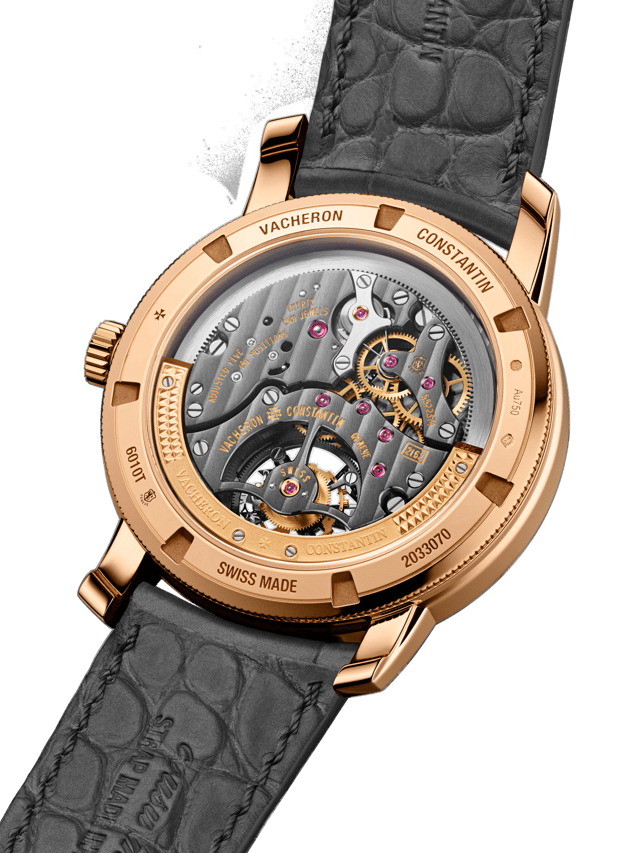
The comparatively thin case (10.4 mm) of the 6000T/000P-H025 is made possible by Vacheron’s ultra-thin self-winding Calibre 2160/1, measuring only 5.65-mm thick. e Maison’s rst self-winding tourbillon movement premiered in 2018 and has been set to a frequency of 18,000 vibrations per hour (2.5 Hz), a relatively slow pace that is often found in historical pocketwatches. e winding system, however, is state of the art: Its 22k gold peripheral rotor not only reduces the thickness of the caliber, it also ensures an e cient build-up of the movement’s impressive 80-hour power reserve (when compared to a micro rotor). In addition, there is no central rotor obstructing the view: e owner can fully observe the peripheral winding ring transmitting energy to the intermediate wheels, and even watch the “Magic Lever”-style, pawl-based bidirectional winding system in action. With a diameter of 31 mm, the automatic movement required a slightly more dominant case in 41 mm, here crafted in platinum and therefore bringing the weight to 127 grams.
The movement finishing consists of a circular-grained base plate appearing on the dial side and hand-beveled bridges adorned with Côtes de Genève on the caseback. In addition, there are multiple interior angles, which are more di cult to nish and fully display a watchmaker’s mastery of technique. e tourbillon with its Maltese cross-shaped carriage demonstrates the same attention to detail. Its suspension bar has been polished in an entirely hand-crafted operation consisting of ling and then polishing the material to obtain a conical and semi-cylindrical shape. In addition, it is also serving as the indicator for the seconds. Combined with the Maltese cross on its carriage, a symbol that has been used by Vacheron since 1880, the Traditionnelle therefore becomes a tting stage for what is often seen as the most established complication for modern luxury watches.
Avant-garde Aesthetic
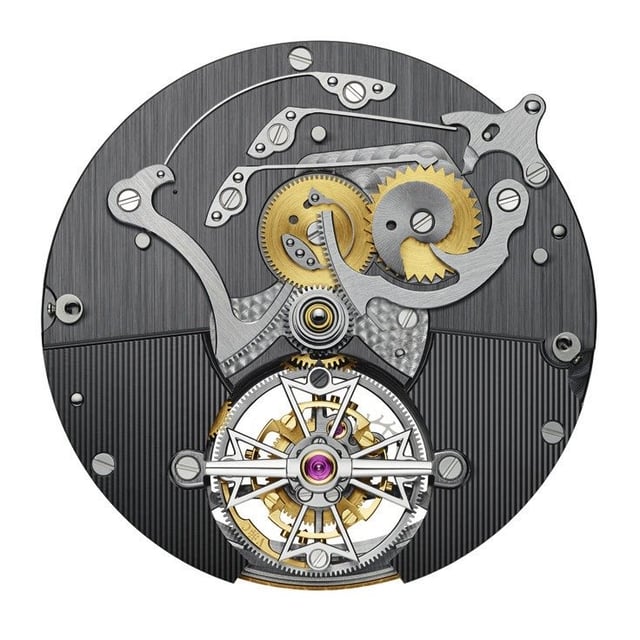
Even more progressive is the brand’s Traditionnelle 6010T/000R-B638 with retrograde date display that was launched simultaneously in Geneva. Like the Traditionnelle Tourbillon, it is equipped with a stepped round case and lugs, a uted caseback, a slim bezel, a railway minute track, bifaceted Dauphine hands and gold baton-type hour markers — characteristic attributes of the Traditionnelle collection and rooted in Geneva’s grand High Watchmaking traditions. But there is, obviously, more: Heir to the References 47245 and 47247 from the early aughts, the Traditionnelle tourbillon date retrograde openface combines its retrograde display with a partially openworked dial, which also has a guilloché segment. It reveals the in-house Calibre 2162 R31, whose retrograde mechanism plate is highlighted by a slate gray surface treatment, achieved by a succession of thin galvanic layers, called NAC.

Three years of research and development by STS Saulcy Traitement de Surface, in collaboration with the University of Franche-Comté, have led to the development of this new decorative coating as an alternative to rhodium. Mainly intended for movement decoration, it lends a deep black polishing appearance to the surfaces it covers. It is non-magnetic, compliant with REACH and RoHS as well as ISO 2819 and NIHS 96-50 standards and has been patented. Next to NAC, the movement finish is further enhanced by vertical hand-brushing on the upper part, its surface having been smoothed with a dedicated abrasive serving to create subtle light e ects, as well as a hand-guilloché lower part. e retrograde date display, complemented by a tourbillon at 6 o’clock, thus gains added depth in an ultra-contemporary yet very watchmaking style. “ is caliber exudes a palpable tension between High Watchmaking traditions and the permanent need to innovate,” notes Selmoni. He’s convinced it will “make a lasting mark on its time.”
Beating at a rate of 18,000 vibrations per hour and measuring just 6.25-mm thick (with 54 more parts than the 2160/1), Calibre 2162 R31 combines its retrograde date also with a tourbillon. is unconventional match is embodied in a technical geometry that makes the retrograde mechanism visible to the naked eye through the openworked dial. Speaking of unconventional: The use of an engraved base plate as a dial element is an equally rare sight.
To learn more, visit Vacheron Constantin, here.
This article is from the WatchTime Archives and was originally published in the September/October 2023 Issue. To subscribe to WatchTime Magazine, click here.