Ad
Ad
Ad
Ad
Ad
Ad
Reading time 8 min.

Flight-Qualified for Space: The Story Behind NASA’s Choice of the Omega Speedmaster
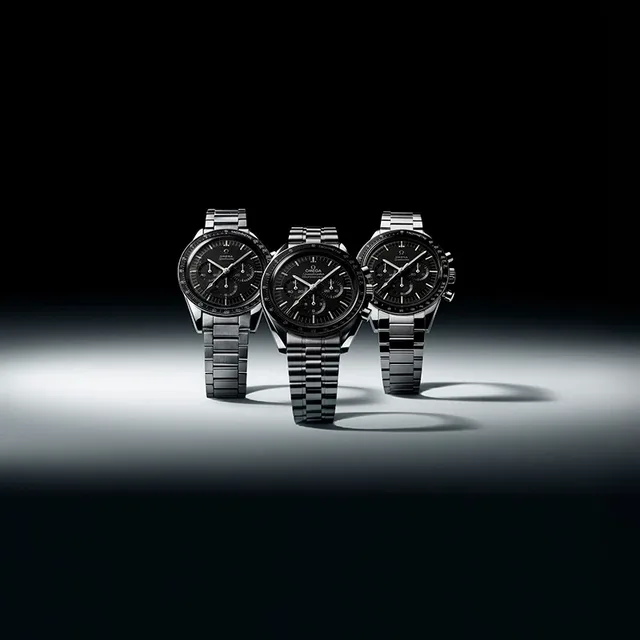
Omega_NASA_certification_SP_Adv_NASAQualif_Family_Full_RVB_large
© PR

Omega's Speedmaster Moonwatch stands as one of the most iconic timepieces of all times. Its legendary status was cemented 60 years ago, in the spring of 1965, when NASA officially certified it as "flight-qualified for all manned space missions." Let's take a detailed look back on the legacy of this extraordinary chronograph on the occasion of the 60th anniversary of this historic designation.
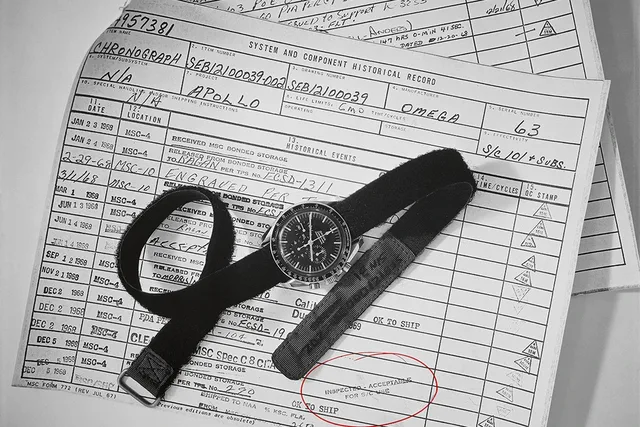
Omega_NASA_certification_1965_Speedmaster_Certificate_Filtre_Neutre_Courtesy of NASA
Courtesy of NASA © PR

"We choose to go to the Moon"

In 1962, John F. Kennedy stood before a crowd at Rice University and made a courageous proclamation: “We choose to go to the Moon.” Most boldly, the U.S. President pledged to achieve this extraordinary feat before the decade’s end. With that, America’s race into space was launched.

Omega_NASA_certification_JFK_Speech_We-choose-to-go-to-the-Moon_12.09.1962_Courtesy-of-John-F.Kennedy-Presidential-Library-Museum-1
Courtesy of the John F. Kennedy Presidential Library and Museum © PR

Project Mercury marked the United States’ first manned spaceflight program and became famous for its pioneering astronauts, known as The Mercury Seven. When the program concluded in 1963, these astronauts approached NASA Operations Director Deke Slayton with a request: dependable wristwatches to accompany them on future missions.

These timepieces were not just accessories; they served a critical purpose. In the event of a failure in the spacecraft’s onboard digital timers, the astronauts would rely solely on their mechanical watches. Reliability and precision were crucial. As NASA prepared for the more advanced Gemini and Apollo missions, it began reviewing all mission equipment. In 1964, Slayton formally requested “high-quality chronographs” from several watch manufacturers. Only four brands responded to his call, one of them was Omega. Each was asked to submit three wrist-worn chronographs, which would undergo some of the most rigorous testing imaginable.
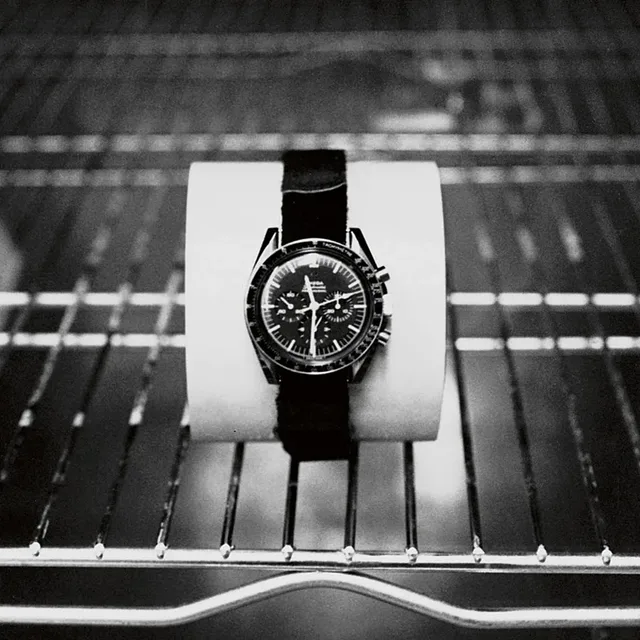
Omega_NASA_certification_SP19_CMYK_Courtesy of NASA
Courtesy of NASA © PR

The testing procedure

Any hardware intended for use on space vehicles first had to be rigorously qualified by NASA's safety, reliability, and quality control teams. One key figure in this process was engineer James Ragan, whose 36-year aerospace career included the crucial task of testing and certifying the chronographs worn by astronauts on manned missions.
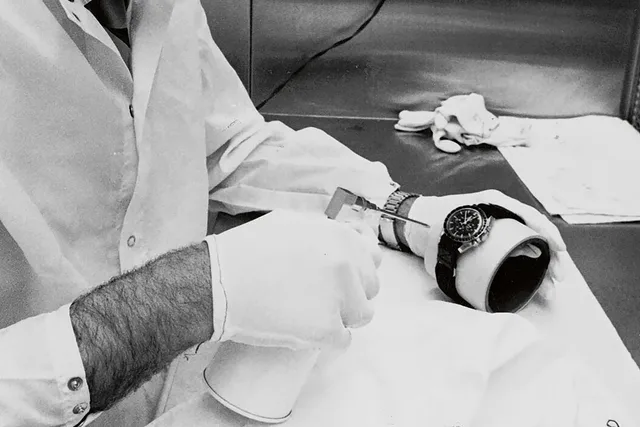
Omega_NASA_certification_SP18_CMYK_Courtesy of NASA
Courtesy of NASA © PR

When Ragan received watches from four different manufacturers, he immediately disqualified one for failing to meet NASA’s basic specifications for a functional wristwatch. That left three contenders. Each of their timepieces was subjected to an intense series of eleven tests—only those that passed every one would be cleared for spaceflight.

1. High Temperature Test

  • Duration: 48 hours at 70°C
  • Followed by: 30 minutes at 93°C in a partial vacuum
  • Result: Only the Speedmaster survived; two other brands failed during the thermal vacuum phase.

2. Low Temperature Test

  • Exposure: 4 hours at -18°C

3. Vacuum Test

  • Procedure: Repeated heating in a vacuum chamber followed by immediate cooling to -18°C over several cycles

4. Humidity Test

  • Environment: 95% humidity
  • Temperature Range: 25°C to 70°C
  • Duration: Ten cycles of 24 hours each

5. Corrosion Test

  • Conditions: 48 hours in an atmosphere of pure oxygen at 70°C

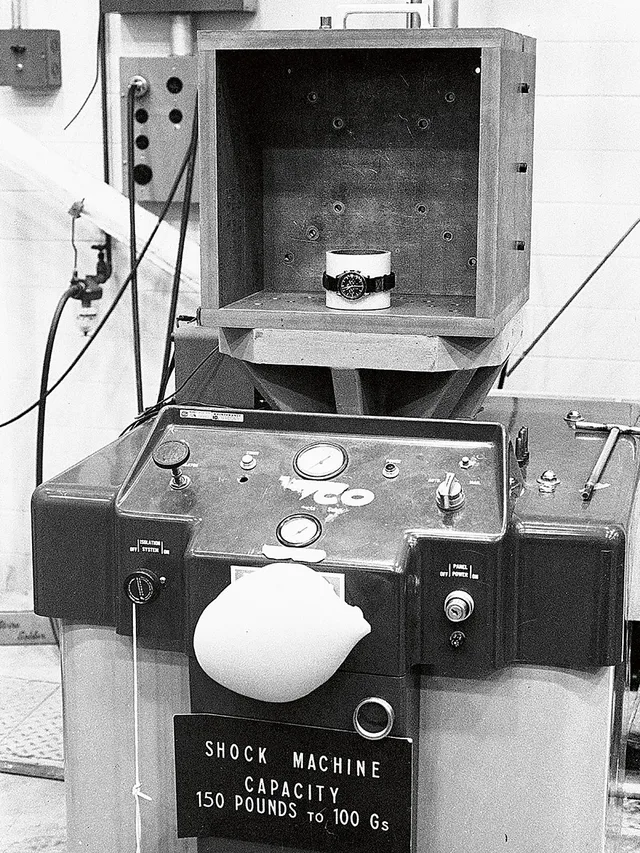
6. Shock-Resistance Test

  • Simulated Space Impact: Six shocks of 40 G
  • Directions: Applied in six different orientations

7. Acceleration Test

  • Progressive acceleration: Up to 7.25 G for 5 minutes
  • Peak acceleration: 16 G for 30 seconds
  • Tested across three axes

8. Low Pressure Test

  • Conditions: Pressure of 10⁻⁶ atmospheres at 70°C for 90 minutes
  • Followed by: 30 minutes at 93°C

9. High Pressure Test

  • Conditions: Air pressure of 1.6 atmospheres for 60 minutes

10. Vibration Test

  • Frequency Range: 5 to 2,000 Hz
  • Duration: 30 minutes
  • Acceleration: 8.8 G in three axes to simulate launch conditions

11. Sound Test

  • Noise Exposure: 130 decibels
  • Frequency Range: 40 to 10,000 Hz
  • Duration: 30 minutes
Omega_NASA_certification_SP22_CMYK_Courtesy of NASA
Courtesy of NASA © PR

Approved by the astronauts

The Speedmaster ST 105.003 successfully passed all eleven of NASA's rigorous qualification tests. Remarkably, this was the exact same model available to the public in retail stores.

In contrast, watches from competing brands failed early in the process—particularly during the high-temperature test. On one model, the large seconds hand warped and interfered with the other hands. On another, the chronograph's crystal deformed and detached from the case.
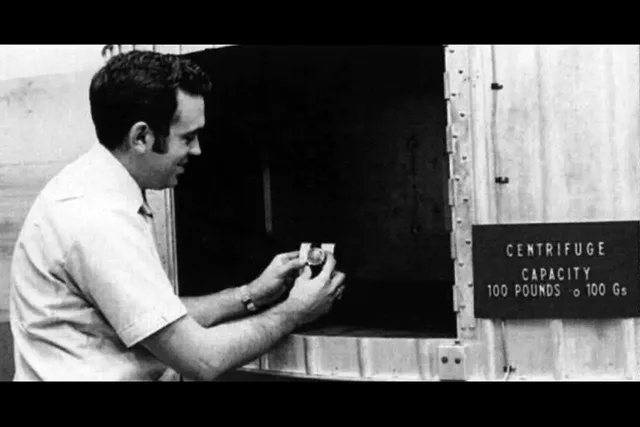
“Even I was surprised that I could get any watches through those tests. The environments were really made for pieces of hardware that you mount on vehicles. It was the most extreme testing you could do to a piece of hardware.”

James Ragan, NASA engineer
Omega_NASA_certification_Jim_Ragan_space_Courtesy of NASA
Courtesy of NASA © PR

But one final hurdle remained— perhaps the most critical of all: the approval of the astronauts. Ragan presented the Speedmaster alongside other candidates to the crews, without revealing the test outcomes. After their own hands-on evaluation, the astronauts unanimously selected the Speedmaster, citing its superior accuracy, reliability, readability, and ease of use.

“It made my life a lot easier,” Ragan later recalled. “I was able to go to the programs office and say, it’s passed the tests— and the astronauts want it.”

Space debut

Just three weeks after receiving NASA’s official qualification, the Speedmaster ST 105.003 made its space debut on March 23, 1965. It was worn by astronauts Virgil “Gus” Grissom and John Young during the Gemini 3 mission. The only modification made to the standard model was the addition of a long Velcro strap, allowing it to be worn over the bulky space suits.

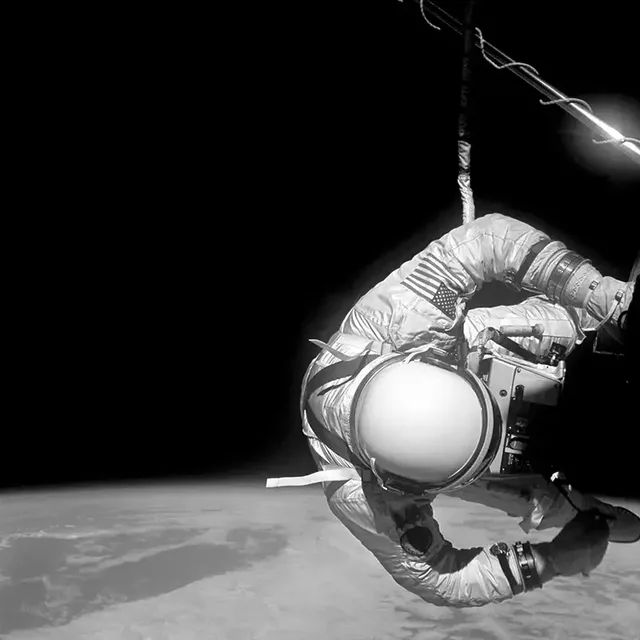
Following Gemini 3, the Speedmaster— and its subsequent evolutions— became an essential piece of equipment for every crewed NASA mission. It gained legendary status when astronaut Ed White wore it during the first American spacewalk later that same year, and again during Apollo 8 in 1968, when its crew became the first humans to witness "the far side of the Moon."

Omega_NASA_certification_Gemini 4 mission_June 1965_1_Courtesy of NASA
© PR

As the missions advanced, so did the importance of the Speedmaster. On July 20, 1969, NASA achieved its ultimate goal: Apollo 11 successfully landed on the Moon. As Neil Armstrong and Buzz Aldrin descended to the lunar surface, the Speedmaster became the first watch worn on the Moon— a milestone in both space exploration and horological history.

From that moment forward, the Speedmaster continued to accompany astronauts on every Moon landing and remained a trusted tool throughout the Apollo program and beyond.

The evolution over the years

When the original Speedmaster was created in 1957, it included many protective technologies used by Omega at the time, such the sealing powers of O-ring gaskets, and the famous “Naiad” crown. Thanks to them, the brand was able to create an incredibly rugged chronograph that was hermetically sealed against the elements and was water-resistant to a 200 feet. Furthermore, the hesalite crystal offered the advantage of flexibility, and therefore shatter-resistance, in high impact situations.

It was also the first watch to feature a tachymeter scale on its bezel, as opposed to the dial. This made it ideal for its intended customer–racing car drivers on the track. Ever since then, the timing scale, with its famous dot over 90 and the dot diagonal to 70, has remained an essential and distinguishing element of the Speedmaster design.

At first glance, the Speedmaster has remained remarkably consistent over the past six decades— a silhouette instantly recognizable to watch enthusiasts and admirers alike. But a closer look reveals a story of thoughtful evolution. While the classic DNA endures, subtle refinements in materials, mechanics, and detailing have brought the Speedmaster into the modern era without losing its iconic identity.

Screenshot-2025-05-11-at-9.54.52 AM
© PR

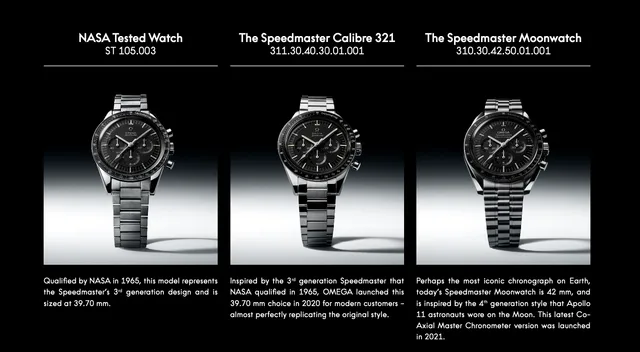
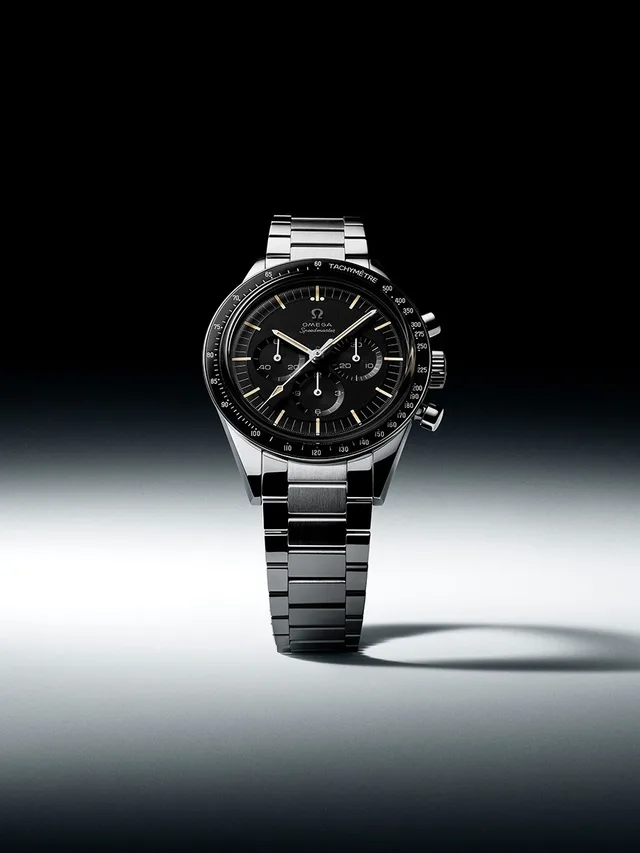
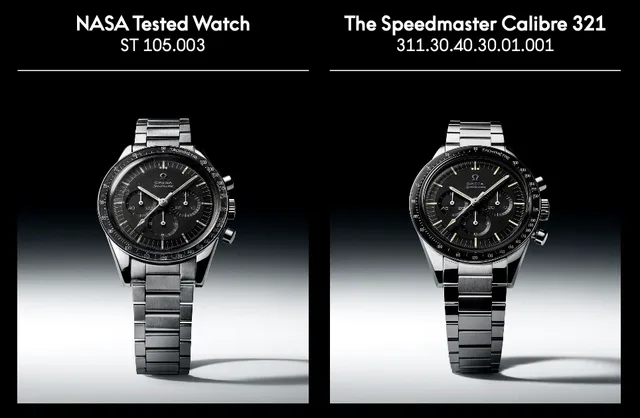
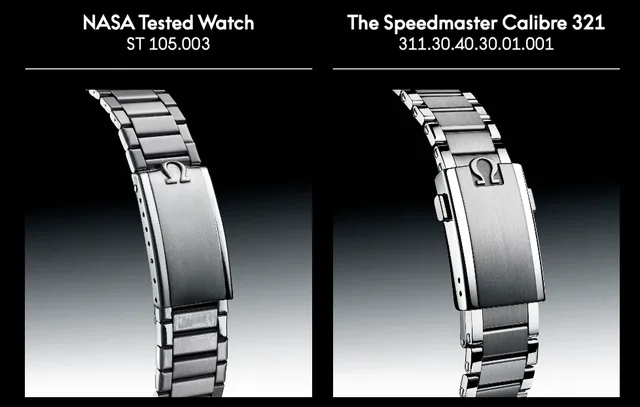
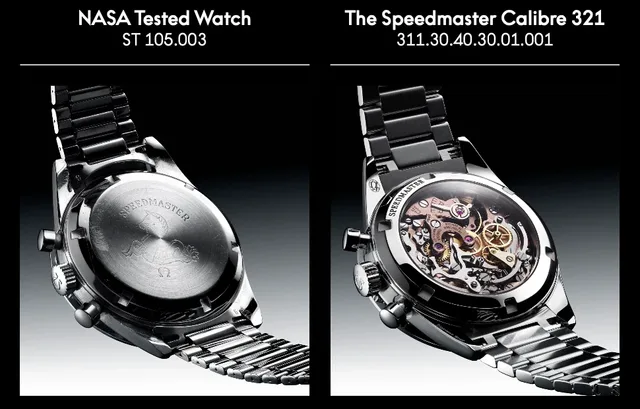
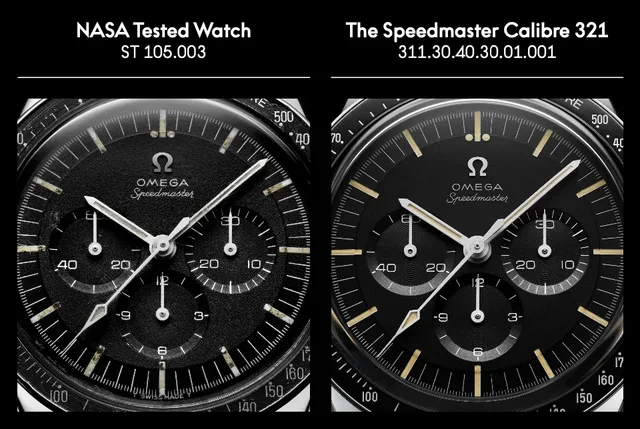
Today, Omega offers two models that closely resemble the watch once tested by NASA: the Speedmaster Moonwatch (ref. 310.30.42.50.01.001) and the Speedmaster Caliber 321 (ref. 311.30.40.30.01.001). The latter, introduced in 2020, is a highly faithful recreation of the watch certified by NASA in 1965.

Speedmaster Caliber 321

Omega_NASA_certification_311.30.40.30.01.001_SP_Adv_NASAQualif_KeyVisual_Full_RVB
Speedmaster Caliber 321 © PR
Screenshot-2025-05-11-at-10.56.07 AM
© PR

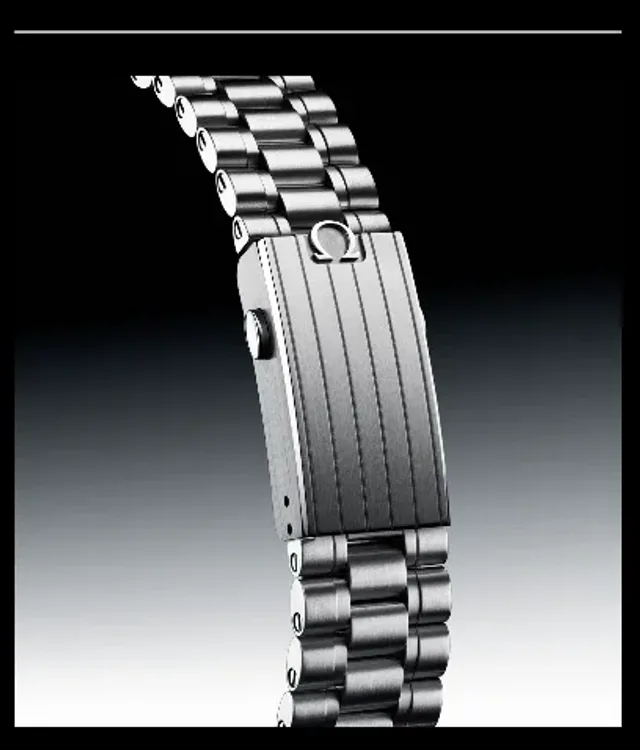
It follows the design of the third generation Speedmaster, particularly evident in its symmetrical case and the matching 39.7mm diameter. The flat, three-link steel bracelet also draws inspiration from the original model.

Screenshot-2025-05-11-at-10.55.06 AM
© PR

The Speedmaster Caliber 321 is powered by a true-to-original version of the manually wound Caliber 321—the very movement that was at the heart of all the watches worn on the Moon. Unlike the original, however, the modern version is equipped with a sapphire crystal case back, allowing wearers to admire the beautiful column-wheel chronograph movement with a Sedna gold PVD coated finish and a power reserve of 55 hours.

Screenshot-2025-05-11-at-10.58.24 AM
© PR

The dial, which in modern days is covered by a sapphire crystal instead of a hesalite one, also reflects the history, featuring the vintage Omega logo and typeface. Naturally, to give it a necessary update, the markers are coated with Super-LumiNova instead of tritium.

Screenshot-2025-05-11-at-10.59.56 AM
© PR

Part of the Heritage Collection, the Speedmaster Caliber 321 retails for $16,200.

To learn more, visit Omega, here.

Speedmaster Moonwatch

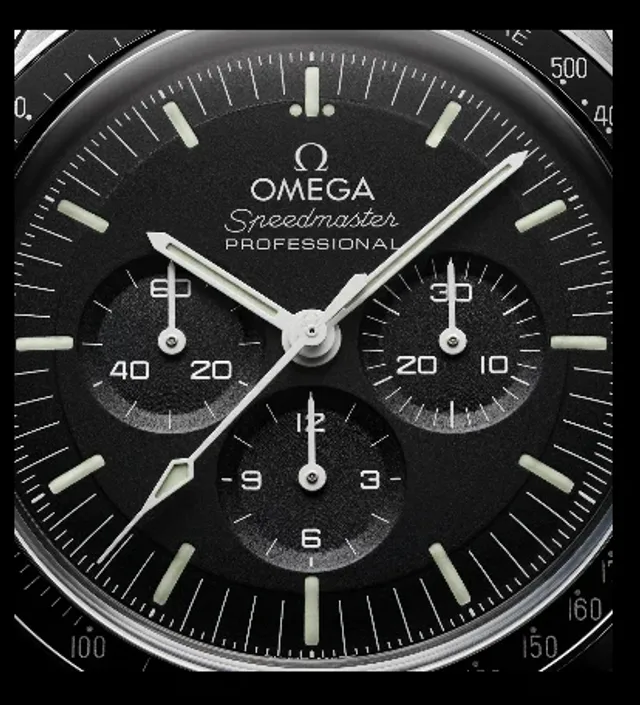
Omega_NASA_certification_310.30.42.50.01.001_SP_Adv_NASAQualif_CloseUp_Cadran_Full_RVB
Speedmaster Moonwatch © PR

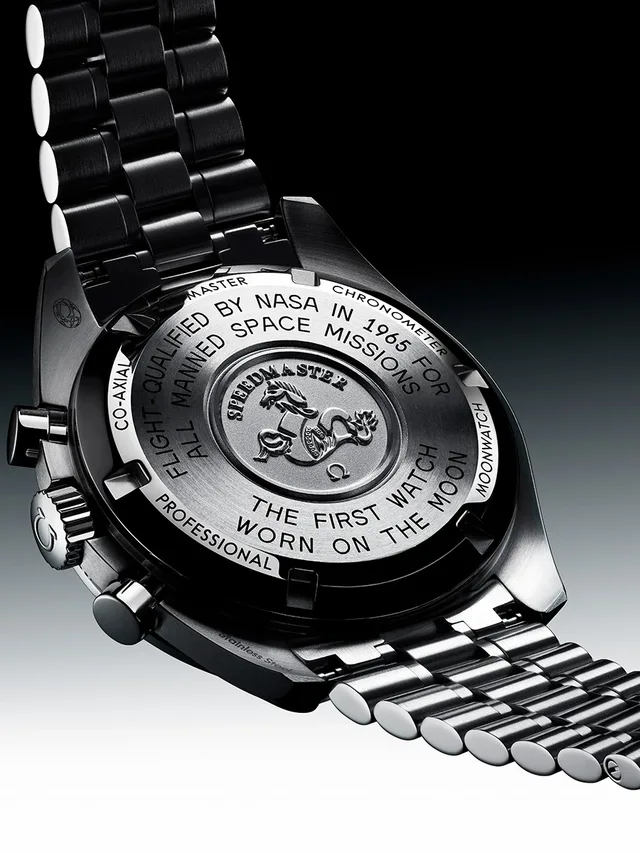
The current Speedmaster Moonwatch was introduced in 2021 and is inspired by the fourth generation—the version worn by the Apollo 11 astronauts. It features the signature asymmetrical case design, with a wider right flank to protect the crown and pushers by preventing them from protruding too far. The Co-Axial Master Chronometer has a 42mm case diameter and a solid case back, just like the original, and bears the classic seahorse emblem in the center. Surrounding it are two inscriptions: “FLIGHT-QUALIFIED BY NASA FOR ALL MANNED SPACE MISSIONS” and “THE FIRST WATCH WORN ON THE MOON.” Since 2021, with the introduction of the Caliber 3861, the text “Co-Axial Master Chronometer” has also been added, highlighting the movement inside.

Omega_NASA_certification_310.30.42.50.01.001_SP_Adv_NASAQualif_CloseUp_CaseBack_Full_RVB
© PR

The Caliber 3861 is the most up-to-date descendant of the Caliber 321. Compared to previous versions, it offers an improved power reserve of 50 hours, chronometric performance and magnetic resistance up to 15,000 gauss. Many innovative features include Omega’s revolutionary Co-Axial escapement as well as the silicon Si14 balance spring. These advancements enable the watch to pass the eight Master Chronometer tests.

Screenshot-2025-05-11-at-3.16.05 PM
© PR
Screenshot 2025-05-11 at 3.17.17 PM
© PR

The current Moonwatch shares the use of an aluminum bezel insert with the original ST 105.003 and a black step dial covered by a hesalite crystal. It features a transferred logo with the addition of “Professional,” which was added in 1964. From 1997 on, the models were upgraded with Super-LumiNova coating for enhanced readability. However, today’s bracelets of the Moonwatch are presented with five arched links per row, with a fold-over clasp and an additional comfort setting.

The Speedmaster Moonwatch steel on steel retails for $7,300.

To learn more, visit Omega, here.

Archiv

Latest Articles

Mühle-Glashütte Introduces the 29er Big GMT - Sport elegance meets GMT
With the new 29er Big GMT, Mühle-Glashütte expands its sport-elegant 29er collection with a dual-time model powered by a modified Sellita SW 330-2 movement and housed in one of the slimmest cases in the series.
3 minutes
Tissot and Pinarello Get Ready for Cycling Season with a Carbon-Clad Special Edition - A watch inspired by and made for the road
As cycling season shifts into high gear, Tissot and Pinarello bring their shared passion for performance to the wrist. Combining Swiss watchmaking expertise with Italian racing heritage, the new Tissot Pinarello captures the spirit of endurance, speed, and innovation in a lightweight mechanical sports watch.
3 minutes
Raymond Weil Goes Integrated Bracelet with the New A.R.T. Watch Collection - A highly competitive entrant to the popular category
A completely new collection for the brand, Raymond Weil's take on the "integrated-bracelet" or "sports-chic" watch stands out less for its spectacle than its value, finishing and tastefully understated approach.
4 minutes
Jun 8, 2026

You might also be interested in

Introducing the Girard-Perregaux Laureato Chronograph 42 mm - Bicolor design with a warm brown dial
A refined take on a 1970s-inspired aesthetic, Girard-Perregaux’s latest Laureato Chronograph combines steel and rose gold with a richly textured brown dial and in-house chronograph movement.
3 minutes
May 22, 2026
Zenith Celebrates the U.S.’s 250th Anniversary with Two Chronomaster Revival Liberty II Editions - 250 editions for 250 years
Limited to 250 pieces in steel and 25 in forged carbon, the new Chronomaster Revival Liberty II models revisit the iconic A384 while honoring Zenith’s historic ties to the United States.
3 minutes
May 28, 2026
The Aura of Patina: Zenith Presents the Chronomaster Revival A384 Tropical - A vintage re-edition
Zenith revisits one of its most distinctive 1969 chronographs with a new “tropical” dial execution, combining vintage-inspired coloration with the El Primero 400 caliber.
3 minutes
May 11, 2026
Ad
Ad
Ad
Ad
Ad