Junghans Celebrates 35 Years of Radio-Controlled Technology with Three Limited Editions
In 1971, Junghans introduced the first quartz wristwatch made in Germany, marking a significant milestone in horological history. Nearly 20 years later, the Black Forest-based brand once again showcased its technological leadership with the Mega 1, the world’s first digital radio-controlled watch. Not only did its innovative radio-controlled movement offer the most precise timekeeping available at the time, but its design was also avant-garde. The agency responsible was frog design, led by the legendary Hartmut Esslinger, who had also won accolades for designing the Apple Macintosh in 1984.

In 2011, Junghans launched the Mega Futura to celebrate the 150th anniversary of the company. The distinctive shape of the Mega Futura took inspiration from the Mega 1, yet reinterpreted it with a fresh perspective. The design retained the asymmetrical basic form with one rounded side and one flat edge, but the left side’s overhang was made more pronounced. As a reinterpretation of the Mega 1, the Mega Futura combines futuristic design, the precision of radio technology, and high-tech craftsmanship made in Germany.
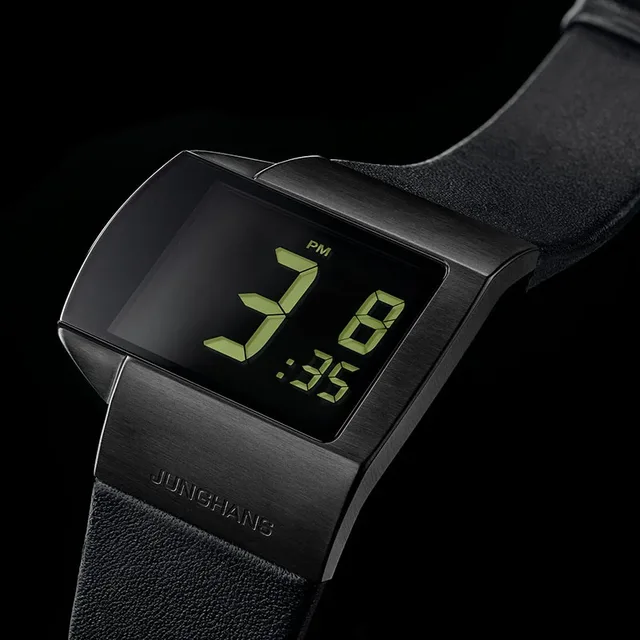
The focus on simplicity is evident in the digital time and date display, which consciously omits the zeroes that hold no relevance for the time information. Three limited editions of the Mega Futura, each limited to 80 pieces, cater to design- and technology-loving watch enthusiasts. Two versions feature matte brushed stainless steel cases with either a light grey or black display. The third version comes with a black PVD-coated stainless steel case, a black display, and green numerals. All three versions are paired with a black leather strap.
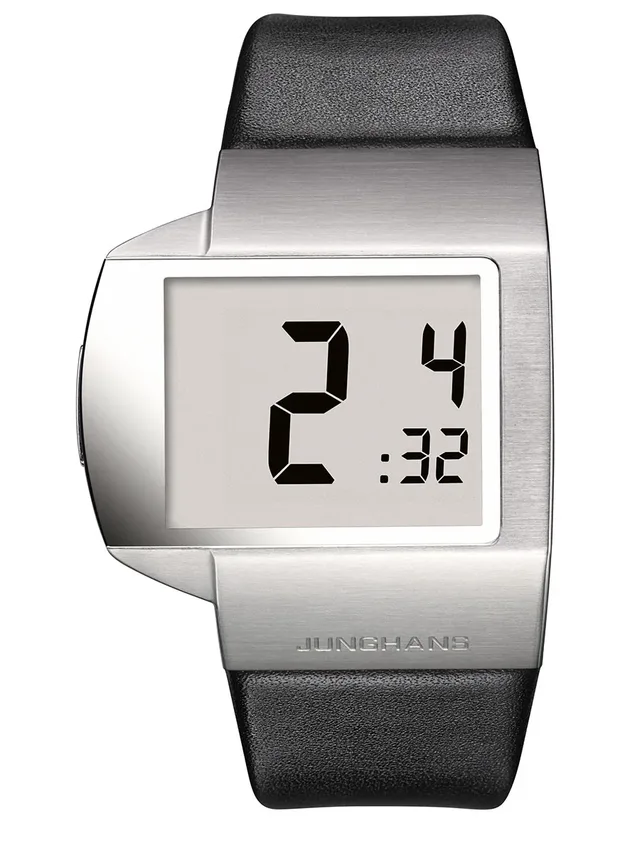
The movement powering the Mega Futura is the multifunctional radio-controlled caliber J604.90, developed and built by Junghans. It displays not only the time (in either a 12-hour or 24-hour format) but also the week number, day, and date. Essentially, this movement features a perpetual calendar, though it is synced with the atomic clock at the Physikalisch Technische Bundesanstalt (PTB) in Germany, which covers nearly all of Europe. The radio-controlled watch synchronizes its time display at least once a day with this time standard. In addition to the DCF-77 signal, the Mega Futura also receives signals from the US WWVB transmitter and the two Japanese time signals, JJY40 and JJY60.
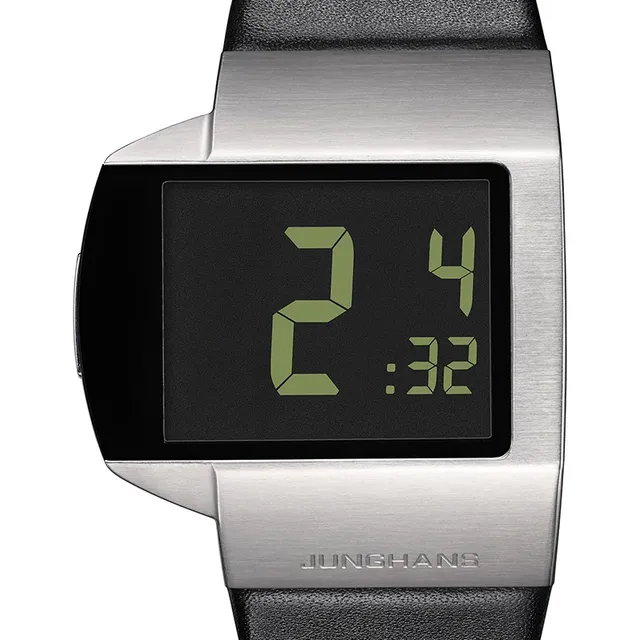
The Mega Futura in classic stainless steel is priced at €490 or approximately $510, while the black-coated version is available for €590 respectively $610.
To learn more, visit Junghans, here.