"And Yet It Moves:" Panerai Introduces the Jupiter Planetarium at Watches & Wonders 2025
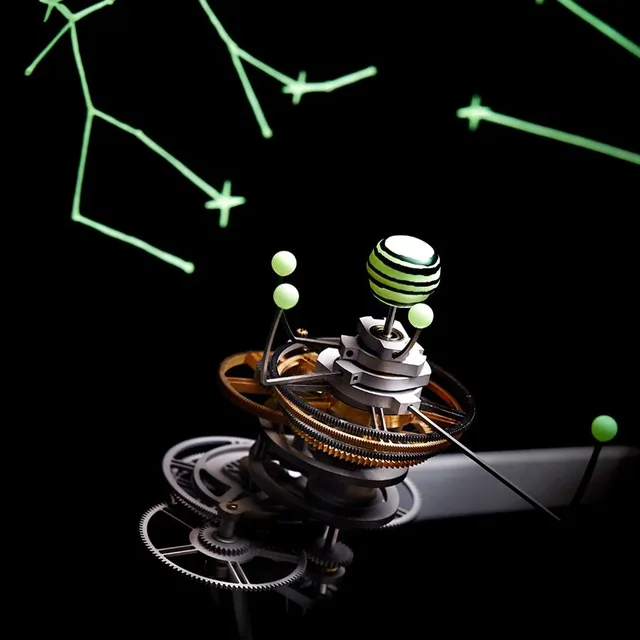
Astronomy and timekeeping have been intrinsically linked for millennia, as the movement of celestial bodies has long served as the foundation for measuring time. Panerai's Jupiterium, a tribute to the genius Galileo Galilei, brings this connection to life, seamlessly combining precision mechanics with the cosmic rhythms of the universe in an astonishing display of technical mastery.

In 1610, Galileo’s observations provided critical evidence that the Earth is not the center of the universe, challenging the long-held geocentric model. With his telescope, he observed four satellites orbiting Jupiter, now known as the Galilean moons: Io, Europa, Ganymede and Callisto. Inspired by this, the Jupiterium sets out to re-create the astronomer’s geocentric perspective of the heavens.
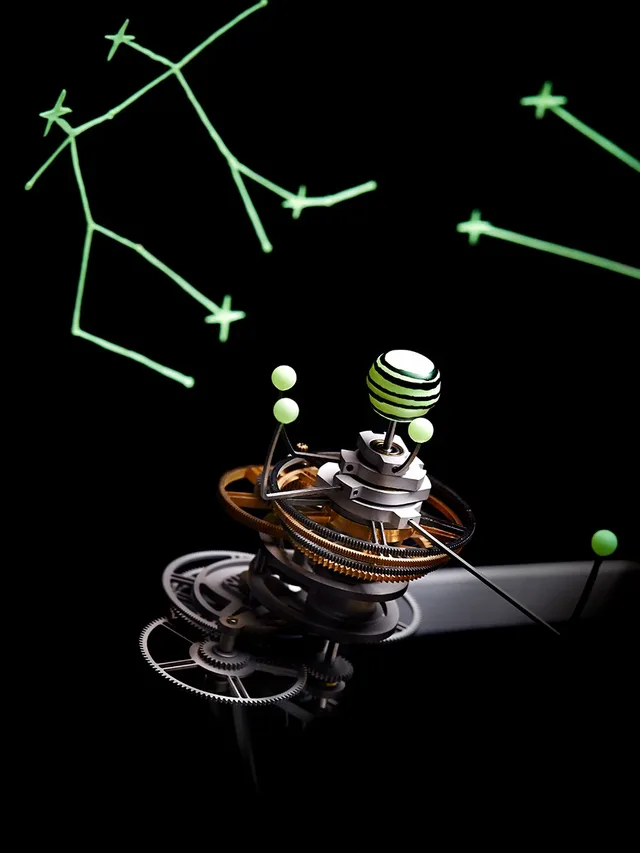
With Earth placed at the center of the celestial sphere with other heavenly bodies rotating around it, the clock displays the positions of the Sun, Moon, and Jupiter, as well as its four Medicean stars. These orbits are guided by a manual-winding mechanism with a single-line display perpetual calendar that drives the real-time movement of the celestial bodies. The mechanism contains eight barrels – beating at 18,000 vibrations per hour – each equipped with a spring that measures 4 meters in length, adding up to a total of 32 meters of spring. These lengthy springs are integral to the clock’s 40-day power reserve system, providing the energy for sustained operation and the smooth functioning of its intricate mechanics.
The Panerai perpetual calendar movement requires no adjustments until the year 2099 and accurately displays the day, date, month and year, adjusting automatically to account for varying month lengths and leap years. Ready to pass until the year 9.999, at the end of each century Jupiterium will only require the intervention of a watchmaker to perform a maneuver to disassemble the movement bridge and rotate the hundreds disc by 90°, thus allowing the watch to continue calculating the years.
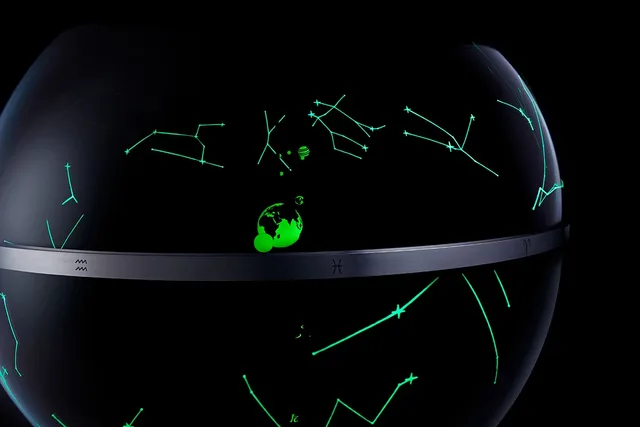
The sphere includes two hemispheres, Northern and Southern, connected by a band symbolizing the Earth’s equator and engraved with the 12 zodiac signs. The celestial sphere completes one full rotation every 23 hours, 56 minutes and 4 seconds — a sidereal day. In the Panerai Jupiterium, Italy is positioned prominently on the Earth model within the central blue sphere. When viewed from the front, Italy is aligned so that it faces directly outward, allowing observers to see the country clearly from a terrestrial viewpoint. This alignment is part of the Jupiterium’s design to represent Galileo’s perspective and Panerai’s Italian heritage, honoring the influence of his discoveries on astronomy and science.
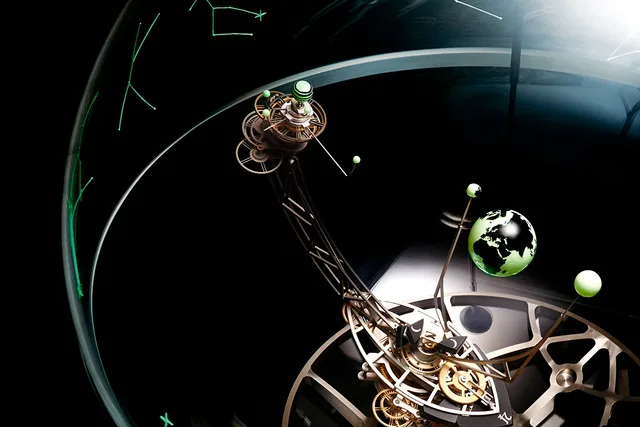
The retrograde function of the Jupiterium is a particularly rare horological feature that represents the apparent “backward” motion of planets as seen from Earth. This phenomenon, known as "retrogradation," occurs when a planet appears to move in reverse against the backdrop of stars due to the relative positions and motions of Earth and the planet in their respective orbits. To simulate this retrograde motion–particularly for Jupiter and its moons–Panerai has developed a patented mechanism that creates a visually accurate portrayal of how Jupiter appears to slow down, reverse, and then resume forward motion in the sky over certain periods, a motion due to Earth overtaking Jupiter in its orbit. This effect is achieved through a complex system of gears and counterweights that control the positions and movement of the celestial bodies. This patented system of high-level precision allows the Jupiterium to display a faithful representation of retrograde motion, adding both technical sophistication and astronomical realism to the clock.
The celestial vault, complete with constellations, rotates to capture the apparent movement of the stars as observed from Earth. The 1,650 intricately crafted components are primarily made from titanium, chosen for its lightweight yet durable qualities, which help manage the overall weight and strengthen the complex mechanism.
Encased within a glass box on a mahogany base measuring 75x86 cm and weighing around 110 kg, its dial is located beneath the main celestial display sphere. Set against a black base, the dial features long stick hour markers and large, luminescent Arabicnumerals at the 12 and 6 o’clock positions, ensuring readability even in low light. The hour, minute, and second hands are similarly coated with Super-LumiNova®, enhancing visibility in darkness. Key indicators include an AM/PM marker and a linear power reserve gauge with the inscription ’40 giorni’ (40 days). The rehaut is engraved with ‘Jupiterium’ while the movement is also indicated in Italian ‘Calendario Perpetuo’ with the day, date, month, and year arranged in a linear display.
Pricing and availability was not available at the time of publication and will be updated as soon as communicated.
To learn more, visit Panerai, here.