Jan 12, 2020
Reading time 5 min.
Vintage Eye for the Modern Guy: Mido Multifort Patrimony
FEATURE
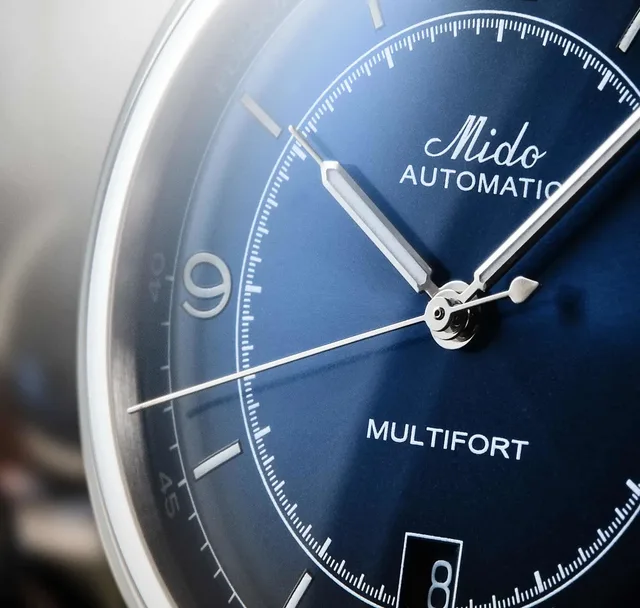
Last year, the Swiss watch brand Mido released a follow-up to its popular Mido Multifort Datometer watch, expanding upon the collection with the new Multifort Patrimony. Longtime readers of this series will remember that in 2018 we covered the Multifort Datometer, a watch commemorating the 100th anniversary of the brand and which upon its unveiling at Baselworld that year was applauded as being a top release of the year. The Multifort Patrimony is an extension of this watch’s success, shifting gears now from the 1939-inspired original model in the collection in favor of a new, and uncommon, mid-century-inspired design.
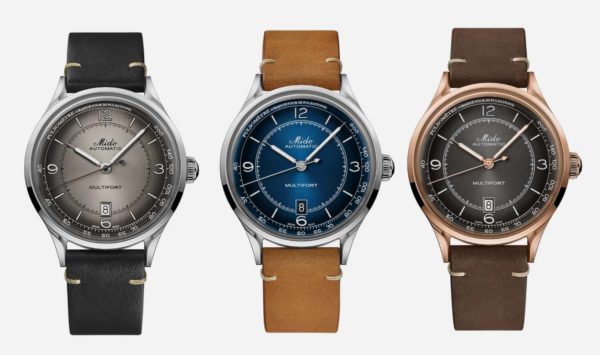
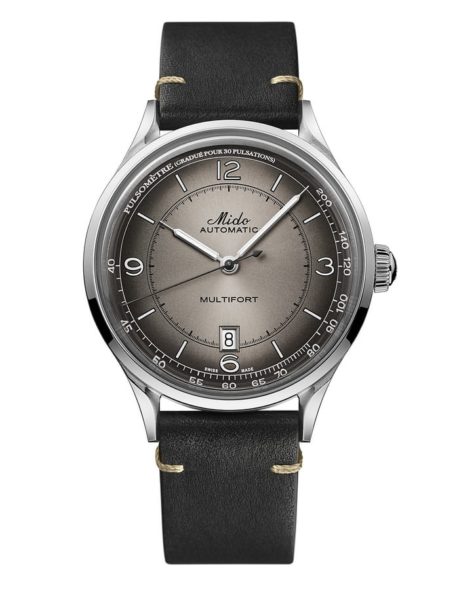
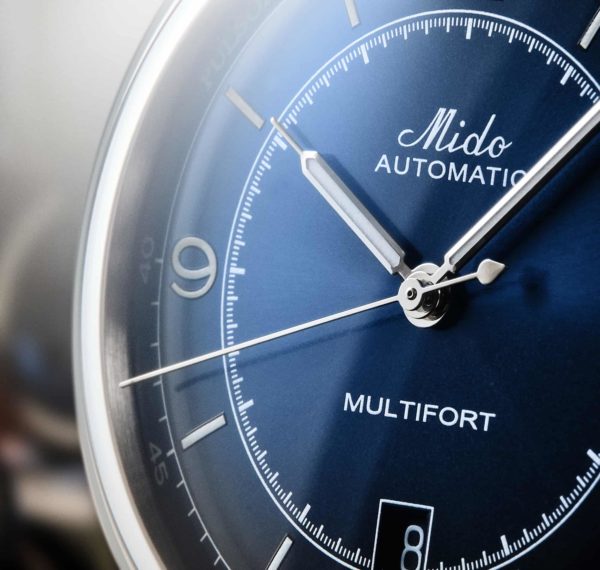
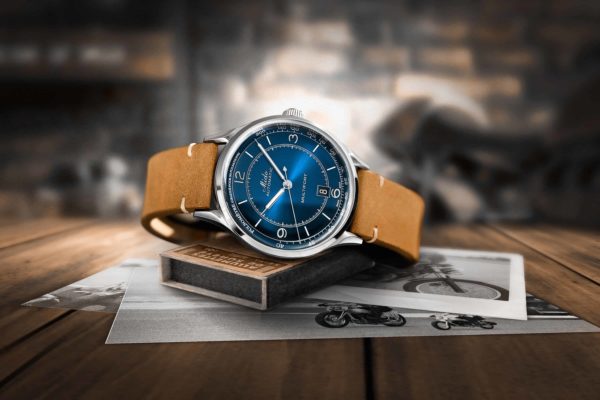 The new watch is available in three different colorways — anthracite, blue, and black — in which the blue uses a sunburst effect and the anthracite and black version use a gradient motif that recalls other watches that take inspiration from mid-20th-Century trends (think pieces produced by luxury manufacturer Glashütte Original, or by the micro-brand Evant). Using a 40-mm case available in either steel or steel with a gold PVD coating, the watch features the Multifort collection’s well-known scallop lugs, as well as a slightly rounded crown to adjust the time.
 On the outer edge of the dial we find the watch’s primary notable feature, a pulsometer scale — a once-practical tool found much more commonly on watches produced from the 1940s to ‘60s, particularly chronographs, than on watches today. Its most common application was for doctors and other medical professionals. To operate the scale, you begin counting 30 beats of a patient’s pulse when the seconds hand is at the top of the minute, and once all 30 are counted you note the corresponding number on the pulsometer, from which you could read the patient’s approximate pulse. A pulsometer is most useful in concert with a chronograph — notable examples of which have been produced by Longines and Patek Phillipe — because on a time-only model one must wait until the seconds hand is at exactly the top of the minute before counting the pulse, whereas on a chronograph the pulse can be taken on demand.
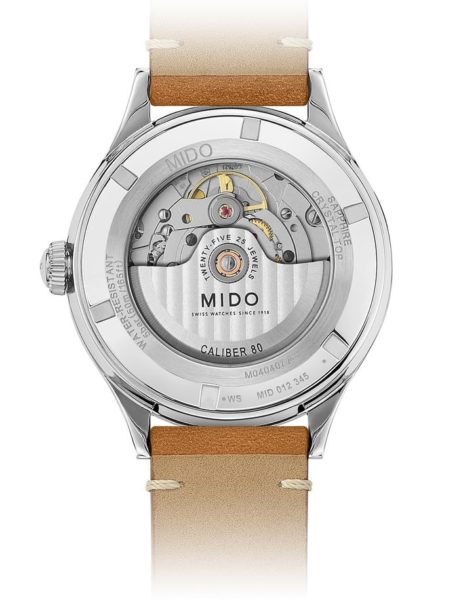
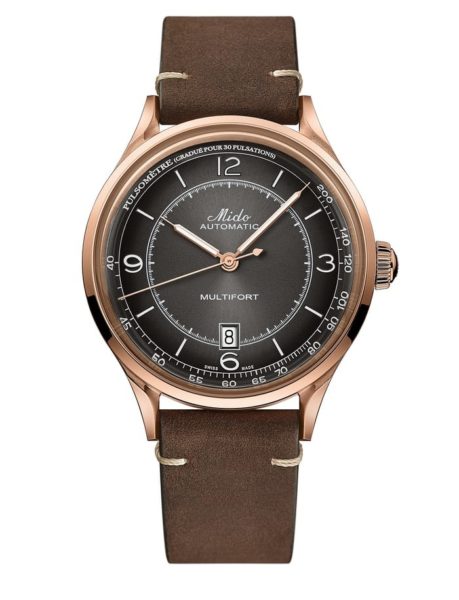 Inside the ring of the pulsometer scale are the rest of the dial’s features, with printed Arabic numerals counting each quarter hour, and slim, printed rectangles indicating the remaining times. Inside the ring of hour markers is what appears to be a racing- or chronograph-inspired minute ring — though obviously lacking the additional chronograph function, and not placed on the outer edge of the dial, which would be more in keeping with traditional chronograph design — with a date window at the bottom, above the 6 o'clock marker. Sweeping over the dial are two syringe-tipped hands for the hour and minute, while a small counter-weight-ended pointer is used for the seconds hand. Inside the watch is the Mido Caliber 80, an automatic movement based on the ETA C07.621 and capable of an 80-hour power reserve, to which Mido has applied its own finishing. The new Multifort Patrimony is competitively priced by the brand: about $790 for the steel models and $890 for the gold PVD edition.
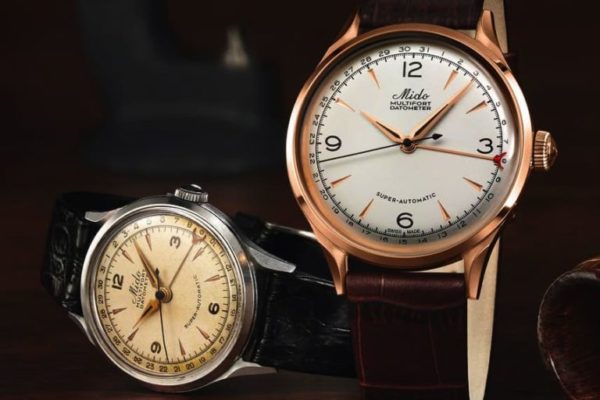
 As I learned while researching this article, the word “Patrimony” in the new Multifort’s name refers to its "heritage," and throughout the new model we can see these “heritage” features. On the outside of the case, there are the scalloped lugs and slightly rounded crown, both features borrowed from the Datometer, which itself borrowed the features from the vintage 1939 model that inspired it (vintage and modern models pictured below). On the dial, you’ll notice the use of the vintage-style pulsometer, as mentioned a rather unusual feature on a modern watch and virtually unseen in time-only models (There are some examples out there, some writers have assured, albeit without citing any specific models.) The dial also uses a vintage-style font for the hour markers which hearkens back to the mid-20th century, while the syringe tipped hands and racing-style minute ring further complement this vintage style.
 Despite these decidedly retro elements, Mido is clearly making an effort at attracting a modern consumer, as can be clearly seen throughout the watch's other aspects. First and foremost this is evident in the size of the model — 40 mm, which is at least 4 mm larger than any mid-century time-only watch would likely be, and also a couple millimeters larger than more period-faithful vintage-oriented models tend to be. In addition the size, the use of a pulsometer on a time-only piece is quite modern, and is another indication of the watch being made for a broader category of consumer; the very competitive price range is also helpful, of course.
 Overall, the Multifort Patrimony seems like a worthy follow-up to the popular Datometer line, and likely indicates Mido’s expected sustained growth within the neo-vintage category. And if the past two years are any indicators, 2020 could well bring us a third interesting and uncommon design in the Multifort line, though it likely won’t be unveiled until Spring at the earliest.
 For the most recent article in the “Vintage Eye” series, in which we discuss the Cartier Tonneau and the historical watch that inspired it, click here.
Caleb Anderson is a freelance writer with a primary focus on vintage watches. Since first discovering horology, he has garnered extensive knowledge in the field and spends much of his time sharing his opinions among other writers, collectors, and dealers. Currently located near New York City, he is a persistent student in all things historical, a writer on many topics, and a casual runner.
For the most recent article in the “Vintage Eye” series, in which we discuss the Cartier Tonneau and the historical watch that inspired it, click here.
Caleb Anderson is a freelance writer with a primary focus on vintage watches. Since first discovering horology, he has garnered extensive knowledge in the field and spends much of his time sharing his opinions among other writers, collectors, and dealers. Currently located near New York City, he is a persistent student in all things historical, a writer on many topics, and a casual runner.
The new watch is available in three different colorways — anthracite, blue, and black — in which the blue uses a sunburst effect and the anthracite and black version use a gradient motif that recalls other watches that take inspiration from mid-20th-Century trends (think pieces produced by luxury manufacturer Glashütte Original, or by the micro-brand Evant). Using a 40-mm case available in either steel or steel with a gold PVD coating, the watch features the Multifort collection’s well-known scallop lugs, as well as a slightly rounded crown to adjust the time.
On the outer edge of the dial we find the watch’s primary notable feature, a pulsometer scale — a once-practical tool found much more commonly on watches produced from the 1940s to ‘60s, particularly chronographs, than on watches today. Its most common application was for doctors and other medical professionals. To operate the scale, you begin counting 30 beats of a patient’s pulse when the seconds hand is at the top of the minute, and once all 30 are counted you note the corresponding number on the pulsometer, from which you could read the patient’s approximate pulse. A pulsometer is most useful in concert with a chronograph — notable examples of which have been produced by Longines and Patek Phillipe — because on a time-only model one must wait until the seconds hand is at exactly the top of the minute before counting the pulse, whereas on a chronograph the pulse can be taken on demand.
Inside the ring of the pulsometer scale are the rest of the dial’s features, with printed Arabic numerals counting each quarter hour, and slim, printed rectangles indicating the remaining times. Inside the ring of hour markers is what appears to be a racing- or chronograph-inspired minute ring — though obviously lacking the additional chronograph function, and not placed on the outer edge of the dial, which would be more in keeping with traditional chronograph design — with a date window at the bottom, above the 6 o'clock marker. Sweeping over the dial are two syringe-tipped hands for the hour and minute, while a small counter-weight-ended pointer is used for the seconds hand. Inside the watch is the Mido Caliber 80, an automatic movement based on the ETA C07.621 and capable of an 80-hour power reserve, to which Mido has applied its own finishing. The new Multifort Patrimony is competitively priced by the brand: about $790 for the steel models and $890 for the gold PVD edition.
As I learned while researching this article, the word “Patrimony” in the new Multifort’s name refers to its "heritage," and throughout the new model we can see these “heritage” features. On the outside of the case, there are the scalloped lugs and slightly rounded crown, both features borrowed from the Datometer, which itself borrowed the features from the vintage 1939 model that inspired it (vintage and modern models pictured below). On the dial, you’ll notice the use of the vintage-style pulsometer, as mentioned a rather unusual feature on a modern watch and virtually unseen in time-only models (There are some examples out there, some writers have assured, albeit without citing any specific models.) The dial also uses a vintage-style font for the hour markers which hearkens back to the mid-20th century, while the syringe tipped hands and racing-style minute ring further complement this vintage style.
Despite these decidedly retro elements, Mido is clearly making an effort at attracting a modern consumer, as can be clearly seen throughout the watch's other aspects. First and foremost this is evident in the size of the model — 40 mm, which is at least 4 mm larger than any mid-century time-only watch would likely be, and also a couple millimeters larger than more period-faithful vintage-oriented models tend to be. In addition the size, the use of a pulsometer on a time-only piece is quite modern, and is another indication of the watch being made for a broader category of consumer; the very competitive price range is also helpful, of course.
Overall, the Multifort Patrimony seems like a worthy follow-up to the popular Datometer line, and likely indicates Mido’s expected sustained growth within the neo-vintage category. And if the past two years are any indicators, 2020 could well bring us a third interesting and uncommon design in the Multifort line, though it likely won’t be unveiled until Spring at the earliest.
For the most recent article in the “Vintage Eye” series, in which we discuss the Cartier Tonneau and the historical watch that inspired it, click here.
Caleb Anderson is a freelance writer with a primary focus on vintage watches. Since first discovering horology, he has garnered extensive knowledge in the field and spends much of his time sharing his opinions among other writers, collectors, and dealers. Currently located near New York City, he is a persistent student in all things historical, a writer on many topics, and a casual runner.