Aug 30, 2016
Reading time 6 min.
7 Milestone Breguet Watches, From 1801 to Today
We showcase in this feature article seven of the most important Breguet timepieces, including the very first tourbillon watch and the first perpetual calendar for the wrist.
Last fall, Breguet presented "Breguet: Art and Innovation in Watchmaking," its first major U.S. museum exhibition at San Francisco's Legion of Honor (click here for our coverage of the exhibit). Below we showcase some of the most important Breguet timepieces featured there, including the very first tourbillon watch and the first perpetual calendar for the wrist.
1801: The First Tourbillon
Possessed of an analytical mind, Abraham-Louis Breguet knew that gravity disturbs the rate of a pocketwatch when the timepiece is worn in a vertical position. The tiniest eccentricities in the center of gravity of the balance and balance spring, as well as various frictional relationships, can lead to acceleration or deceleration of the balance’s oscillations.
Even the most meticulous fine adjustments couldn’t entirely eliminate these eccentricities, so Breguet’s thoughts turned to compensation. He mounted the balance, the balance spring and the escapement inside a lightweight steel cage that rotated around its own axis. Fractions of a second lost to deceleration, e.g., during the first half of a minute, were regained by corresponding acceleration during the second half of the minute. Breguet received a patent for his “régulateur à tourbillon,” as he dubbed it, on June 26, 1801. The device’s public presentation followed at the Paris Industrial Exposition in 1806.
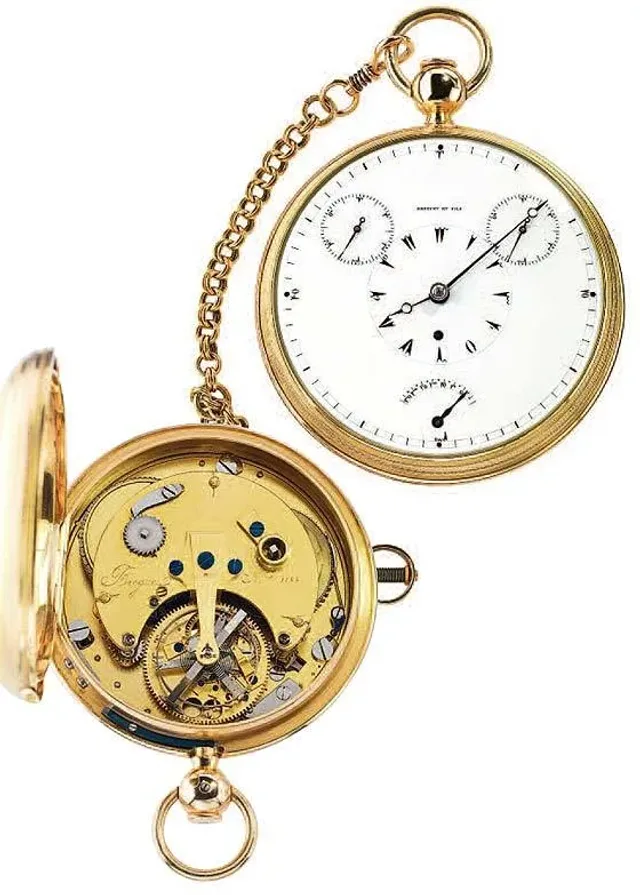
Breguet's First Tourbillon - 1801
PR
1929: The First Perpetual Calendar Wristwatch
Breguet completed his first perpetual calendar pocketwatch in 1795. The calendar adjusted automatically to account for months of different lengths and for leap years and would not require manual setting until 2100.
The first wristwatch with a perpetual calendar — along with a moon-phase display — was developed by the Breguet company, then owned by the Brown family, on the eve of the Great Depression. The fine, hand-wound movement measured slightly less than 23 mm in diameter, was equipped with 18 jewels and — as an elaborate special feature — also included simultaneously jumping indicators. The watch, completed in 1929, had a tonneau-shaped, white-gold case. On April 14, 1991, the Antiquorum auction house in Geneva auctioned it off for 550,000 Swiss francs.
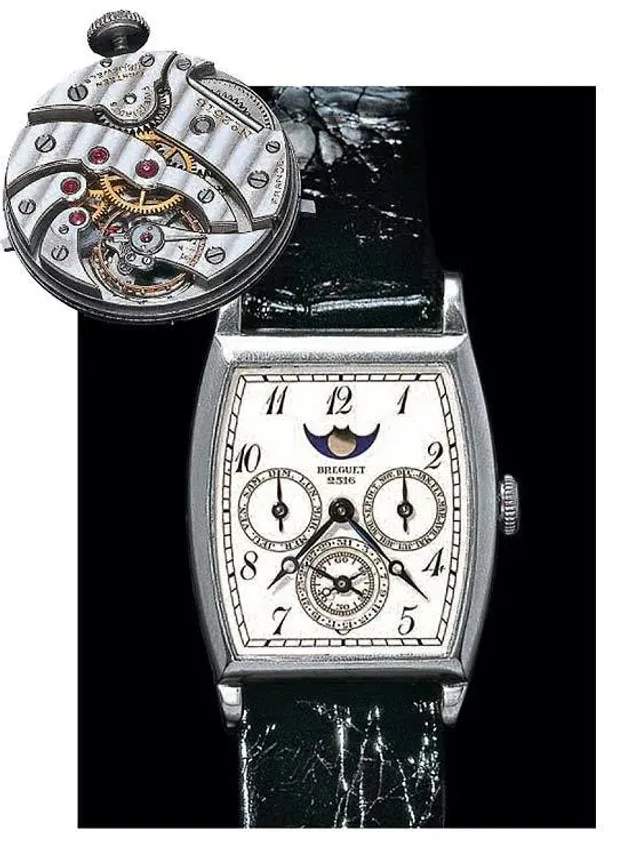
Breguet Perpetual Calendar - 1929
PR
In the mid-20th century, under the ownership of the Brown family, Breguet began making pilots’ chronographs with elapsed-time counters. (The Browns owned Breguet from 1870 to 1970.) The company continued to develop these special watches in collaboration with airlines and airplane manufacturers.
Beginning in 1954, three generations of the Type XX Chronograph were built for France’s Centre d’Essais en Vol, the military agency that approves new aircraft. The stopwatch was based on Breguet’s first wristwatch chronograph, which had debuted in 1935. Its distinguishing features were a rotating, easy-to-grasp bezel and a flyback mechanism, which responds to a single push of a button by returning the chronograph’s elapsed-seconds hand to zero and instantly restarting it. Breguet produced similar instruments for the pilots of the French Air Force. The dial and hands were designed to be easily legible in all lighting conditions. The Type XX contained the 14-ligne Caliber 22, made by Valjoux.
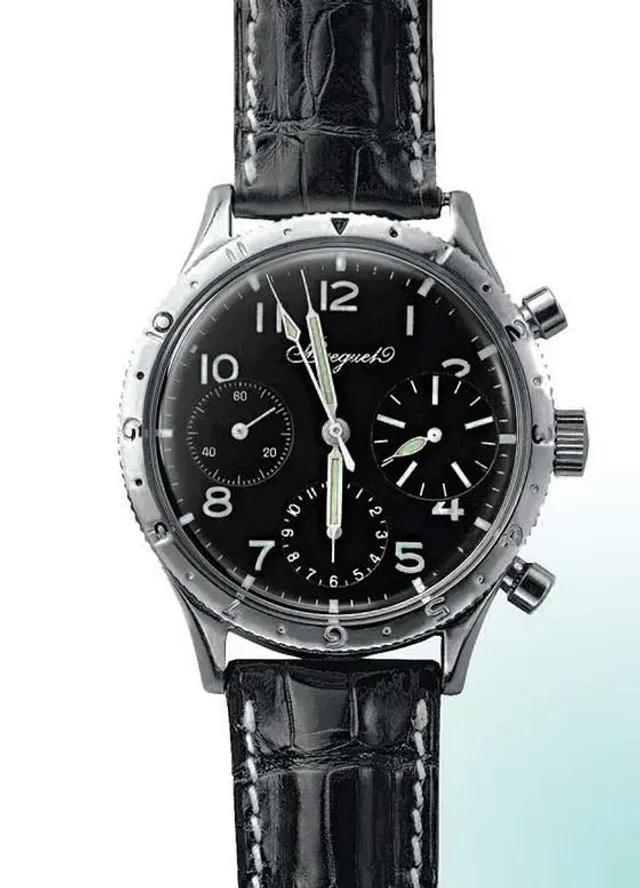
Breguet Type XX chronograph - 1954
PR
1988: The Tourbillon Wristwatch
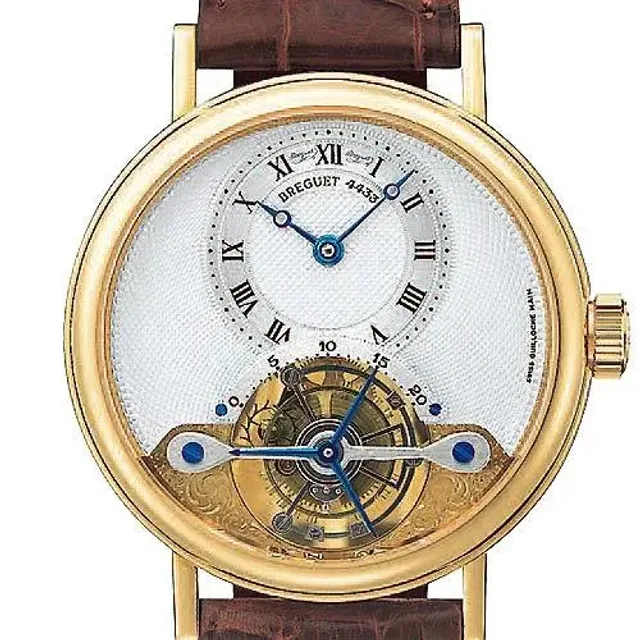
The movement maker Nouvelle Lémania developed the first wristwatch tourbillon movement for Breguet in the mid-1980s. (Nouvelle Lémania is now known as Manufacture Breguet. The Swatch Group bought both the Breguet brand and Nouvelle Lémania in 1999 and folded the latter into the former.) The tourbillon in the 131⁄2-ligne, hand-wound Caliber 387 is located at 6 o’clock. The balance has a frequency of 18,000 vph. The hour and minutes hands share an off-center dial at 12 o’clock. The brand debuted a gold wristwatch with a tourbillon in Basel in 1988, when Breguet was owned by Investcorp. A second tourbillon model, Reference 3357BA/12/986, came out in 1990. Nouvelle Lémania also made the movement for that watch.

Breguet Tourbillon Watch - 1988
PR
2005: The Tradition 7027
Caliber 507DR was designed for the watch lover who wants to see his watch’s movement at work without having to take the watch off his wrist. Nearly everything is visible through the sapphire crystal in the front. The complete gear train, including the screw balance and Breguet balance spring, is readily visible. The dial, embellished with manually applied guilloché, is positioned off center at 12 o’clock. The power reserve is shown twice, on the watch’s front and back. The pivots of the balance staff are protected by an unconventional shock absorber that looks very much like Abraham-Louis Breguet’s pare-chute device from the late 18th century. The balance has a frequency of 21,600 vph, rather than the more common 28,800 vph, to make it easier to see the wheel rotating back and forth.
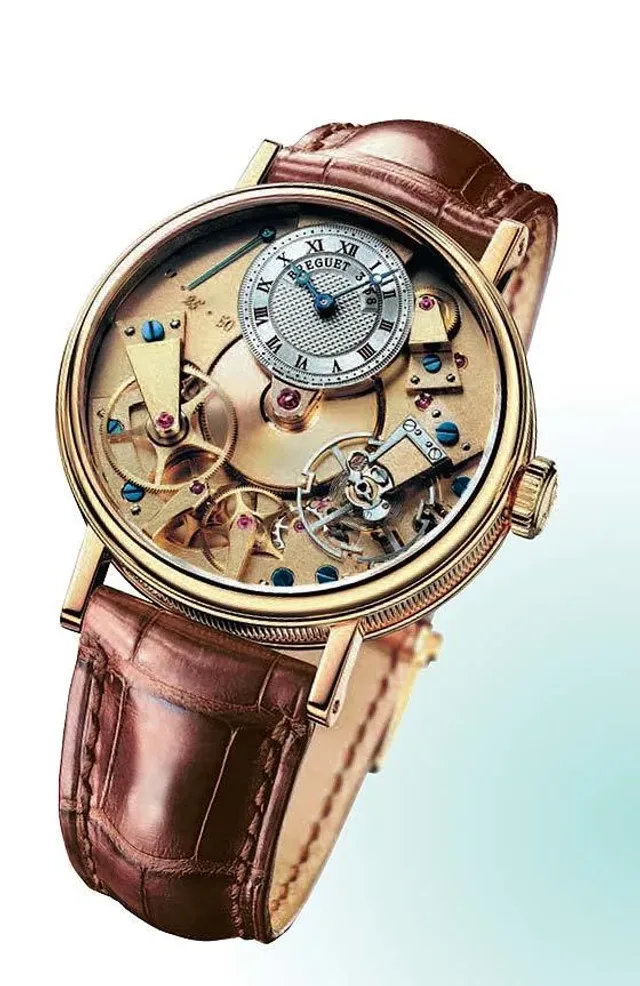
Breguet Tradition 7027 - 2005
PR
2011: The Hora Mundi 5717
With the Hora Mundi 5717, Breguet launched a world’s first: a second-time-zone mechanism that enables the wearer to toggle back and forth between two time zones by simply pushing a button. Doing so causes the hour hand, date, city and day/night indicator (which sits between 3 and 4 o’clock and looks like a moon-phase display) to move simultaneously to display the new information.
The date is shown in an arc-shaped window at 12 o’clock. Beneath the window is a rotating date disk. The current date is framed by a little circle at the tip of a hand. This hand accompanies the date from left to right through the arcing aperture as the day progresses. At the stroke of midnight, the hand leaps back to its starting position, where it encounters the numeral for the new day’s date.
The base movement is Caliber 77FO, which has a silicon escapement. The watch has four patents protecting its two-time-zone feature and its date display. There are three versions of the dial, one showing Europe and Africa, another the Americas, and a third Asia and the Pacific Ocean.
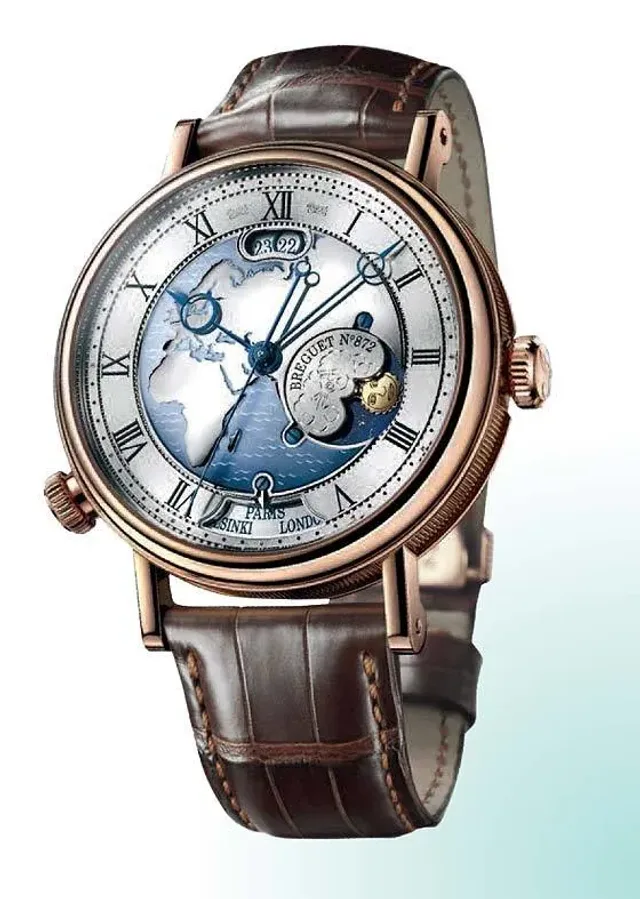
Breguet Hora Mundi 5717 - 2011
PR
2013: The Classique Chronométrie
The headline feature of the Classique Chronométrie 7727 is micro-magnets. There are two of them, one in each of the endstones that support the balance-staff pivots. The pivots move in the field generated by these magnets. This nearly contact-free bearing allows the pivot to shift laterally so that hard blows can cause no damage. It also reduces friction, thereby increasing precision. According to Breguet, the watch has a rate of -1/+3 seconds per day.
Conventional balance springs would malfunction because they would become magnetized, so the springs in this watch – there are two of them − are made from silicon, which cannot become magnetized. The lever and escape wheel are also made of silicon, which reduces friction and, because it is lightweight, minimizes the amount of energy consumed by the oscillating and escapement system. The balance, made of titanium, has a frequency of 72,000 vph. (For more on the Classique Chronométrie 7727, download “Breguet’s Magnetic Moment,” the cover story of the April 2014 issue.)
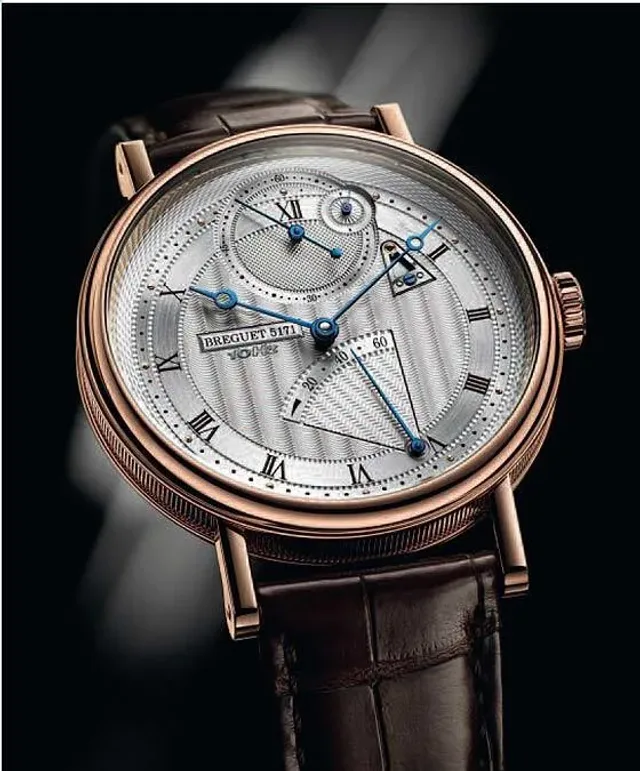
Breguet Classique Chronometrie - 2013
PR
To discover all 16 of the timepieces in our survey of "Breguet Milestones," including the historic Souscription pocketwatch and the famous Reveil du Tsar, click here to download the complete feature from WatchTime's online store for $2.99.