May 27, 2015
Reading time 4 min.
Master Makeover: Testing the Omega Seamaster Aqua Terra
In recent years, the Omega Seamaster Aqua Terra watch was upgraded to the brand’s in-house Caliber 8500. Find out in this watch test feature how the timepiece fares under WatchTime’s exacting scrutiny.

In 2008, Omega’s Seamaster Aqua Terra watch was upgraded to the brand’s in-house Caliber 8500. How does the timepiece fare under WatchTime’s exacting scrutiny? Find out in this watch test feature by writer Alexander Krupp and photographer Nik Schölzel.
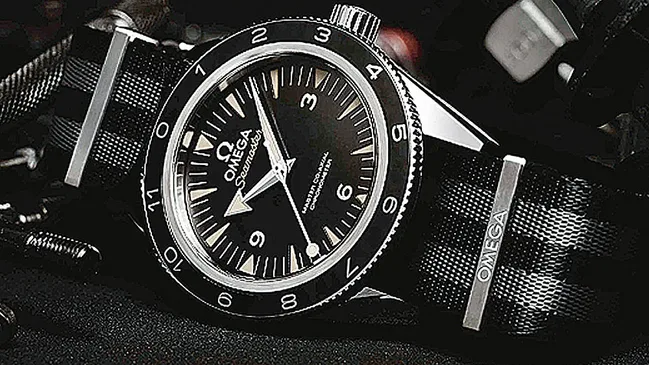
Omega’s in-house base Caliber 8500 debuted in the De Ville Hour Vision at the beginning of 2007, and has since served in many Omega watches. Among these is the Seamaster Aqua Terra, which was outfitted with the automatic movement in 2008. Omega has also refined the watch’s exterior. The formerly smooth dial now sports vertical, parallel ridges, and the frame around the date display has been raised higher above the plane of the dial. The frame’s faceting is a good match for the distinctively three-dimensional hour indices, which are now coated with luminous material. Two-digit numerals at five-minute intervals have replaced the small, luminous dots around the periphery of the old Aqua Terra’s dial. The hands are double-faceted along their longitudinal axes, matching the faceting on the indices, and a welcome replacement for the simple fold that defines the long axes of the older hands.
The dial makes a high-quality impression, as does the 41.5-millimeter-diameter case, whose shape has remained the same. Credit for the visual panache is mostly due to the middle piece, which has organically curving lugs and very precisely alternating polished and satin-finished surfaces. On the watch we tested, only the transition to the lugs, where the polishing disk couldn’t reach into the narrow angles, is less than meticulously executed. Otherwise, the craftsmanship of the case is excellent. The case has sapphire crystals in the front and back, with nonreflective treatment on both surfaces of the front crystal. The crown can be screwed shut and the back is threaded around its periphery. These details guarantee that the case can resist 150 meters’ worth of water pressure. (Click on photos for larger images.)

Omega Seamaster Aqua Terra
PR
The attention to quality is also evident in the stainless-steel bracelet, although the styling here has fewer details than that of the dial and case. The bracelet is massive but not too thick, and its links are solidly screwed. Its upper surface is satin-finished and its flanks are polished. The double-folding clasp has its pluses and minuses. All components, including the two safety buttons, have been milled from a solid block of steel, and the lack of a closure bow gives the clasp a very elegant appearance on the wrist. But the bracelet’s length cannot be adjusted by means of spring bars, so the only way to do so is to use a screwdriver to remove either half a link or an entire link until the bracelet fits perfectly. This means that the wearer cannot adjust the bracelet for minor variations in the size of his wrist without using a tool. Furthermore, the safety buttons open only one wing of the double-folding clasp, so the wearer must then flip open the other side by giving it a little tug.
This watch is very easy to operate. Its crown is constructed in such a way that it is firmly screwed, but has a large and easy-to-grip surface and snaps smartly into its various positions. After the crown has been unscrewed, the watch offers little resistance and clicks almost inaudibly when its mainspring is manually wound — although manual winding won’t be necessary very often, because this self-winding watch amasses a 60-hour power reserve. You’d have to leave it motionless throughout an entire weekend before you’d need to reset and rewind it. Read the full review here.
This article was originally published on March 6, 2013 and has been updated.
Save
Save