Jul 8, 2020
Reading time 7 min.
Direction Selection: A Hands-On Review of the New Oris Aquis GMT Date
FEATURE:

The Aquis GMT Date doesn’t represent a venture into previously unexplored terrain for Oris because the popular independent brand from Hölstein, Switzerland, has previous experience with time-zone watches. The Oris Big Crown ProPilot Worldtimer is a pilots’ watch with innovative time-zone setting via the bezel. The local time advances in single-hour increments when you turn the bezel clockwise and retreats in hourly steps when you turn the calibrated ring counterclockwise; the date moves correspondingly backward or forward whenever the reset hour hand passes midnight. With the Big Crown ProPilot Caliber 114, Oris has even equipped Caliber 114, which was developed in-house, with a second time zone via a 24-hour scale, 10 days of power autonomy, and a 240-degree power-reserve display.
Oris’s experience with world-time watches dates back to the 20th century. The launch of its Worldtimer in 1997 was a world first because its patented time-zone mechanism let the user reset the local time forward or back in hourly increments simply by pushing a designated button on one side of the case or the other. Even in this first model, the date jumps forward or back whenever the local time crosses the midnight mark. In 2008, Oris launched the BC4 Flight Timer, a watch with three time zones, one of which could be reset using a vertical crown at 2 o’clock. This watch even won a Red Dot Award in the “Best of the Best” category in 2009.
The Time-Zone Settings Can be Used in Different Ways
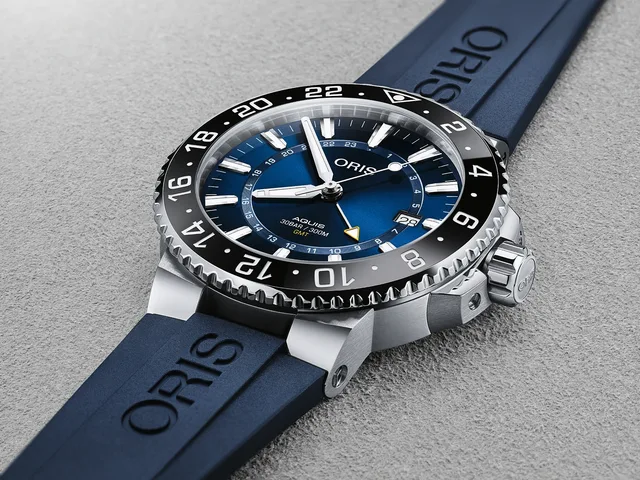
During the day, the indexes and hands stand out clearly against the gleaming dial and all displays are easy to read.
PR
By comparison, the representation of three separate time zones seems downright unspectacular on the Oris Aquis GMT Date, the watch tested here. The hour hand cannot be reset in hourly steps nor does the date jump forward or back when the hour hand passes midnight. A pair of bold hands shows the local time conventionally from the center of the dial. A second time zone is also indicated from the dial’s center by an additional slim hour hand with an arrowhead at its tip. This hand requires one full day to complete each of its orbits and refers to an inner 24-hour scale. If desired, you can position the bidirectional rotatable 24-hour bezel so it can show the time in a third zone. To accomplish this, align the corresponding hour numeral or index point, both of which are engraved into the bezel, with a full hour marking on the inner 24-hour scale. To then be able to read the time in this third zone, the 24-hour hand must first be brought into the correct position. This can be accomplished, albeit somewhat awkwardly, by withdrawing the crown to its middle position and then turning it clockwise. Incidentally, the date can be reset by turning the partially withdrawn crown counter-clockwise. The time in a second zone can now be read directly from the 24-hour hand, while the time in a third zone can be read by visualizing this hand’s axis extending out to the rotatable bezel. If you reset the main time while traveling in a different time zone, the 24-hour hand must also be adjusted so the home time is shown correctly. Alternatively, the user can temporarily rely on the 24-hour hand to indicate the time in the new zone by adjusting this hand as necessary and leaving the main time untouched. Both options are possible, but neither is as convenient as a jumping hour hand, especially because you must pay attention to the date switching and to the time-zone bezel, if it’s also in use. Another drawback is that the caliber comes to a halt when the main time is being reset so the exact second is lost. Furthermore, if you temporarily use the 24-hour hand to indicate the main time, you must also bear in mind that it requires a full day to complete one full journey around the dial. This procedure is admittedly somewhat time consuming, but its welcome result is that the watch’s face always provides a good overview of the times in three different zones.
It Knows Every Trick in the Book
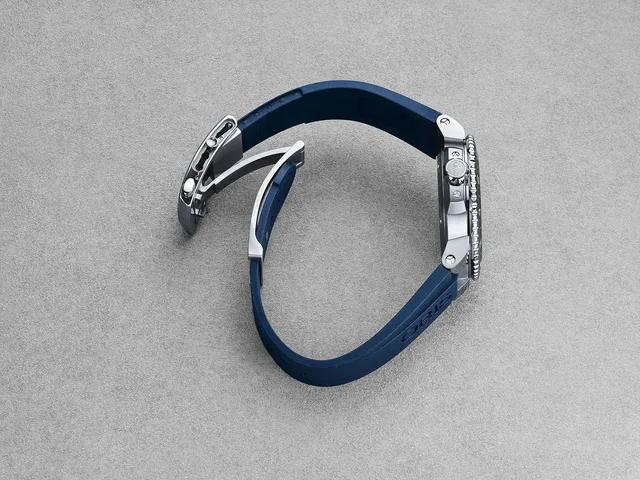
The rubber strap can be adjusted in a series of five steps that total 16 mm in length.
PR
The hour appliqués and the hands stand out in contrast against the shiny blue dial, which shimmers in the light and reminds us of the origin of the Aquis as a divers’ watch. The 24-hour scale on the inner radius of the hour indexes is large and clear, to say nothing of the fine clarity of the calibrated bezel. All elements of the time display glow in the dark with a splendid blue hue – another reference to the maritime tradition of the Aquis. The bezel is bidirectionally rotatable, so this timepiece has given up its claim as a full-fledged divers’ watch, but this doesn’t mean that it is afraid to get its feet wet. In any case, today’s professional divers almost always have a diving computer with them. Pressure resistant to 30 bar, the Aquis is always suitable to serve as a mechanical update – perhaps not for professional diving, but for snorkeling in the Red Sea, swimming in the Atlantic, bathing in the Caribbean, or sailing on Lake Geneva. This capability is not only due to its water tightness of 300 meters, but also to its massive 43.5-mm stainless-steel case with its threaded screw-in back and screwed-down crown. Moreover, two screwed-on flanks protect the crown against lateral impacts and shocks.
The Clasp and Loop Hold Securely
The sturdy blue rubber strap on our test watch is securely screwed to the strap lugs using Oris’s unique method and ends in a functional deployant clasp. Introduced in 2010, this sliding clasp integrates a length-adjusting, quick-release system that can be operated without having to slip the watch on your wrist – an ideal mechanism for people who enjoy water sports. It allows the overall length to be varied up to 16 mm, in five individual steps. One end of the rubber strap is fastened to the clasp by a pin. On the other end is a loop that catches the clasp, should it accidentally open. This prevents the watch from inadvertently slipping on the wrist – a big advantage, not only when you’re in the water.
All the elements of the time display glow a handsome blue in the dark.
PR
Everyday Usability at an Attractive Price
Oris watches are designed to be highly suitable for everyday use and to have a favorable price-performance ratio. These qualities are also evident in our test watch’s movement, which is left relatively unadorned but is nonetheless visible behind a pane of mineral glass in the fully threaded caseback. The characteristic red rotor catches one’s eye and immediately distinguishes this watch as an Oris. As a registered trademark since 2001, it symbolizes the philosophy of the brand, and when you take a closer look at the movement, you see that it simply has to fulfill its purpose. The position of the regulator screw shows that the movement has been deliberately adjusted to gain slightly; it could run with a bit better balance if it were slightly readjusted in the “6 o’clock up” position. But on a journey across the world’s oceans that involves hours, this very small irregularity is unlikely to play any role.
PR

PR

PR