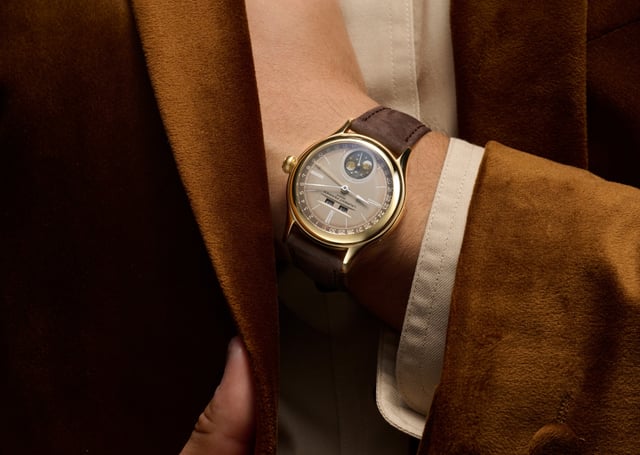
The Measure of All Things: Spotlight on the Audemars Piguet Code 11.59 Universelle RD#4

Most people think of the Royal Oak when they hear the name Audemars Piguet. But the fact that the company, based in Le Brassus in the Swiss Jura region, is one of the top names in the watch world is by no means only due to this classic stainless-steel sports watch introduced in 1972. From its founding in 1875, Audemars Piguet has specialized in complications, presenting the first pocketwatch with a perpetual calendar in 1882, followed in 1889 by the first Grande Complication, equipped with split-seconds chronograph, perpetual calendar and minute repeater. This extraordinary timepiece was awarded a medal at the World Fair held in Paris.

Audemars Piguet has always searched for new challenges, and one of these was miniaturization. In 1891, the company created the smallest watch movement with a minute repeater, which has a diameter of only 18 mm, and presented the first wristwatch with this complication one year later. Audemars Piguet is also mastering the art of combining a large number of components in the flattest possible construction. The thinnest pocketwatch, from 1925, with a thickness of only 1.32 mm, was followed by additional world record-breaking thin watches after 1946. This culminated in the first 4.8-mm-thin wristwatch with a tourbillon and automatic mechanism, introduced in 1986. And this is also historically significant because it heralded the era of wristwatches with a tourbillon, which so many other brands began offering in 2000.
Record-setting Watch
In 2023, there is a new record-setting watch. After seven years of research and development, the Code 11.59 Ultra-Complication Universelle RD#4 has emerged as the most complicated watch, not simply wristwatch, ever made by Audemars Piguet, according to its own reports. The manufacture lists 40 functions, and divides them into 23 complications and 17 “special technical devices.” In every group of complications there are details that make them even more exceptional. For example, the minute repeater does not stand alone but is combined with a grande and a petite sonnerie. And the perpetual calendar will need to be adjusted in the year 2400, not in 2100 like most others. Audemars Piguet calls this a “semi-Gregorian perpetual calendar.” The chronograph function also has a split-seconds hand and a flyback function, and the tourbillon has a flying design, with no overarching bridge, which is an additional achievement.

User-friendly Operation
Assembling a lot of mechanisms in a single watch was not Audemars Piguet’s primary focus. According to Giulio Papi, Audemars Piguet’s Technical Director, this masterpiece was intended to fulfill three basic objectives: It must be easy to use, be as thin as possible, and have a dial that is not overloaded with detail.
This mission was accomplished. With a case thickness of 15.55 mm, the 42-mm watch in white or pink gold is remarkably thin, given all its complications, and lies comfortably on the wrist. Even its weight of 180 grams is acceptable.
Setting the functions is really very simple. Audemars Piguet has avoided recessed pushers that require a metal stylus or other pointed tool to correct the calendar. Three pushers are placed on the left side of the case: The middle pusher at 9 o’clock is used to correct the day of the week, and the lower pusher at 7:30 is used to adjust the moonphase. The upper pusher is used to start the minute repeater and replaces a conventional slide lever.
Placed on the right side of the case are three crowns, each of which has an integrated coaxial pusher. The top crown is used to select the chiming mode: Grande sonnerie, which chimes the hour and quarter hours; petite sonnerie, which chimes only the hours; or Silent mode. As usual, this pusher serves to start and stop the chronograph. The middle crown is used to set the hands when fully pulled out and to adjust the date in mid-position. Its integrated pusher is used to operate the split-seconds mechanism. The bottom crown is used to adjust the month indication at 3 o’clock and can be turned in either direction. The double-digit display for the year at 4 o’clock will change automatically when advancing the month from December to January. The pusher is used to reset the flyback chronograph to restart at 0 without stopping.

The Code 11.59 Ultra-Complication Universelle RD#4 is available in four different versions — two with skeletonized dials in a white-gold or a pink-gold case and two white-gold models with a closed black or beige dial. The solid-dial versions are surprisingly legible for such a complicated watch.
The dial is dominated by the two counters for elapsed minutes at 9 o’clock and hours at 3 o’clock and the opening for the flying tourbillon at 6 o’clock. The calendar functions are arranged around the dial — the day of the week at 9 o’clock, the large date at 12 o’clock, the month at 3 o’clock, the double-digit year at 4 o’clock, and the moon-phase at 8 o’clock.
Movement with 1,140 Components
If you turn the watch over, the first thing you will see is a closed caseback, which can be opened with a small slide lever on the left side. This releases the “secret” cover and provides an astonishing view not only of its finely guillochéd inner surface with specially designed openings to amplify the sound of the chime, but above all, its spectacular movement. The self-winding manufacture Caliber 1000 consists of 1,140 separate components, including 90 bearing jewels made of synthetic ruby. It provides a power reserve of 64 hours and oscillates at a respectable 3 Hz, equal to 21,600 vph. It measures 34.3-mm across and is only 8.75-mm high.
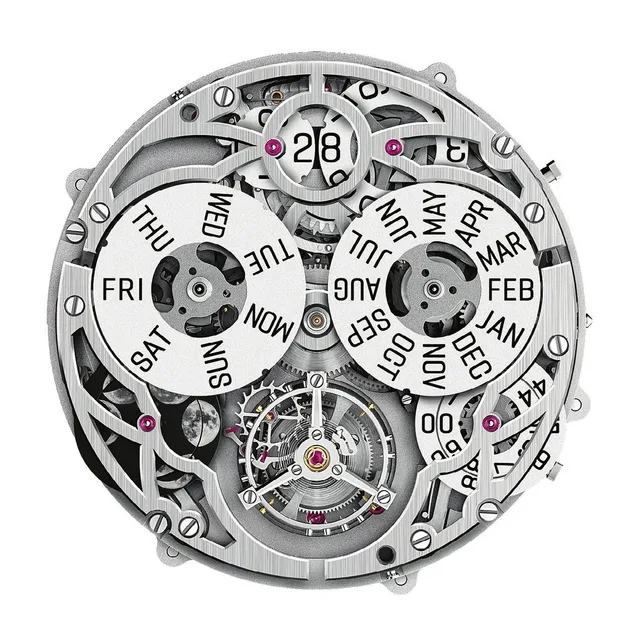
The Universelle, also known as the RD#4, combines the Supersonnerie technology introduced in 2015 in the RD#1, which ensures a clear chime, thanks in part to a soundboard; the ultra-thin construction of the perpetual calendar introduced in 2018 (RD#2); and the oscillator with increased amplitude from 2022 (RD#3). The chiming mechanism has a separate barrel, which is wound alternately with the main barrel. The gongs are attached to the extremely thin soundboard, newly designed for the Universelle. This is made of sapphire crystal and is only 0.6 mm thick. The oscillating weight is also remarkable. It is made of platinum and decorated with engraved sound waves. Integrated in the center of its large ball bearing is the split-seconds mechanism and its clamp jaws. This design, as well as the arrangement of the perpetual calendar functions on a single plane, result in a considerable reduction in the overall thickness of the movement.
No Adjustment Needed Until 2400
The perpetual calendar has another refined feature. Unlike most of its competitors, whose calendars must be corrected in the year 2100, it will not need adjustment until 2400. It also accounts for the fact that in the Gregorian calendar, a leap year falls in years that are divisible by 100 but not by 400. Most people haven’t been bothered by the fact that the majority of perpetual calendars will need to be manually corrected on March 1, 2100, since most of us won’t be around to see this date. But since that date is getting closer, it will become an increasingly important issue for developers of new perpetual calendars over the next few decades. Audemars Piguet has already reacted to this.

Incidentally, the addition of “Universelle” to the Ultra-Complication name is a nod to another ultra-complicated watch in Audemars Piguet’s history. The Grande Complication Universelle from 1899, just like its successor, boasted both a grande and petite sonnerie in combination with a minute repeater, split-seconds chronograph and perpetual calendar. Similarly, the movement was housed in a platinum officer’s case with a spring-loaded cover. It also had an alarm and foudroyante (flying second hand).
New Manufactory in Le Locle
The Code 11.59 Ultra-Complication Universelle RD#4 is not limited to a specific number of pieces, but in light of its complexity, it is naturally being produced in smaller quantities: seven pieces in 2023 and twice that number for 2024. Like all complications from Audemars Piguet, it is being produced in the new manufactory opened in Le Locle in 2021, while “simpler” watches will continue to be made in Le Brassus in another new production facility. The price of the Universelle is just as exclusive as the watch itself, currently listed at between 1.45 and 1.6 million Swiss francs (plus tax), depending on the version.

With the Code 11.59 Ultra-Complication Universelle RD#4, Audemars Piguet has brought another masterpiece to life. The company was not satisfied to simply combine several complications in a single watch — a feat that would have been difficult enough. It has created an extraordinarily complex watch that is easy to wear, operate and read. Its high price means that very few people will be able to enjoy its many virtues. But we can expect that in the future, the manufacture will reveal one or more similar offerings in less-complicated watches. For the time being, the Universelle at Audemars Piguet remains the measure of all things.
To learn more, visit Audemars Piguet, here.
This article was originally published in the July/Aug 2023 print issue. To subscribe to the magazine, click here.