Sep 3, 2020
Reading time 6 min.
Under the (Magnetic) Waves: Hands On With the Omega Seamaster Planet Ocean 600M Master Chronometer
WATCH REVIEW
The Seamaster Planet Ocean 600M Co-Axial Master Chronometer represents Omega’s maritime heritage, but instead of a dive test, we expose this watch to the continuous magnetic force inside an MRT.
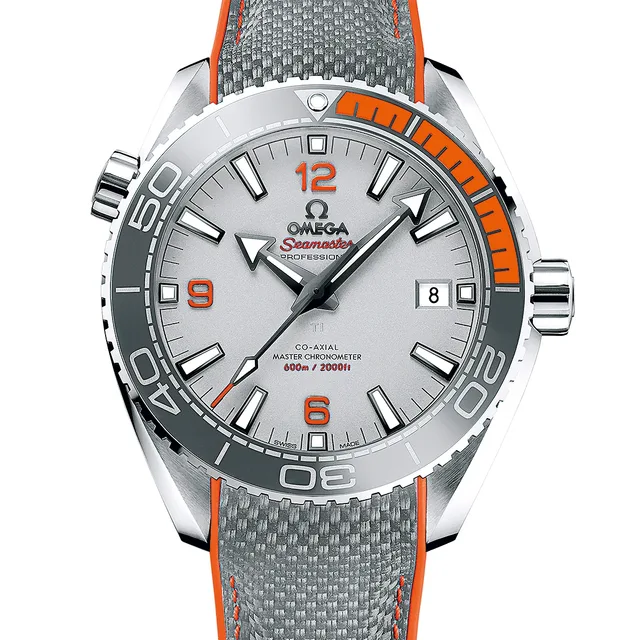
The Seamaster Planet Ocean 600M Co-Axial Master Chronometer represents Omega’s maritime heritage, but instead of a dive test, we expose this watch to the continuous magnetic force inside an MRI.
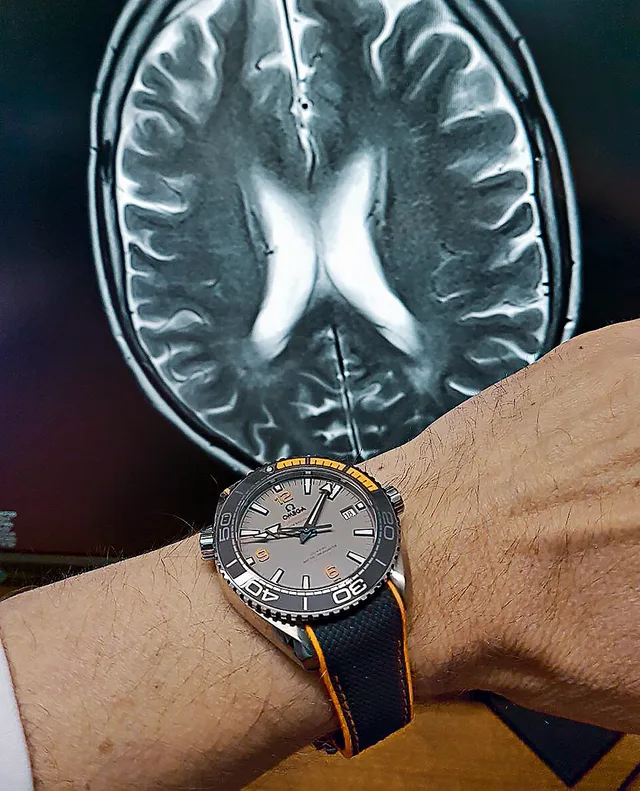
Omega Seamaster Planet Ocean 600M under MRI
PR
Dr. Hans-Ulrich Röder inspects the 43.5-mm Omega Planet Ocean with some skepticism. Only then does he reluctantly take off his much more elegant Omega Seamaster Aqua Terra >15,000 Gauss that he’s owned since 2013 and put on the Planet Ocean. Dr. Röder is a radiologist in Heidenheim, Germany, and one of the creators of the Omega Master Chronometer project. He told us he always wanted a watch that wouldn’t be damaged at work, and so we passed his request on to Omega. We designed our extended test to be carried out on and in a magnetic resonance tomograph (MRI) – just right for Dr. Röder and his work.
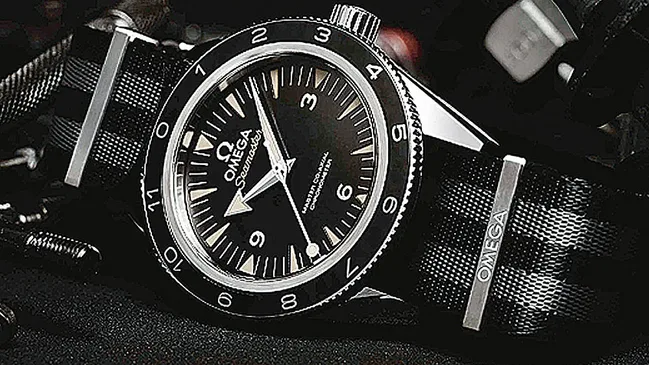
When Dr. Röder first put the watch on, he didn’t realize that he’d appreciate the dive watch with its orange accents on the gray dial, the ceramic bezel and the rubber strap so quickly. He found the titanium case lighter and the rubber strap more comfortable to wear than he first thought. “It feels perfect despite its size and thickness,” was his pragmatic first impression. Strong contrasts on the dial mean the time is easy to read and its Super-LumiNova coating creates a beacon of light at night.
“The rotating bezel ratchets nicely,” Dr. Röder continued, but its size makes it a killer with a regular shirt cuff. Oh, well – we'll let him put the Aqua Terra back on for a night at the opera. The chronometer-certified Omega manufacture Caliber 8900 in the Planet Ocean has a power reserve of 60 hours provided by two barrels, so it’s just fine to let it relax on the bedside table over the weekend.
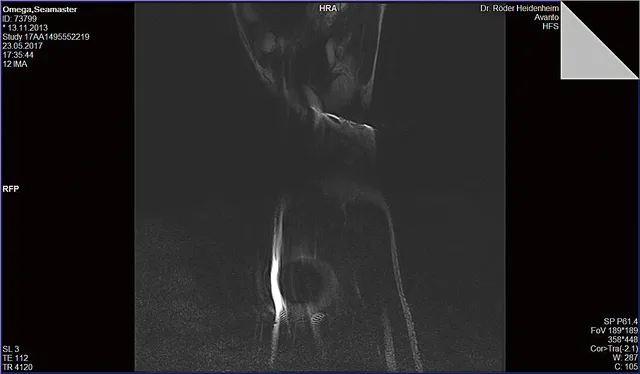
Photo series of the Seamaster Planet Ocean on Dr. Hans- Ulrich Röder's wrist during an MRI examination.
The watch is on the left side of the wrist.
PR
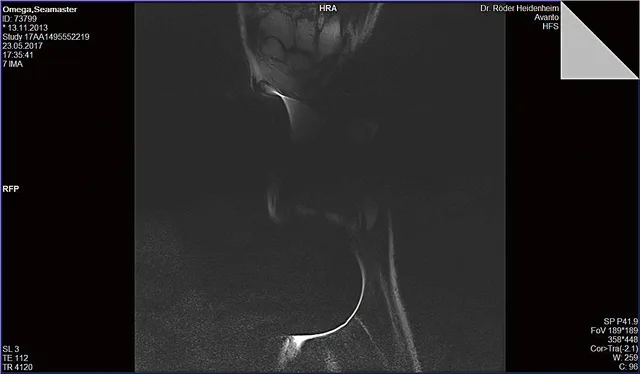
Photo series of the Seamaster Planet Ocean on Dr. Hans- Ulrich Röder's wrist during an MRI examination.
The watch is on the left side of the wrist.
PR
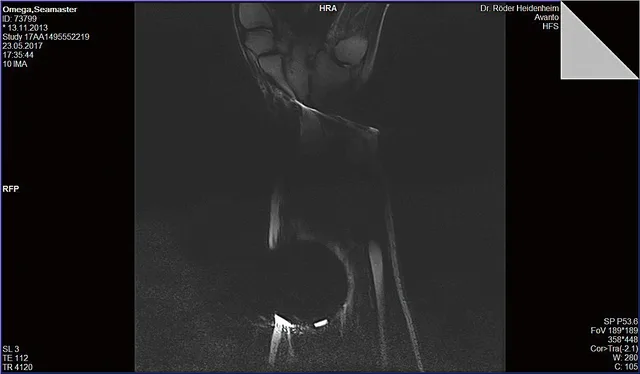
Photo series of the Seamaster Planet Ocean on Dr. Hans- Ulrich Röder's wrist during an MRI examination.
The watch is on the left side of the wrist.
PR
But here’s where we were wrong. On Sunday morning, Dr. Röder had to get back to work. By this time he had come to appreciate the advantages of the Planet Ocean’s rotating ceramic bezel, and not just for diving and swimming, for which it is well suited and easy to read under water. He also used the bezel to time his cycling and jogging, for boiling eggs and steeping tea, for timing his phone calls and while watching sports. This is the world’s first gray ceramic bezel made of silicon nitride with a dive track made of Liquidmetal — an alloy that is considerably harder than steel, blends seamlessly with ceramic, and is extremely resistant to scratches and corrosion.
Regarding the Planet Ocean’s qualifications as a dive watch, it has a unidirectional rotating bezel; a screw-down crown in a case tube; an unusually thick, domed sapphire crystal; and a case design that withstands pressure to 60 bar. The Master Chronometer-certified Planet Ocean is remarkable for its incredible resistance to magnetic forces. Omega cites its resistance to magnetic fields up to 15,000 gauss (1.5 teslas). And it is precisely this kind of magnetic field to which we subject the Planet Ocean during our months-long test at Dr. Röder’s radiology office.
First, when worn on the wrist, it comes to the edge of the MRI machine and is exposed to a constant and often changing magnetic field. Dr. Röder notes positively that the minimal deviation in rate is no more than 1 second per day, and usually even less. But then the watch is put into the MRI – first by itself, and then on the doctor’s wrist. In both instances, it continues to run trouble-free.
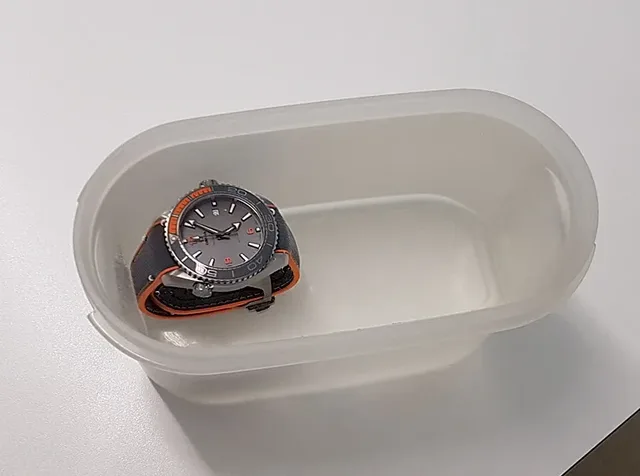
1) Immersing the Planet Ocean in water
PR
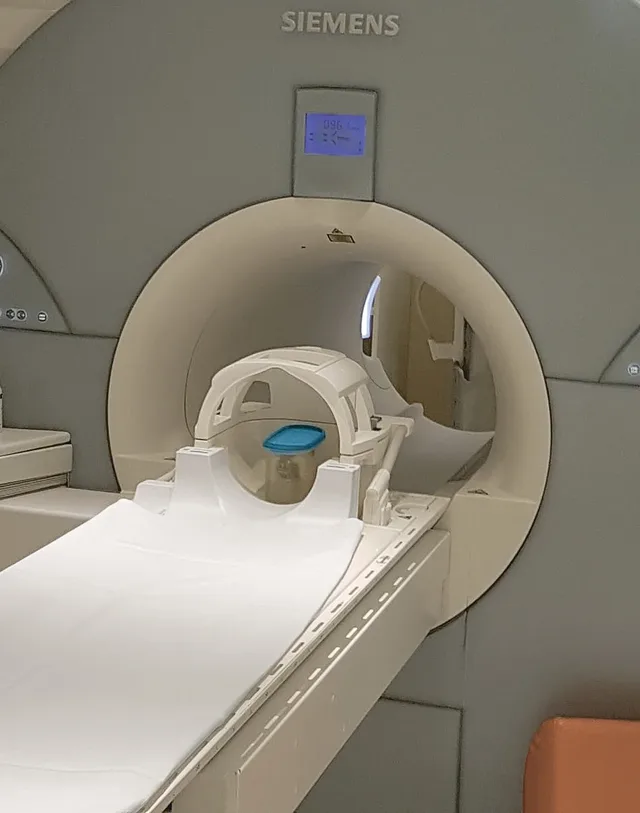
2) The Planet Ocean right before the experiment
PR
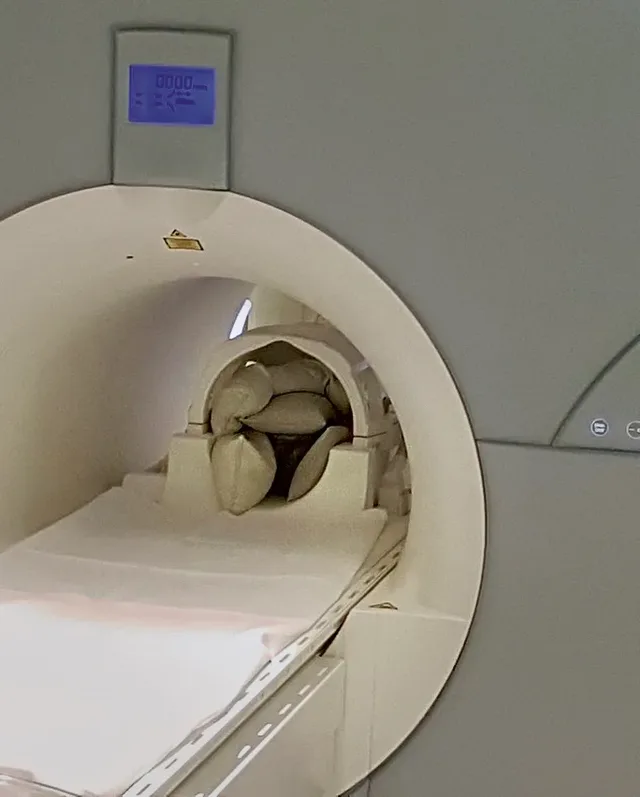
3) The watch in variable magnetic fields
PR
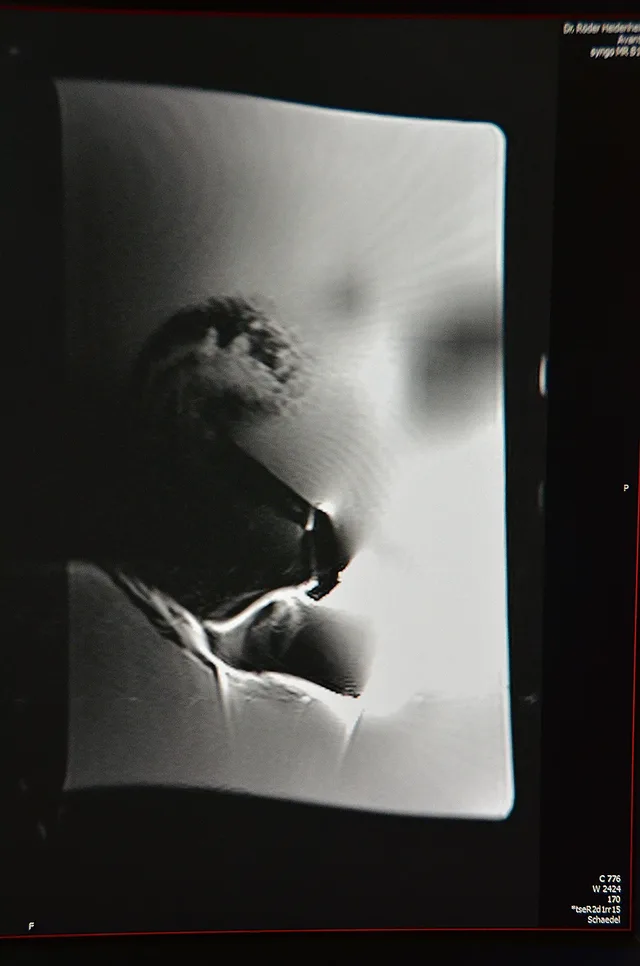
5) Underwater photo from the experiment
PR
Dr. Röder is impressed and comes up with the idea to “examine” the Planet Ocean in its natural medium – water – and not just to record photographic evidence. In the MRI, “we’ll see very little of the watch,” he tells us, to our disappointment, “because the metal causes a loss of signal.” He knows this from viewing titanium medical implants such as hip replacements. “But,” he continues, “we will prove that the watch can survive centrally in the magnet, in a coil with changing measurement sequence and strong gradient fields that change in milliseconds. If it works, we’ll be the first ones to show proof of it.” Dr. Röder openly admits his excitement and explains the difference between this experiment and the tests carried out by Omega. The manufacturer guarantees magnetic field protection up to 15,000 gauss, measured in a static field of a permanent magnet. In contrast, the MRI provides a constantly changing mag- netic field. Whirlwinds, vibrations and high-frequency waves produce the images in a matter of milliseconds, creating a much higher load for the watch than a permanent magnet. Dr. Röder calls it “turbo-spin echo sequences with a high turbo factor.” Whatever that might mean to the uninitiated, the test result is, like the meaning of the word, a real turbo performance. “Nothing rattles this watch or the movement,” Dr. Röder confirms.
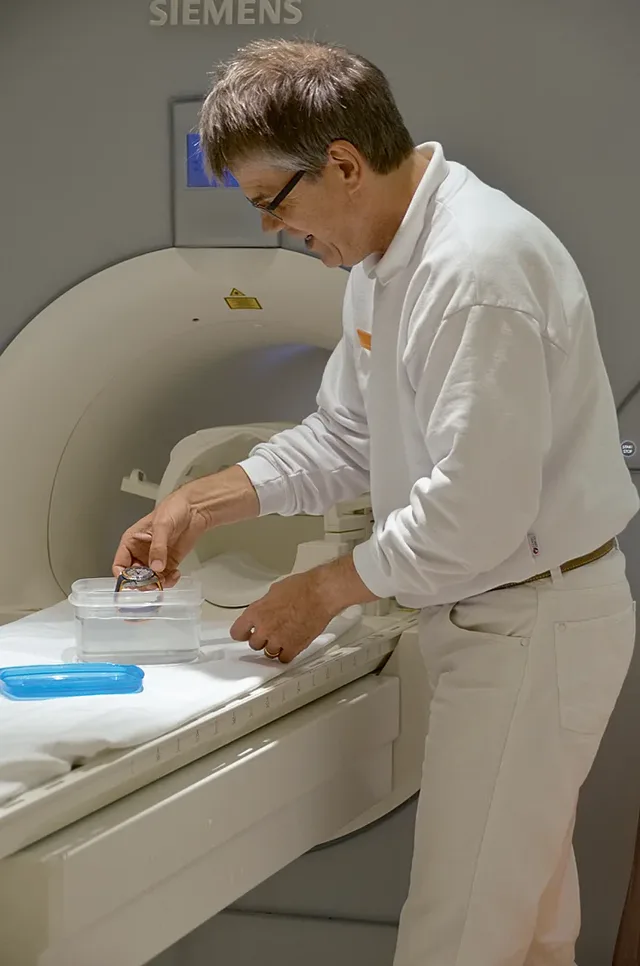
6) Dr. Röder wore the watch for several months while operating the MRI.
PR
Back at the editorial office, the Seamaster Planet Ocean shows the same excellent rate results as it did before its months-long stay inside the MRI – only the amplitudes are somewhat lower. But this is no great concern. Following our earlier tests in magnetic fields of up to 70,000 gauss, which were only brief snapshots, our extended test proves that Omega’s Master Chronometers can withstand prolonged loads in constantly changing magnetic fields and are extremely useful and suitable for everyday wear.

Strong contrasts on the Planet Ocean’s dial mean the time is easy to read.
PR
SPECS:
Manufacturer: Omega S.A., Stämpflistrasse 96, 2504 Bienne, Switzerland
Reference number: 0215.92.44.21.99.001
Functions: Hours, minutes, central sweep seconds, date, time-zone function, rotating dive bezel, screw-down crown, helium escape valve
Movement: Omega 8900, automatic, COSC certified, certified by METAS to be antimagnetic to at least 15,000 gauss, 25,200 vph, 39 jewels, Nivachoc shock absorption, titanium balance, Silicon (Si14) hairspring, screw-type fine regulation, 60-hour power reserve, diameter = 30.0 mm, height = 5.50 mm
Case: Titanium with ceramic bezel, water resistant to 600 m
Strap and clasp: Rubber strap with single-sided folding clasp
Rate results (Deviation in seconds per 24 hours, before/after MRI test)
Dial up +2.1 / +1.7
Dial down +0.4 / +1.2
Crown up +1.1 / –2.8
Crown down –0.3 / +2.9
Crown left +1.3 / +3.5
Greatest deviation 2.4 / 6.3
Average deviation +0.9 / +1.3
Average amplitude:
Flat positions 278° / 271°
Hanging positions 252° / 248°
Dimensions: Diameter = 43.5 mm, height = 16.2 mm, weight = 104 grams
Variations: With titanium bracelet; stainless- steel case with leather or rubber strap or stainless-steel bracelet; various dials and bezels; Sedna gold case; with diamonds
Price: $8,100
Photos by Dr. Hans-Ulrich Röder, the author, and Omega.