Ochs und Junior's Minimal Complications
This article was originally published in the Design 2023 Issue of the WatchTime print magazine. Photos by Marcus Krüger and Ochs und Junior.
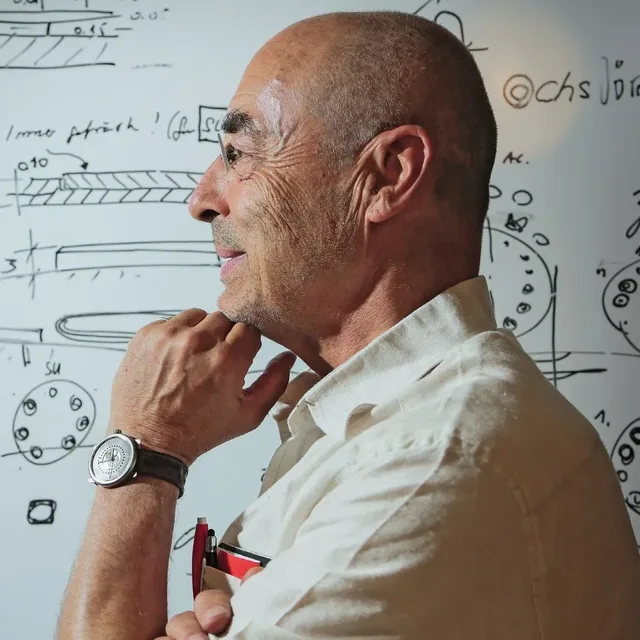
Ochs und Junior was founded in 2006 by the innovative developer Ludwig Oechslin and his partners; today it belongs to the Oechslin family. Only 130 watches are produced each year at the company’s headquarters inside an Art Nouveau villa in La Chaux-de-Fonds. One might expect extremely high prices under these conditions, but the watches begin at 3000 euros even with an innovative weekday display. Ludwig Oechslin carried out and documented a restoration of the Farnese Clock in the Vatican from 1978 to 1982. He was then discovered by Rolf Schnyder (CEO of Ulysse Nardin until his death in 2011) when searching for a designer who could create astronomical complications. Oechslin first developed an astrolabe for Ulysse Nardin, followed by other complex models like the Freak and a perpetual calendar. From 2001 to 2014, Oechslin led the Musée International d’Horlogerie in La Chaux-de-Fonds. He studied mathematics, astronomy, archaeology and theoretical physics in his academic career, culminating in doctoral and post-doctoral degrees. And during that time, Oechslin also completed a watchmaking degree and master watchmaker examination. For him, science and craftsmanship are not polar opposites but come together neatly in watchmaking. “For me, everything is part of a single thing, the one complements the other. Scientific work provides the foundation for creative action.” Versatility also has a practical effect. According to Oechslin, “Intellectual labor is a vacation from manual labor, and vice versa.”
The idea behind Ochs und Junior is to design functions as simply as possible with displays that are also just as simple. This is why the perpetual calendar module is made of only nine additional and three modified parts. This model is named Calendario Cent’Anni (CCA), or the “hundred-year calendar” in Italian — a more precise description than “perpetual” since every 100 years there is no leap year (with the exception of the years that are divisible by 400). The next time this occurs will be in 2100, which is the point when the calendar must be corrected. This also applies to perpetual calendars from other brands.
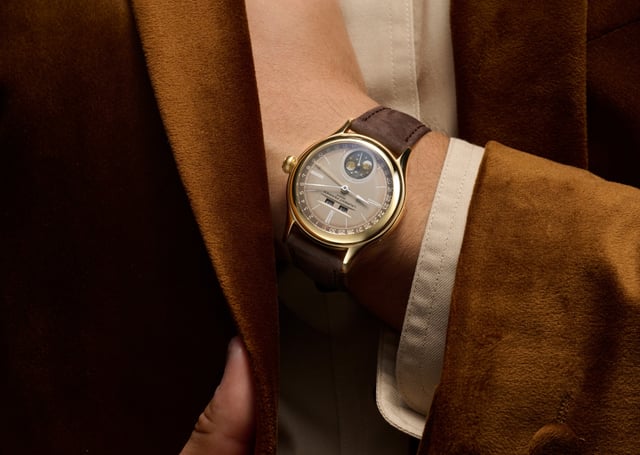
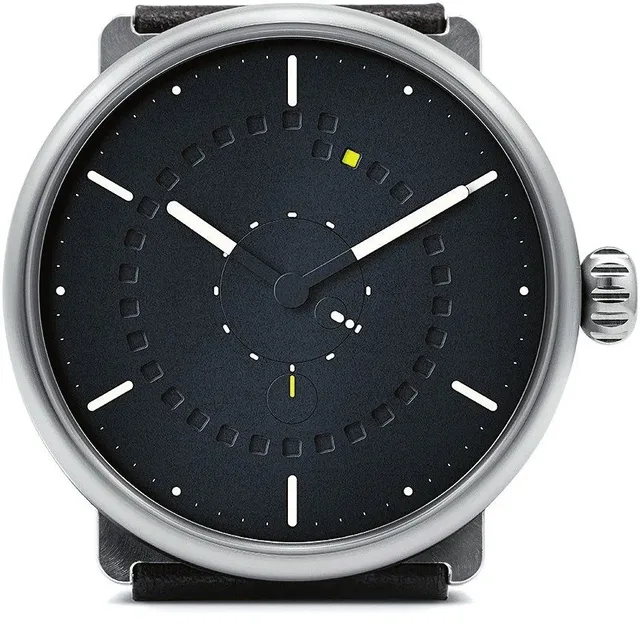
Reading the Perpetual Calendar watch is not immediately apparent, but after a brief explanation it very quickly becomes intuitive. Hour and minute hands work in the conventional way, and the running seconds are displayed by a small disk at 6 o’clock with a line pointer in a contrasting color. A snail-shaped track with 31 small openings — one placed at every other minute — shows the date. The central inner disk indicates the month, with a dot that points to 12 markings that are arranged in line with the hour markers. A small satellite inside this disk indicates a leap year when the marker points outwards. Despite the small number of parts, operation is extremely easy. The date, and all other displays along with it, can be adjusted forwards or backwards via the crown. T he Perpetual Calendar is available in different variants, including a modern design with a black dial and white or yellow accents, and with or without numerals. Or, customers can design the watch themselves using an online customizer. There is a choice between silver or titanium for the case material, with or without coating, as well as a variety of straps and colors for every element on the dial. In addition to different varnish colors, there is a signature Ochs und Junior brushed and oxidized brass finish option for the dial. The case is also plain and simple — round with short lugs. Oechslin describes it as a container that protects the movement, but one that does not distract from the principal element, which is the dial. Every watch is also water resistant to 100 meters and has a screw-down crown. Ochs und Junior is also different in other ways. The brand name is not found on the dial but on the inside of the strap. And all suppliers and partners are named transparently on the homepage. ETA movements are usually the basis for the complications, while the models with small seconds are based on movements by Ulysse Nardin.
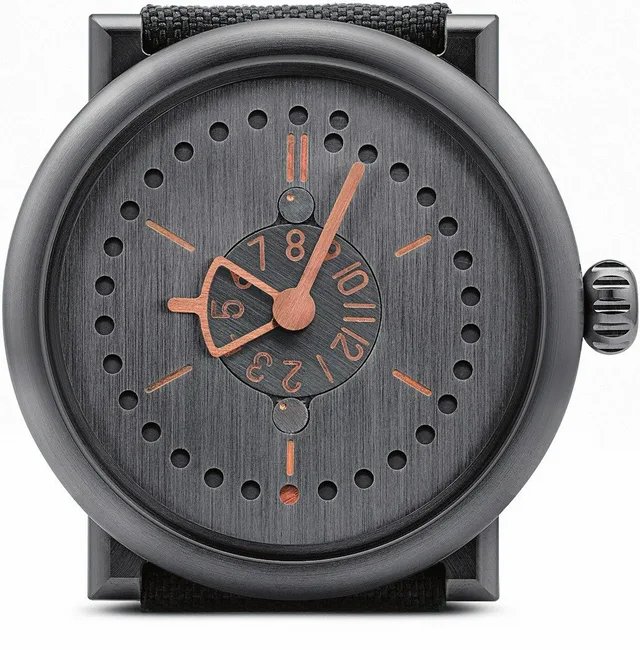
The Settimana entry-level model with weekday display is offered in several different dial colors. The weekday is indicated via seven small round windows and a colored dot. If the dot is visible in the first window, that means it’s Monday. On models with a second time zone, a 12-hour disk that can be advanced using the crown so that the hour hand also shows a second time zone on the track in a 12-hour format.

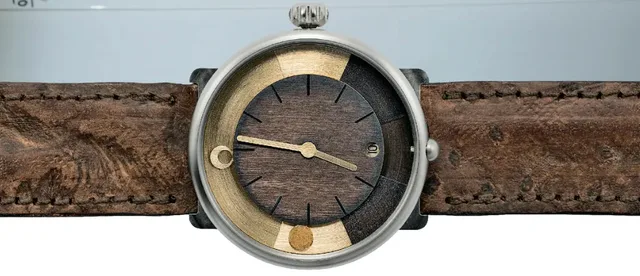
The Day/Night model offers a completely separate complication is that is available only by special order. Each piece is specially calculated and manufactured for the customer’s location. The 12-hour marker for “south” and the two celestial bodies that circle around the inner hour dial are placed in the same positions as the sun and moon at the actual location, so the watch can show the moon-phase and the true midday — i.e., the point in time in which the sun is exactly in the south. The ever-changing dark portion of the lower part of the dial indicates the nighttime hours. It shows exactly how long it will be dark, and when the sun will rise and set. Ludwig Oechslin says he has even more ideas for complications on the drawing board. It will be exciting to see what other brilliant and minimalist innovations are coming next.
To learn more about Ochs und Junior, click here, and to subscribe to the WatchTime print magazine, click here.