Mirror of Civilizations: Spotlight on the Parmigiani Fleurier Tonda PF Xiali Calendar
Michel Parmigiani, founder and Master Watchmaker of Parmigiani Fleurier, explains, “Calendars are a radiography of civilizations. It’s something magical because the calendar comes from the observation of humans as well as of nature. By observing nature, one can travel through history and trace the development of civilizations. I think of the Maya and the Toltec cultures, which had calendars that were very similar to the Chinese calendar. Calendars were born from a need to understand nature’s seasons, to plan the times for sowing seeds and harvesting crops, to anticipate and manage the winter’s cold and the summer’s heat. The calendar exists because we need to anticipate the phenomena of nature’s nurturing.”
Today, the majority of the world obviously uses the Gregorian calendar, introduced by and named after Pope Gregory XIII (Jan. 7, 1502 – April 10, 1585) in 1582. This internationally accepted civil calendar replaced the Julian calendar, and shortened the average (calendar) year by 0.0075 days to better match Earth’s revolution around the Sun. Although modern-day China also uses the Gregorian calendar, the traditional Chinese calendar still governs holidays, such as the Chinese New Year and Lantern Festival, in both China and overseas Chinese communities. And there are several major differences: Instead of naming the months and numbering the years, the Chinese calendar names the lunar years and numbers the months. The names of the years are repeated on a 60-year (sexagesimal) cycle, but the calendar, including dates, days and months, is calculated on the basis of astronomical observations and varies. Because of this, it is impossible to make a mechanical “perpetual” Chinese calendar. Therefore, Parmigiani Fleurier’s creation goes as far as it is possible to go in creating the most complete, and most precise, Chinese calendar in a mechanical watch. The numbering system of the time units is based on the combination of a decimal cycle, the 10 Celestial Stems, and a duodecimal cycle, the 12 Earthly Branches. The 10 Celestial Stems assign elements to seasons and the planets — water, wood, metal, fire and Earth. The 12 Earthly Branches correspond to the signs of the zodiac: Each is represented by an animal, which designates the years of the sexagesimal cycle and will influence the destiny and character of human beings born in that year.
Guido Terreni, CEO of Parmigiani Fleurier, adds, “This year is indeed a very special year. This is a project that I’m very attached to, and it is the nucleus of this year’s collection. The Parmigiani Fleurier Tonda PF Xiali Calendar is a complete Chinese calendar, born from Michel’s passion for cultural calendars. And it is very dear to me because it is also about respecting and understanding different cultures. What sets civilizations apart is the ways in which they interpret time. The Chinese calendar is among the most difficult calendars to master because it’s both a solar and lunar calendar together. For the first time on the wrist, you will be able to see all the elements of the calendar that are not cyclical. It has been a great challenge to master.”
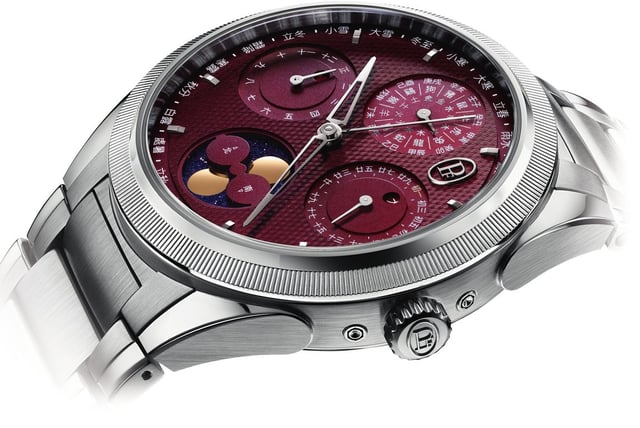
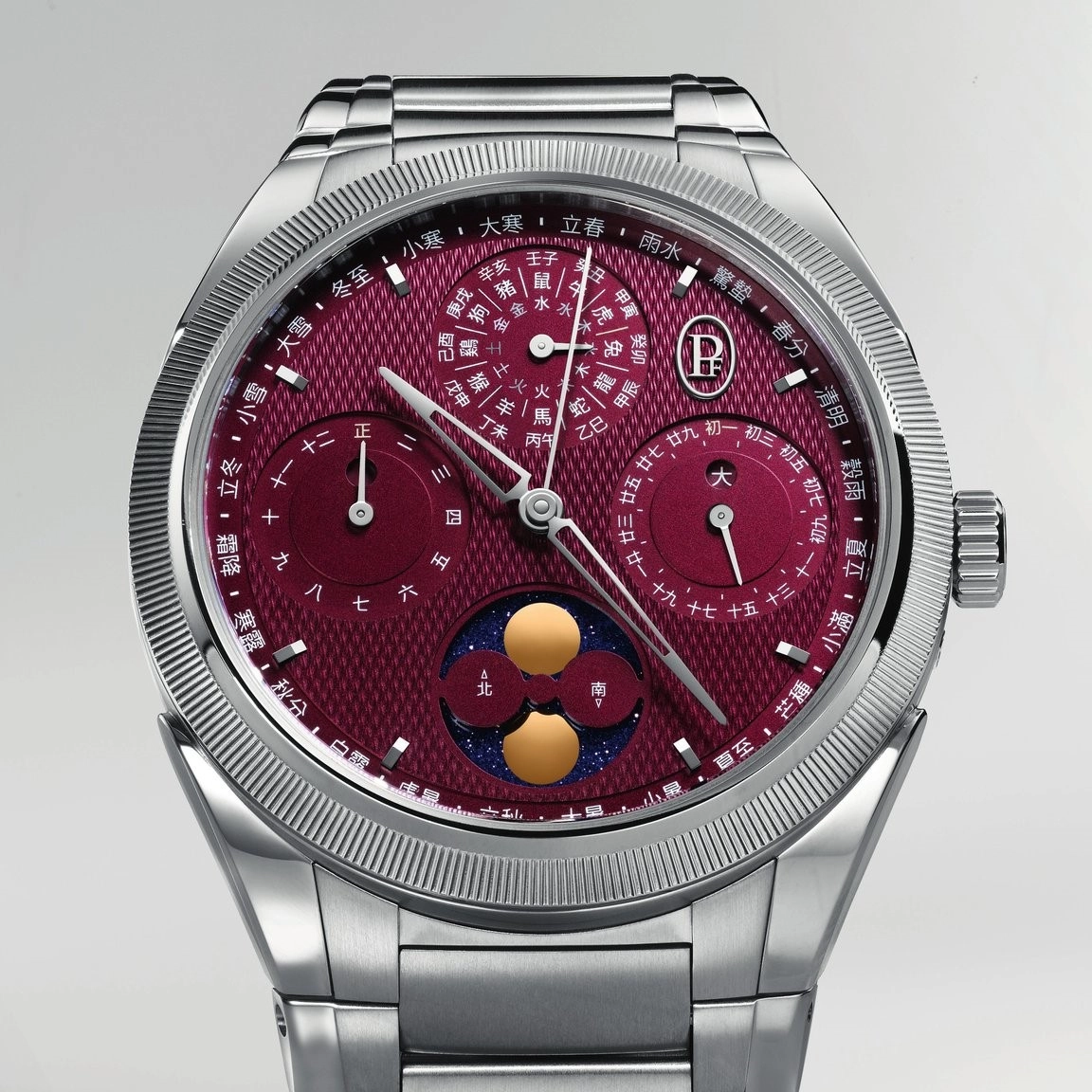
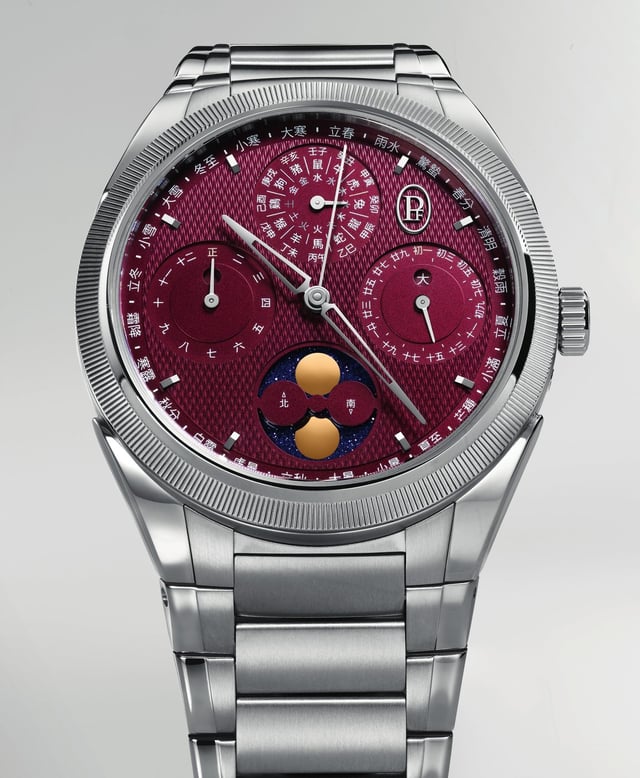
Parmigiani Fleurier managed to condense all information on one dial: hours and minutes; the display of the month and its numbering; an additional month when applicable (i.e., every three years); short month (29 days) or long month (30 days); solar terms as corresponding to 24 divisions of 15° of the Sun’s path along the ecliptic (the Sun’s trajectory as seen from the Earth); pointer and name of the year; indication of the animal and the elements with alternating colors, whether Yin or Yang; numbering of the days and moonphases. All the information and adjustments can be made quickly, thanks to the various correctors located on both sides of the case middle. Inside the 42-mm steel case, Caliber PF008 allows for the display of this information in the classical Chinese characters, and covers a period of 12 years via a cam system. At the end of these 12 years, the watch has to be reset for a new equivalent period. During this period, however, all information remains accurate without any intervention necessary, obviously as long as the watch does not stop.
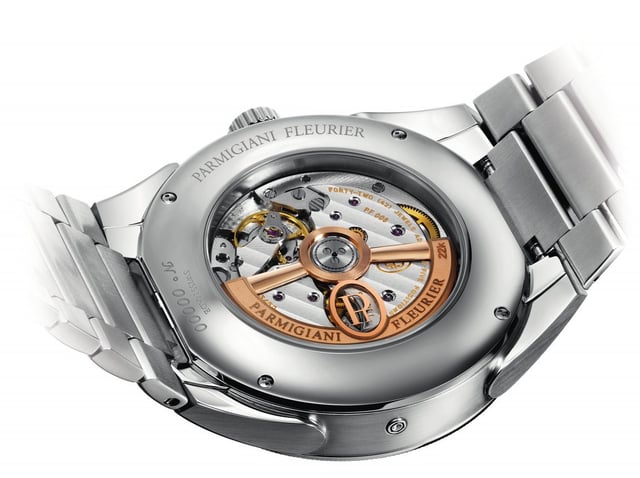
The multi-level dial of the Tonda PF Xiali Calendar comes with rhodium-plated 18k white-gold appliqués and skeletonized hour and minute hands; it is executed in Imperial Red with a “barley grain” guilloché pattern enhancing its surface. The stainless-steel case has a knurled bezel in 950 platinum. As is customary at Parmigiani Fleurier, the caseback is open to show the movement and its decorations through a sapphire crystal. The new Tonda PF Xiali Calendar retails for $65,300 and continues a tradition at Parmigiani Fleurier.
An Award-Winning Perpetual Calendar Unlike the Hebrew or Chinese calendars, the Islamic, Muslim or HijrĪ Calendar does not use leap months or days to account for the difference in length of the solar year. Therefore, the named months do not remain in the same seasons. Instead, they slowly retrogress through the entire solar year, taking 32 and a half years to reoccur at the same seasonal time. The start date of the calendar is based off the Hegira (Arabic: “Migration” or “Emigration,” also spelled “Hejira” or “Hijra”), the Islamic Prophet Muhammad’s journey from Mecca to Medina in 622. Today, the Islamic calendar is primarily used for religious purposes, while the Gregorian calendar is used for civil purposes. In December 2019, Parmigiani Fleurier introduced its very first Hijri Perpetual Calendar wristwatch, based on a technology Parmigiani Fleurier had developed for an exclusive table clock that was launched in 2011 and inspired by the restoration of a pocketwatch featuring an Arabic calendar.
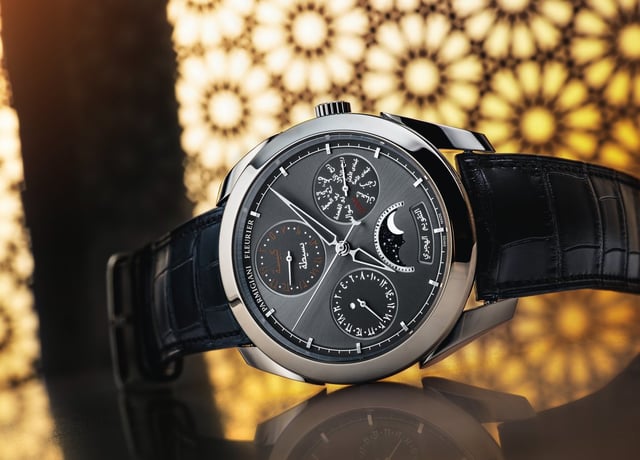
The Hijri Perpetual Calendar (Ref. PFH980-2000110-HA1482) features a 44.5-mm platinum case (with a water resistance of 30 meters), a slate dial and rotor in platinum. It shows the hours and minutes and date in Arabic numerals, the name and length of the months in Arabic calligraphy, as well as the abundant and the common years. It also features a moon-phase in an aventurine sky and a power reserve of up to 48 hours when fully wound. As with all Parmigiani creations, every single component of the movement (Caliber PF009), even the hidden parts, are decorated by inhouse specialists. No components were made of gold. Perhaps more importantly, the bridges are inspired by the typical arches of mosques and adopt the shape of growing and shrinking crescent moons. The Rub el Hizb, an Islamic symbol represented by two overlapping squares, which in Arabic calligraphy marks the end of a chapter, is often used in the holy book of Quran and is also represented in this design to honor the cultural richness of the Arab world through modern watchmaking.
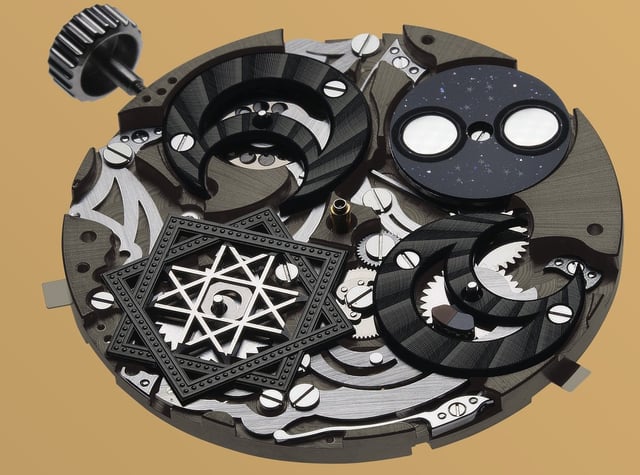
In 2020, Parmigiani Fleurier won the prestigious Innovation Prize from the Grand Prix d’Horlogerie de Genève (GPHG) for its creation of the first Hijri perpetual calendar wristwatch. While it seems like only a matter of time until we will get to see a Hebrew calendar or one of the various Hindu calendars executed in a Parmigiani Fleurier watch, there is, of course, also the 42-mm Tonda PF Annual Calendar (Ref. PFC907-2020001-200182 in rose gold, Ref. PFC907-1020001-100182 in steel with platinum bezel) worth mentioning. Powered by the Caliber PF339, the watch comes with a retrograde date, day, month and 122-year moon-phase visible in both hemispheres.
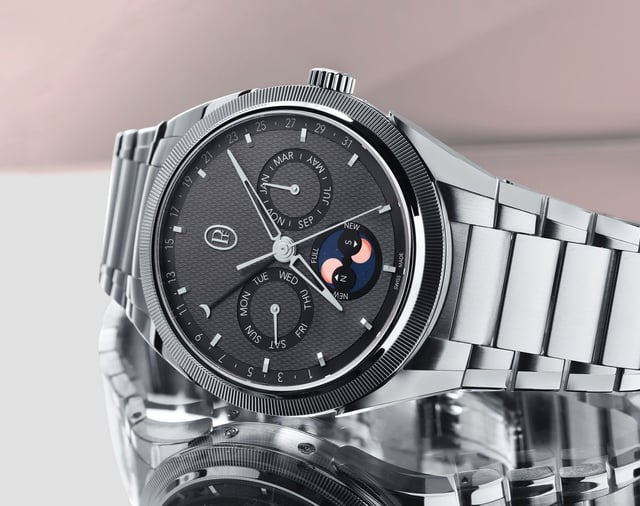
The Tonda PF collection was unveiled during Geneva Watch Days in 2021, and described by Parmigiani CEO Guido Terreni as “a watch of purity.” As with many of Parmigiani Fleurier’s creations, the Tonda PF’s design is driven by the Fibonacci sequence, a mathematical formula associated with the golden ratio, which has been at the root of virtually everything Michel Parmigiani has ever created. It’s the guideline of the size of hands and counters, the curvature of lugs, the guilloché patterns, case proportions and countless design details that suffuse the Parmigiani Fleurier aesthetics. Prices for the Tonda PF Annual Calendar start at $38,700 on bracelet.
Today, there are more than 40 calendars (or rather six principal calendars) used around the world, there is even a gap of seven to eight years between the Ethiopian and Gregorian calendars. Every single one of them represents a different culture, religion or civilization. It is truly wonderful to see them reflected in a dedicated mechanical movement, and housed in a universally elegant case.
This article is from the WatchTime Archives and was originally published in the January / February 2023 Issue. To subscribe to WatchTime Magazine, click here.
And to learn more, visit Parmigiani Fleurier, here.