Richard Mille Shifts Into A Higher Gear with RM 65-01 Automatic Split-Seconds Chronograph
Richard Mille has built much of its brand on combining highly sophisticated micromechanical technology with ultra-modern materials from the automobile and aerospace industries, and its latest chronograph-equipped timepiece, the RM 65-01 Automatic Split-Seconds Chronograph, continues the tradition. It is also, the company claims, the "most complex timepiece ever to leave the Richard Mille workshops."
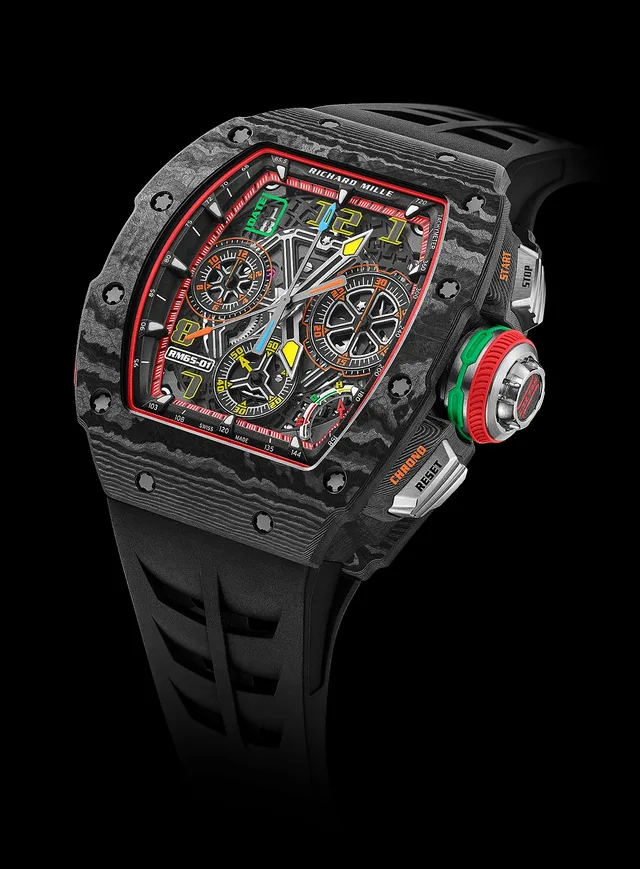
Some five years in development, and designed by Richard Mille's engineers in partnership with the movement artisans at Vaucher Manufacture Fleurier (of Parmigiani fame, among other horological plaudits), the new movement inside the RM 65-01 boasts a high-frequency, variable-inertia balance that oscillates at a breakneck pace of 36,600 vph (5 Hz). Its integrated, split-seconds chronograph mechanism is thus endowed with the capacity of ultra-precise stopwatch calculations, to the 1/10th second. Outside of Zenith's El Primero, few other chronograph calibers can achieve this level of pinpoint accuracy. The movement's architecture uses six column wheels and vertical coupling. Its mechanical "brain," seen through the base, stands on a grade 5 titanium chassis, supported by bridges in the same material, and receives energy from a fast-rotating barrel that maintains ideal torque throughout the caliber's 60-hour power reserve.
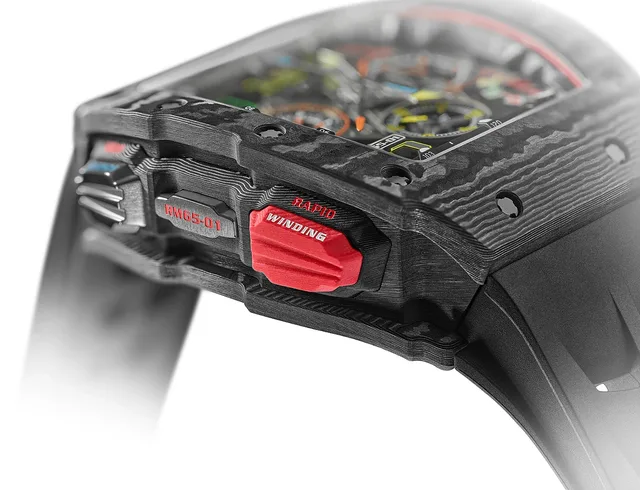
Filling the watch's tank with that power reserve is accomplished via a new and innovative feature, a patented rapid-winding mechanism activated by a pusher at 8 o'clock on the tonneau-shaped Carbon TPT case. One hundred-twenty-five presses of this button fully wind the movement, which is also designed to maintain optimal torque while worn on the wrist. As in previous Richard Mille timepieces, the rotor offers "variable geometry," which means the wearer can adjust its inertia for optimal winding yield based on his level of activity. The caliber, which comprises no less than 600 pieces, has passed a battery of tests that Richard Mille deems "merciless," including for antimagnetism, water-resistance, shock resistance, and simulated 10-year aging of the mechanisms (in which the winding button was deployed thousands of times).
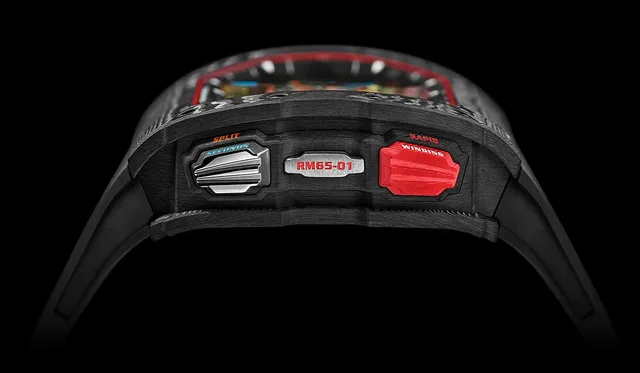
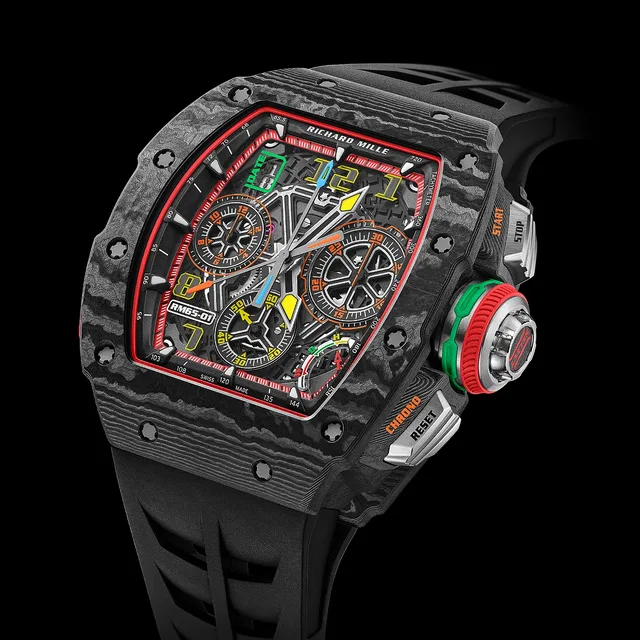
Despite its complexity, the RM 65-01 is also a watch that emphasizes legibility for all of its verious functions thanks to an ingenious use of color coding. Yellow is used for the timekeeping elements — the hour and minute hands, hour numerals, and the small seconds subdial at 6 o'clock. Orange identifies the central chronograph seconds hand and the 30-minute and 12-hour chronograph subdials at 3 and 9 o'clock, respectively. The winding mechanism is in bright red, the date is framed in green, and the split-seconds hand is in blue, a color echoed on the pusher that activates it.
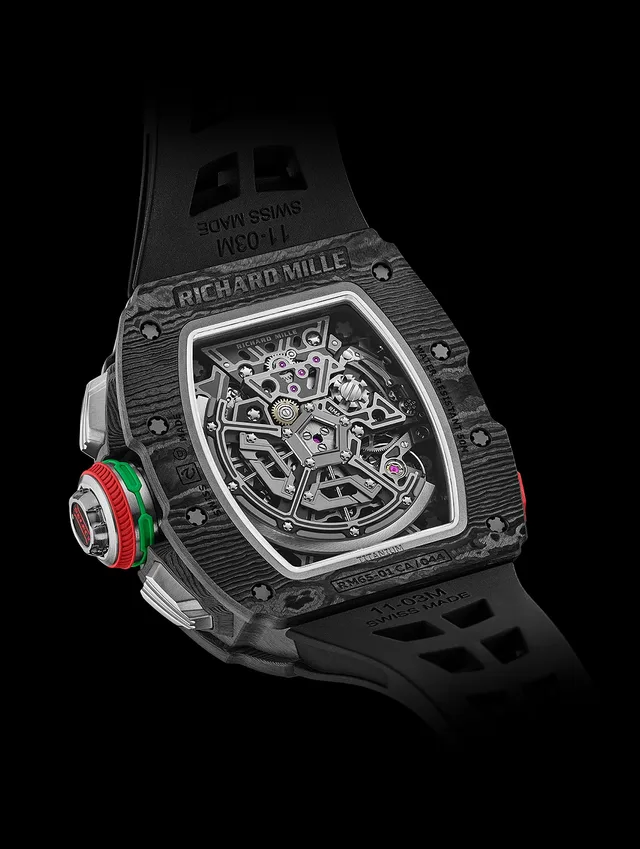
The bezel, caseband, and caseback are in Carbon TPT, a material used in racing yachts, Formula 1 racecars and aircraft, which Richard Mille brought to watchmaking back in 2013. The crown and push-buttons are in micro-blasted and satin-finished grade 5 titanium, and the rapid-winding button is formed from red quartz TPT. Another technical feature emblematic of Richard Mille timekeepers: the gearbox-style function selector that allows the user to switch easily between traditional winding (W), quick date adjustment (D) and time setting (H) with a simple press of the crown.
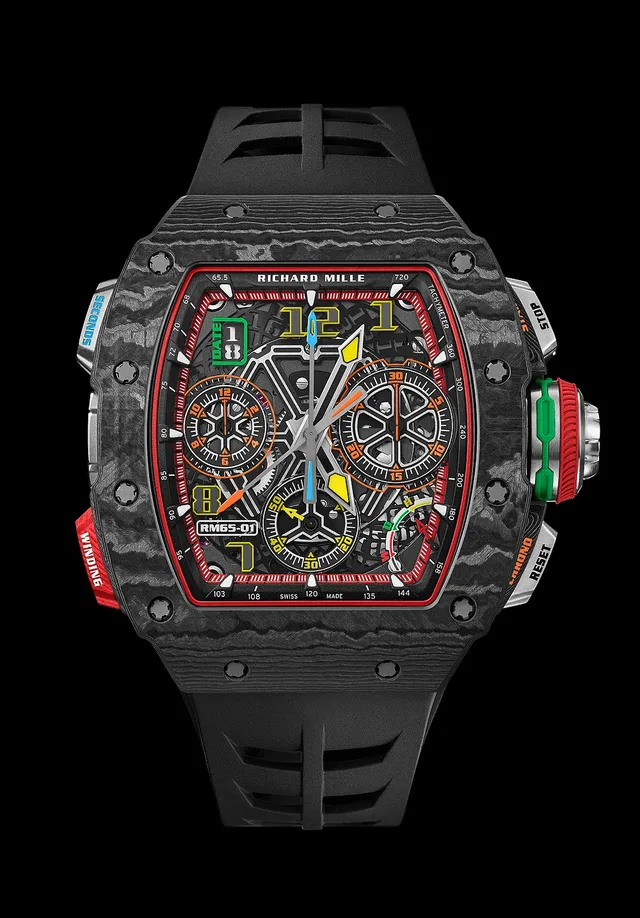
The Richard Mille RM 65-01 Automatic Split Seconds Chronograph will retail for $310,000 in the full carbon TPT case, pictured. Another version in Carbon TPT and gold is also on the horizon, the brand says.