Jaeger-LeCoultre: Master Control, Tourbillon and Reverso Art
Watches and Wonders 2026

Jaeger-LeCoultre has presented more than just a product update for 2026. The entirety of the new releases can be divided into three strategic strands: firstly, the serious entry into the integrated-bracelet segment with three new Master Control models; secondly, the revision of one of the manufacture's most horologically significant tourbillon calibers; and thirdly, a broad rollout of the Reverso as a platform for Métiers Rares works. The revue ranges from the 38-millimeter dress sport watch to the triple-axis tourbillon limited to 20 pieces with a platinum case.
Jaeger-LeCoultre Master Control Chronometre Date Power Reserve
Jaeger-LeCoultre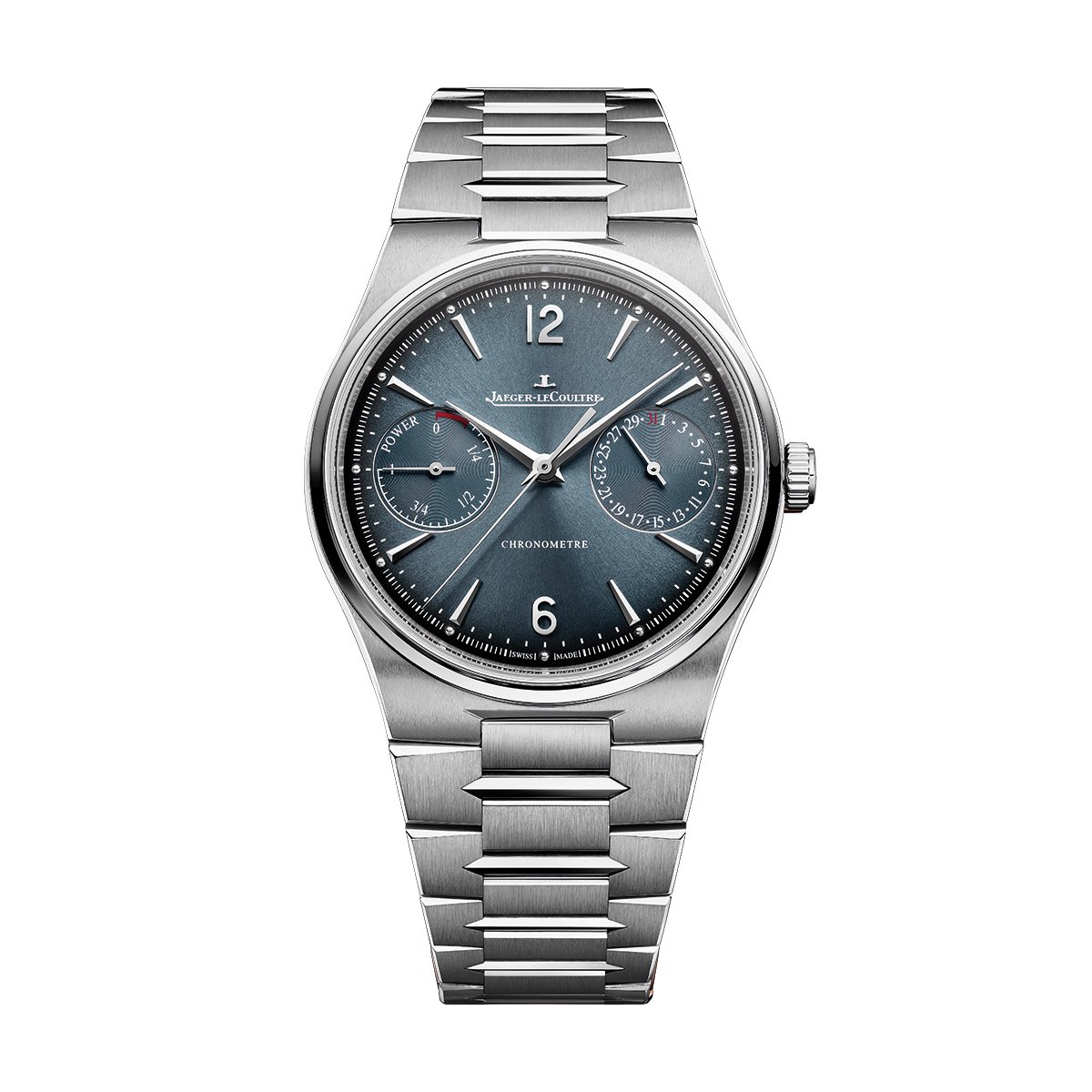
Master Control Chronometre Date Power Reserve
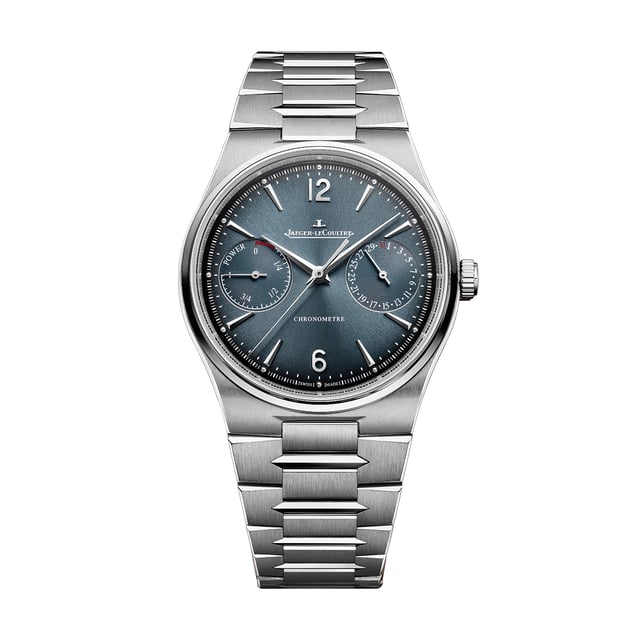
The opening model of the new collection, the Master Control Chronometre Date Power Reserve, is also the most technically daring. The reason: Jaeger-LeCoultre has developed a completely new in-house movement for this model, caliber 738, which features a combination of power reserve indicator and date, in an automatic, self-winding caliber only 4.97 millimeters thin, with a 70-hour power reserve and a 4 Hz frequency. The dial takes on the basic structure of the Futurematic from 1951, one of the earliest Jaeger-LeCoultre watches with automatic winding and two circular subdials on the 9 o'clock/3 o'clock axis: the left shows the power reserve with a red marker indicating the end of the reserve, the right shows the date. Both subdials are in the same blue-gray tone as the main dial, with an azuré finish featuring an engraved circular pattern.
The case measures 39 millimeters, has a height of 8.9 millimeters, and is made of stainless steel with a fully integrated three-link bracelet and double folding clasp. The finish combines polished and satin surfaces, with the typical contrast between the bezel and the lugs. The model is only available in steel; there is (yet) no precious metal variant. This positions the model with a price of $21,000, clearly as an entry point of the collection.
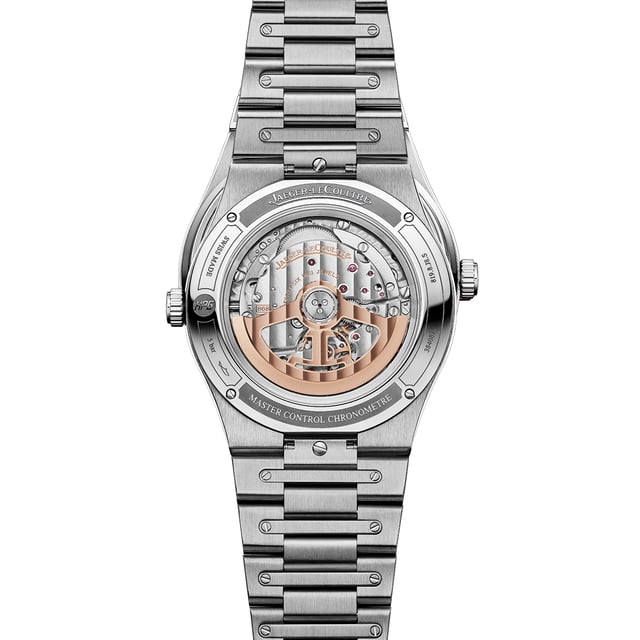
Jaeger-LeCoultre Master Control Chronometer Perpetual Calendar, Caliber 868
Jaeger-LeCoultre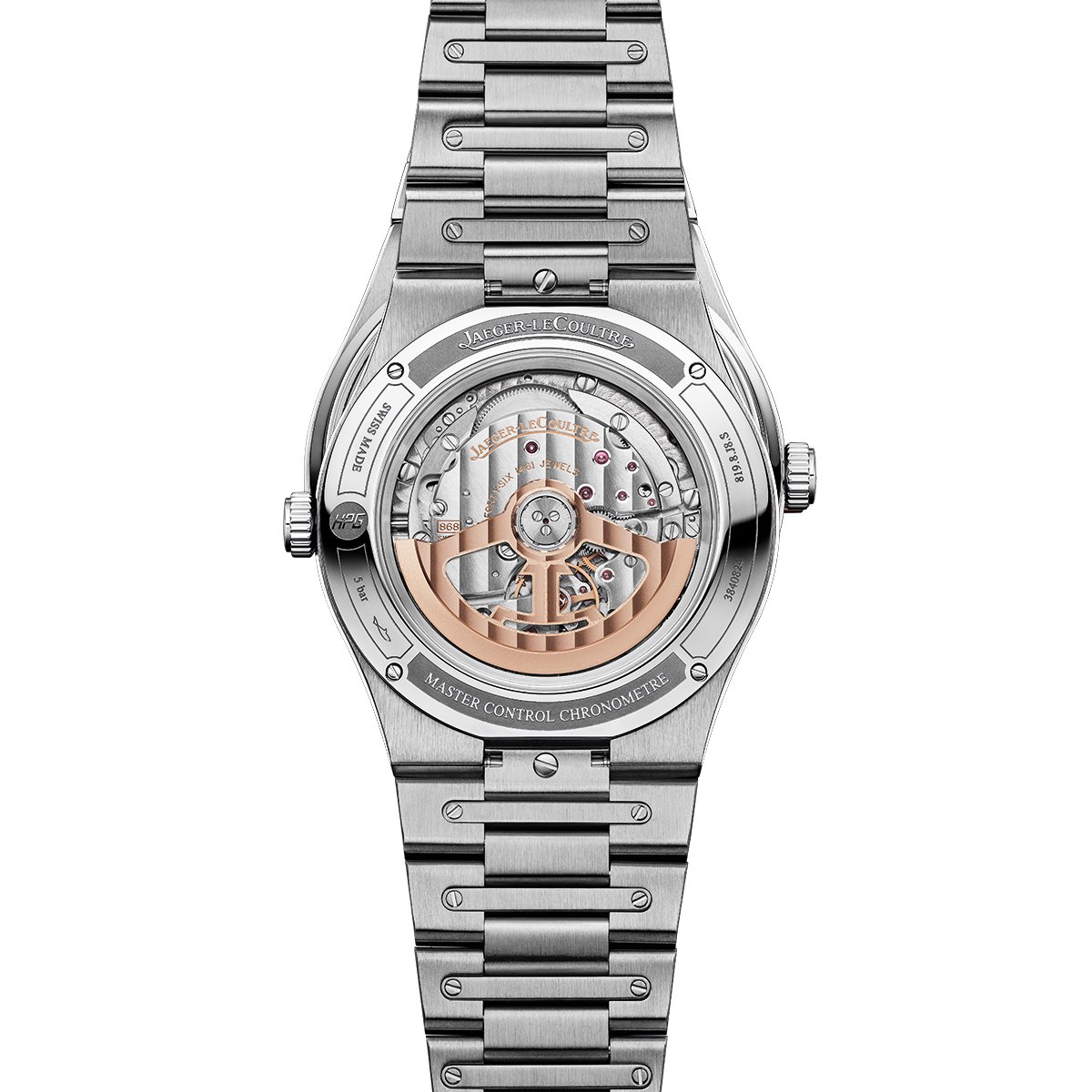
Master Control Chronometer Perpetual Calendar
The Master Control Chronometer Perpetual Calendar is the most complex complication of the collection and serves a clientele that prioritizes functional completeness over aesthetic reduction. The caliber 868, with only 4.72 millimeters in height, impresses with a 70-hour power reserve. It displays the year, month, day of the week, date, and moon phase. All calendar indications can be adjusted simultaneously via a single corrector, providing a significant comfort advantage in everyday life. The mechanism requires no manual correction until 2100, as long as the watch remains wound. The dial arranges the four calendar indications into four subdials: 12 o'clock shows the month and year, 3 o'clock the day of the week, 9 o'clock the date, 6 o'clock the moon phase.
In the stainless steel version, the moon appliqué is made of platinum sheet (999/1,000); in the rose gold version, of hammered gold (958/1,000). This sounds like a minor detail, but is significant in craftsmanship as it requires more elaborate production than the usual die-cast moon discs. The watch is offered in steel (blue-gray gradient dial) and 18K rose gold (bronze dial). Both variants are worn on the integrated bracelet of the respective metal. Price: $55,500 in steel; the rose gold variant costs around $95,000.
Jaeger-LeCoultre Master Control Chronometre Date
Jaeger-LeCoultre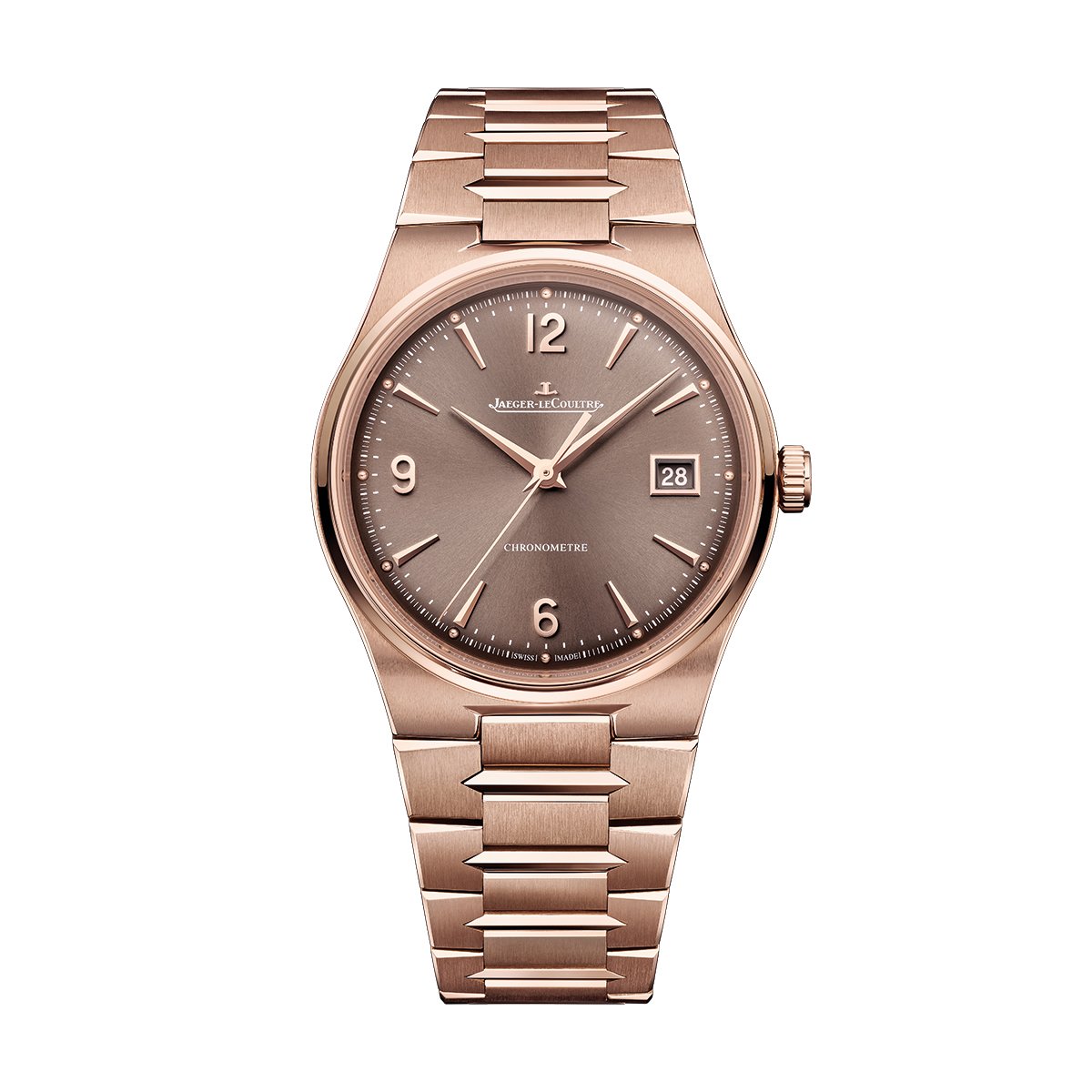
Master Control Chronometer Date
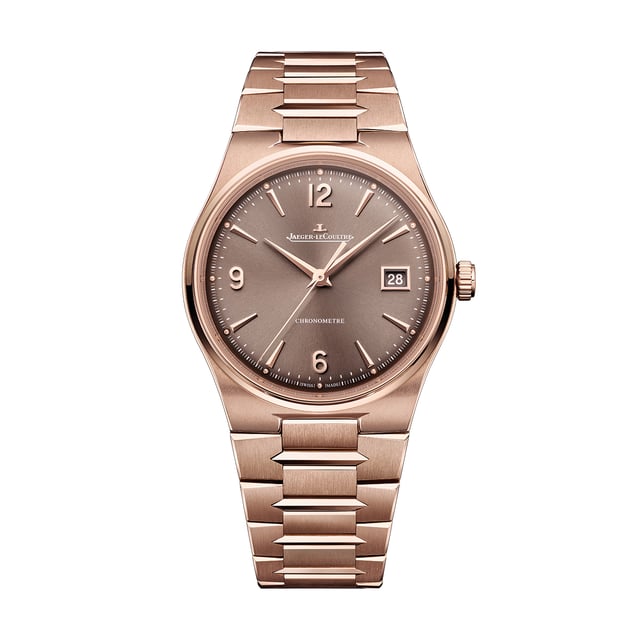
The slimmest model of the collection, the Master Control Chronometer Date, measures 38 millimeters in diameter, 7.9 millimeters in height. Behind it is the caliber 899 in its latest version, automatic, with 70 hours of power reserve and a date window at 3 o'clock. No further complication. This is consistent reduction and is the watch that can be worn most widely. A diameter of 38 millimeters is at the center of demand today.
The dial is available in blue-gray (steel) or bronze (rose gold), each with a sunburst finish featuring a color gradient from inside to outside. The design is complemented by centrally positioned Dauphine hands. The integrated bracelet is complemented by a double-folding clasp. The reference Q4158120 (steel) is likely to be the highest-volume version of the new Master Control Chronometer collection. The stainless steel version is even less expensive than the power reserve variant at $17,000, but a rose gold variant is also available, priced at $64,000.
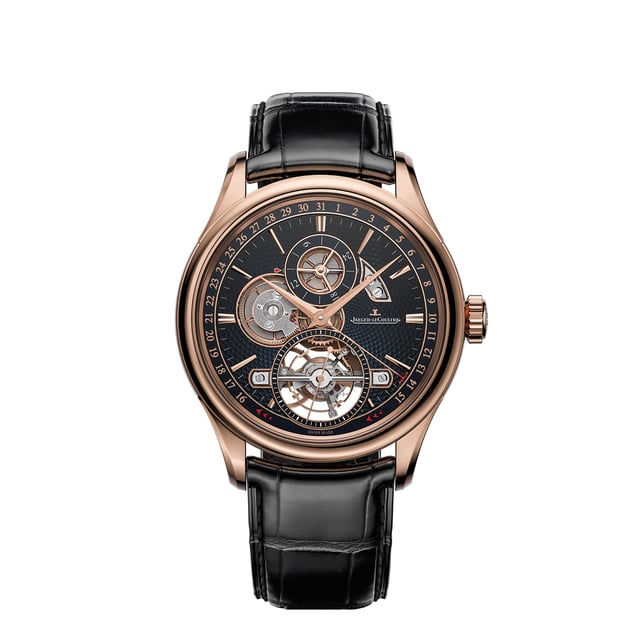
Jaeger-LeCoultre Master Grande Tradition Tourbillon Jumping Date
Jaeger-LeCoultre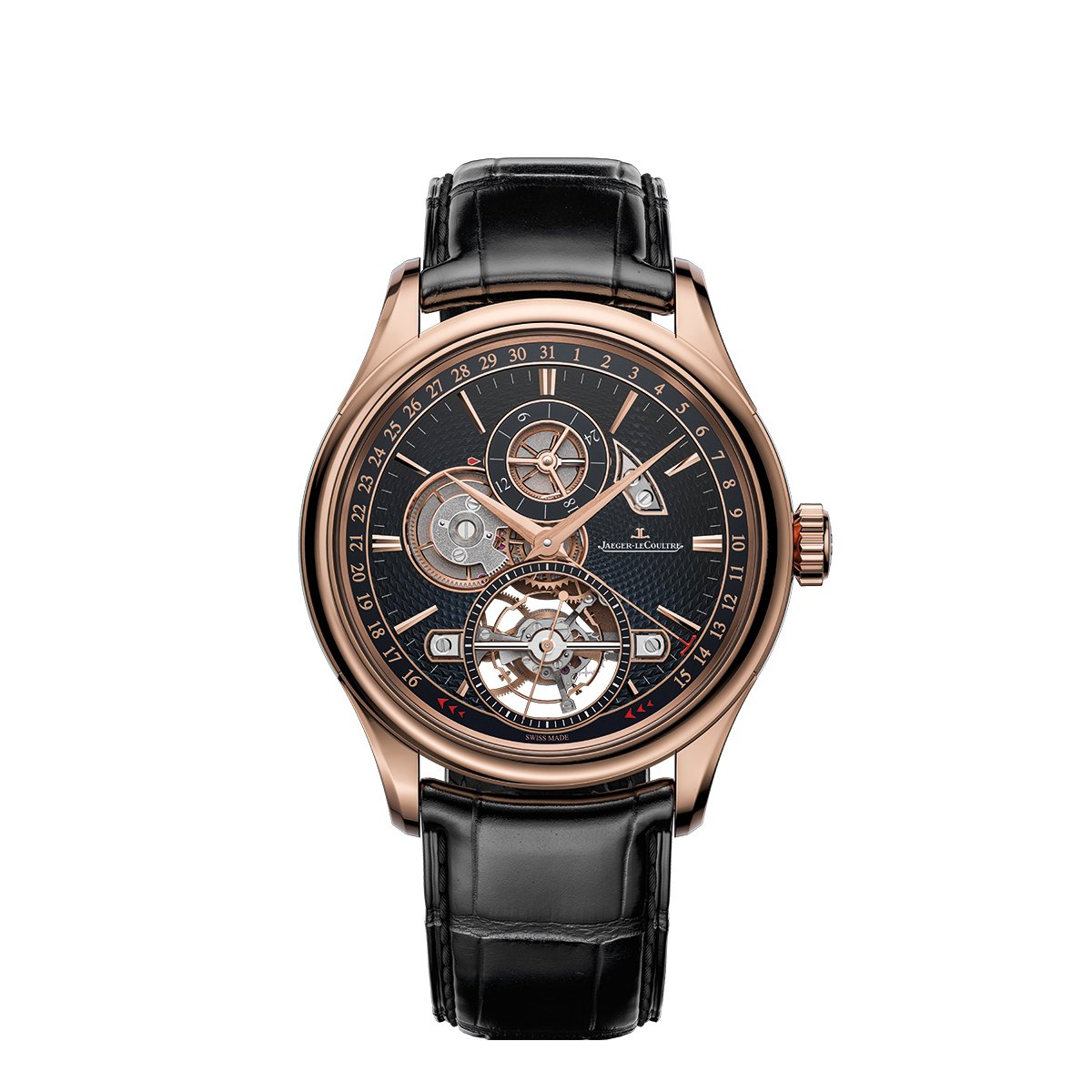
Master Grande Tradition Tourbillon Jumping Date
The caliber 978 already has an impressive biography: It won the first modern chronometry competition in 2009, a 45-day endurance test monitored by two independent institutions, which tested not only accuracy but also shock resistance and magnetic field resistance. Previously housed in a less accessible case, the caliber now gets a new chance in a more contemporary form in the Master Grande Tradition Tourbillon Jumping Date.
Jaeger-LeCoultre has completely redesigned the movement architecture: 305 components; the dial is open-worked; a window reveals the tourbillon cage (77 components, under 0.5 grams), the 24-hour disc, and the date driver. The latter sits at 9 o'clock and is visible through an additional aperture. This allows observation of how the mechanism lets the date hand jump almost 90 degrees at midnight on the 15th of each month to keep the tourbillon opening unobstructed. It is a construction that combines function and display value, without one being subordinate to the other. The 24-hour disc can be adjusted independently of the hour and minute hands and thus also functions as a standalone second time zone. This is an underrated complication in a tourbillon context. The power reserve is 45 hours.
Special attention is deserved by the white gold tourbillon bridges. They receive a berçage polish: The crescent-shaped cross-section is achieved through a burnishing movement. The process is complex, rare, and hardly industrially scalable. Also visible through the glass case back is the Côtes de Genève Soleillé finish of the bridges, radial stripes corresponding to the baseplate shape. The dial features a barley grain engraving pattern on a rose gold base, overlaid with blue translucent enamel. The date hand has a red JL anchor, and a red arrow on the 24-hour subdial adds accents. The color accents are used sparingly but consistently. The case is crafted in 18K rose gold, measuring 42 millimeters with a height of 12.5 millimeters. Limited to 100 pieces, reference Q4202480. The price: approximately $153,000.
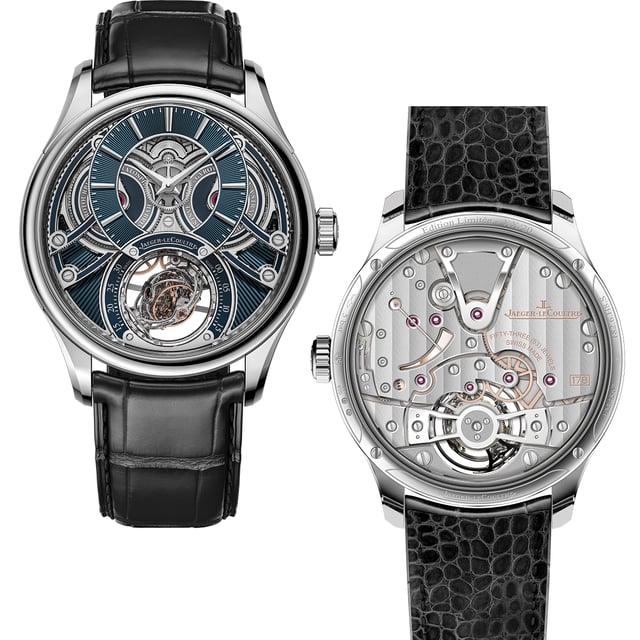
Jaeger-LeCoultre Master Hybris Inventiva Gyrotourbillon À Stratosphère
Jaeger-LeCoultre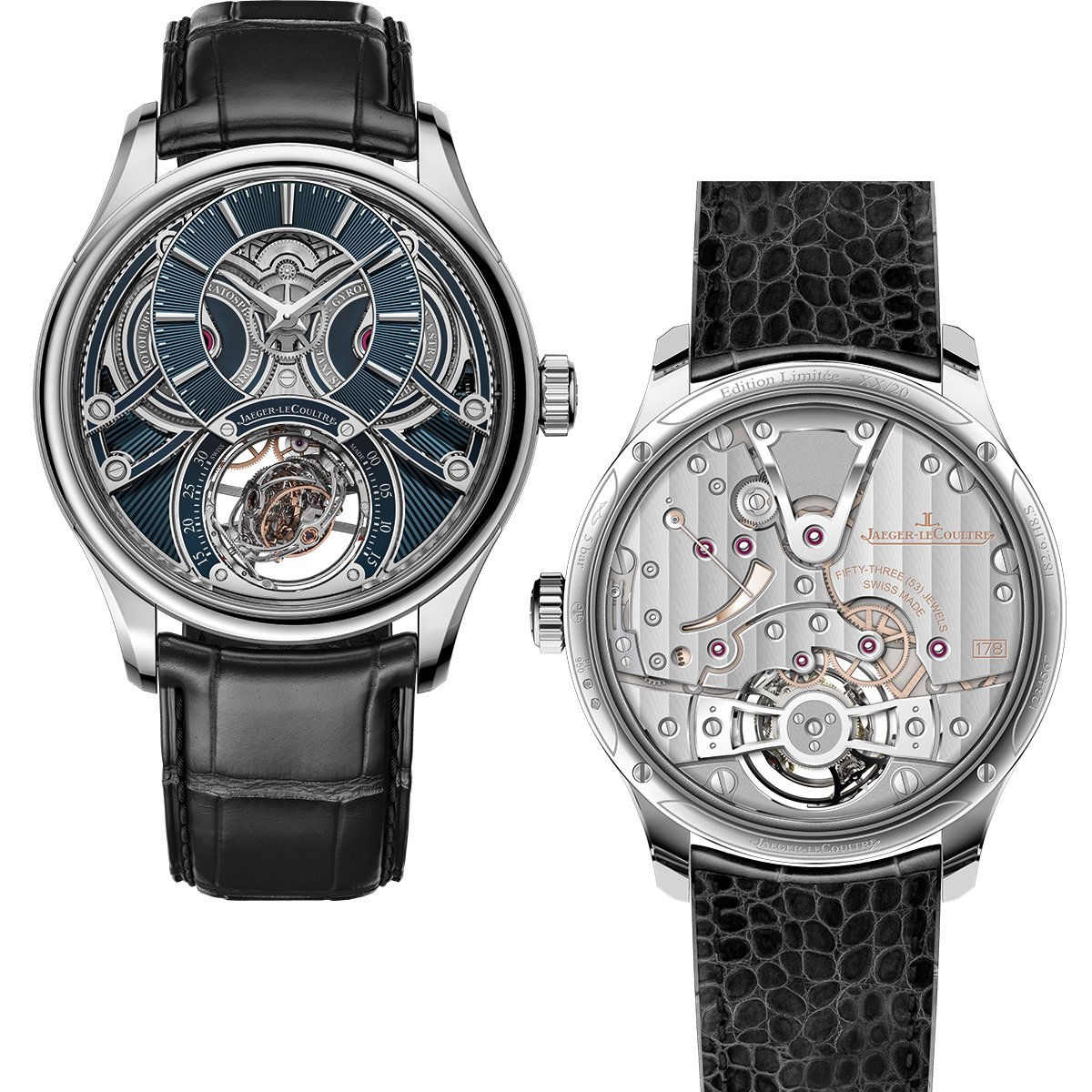
Master Hybris Inventiva Gyrotourbillon À Stratosphere
The Master Hybris Inventiva Gyrotourbillon À Stratosphere may be one of the most elaborate horological statement of the year, and not just for Jaeger-LeCoultre. The caliber 178 houses a triple-axis tourbillon with 189 components and a total weight of 0.783 grams. The three titanium cages rotate on the X, Y, and Z axes at different speeds: inner cage 20 seconds, middle reference cage 60 seconds, outer cage 90 seconds. The result: 98 percent of all possible positions are covered. No other 4 Hz tourbillon on the market currently reaches this value. The comparison is relevant because precision in tourbillons is usually associated with frequency: higher frequencies reduce the impact of short-term disturbances, while multiple rotation axes reduce the influence of gravity in different orientations. The balance spring is cylindrical, which guarantees concentric oscillation in any position, regardless of amplitude, position, or state of reserve. It is mounted on ceramic roller bearings, minimizing friction and wear. Several patents have been filed for caliber 178. The manual-winding caliber has a power reserve of 72 hours.
The decorative finishing of the caliber is equally elaborate. Sixteen different surface techniques were applied, including guilloché, enameling, shagreen lacquering, diamond polishing, and sunray brushing. Sixty-five hours alone are accounted for the handwork on 55 individual components, including 20 bridges, 18 cage parts, and 11 wheels. All 64 inner angles were hand-finished. Thirty-three components are made of solid gold.
The dial in 18K white gold is finished with sunray guilloché and coated with translucent blue enamel. The visible white gold bridges are filled with blue lacquer, as are the barrel caps at 2 and 10 o'clock. The result: the boundary between the dial and movement completely dissolves. The reference Q5306480 is housed in a platinum case (950/1,000), measuring 42 millimeters with a height of 16.15 millimeters. Blue alligator leather strap with an 18K white gold clasp. Limited to 20 pieces. For this model, you should expect a price of $707,000 exclusive of taxes.
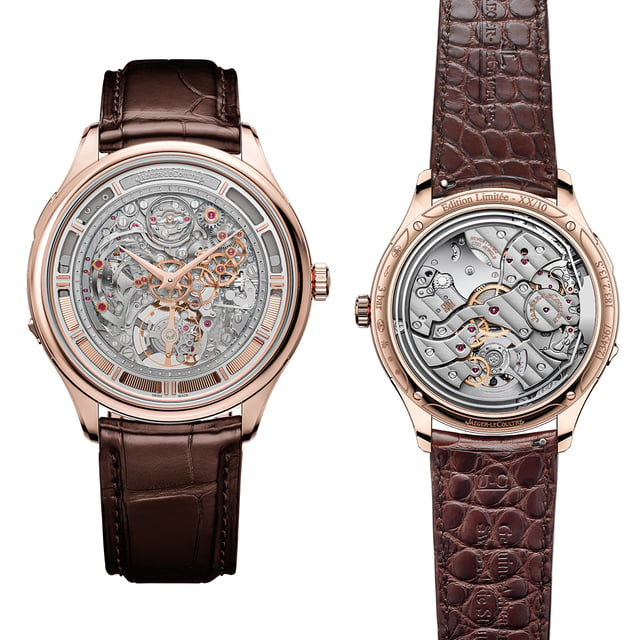
Jaeger-LeCoultre Master Hybris Mechanica Ultra Thin Minute Repeater
Jaeger-LeCoultre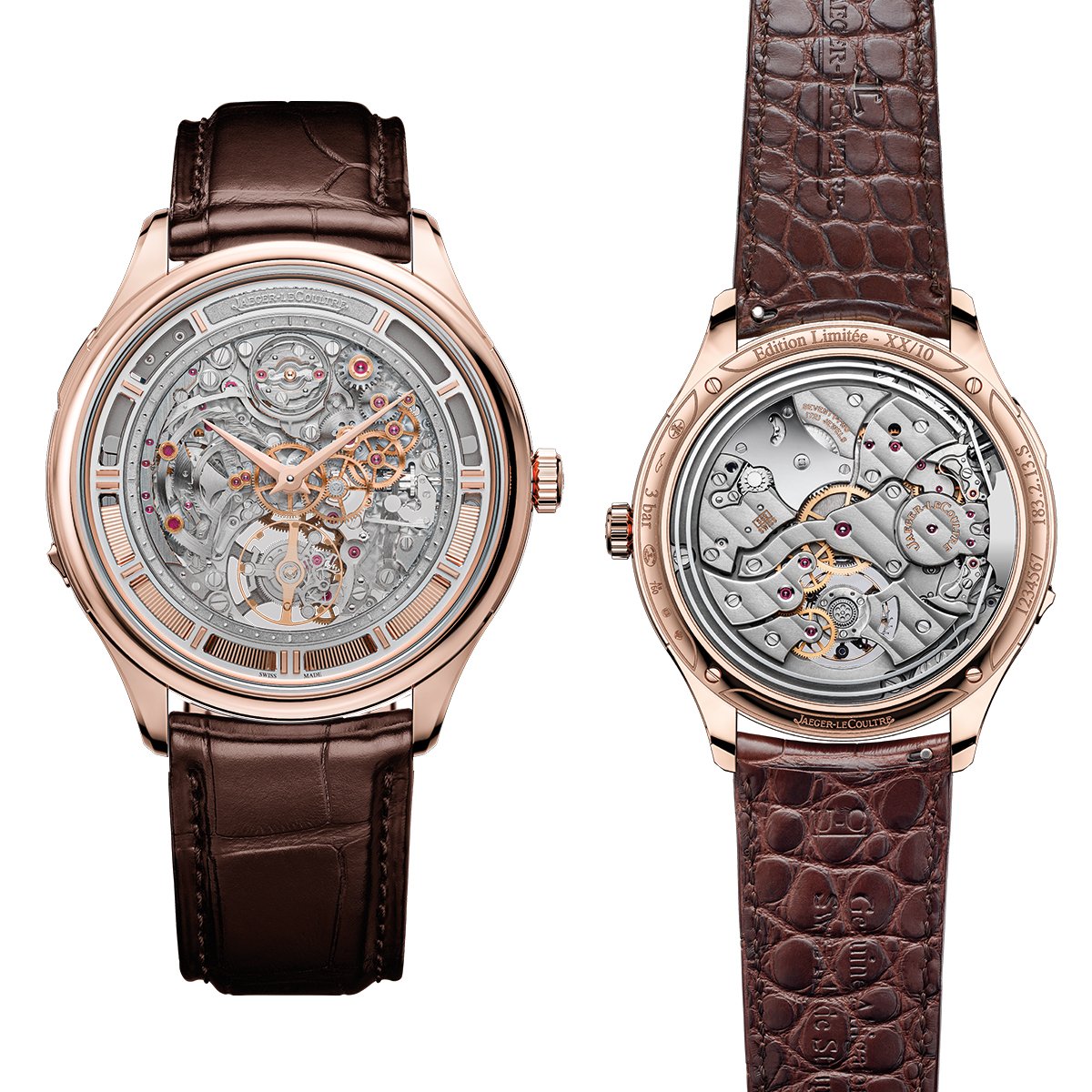
Master Hybris Mechanica Ultra Thin Minute Repeater
The caliber 362 remains the thinnest automatic minute repeater tourbillon in the world. This title has stood since 2014 and has yet to see a challenger. The Master Hybris Mechanica Ultra Thin Minute Repeater is a new interpretation of the same caliber, now in a redesigned case that aligns with the design codes of the Master Grande Tradition line. What technically distinguishes the caliber: The minute repeater is not mounted as an additional module on a base movement but has been developed from the outset as an integral part of the movement's architecture. The striking mechanism occupies about a third of the total volume and is directly integrated into the main plate. The hammers follow the trebuchet principle: an articulated joint mechanism that increases striking speed, thereby improving sound volume and clarity. The gongs are one-piece, with a square cross-section profile, optimized for tonal purity.
Another patent: the Silent Timelapse Reduction System, which minimizes the pause between the last hour tone and the first minute tones. This might sound like a detail, but it is crucial for listening to the repeater. The flying tourbillon, with 59 components and 0.248 grams, has no upper bridge. The patented S-shaped hairspring is completely visible. The main plate opening and the three sapphire bridges (each with 18K rose gold chatons for the jewels) create an almost complete transparency of the caliber. For the 537 components, assembly takes seven weeks. The 18K rose gold case has a diameter of 41.4 millimeters with a height of 8.25 millimeters. The open-worked white gold dial is arranged in a circular fashion around the caliber. The peripheral rotor is raised on 36 ceramic ball bearings, and the power reserve is 42 hours. Reference Q13125S2 is worn on a brown alligator strap with a rose gold clasp. Limited to 10 pieces. Price: $754,000 excluding taxes.
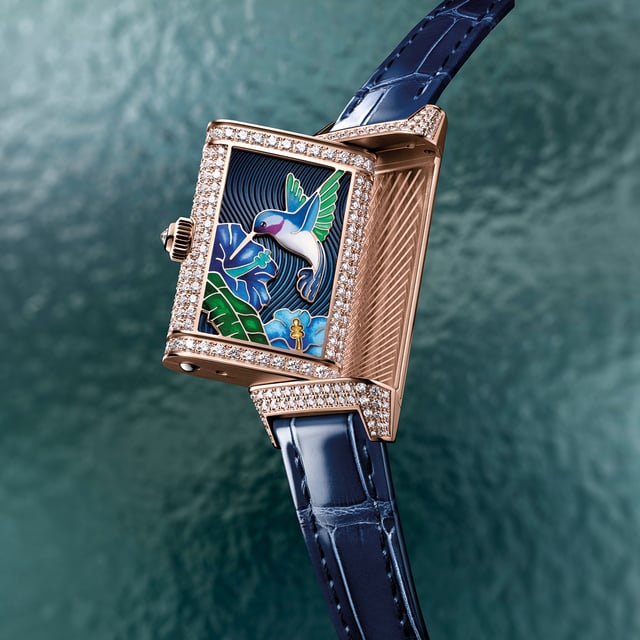
Jaeger-LeCoultre Reverso One ‘Hibiscus Syriacus’
Jaeger-LeCoultre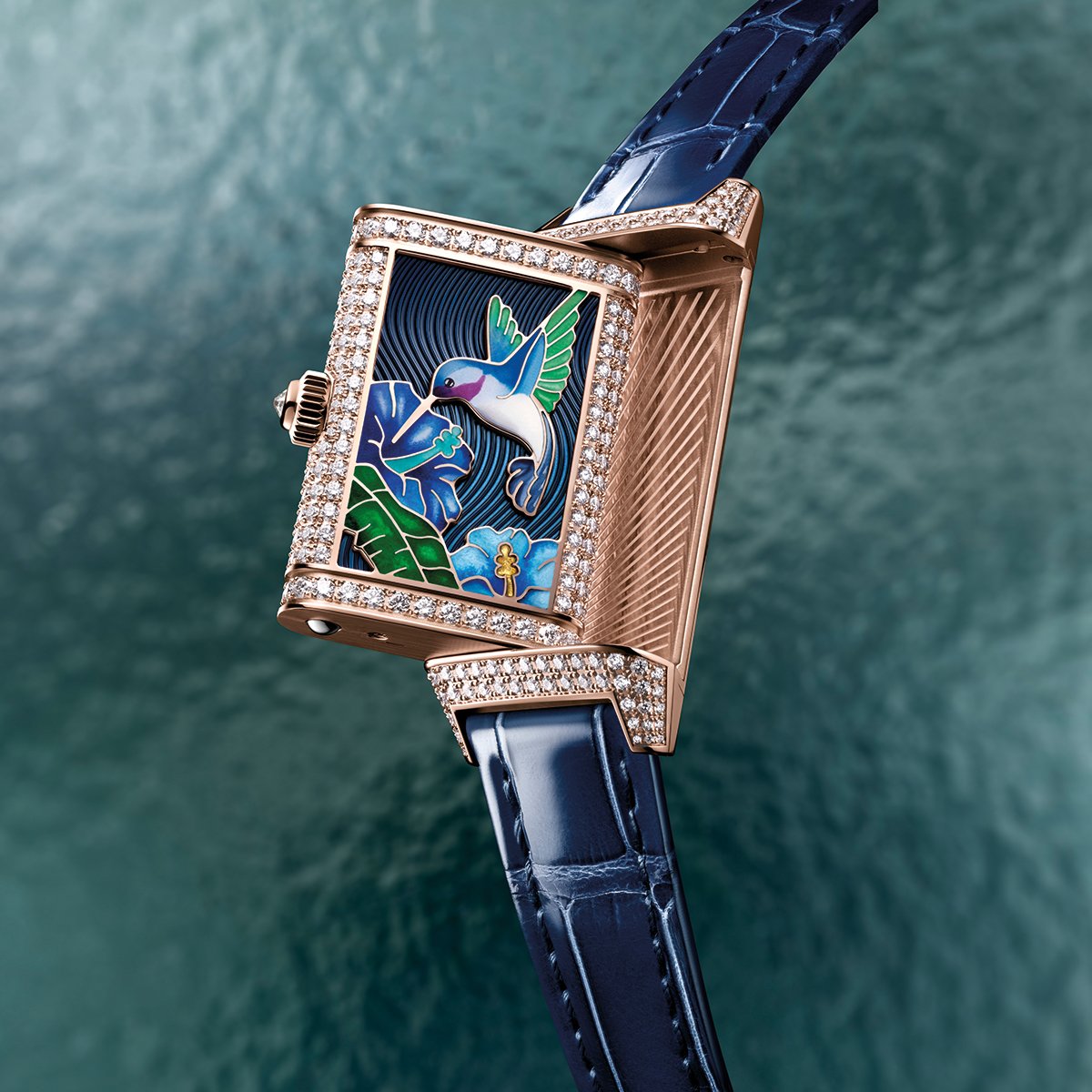
La Vallée des Merveilles: Reverso One in Three Métiers-Rares Versions
With the new capsule collection La Vallée des Merveilles, Jaeger-LeCoultre introduces its own sub-line for Métiers Rares pieces, which operates outside the Hybris hierarchy. The first capsule includes three new Reverso One models that use images from Hawaii and Japan as themes.
Reverso One Hibiscus Syriacus
Back: An Akialoa bird drinks nectar from a blue hibiscus flower. The image is constructed in two layers: the background layer with blue lacquer on wave-shaped engraved lines; the foreground layer is crafted with grand feu champlevé enamel from the case metal. The bird in miniature painting impresses with nine metal-oxide pigment colors, the foliage in multiple overlaid translucent and opaque enamel layers. The pistil of the flower is set in 24-carat gold paillonné. The artwork is housed in an 18K rose gold case with 335 grain-set diamonds. An optional fully diamond-set rose gold strap (384 additional stones) is available.Reverso One Hibiscus Rosa
Same case, different image program: in the foreground, the red hibiscus, the national flower of Hawaii. The red is horologically relevant because metal oxides quickly turn brown at grand feu temperatures (up to 800 degrees). Nine enamel layers are needed to maintain the desired saturation level. Additionally, 489 snow-set diamonds in nine different sizes are applied. The snow-setting technique simulates a random scatter, but each stone's position is chosen so that the metal of the background almost disappears. Overall, this means over 130 hours of Métiers Rares work per watch head.
Reverso One Sakura
18K white gold with an 18K white gold strap. The back shows a Japanese crane on a lakeshore under cherry blossom branches. The crane's white body feathers, in snow-setting with diamonds, are combined for the first time with two-colored sapphires to simulate the reflection of sunlight on the water. In addition, there are 269 diamonds and 395 sapphires, equating to 125 hours of setting work. The enameller made his own brushes for the detail painting; the neck feathers were executed with single-hair brushes.
All three models have dimensions of 40 × 20 millimeters, with a height of 9.09 millimeters. The watches are powered by the caliber 846 (manual winding) with 50 hours of reserve. Limited to 20 pieces each. The starting price of the collection is approximately $153,000; the most expensive model, Hibiscus Rosa with full diamond setting, comes to over $236,000.

Jaeger-LeCoultre Reverso Tribute Enamel Hokusai Waterfalls
Jaeger-LeCoultre
Reverso Tribute Enamel Hokusai Waterfalls: The last four
Jaeger-LeCoultre will complete the Reverso Tribute Enamel series centered around Hokusai's Waterfall Series, which has been ongoing since 2021. The four concluding pieces depict the Rōben Falls in the Province of Sagami, the Kiyotaki Kannon Falls on the Tōkaidō, the Yōrō Falls in the Province of Mino, and the Aoigaoka Falls in the eastern capital. Hokusai's cycle is especially interesting because it is one of the earliest applications of Prussian blue in Japanese print art. This pigment, originally synthesized in Berlin in 1704, reached Japan in the early 19th century and offered a depth and permanence that plant-based indigo dyes could not achieve. Hokusai was an early and consistent user, and the waterfall series shows this application with a high blue content. The rendition on the Reverso backs is done using the Geneva miniature painting technique: at least 14 layers of enamel, each individually fired at 800 degrees, totaling 80 hours of work per piece.
Reproducing the bokashi effect (gradual color gradient in woodblock prints) in enamel is one of the most challenging transfer tasks in enamel painting. Remarkable: the Japanese original signatures in the image cartouches are handwritten on an area of 2 cm² and still readable. The front dials each feature a different guilloché pattern, thematically matched to the back image: barleycorn engraving (Rōben, 147 stitches), wave engraving (Kiyotaki, 198 stitches), bamboo pattern (Yōrō, 144 stitches), herringbone engraving (Aoigaoka, 360 stitches). Four to five layers of translucent enamel are applied over the guilloché motif. All four models are made in 18K white gold cases, measuring 45.6 × 27.4 millimeters, with a height of 9.73 millimeters. The watches are powered by the caliber 822 with manual winding (2.94 millimeters in height), and the power reserve is 42 hours. The series can be combined with a black alligator strap or with the Milanese bracelet introduced last year— now in white gold for the first time. Limited to 10 pieces each. Priced from at least $165,000.
Big picture: What 2026 Means for Jaeger-LeCoultre
Rarely has a single manufacturer covered such a wide range of complexity levels in one year: from the 38-millimeter dress sport watch for upscale everyday use to the triple-axis tourbillon on a platinum base in 20 pieces. Jaeger-LeCoultre addresses a market in the Master Control Chronometer collection that has been largely dominated by Patek Philippe, Audemars Piguet, and Vacheron Constantin, and does so with a new HPG seal as its own quality feature. It certifies, in addition to the finishing, the chronometric precision in the wound state. The test protocol is patent-pending and evaluates the finished calibrated watch under four everyday parameters: altitude, shocks, positions, and temperature. Additionally, each model carries external COSC certification, which is a prerequisite for the designation “Chronomètre.”
At the same time, the manufacture asserts a horological frontier position with the Gyrotourbillon À Stratosphère and the Hybris Mechanica Minute Repeater Tourbillon, which only a few can reach worldwide. The Reverso remains what it has always been: the most flexible platform for craftsmanship in the Swiss watch market. With La Vallée des Merveilles, this area now receives its own brand architecture, which means in the long term that Jaeger-LeCoultre can position collector watches at a collector's level in an independent logic without burdening the classic Reverso line.
The overarching motto “Valley of Inventions” experiences its first physical implementation at the Watches and Wonders booth in Geneva, where Jaeger-LeCoultre stages the history of the Vallée de Joux as the birthplace of modern watchmaking art.
To learn more, visit Jaeger-LeCoultre, here.