To the Summit without Oxygen: A Spotlight on the Montblanc 1858 Geosphere 0 Oxygen
The reasons why the owners of the Simplo Pen Co. named their brand after Europe’s highest mountain in the early 20th century are the subject of anecdotes and speculation to this day. What is certain is that concepts such as “summit” and “peak” played a role, so striving for the best became a commitment for the brand early on. As the decades passed, the Hamburg-based company became a global luxury brand with its first-class fountain pens. The name “Montblanc” stood for the highest quality, and the brand had many loyal fans, so it made sense to expand the portfolio beyond writing instruments. Fine leather goods were added first, followed by high-quality watches in 1997.
Laurent Lecamp has headed Montblanc’s Watch Division for slightly over two years. The 45-year-old, who holds dual French and Swiss citizenship, came to the company with a vision. He understood the brand’s name not only in an abstract sense, as striving for the highest, but also very concretely. After all, the mountain Mont Blanc is associated with topics like mountaineering, ice and glaciers. Would it be possible to transfer those themes to watches in an exciting way? Lecamp proved it could be done. The first collection for which he was responsible was launched in 2022. The 1858 Iced Sea, with a dial showing glacier-like structures, caused a stir at Watches and Wonders Geneva in 2022, as did the 1858 Geosphere Chronograph 0 Oxygen, which features a similarly styled dial.

Inspiration from Reinhold Messner
Lecamp got the idea for the “Zero Oxygen” — a watch without oxygen, by studying the career of Reinhold Messner. The extreme mountaineer achieved worldwide fame in 1978 when he became the first person to climb Mount Everest without the aid of bottled oxygen. Eight years later, he accomplished this feat on all 14 eight-thousanders, which is what mountaineers call peaks with altitudes greater than 8,000 meters (26,247 feet).
Montblanc was already working with Messner when Lecamp joined the Hamburg-based company. Lecamp wanted to know more about the mountaineering legend, so he read some of Messner’s books. In the process, he stumbled upon the problem of bottled oxygen. When he met Messner, he learned the real reason that had led the adventurer to his dangerous scheme: Messner’s decision to climb without supplemental oxygen was the result of a lack of money. He couldn’t afford to hire Sherpas and he wasn’t able to carry the seven required bottles of oxygen on his own, in addition to his food and other equipment. Lecamp said, “Reinhold Messner climbed alone and without bottled oxygen because he had no other choice. That impressed me. Many of history’s greatest achievements have happened because somebody had no other alternative.”
Nitrogen Instead of Oxygen
A watch without oxygen? That sounds like a lot of effort. And it isn’t only a matter of telling a cool story. How does it benefit the watch’s wearer? The head of Montblanc’s Watch Division explains the technical advantages, “Removing the oxygen prevents the usual oxidation processes from occurring inside the case. This protects the movement’s components and especially the lubricant oils, which age much more slowly. And the absence of moisture prevents the formation of condensation droplets, even if the watch is exposed to extreme temperature fluctuations. For example, if you get off your plane in Dubai and the ambient temperature suddenly rises from 21 degrees to around 40 degrees Celsius [70 degrees to 104 degrees Fahrenheit], the underside of your watch’s crystal may fog up. This won’t happen if you’re wearing the 0 Oxygen.”
How does all this work in the manufacturing process? And what gas replaces ordinary air inside the case? Lecamp explains that the air is replaced with nitrogen. A watchmaker sits in front of a large glass box at Montblanc’s manufacturing facility in Le Locle. Empty watch cases are waiting inside the hermetically sealed box. Fully assembled movements are inserted through a port on the right-hand side. To work inside the box, the watchmaker slips his hands and arms into long nitrile gloves, which are integrated into openings on either side of the box. Once all the oxygen inside the box has been replaced by nitrogen, the watchmaker begins fitting the movements in their cases.
Montblanc expanded on the 0 Oxygen theme in 2023. At Watches and Wonders Geneva, four more models were introduced as part of a capsule collection consisting of two chronographs and two automatic watches, each with and without a Geosphere world-time function. The capsule collection is called “The 8000” and refers to the 14 mountains with altitudes over 8,000 meters: Mount Everest, Shishapangma and 12 other peaks.
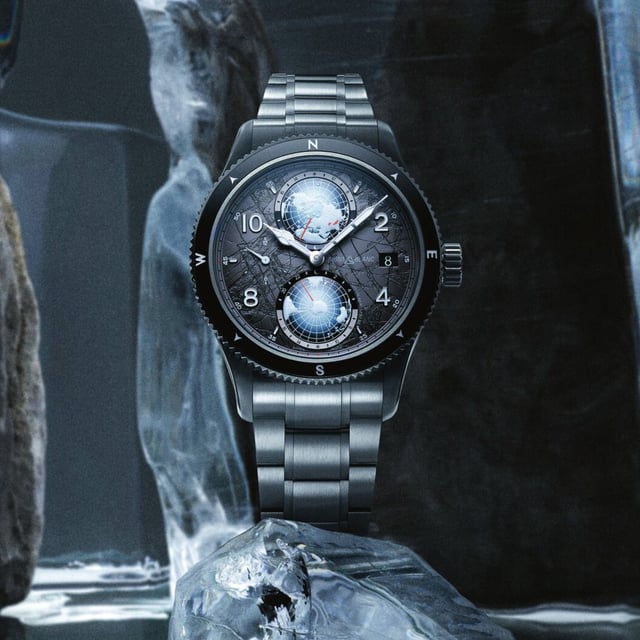
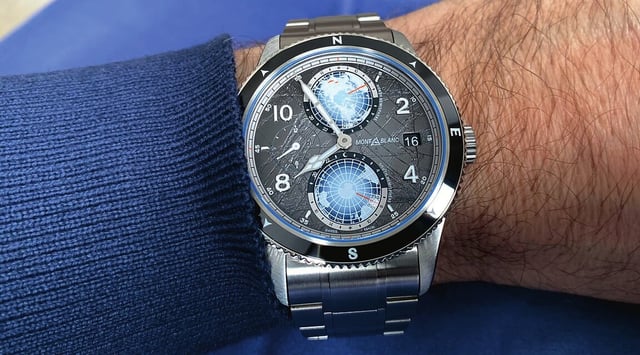
The full name of the watch dedicated to Reinhold Messner is “1858 Geosphere 0 Oxygen The 8000.” Two three-dimensional hemispheres dominate its dial: The upper one shows the Northern Hemisphere with the North Pole at its center and the lower one, the Southern Hemisphere with Antarctica at its midpoint. Montblanc had already used this visually very successful type of world-time indication on other Geosphere models. The hemispheres rotate in opposite directions: The northern one turns counterclockwise, the southern one rotates clockwise. The meridians of longitude are shown by 24 applied lines, with an orange line marking the Prime Meridian. This enables you to estimate the true local time. The central hour hand can be adjusted separately in hourly steps, so you can quickly set the local time when flying to a different time zone. The hand at 9 o’clock continues to show home time. A supplied stylus with the Montblanc logo can be used to reset the home time, but as long as the watch is kept running, this adjustment will only be necessary twice a year, when we “spring forward” in March and “fall back” again in November.
An Aesthetic Solution for the Back of the Case
Automatic Caliber MB 29.25, which ticks in the wear-free nitrogen atmosphere, is based on the Sellita SW300, but Montblanc itself developed the world time module. The caliber cannot be seen from the outside because the caseback is opaque and decorated with a laser engraving of K2, the world’s second-highest mountain. Reinhold Messner chose K2 as the motif because he associates this mountain with a very special experience (see the following interview).
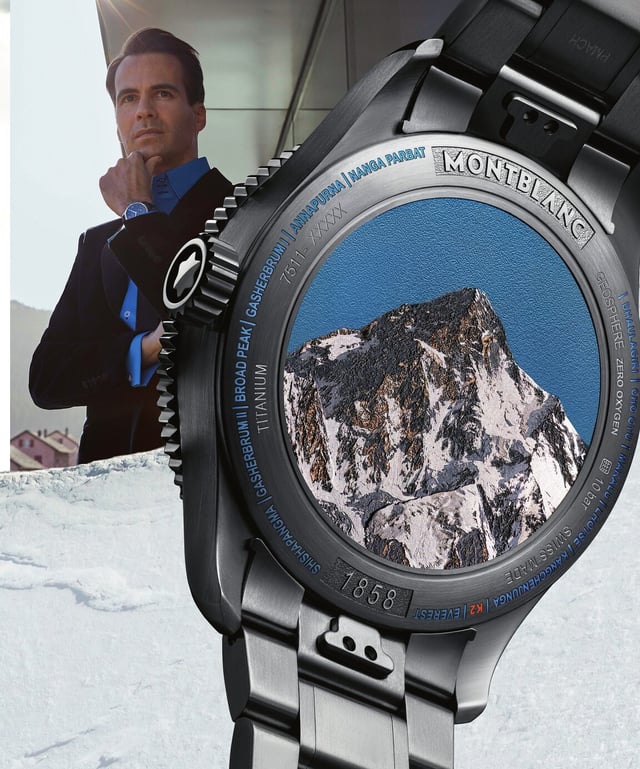
Lecamp was looking for a highly aesthetic solution for the back of the case, even though it is ordinarily hidden from view on the wearer’s wrist. “Luxury is not only what we see,” he says, “but also what we don’t see.” The laser-engraved back with the colorful alpine motif will encourage the watch’s owner to slip it off their wrist more often. Picking up the watch shows the near-photo-quality engraving, and the brilliance of the colors. Lecamp points out that the colors are permanent: “The colors won’t fade. What you see today will look the same 20 years from now.” The secret lies in the fact that no paints or dyes are used in producing the image. After a long search, the head of Montblanc’s watch division found a supplier that was able to process the case’s material with a special laser in such a way that picture-like motifs with beautiful colors could be created. The colors and contours result solely from this type of lasering. Four variables are decisive here: the intensity of the laser beam, its duration, the distance between the laser and the object and, above all, the angle from which the laser beam strikes. Lecamp explains, “If you change the angle from 30 to 29 degrees, for example, you get a different color.”
It Only Works on Titanium
The process is correspondingly complex. Lecamp says that it takes several hundred hours to learn how to set up the machine for the desired motif. The laser engraving itself takes only another 3 to 4 hours.
Montblanc and its supplier, whose identity remains unrevealed, discovered that this engraving process works only on titanium. There were too many rejects using stainless steel, and it didn’t work at all with gold. That’s why the 1858 Geosphere 0 Oxygen The 8000 has a 42-mm titanium case and a titanium back. Its stainless-steel bezel bears a ceramic inlay with four letters to indicate the cardinal directions.
In addition to the Geosphere described above, “The 8000” capsule collection also includes the 1858 Geosphere Chronograph 0 Oxygen, which is limited to 290 pieces and dedicated to the record-breaking Nepalese mountaineer Nimsdai Purja, as well as a chronograph and an automatic model without world time function. The caseback of the first watch in this trio is decorated with a laser engraving with a blue background and the silhouettes of the 14 eight-thousanders that Purja climbed one after the other in the record-breaking time of six months and six days. Above all, the many colorful flags along the lower edge show what laser technology can accomplish. The other two watches in the threesome have stainless-steel cases with conventional engravings on their backs. Each of the three watches has a sfumato dial on which the gray hue darkens as it progresses from the center to the edge. Glacier-like structures are superimposed over the entire face.
I had the good fortune to wear the 1858 Geosphere 0 Oxygen for a few weeks and I must say, it’s lots of fun to scrutinize all the little details on the dial and back. The fine lines of the meridians, the three-dimensional continents, the polished and light-reflecting hands and applied numerals, and last but not least, the previously mentioned structured dial — all details are precisely crafted, as is the image of K2 on the back. Not only do the peak’s contours contrast visually against the blue background; your fingertips can feel the line separating the mountain from the sky. The names of all fourteen 8,000-meter peaks are engraved along the rim of the caseback: K2 is written in red; the other 13 names are in blue.
Worldwide Service
This watch is easy to operate. The bezel with the compass-star orientation letters can be rotated in either direction through a total of 64 detents. Pulling the crown all the way out lets you adjust the local time, and the home-time hour hand at the 9 moves along with the local-time hour hand. If you pull the crown halfway out, you can reset only the central hour hand in hourly increments and in either direction. This is convenient when traveling to another time zone or switching between standard time and daylight saving time. This function is also used to quickly reset the date in either direction. You can pull the crown as often as you like: No air can get inside the case because built-in nitrile seals reliably seal the interior from the outside.
And what if the watch needs servicing? Is there no other option than to send it to Le Locle, even if you don’t live in Europe? Lecamp smiles. It’s obvious that this isn’t the first time he’s heard this question. Montblanc has thought of this. “We’re currently implementing various after-sales service centers for the 0 Oxygen worldwide,” he says. “We’re starting in Hong Kong and Dubai, and there will soon also be similar service centers in Germany and Switzerland, which will be equipped accordingly.”
To learn more visit Montblanc, here.
This article was originally published in the November / December 2023 print issue. To subscribe to WatchTime Magazine, click here.