The Iconic Pilot: A Watch Test of the IWC Mark XX

Photography by Roger Ruegger, Jens Köppe, and IWC.
For decades, IWC has been a proverbial flying ace when it comes to shaping the design of pilots’ watches: The Schaffhausen-based company has been making wristwatches for aviators since the 1940s, when IWC developed its original design in close cooperation with military clients. As a result, the focus was on functional aspects, such as good legibility by day and by night. And this is exactly what has made these watches attractive to civilian customers and collectors decades later.
Both the Big Pilot’s Watch, which was built by IWC in 1940 for the German Air Force, and the Mark 11, which was commissioned by the British Royal Air Force in 1948, are ancestors of IWC’s pilots’ watch design. The former is older, but its history isn’t nearly as continuous. The Big Pilot’s Watch disappeared soon after World War II — only about 1,000 watches in all were built — and IWC didn’t revive it until 2002. The Mark’s history is much more consistent. Produced until 1981, collectors continued to buy it and love it long after IWC stopped manufacturing it. After a few brief interludes, the Mark returned to the market as the Mark XII in 1994.
The Mark XII confirmed IWC’s status as a pilots’ watch brand. This model’s success in the second half of the 1990s, which was predictable considering the steadily increasing demand for old Mark 11 variants at auctions, prompted the company to focus more and more on this genre. In 1998, IWC’s UTC with second time zone caused a sensation, followed by the reissued Big Pilot’s Watch in 2002 and the Spitfire with its relief-accented dial in 2003. The first limited editions dedicated to the French author and pilot Antoine de Saint-Exupéry were introduced in 2006. Then in 2007, the first version of the Top Gun followed. Today, alongside the Portugieser, IWC’s Pilot’s Watch series is the brand’s most successful line.
IWC releases an updated version of the Mark every few years. These typically involve a few modernized details and a new serial number. This careful cultivation has enabled the Mark to remain a key part of IWC’s collection without interruption. In this test, we explore the following questions, among others: What changes differentiate the new Mark XX from its immediate predecessor, the Mark XVIII? How much of the Mark 11 is still in the Mark XX? And how closely does the Mark XX resemble today’s Big Pilot’s Watch?
Comparing the Mark XX to the Mark XVIII
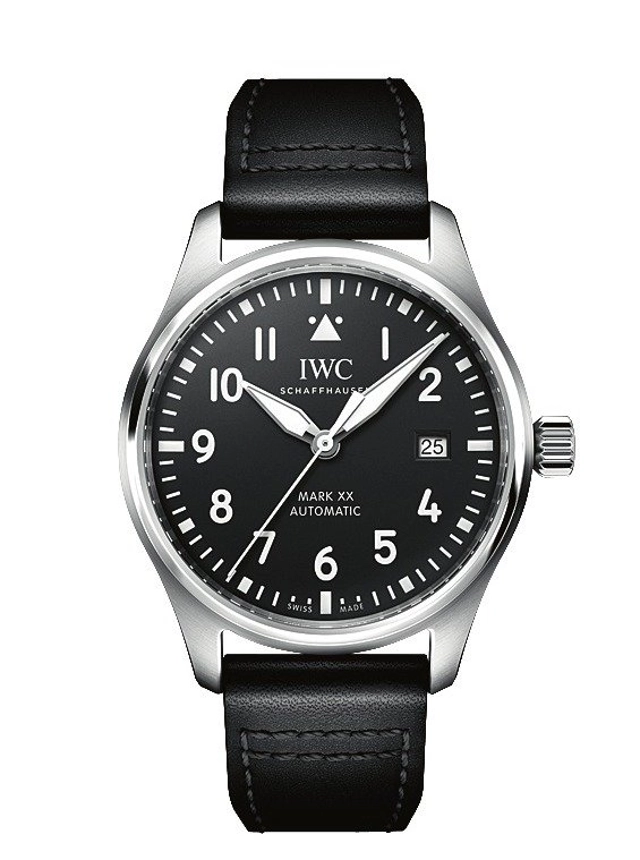
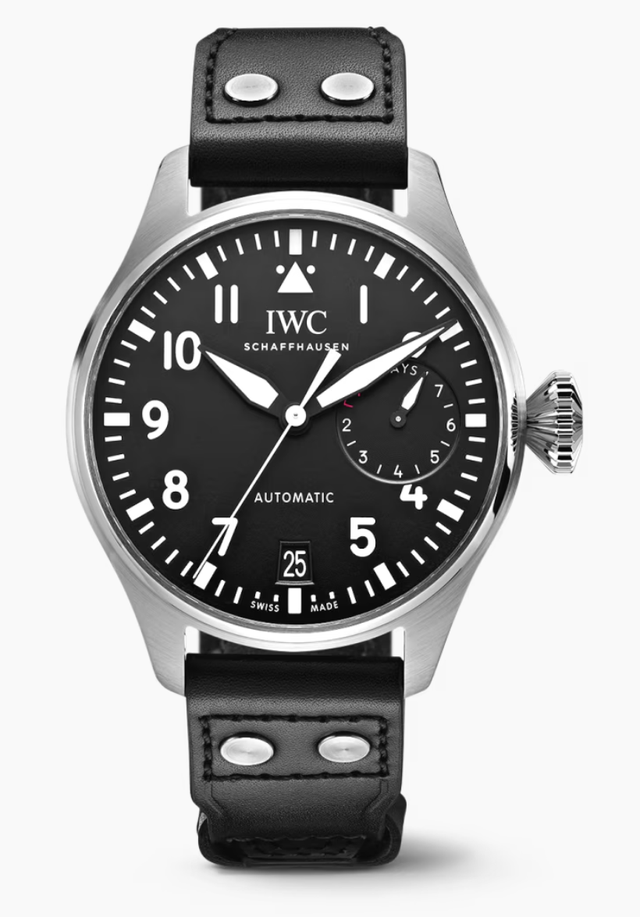
If you hold the Mark XX and the Mark XVIII side by side, the first thing you’ll notice is the strong similarity between the two models. No new Mark has ever looked quite so like its older sibling. The shapes of the hands and the typography of the numerals have remained the same, as has the diameter of 40 mm. If you look closely, you can see three small changes in the design. First, the hands are no longer black, but rhodium plated: This is a small detail, but it makes a big difference because it causes additional reflections of light and makes the face look even classier. Next, the hour indexes at 3, 6, 9 and 12 are again longer than the eight other hour markers. This modification corresponds to the Mark’s history because these four markers had always been longer and more prominent than the others, except on the dial of the Mark XVIII. A third change involves the date disk, which is white, as on the Mark XII and XV, and no longer the same color as the dial. This may come as a surprise because monochrome has become the norm for high-end watches, but the bicolor arrangement is an aesthetic improvement and makes it clear that this timepiece doesn’t encase an off-the-shelf movement. After all, a white date disk is more noticeable and perhaps a bit easier to read thanks to the bolder contrast. Last but not least, the Mark XII and Mark XV also had white date disks.
However, the biggest differences between the Mark XX and the Mark XVIII are in the movement and the wristband. Instead of Caliber 30110, which is based on ETA Caliber 2892, IWC now uses self-winding Caliber 32111. IWC designates this movement as a “manufacture caliber,” but the phrase is misleading. Caliber 32111 is a not brand caliber, but a group caliber, which means it’s built by Richemont’s movement specialist Valfleurier and is also used by fellow Richemont brands Baume & Mercier (as Baumatic BM13) and Panerai (as P.900). Its greatest advantage over the ETA 2892 is its significantly longer power reserve of 5 days instead of 42 hours. It’s also more exclusive and larger, with an ample diameter of 28.2 mm rather than 25.6 mm. It fills the 40-mm case more fully, so the date window is repositioned a bit further away from the center and closer to the edge. Caliber 32111 makes the date jump almost exactly at the stroke of midnight. The display on our test watch advanced 30 seconds before midnight. Unlike Panerai’s variant, Caliber 32111 offers both a stop-second mechanism and a quick date adjustment. It’s also regulated quite precisely, although we suspect that our test watch was adjusted in only five positions because the Witschi timing machine detected an outlier in the crown right position, which some manufacturers neglect. This inconsistency unfortunately caused us to deduct a point or two from the overall rating. Worn on the wrist, the Mark XX lost only about 1 second per day.
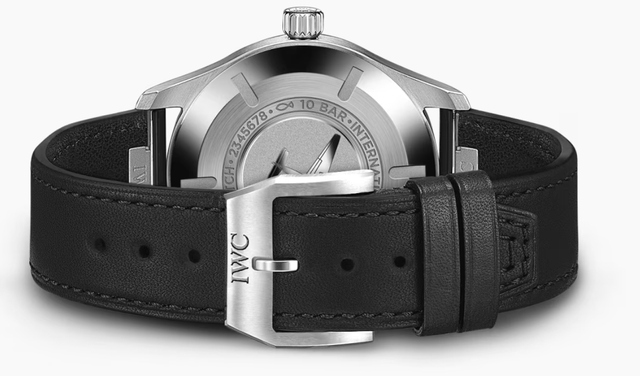
We’re happy to report that the “EasX-Change” quick-change system, which was introduced with the Big Pilot 43 in 2021, is now also used on the Mark. If you own a second wristband, such as the five-row stainless-steel bracelet, you can easily separate one wristband from the case and replace it with another, entirely without the need for any additional tools. Personally, I’m a fan of the metal bracelet, although it adds $900 to the watch’s price. I’m not entirely satisfied with the feel of the leather strap: The quick-change mechanism feels and sounds a bit rickety when you hold the watch in your hands. However, you only feel this when you hold the watch and turn it back and forth. You don’t notice it at all when the watch is on your wrist. Finally, the Mark XX also has increased water resistance to 100 meters, compared to the 60 meters offered by its predecessor.
Comparing the Mark XX to the Mark 11
The Mark 11 owed its popularity, first with the military and later among civilian watch collectors, to its functionality and the resulting design. It has a tight and simple steel case with a shape that causes no visual distractions and has no corners or recesses where dirt can settle. It also has an easy-to-read black dial without superfluous displays, with a triangular marker at the
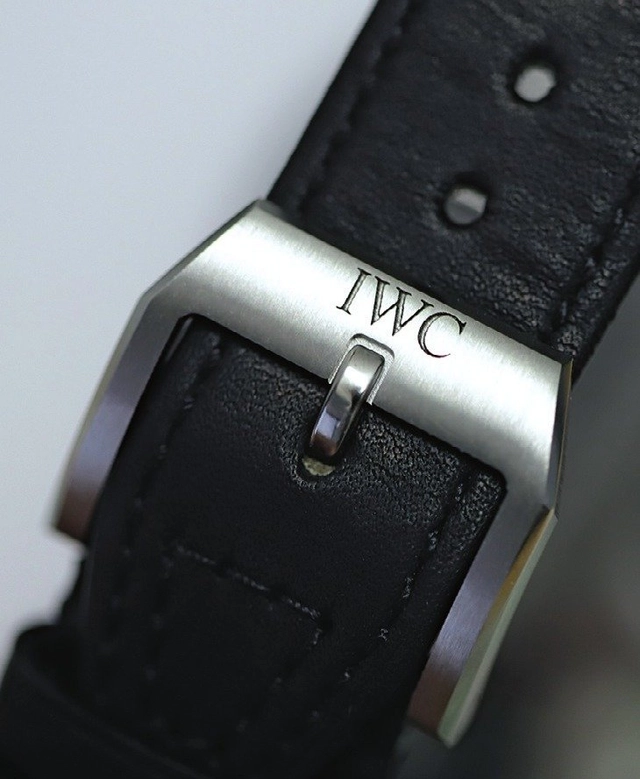
12, which can also be read at night thanks to ample luminous material on the hands and hour indexes. The crown is large, ribbed and easy to grip, so pilots can operate it while wearing gloves. Finally, pilots fasten this watch to their wrists with a simple black leather strap secured by a pin buckle. All of these features not only distinguish the Mark 11, but also became recognizable and genre-defining characteristics of pilots’ wristwatches. IWC retained each of these practical features on all successors to the Mark 11, from the Mark XII to the Mark XV, XVI, XVII, XVIII and XX. (The numbers 13, 14 and 19 were not used because they are considered to be unlucky in some parts of the world.)
An Alternative to the Big Pilot?
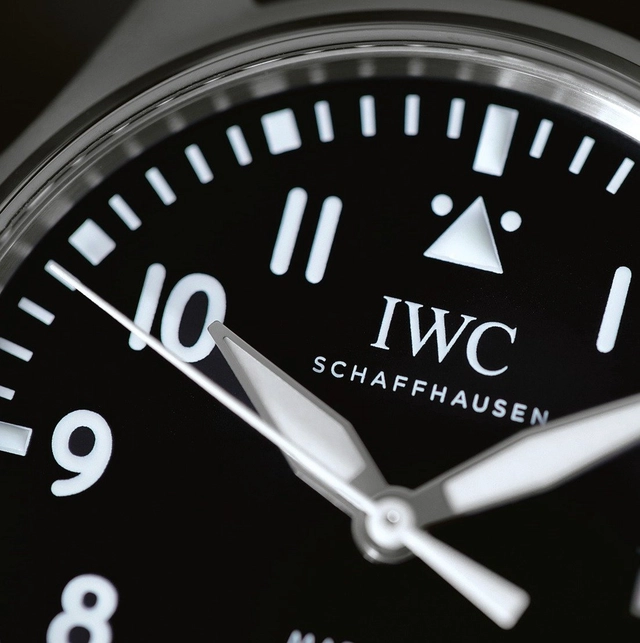
Although the Mark models and the Big Pilot’s Watch have different genealogies, they are now more similar than ever. The trajectory toward greater similarity began in 2006, when the Mark XVI adopted the lance-shaped hands from the Big Pilot that IWC has since used for all its pilots’ watches. At the same time, the Mark XVI was given the longer numerals, also from the face of the Big Pilot’s Watch. The Big Pilot’s characteristic two dots can be found to the right and left of the triangle at the 12 as well. The Big Pilot’s generous diameter of 46.2 mm, its triangular crown and its power-reserve display at 3 o’clock still clearly distinguished the Big Pilot from the Mark XVI. But the two designs moved even closer together with the introduction of the Big Pilot in 2021, which shrank to 43 mm and eliminated the power-reserve indicator. The Mark XX takes further steps in this direction by adopting the Big Pilot’s rhodium-plated hands and its EasX-Change quick-change strap system.
Of course, important differences remain. These range from the size (40 to 43 mm), to the shape of the crown, the slightly different minute track and the date display (the Big Pilot doesn’t have one), to the genuine manufacture caliber inside the Big Pilot, the glass caseback and the soft-iron inner cage, which protects the Mark XX against magnetic fields. However, if you consider that the group caliber inside the Mark XX is more exclusive than the previously used ETA 2892 and has a power reserve of 120 hours, which is twice as long as IWC’s Caliber 82100 in the Big Pilot, then you may start to wonder about the price comparison. At $5,250, the Mark XX is significantly less expensive than the Big Pilot’s Watch 43, which sells for $8,950 on a calfskin strap (Ref. IW329301).
The Features
Bearing all these similarities in mind, we can assume that the next Mark also will not exceed the current size of 40 mm. It seems to have found its perfect diameter — it’s large enough for contemporary tastes, it offers ample space for a well-proportioned dial and it fits comfortably on the wrist. Looking at the dial is a delightful experience. Despite all the apparent simplicity, there are still a few subtleties, which make this a luxury watch and justify the price compared to less expensive pilots’ watches. The details include, above all, the hour and minute hands, which are perfectly polished to a high gloss, as well as the bezel and the slender line that connects the outer edge of the case with the lugs. The lugs are gloss polished and, like the hands, sharply reflect the light, creating an exciting contrast to the matte case and the lightabsorbing dial. The accurately applied and slightly raised luminous material on the four larger hour markers and on the triangle are handsome details as well: The Super-Lumi-Nova on the triangle, for example, forms a triangle itself, which shows additional effort in the manufacturing process.
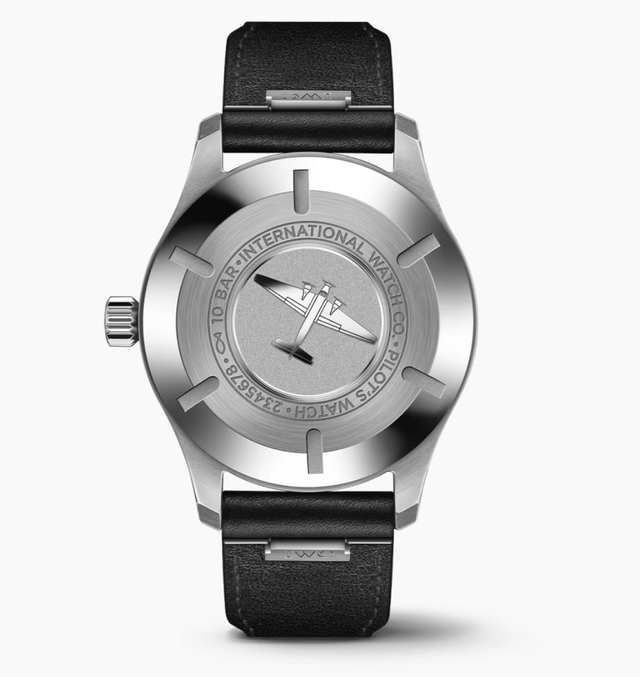
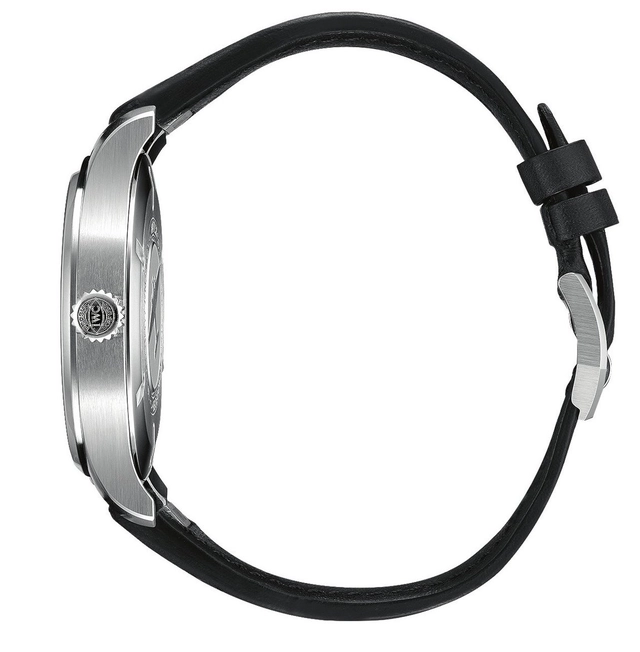
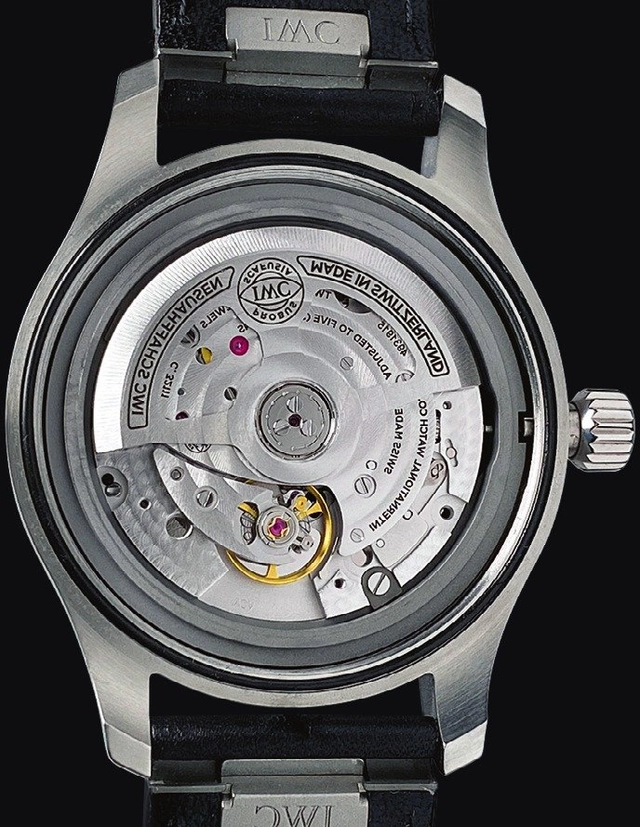
Like its predecessors, the Mark XX is protected against magnetism by a soft-iron inner case, so you won’t find a pane of glass in the back of the case. Although the movement is hidden beneath the threaded, screw-in back, which is engraved with the image of a Ju-52 aircraft, the caliber is nonetheless decorated with circular graining and Geneva waves. The screw down crown is large and easy to grip. When you pull it out, you’ll notice its thick and sturdy tube. This detail underscores the functionality of the watch, which never looks unduly austere and always retains a dash of elegance.
Elegance and Color
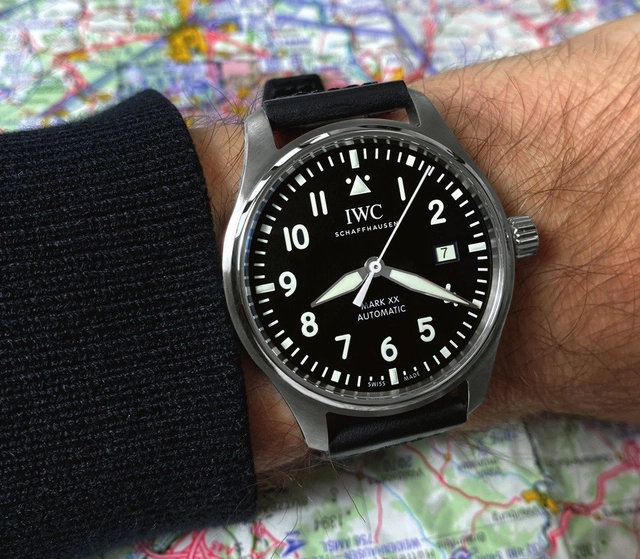
This elegance is another important reason for the Mark’s enduring success. Its heritage makes it a tool watch, but you can wear it just as well as an elegant watch with a business suit or as a sports watch with outdoor apparel. The Mark XX also brings color into play: In addition to the classic black dial, there’s also a blue one combined with a blue strap and a green dial complemented by a brown strap. This is another similarity to the Big Pilot, which offers the same color options, as well as a green strap.
Conclusion
Thanks to its technical features and its pilots’ watch design, which has been cultivated over decades and kept at a high level through slight modifications, the Mark XX is perhaps the best Mark so far. It is at least surely the best Mark for our time. It has what it takes to continue in this form for many years before it’s ultimately succeeded by a future Mark XXI. Still, no Mark has ever been as similar in design to the Big Pilot. IWC should be careful not to bring both models even closer together or to commercialize them even more with additional color variations.
Specs
IWC Mark XX
Manufacturer:
IWC Schaffhausen
Baumgartenstrasse 15, 8201 Schaffhausen, Switzerland
Reference Number:
IW328201
Functions:
- Hours, minutes
- Central second hand with stop-seconds function
- Date display
Movement:
- IWC Caliber 32111, automatic
- Frequency: 28,800 vph
- Jewels: 21
- Power Reserve: 120 hours
- Components: 164 individual parts
- Dimensions: Diameter = 28.2 mm, Height = 4.2 mm
Case:
- Material: Satin-finished stainless steel
- Features:
- Soft-iron inner case to protect against magnetic fields up to 24,000 A/m (301.59 gauss)
- Polished bezel and case edges
- Threaded, screw-in back engraved with a Ju-52 airplane
- Crystal: Sapphire, anti-reflective on both sides
- Water Resistance: 100 m
Strap and Clasp:
- Strap: Calfskin with quick-change system
- Clasp: Stainless-steel pin buckle
Dimensions:
- Diameter: 40 mm
- Height: 10.8 mm
- Weight: 80 g
Variations:
- With blue dial and blue calfskin strap or green dial and brown calfskin strap (Ref. IW328203 or Ref. IW328205, $5,250)
- Available with a five-row stainless-steel bracelet with a quick-change system (Ref. IW328202, Ref. IW328204, or Ref. IW328206, $6,150)
Price:
$5,250
Scores
Strap and Clasp (Max. 10 Points):
- The black calfskin strap is simple, elegant, and complements the model’s style.
- The quick-change system functions well, but the feel could be improved.
Score: 8
Case (Max. 10 Points):
- Functional with a touch of sophistication, thanks to the contrast between the matte case and the polished bezel.
Score: 8
Dial and Hands (Max. 10 Points):
- Rhodium-plated hands enhance the plain black dial with a sophisticated appearance compared to the black hands used previously.
- Luminous material is precisely and symmetrically applied to the center of each hand.
- Excellent craftsmanship befitting a luxury watch.
Score: 8
Design (Max. 15 Points):
- Clear layout with excellent legibility.
- Classic design with elements resembling the Big Pilot’s Watch, including case, hands, and numeral typography, rather than the historic Mark 11.
Score: 14
Legibility (Max. 5 Points):
- High contrast on the dial and anti-reflective sapphire crystal provide very good readability.
- Nighttime legibility is strong, thanks to the luminous material.
Score: 5
Operation (Max. 5 Points):
- Simple and convenient due to a large, easy-to-use crown and a quick-reset mechanism for the date.
Score: 5
Wearing Comfort (Max. 5 Points):
- Comfortable and slim on the wrist.
- Although the lugs and clasp are sharp-edged underneath, this sharpness isn’t felt during wear.
Score: 5
Movement (Max. 20 Points):
- Automatic Caliber 32111, exclusive to Richemont Group brands, offers an impressive 120-hour power reserve.
Score: 14
Rate Results (Max. 10 Points):
- Good, stable rate in five positions, with a slight outlier in the sixth position.
- On the wrist, the watch had an average loss of only 1 second per day.
Score: 8
Overall Value (Max. 10 Points):
- Improvements in movement, wristband, and water resistance justify the higher price.
- A strong competitor to the Big Pilot’s Watch 43, which is only 3 mm larger but costs $3,700 more.
Score: 9
Total Score: 84 Points
This article is from the WatchTime Archives and was originally published in the March / April 2023 Issue. To subscribe to WatchTime Magazine, click here.
To learn more, visit IWC, here.