Hands-on with the Benjamin James Scarifour Burnt Orange Agate
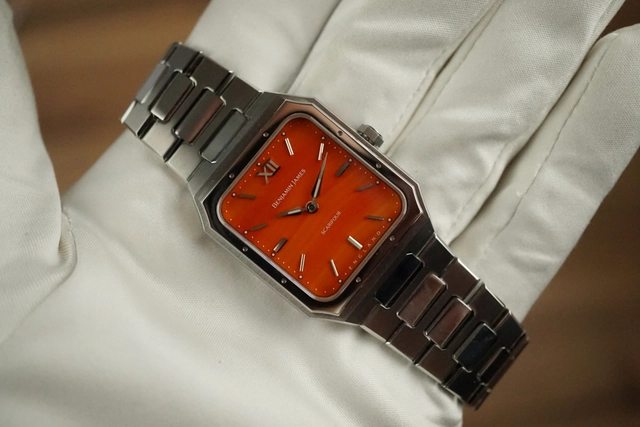
Stone dials are among the hottest commodities these days in the watch world. Where, for decades, it was the exclusive area of top-tier brands, these types of dial are now also available at more affordable price points. Benjamin James now also dons its Scarifour with stone dials, but can they come out of the shadow of its upscale counterparts?
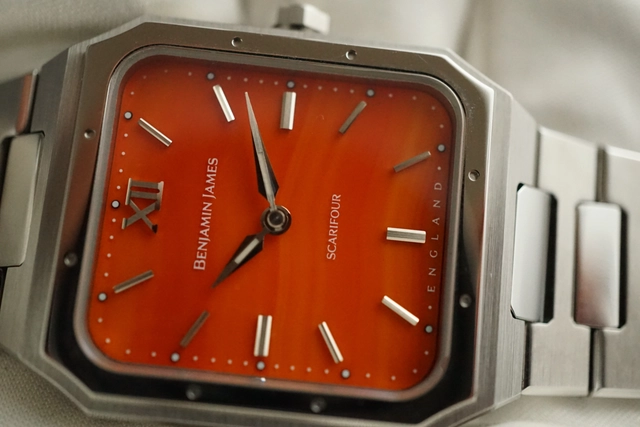
The agate dial is vibrant in color and subtle in its details
Martin GreenBenjamin James opted for three different types of stone for its limited production Scarifour models. Among them, Lapis Lazuli is the most traditional choice but for good reason a classic. With Jade, a popular green dial version was created, but I was most interested in the Scarifour with a burnt orange Agate dial. In watches, agate is not often used. While it shows some similarities with Malachite, it is a copper carbonate mineral. In contrast, agate is a type of Chalcedony, along with Onyx and Tiger's Eye, two other minerals commonly used for watch dials. One of the reasons that I like Agate is because of its banded patterns and beautiful red tones.
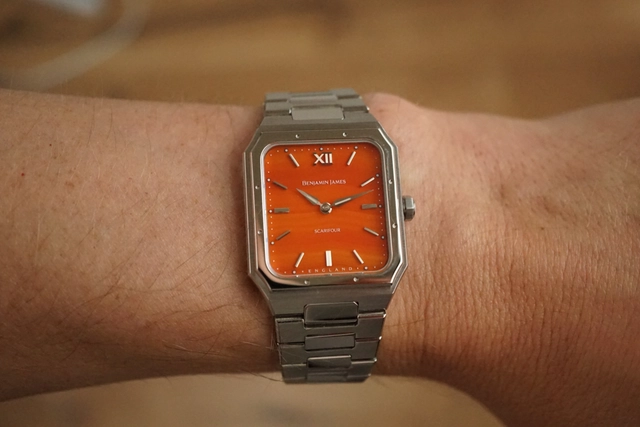
The Scarifour is a joy to wear
Martin GreenThe Scarifour I tried out, which is a pre-production model, hence the printing on the dial is not yet perfect, showed a subtle banded pattern in a vibrant color. It makes a bold statement, yet with a certain refinement. This is aided by the applied hour markers, which give the dial a sense of depth, a feature not commonly found in stone dials. To secure them, you have to drill in the dial, and being stone, they can always break, so brands often like to avoid that additional risk and cost. The sword-shaped hands also fit nicely into this theme of refinement, as they are faceted like the hour markers for improved visibility.
While the Scarifour is not a new model, it is one that remains pleasing. Its dimensions have a classic subtlety to them, with the case measuring 31mm in width and 40mm in length. The case thickness is also kept in check at 8.3mm, while the watch still boasts a manual-wound movement. Benjamin James did well by giving the sapphire crystal an anti-reflective coating, as this allows the beauty of the stone dial to reach the eye in its purest form. The shape of the case has a bit of seventies swing to it, highlighted by the polished bezel. Extra credits go to the crown, which is subtle but with character and easy to operate.
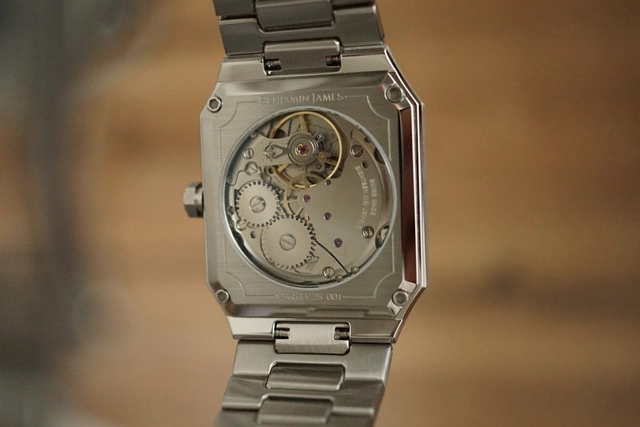
A solid movement, but I could do with a bit more exciting finishing
Martin GreenThat is also needed, as you will get into a more intimate relationship with it, as this Scarifour is powered by a manual-wound movement. Benjamin James opted for Sellita's SW210-b, which is also visible through the mineral insert in the caseback. While the caseback itself meets the expectations I got from viewing the front of the watch, I am slightly disappointed about the lack of finish on the movement itself. It looks very industrial and therefore misses the flair of the rest of the watch. A missed opportunity in my opinion, as caliber SW210-b is by itself a perfect choice for a watch like this.
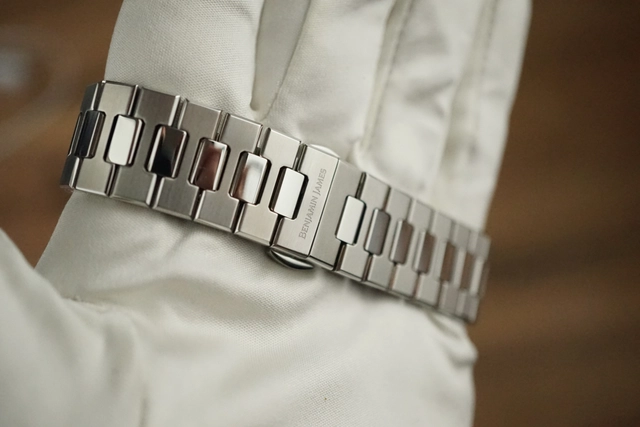
However, I am a big fan of the bracelet. It is relatively thin, better finished than pictures can give it credit, and very comfortable to wear. Its thinness plays a role in that, but also that it naturally has a little slack. It wears, therefore, more like a jewelry bracelet than a watch, and that adds a lot to the experience of this Scarifour. While the price of £790 is not exclusive, it is unlikely that you will see many of these watches around, as Benjamin James has to cap yearly production at 100 pieces each due to the stone dials. While a more appropriately finished movement would have been the cherry on top, the Scarifour is still quite the powerhouse. It showcases the beauty of stone dials in an attractive and affordable package, with as a secret super power that this also makes it far more wearable than its upscale counterparts.
For more info, visit Benjamin James, here.