Introducing the Urwerk UR-1001 Amadeus
Measuring seconds to a millennium

A Horological Tour de Force
Urwerk's UR-1001 Amadeus is extraordinary in every sense. Created as a unique piece, the pocket watch brings together a mechanism of staggering complexity and an exuberant, almost baroque exterior. More than simply displaying the time, it maps its passage across an astonishing range–from seconds and minutes to years, centuries, and even a full millennium. As is characteristic of the independent Swiss manufacture, the UR-1001 Amadeus relies on flamboyant mechanisms, including carousels, retrograde and satellite displays, creating constant motion across the dial and an unmistakable sense of mechanical drama. The result is a spectacular showcase of Urwerk’s creativity and its determination to rethink the conventions of mechanical watchmaking. The modern, highly technical in-house movement inside the watch stands in striking juxtaposition to the richly hand-engraved titanium case created by Florian Güllert that involved hundreds of hours of artisanal craftsmanship.
The name Amadeus reflects the lavish character of the creation. According to Urwerk co-founder Felix Baumgartner, it refers to Wolfgang Amadeus Mozart, whom he describes as an avant-gardist and brilliant madman. The UR-1001 Amadeus aims to capture that spirit of ingenuity.
UR-1001 Amadeus
Urwerk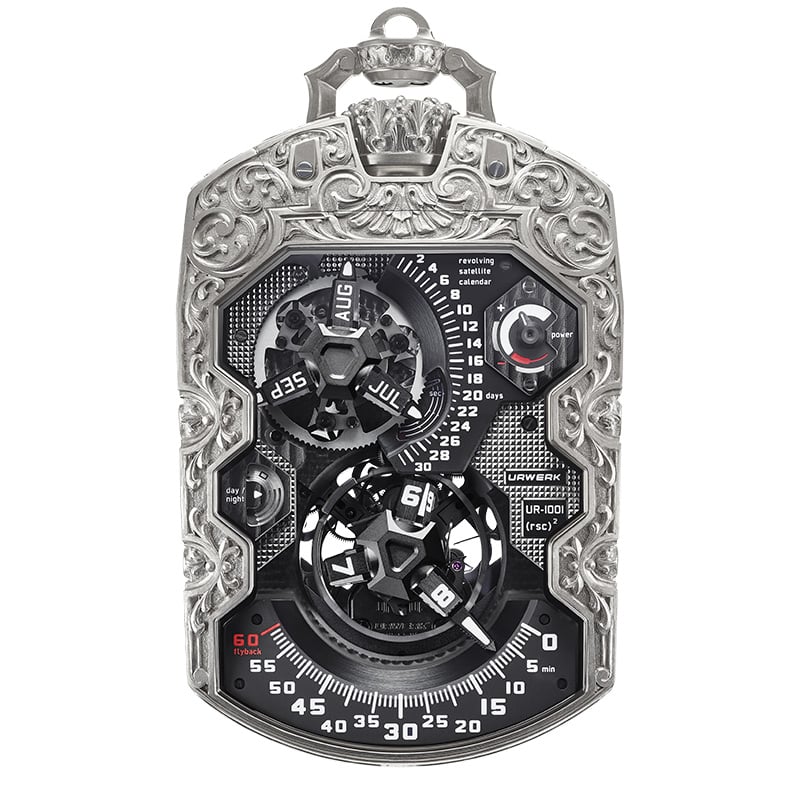
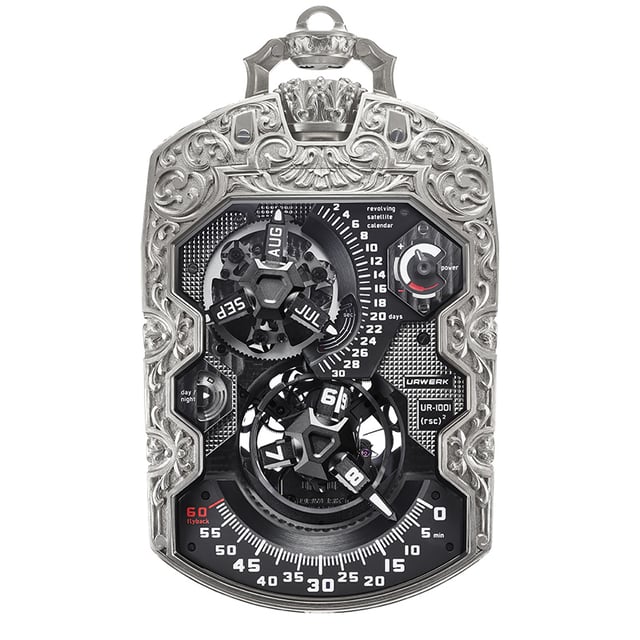
At first glance, it becomes clear that the UR-1001 Amadeus is a timepiece that invites discovery. On the front, the brand's signature satellite display takes center stage. At 6 o’clock, the flying hours satellite, devoid of an upper bridge, appears to float above the movement, which can be seen thanks to the open-worked design, while the retrograde minutes mechanism, placed onto an arc completes the time display. At 12 o’clock, the same mechanism with rotating orbital arms indicates the months and dates, automatically accounting for the specific duration of each: 28, 30 or 31 days. On closer inspection, the seconds display can be seen integrated into the design.
At 9 o’clock, a hand-painted day/night indication is integrated into the intricate composition. A black Superluminova-treated surface represents nighttime, while brushed white ruthenium indicates daytime. Alternating stripes mark the transitional phases of dawn and dusk. A separate indicator positioned at 1 o'clock indicates the remaining energy of the 39-hour power reserve of the self-winding UR-10.01, with a red zone signaling that the reserve is running low.
UR-1001 Amadeus
Urwerk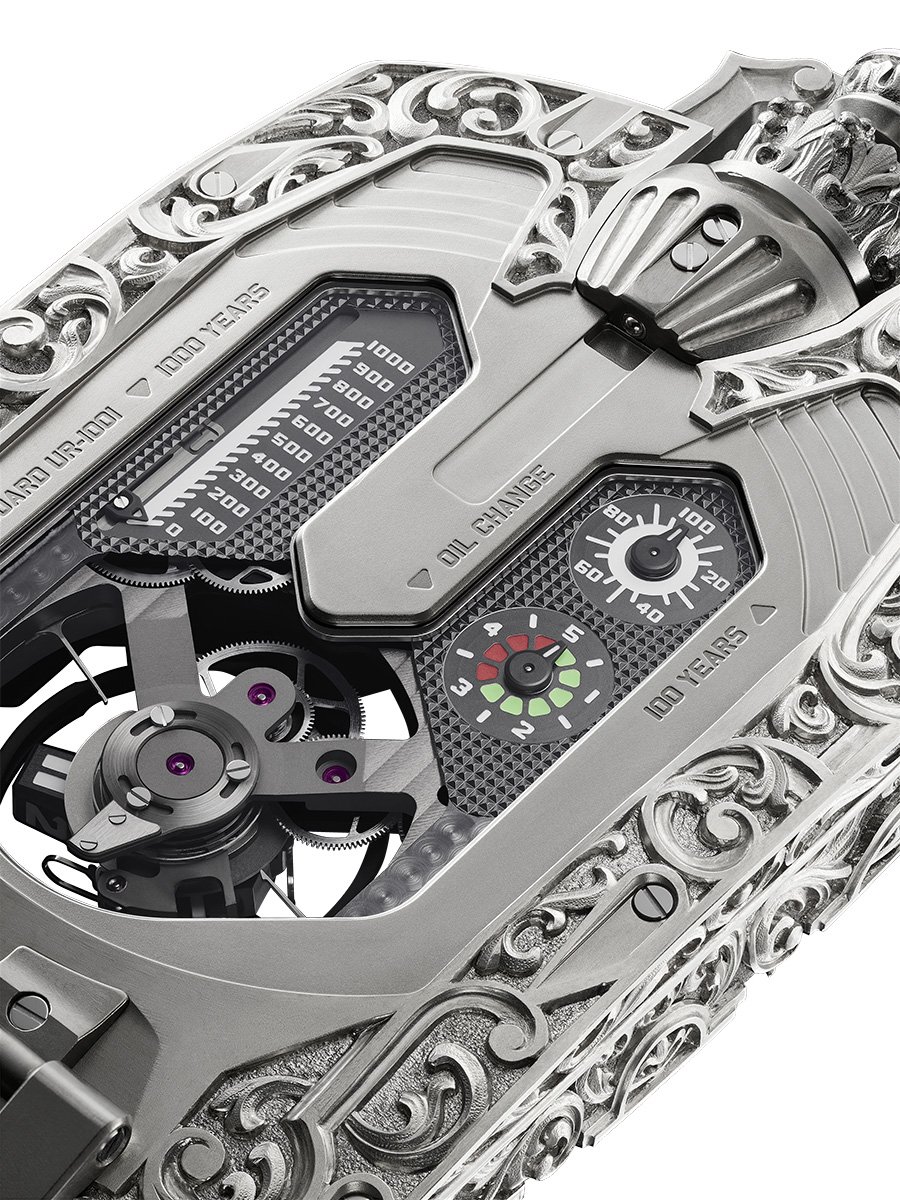
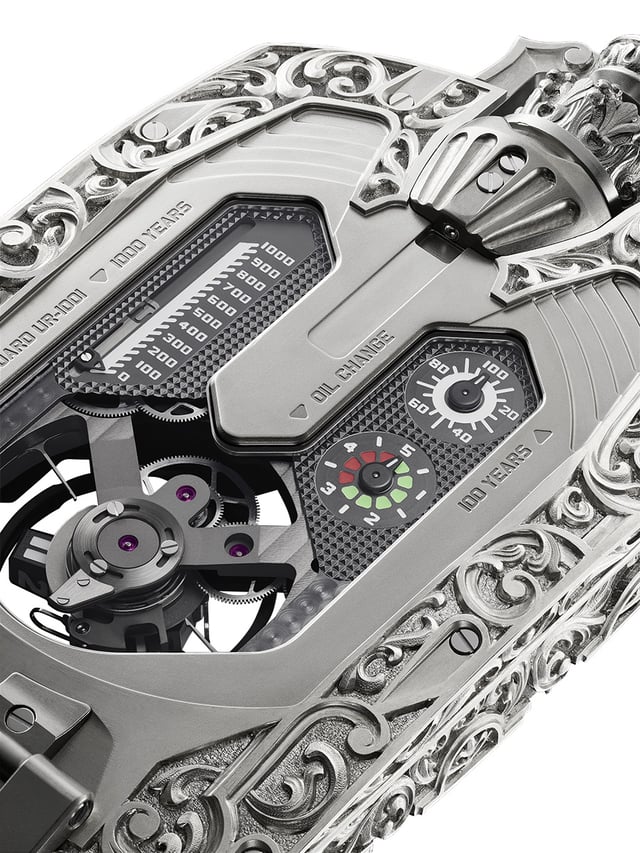
The reverse side takes the concept of time to an entirely different scale. An “Oil Change” indicator records the recommended service interval over a five-year cycle. A further indicator tracks 100 years in five-year increments, functioning much like a mechanical odometer. At the end of each century, it sends a pulse to the linear 1,000-year indicator. In this way, the UR-1001 Amadeus juxtaposes the almost imperceptible passage of a millennium with the fleeting movement of seconds – making the perception of time itself part of the watch’s concept.
UR-1001 Amadeus
Urwerk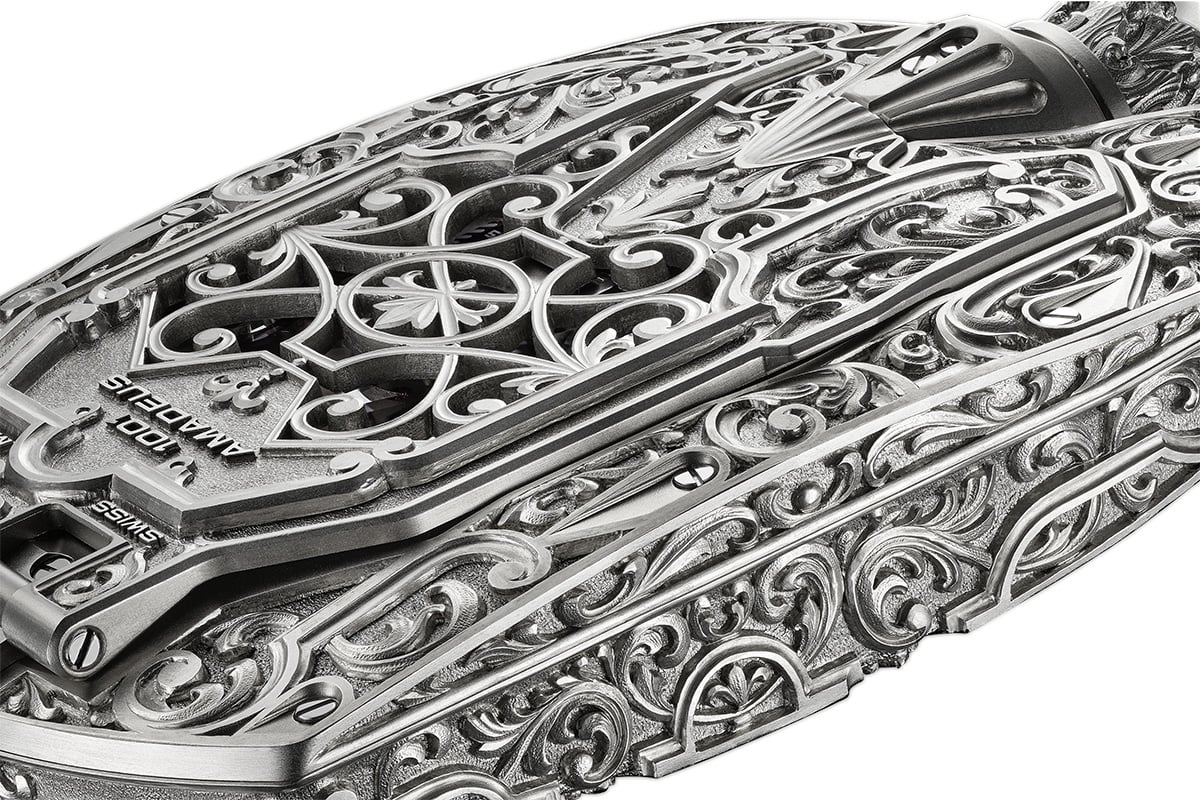
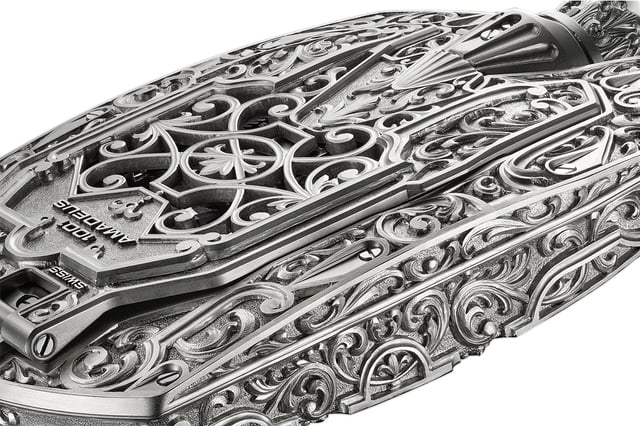
The case provides the artistic counterpoint to Urwerks’s futuristic mechanics. Measuring 106 x 62 x 23mm, it is made from titanium and has been entirely hand-engraved by Florian Güllert. The Munich-born engraver spent almost three months, or around 500 hours, on the project, including the design phase. The process began with laser rough-cutting of the titanium before the material was prepared for extensive hand-finishing. Using a pneumatic chisel, Güllert then gradually carved the design into the metal, working with thick and thin strokes, textured backgrounds, voids and varying surface treatments to create a baroque-inspired, floral pattern that seems to emerge organically from the metal.
The unique Urwerk UR-1001 Amadeus carries a price tag of CHF 450,000 or approximately $560,000 when converted to USD.