The Richard Mille RM 43-01 Isn't What Anyone Expected from the Ferrari Collab

The world's thinnest mechanical watch is an attention-grabbing way to announce a brand partnership. That was how Richard Mille and Ferrari kicked off their alliance in 2022. Now, the second product to result from it shows the relationship is about much more than ultra-thin watches.
The new Richard Mille RM 43-01 Tourbillon Split-Seconds Chronograph Ferrari is, in fact, a full 17.1mm thick (15.35mm thicker than its predecessor) and packed with as much complicated clockwork, techy materials and automotive nods as one could imagine fitting in that space.

As 2022's ultra-thin UP-01 was undoubtedly in development longer than the partnership, its Ferrari association was likely a serendipitous addition. It broke new ground for the brand and was a complete surprise to watch lovers. The new 43-01, on the other hand, is classic Richard Mille in its concept, form and style.
That means no-holds-barred overengineering, wildly styled, crazily complicated, tonneau-shaped, and priced in seven figures. WatchTime joined Richard Mille in Paris for the launch to get a firsthand look as well as to understand more about the Ferrari partnership and the intricacies of the new watches.
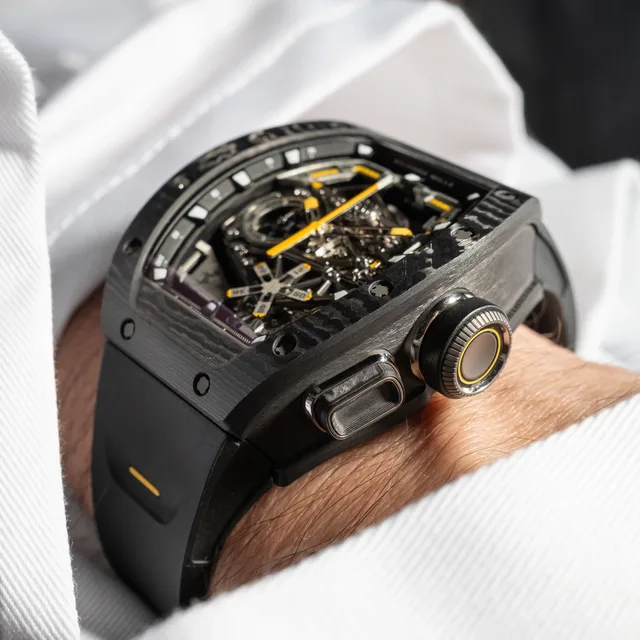
The two limited models come in titanium (with red highlights) and, a Richard Mille favorite, Carbon TPT (with yellow) each measuring 42.9mm by 51.2mm. But we're not just talking about case materials. Each primary material features throughout the movement as well. The result comes across as more thoughtful and holistic than merely a cosmetic difference — though both materials were selected for their lightness and strength, and choosing between the two as a consumer likely comes down to style/aesthetics.
Moreover, the materials used in the movement ended up necessitating some design adaptation. When placed side by side, for example, you can see (if you know where to look) that a carbon bridge needed one more screw than the same component in titanium — the former requiring a little extra reinforcement.
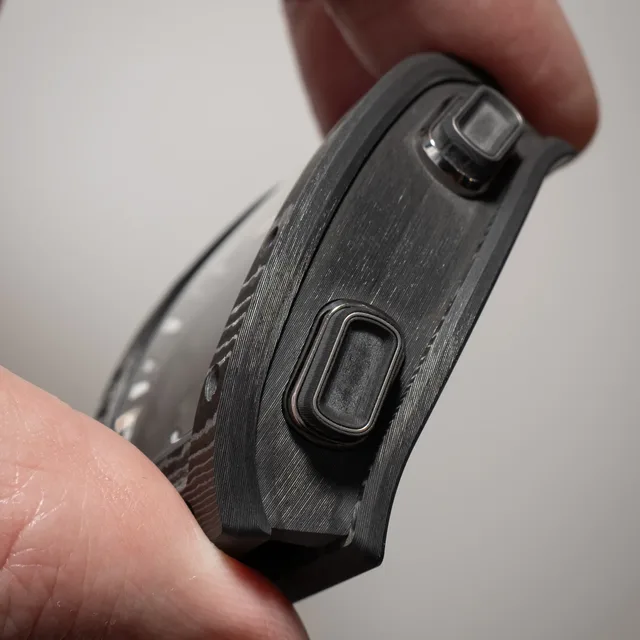
With the movement's complexity and hand finishing, as well as element's like the carbon version's interesting material texture (which actually feels like charcoal when you pick it up), the RM43-01 is indeed worth looking at that under a loupe. But first, you might want to grasp exactly what your seeing at wrist distance. You wouldn't be blamed for encountering this or many other Richard Mille watches and first saying "wow" followed by "but what time is it?"
It might take a minute to locate the time-telling hands, much less decipher some of the other indications. Here's what you're looking at, and it takes a bit of breaking down:
To read the time you'll want to find the painted tips of the otherwise skeletonized hands (yellow for the carbon version and white for the titanium) among all the busyness. The chronograph's seconds hand stands at attention at 12 o'clock until activated, and beneath it hides the second chronograph hand that executes the split-seconds functionality for measuring two events or marking a time (such as a lap) as you continue tracking a larger event. The large subdial near 9 o'clock is the chronograph's 30-minute counter.

To operate the chronograph, the stop/start button is found on the lower left of the case with the reset button above it, and on the case's lower right is the split-seconds button. Smooth, solid and satisfying, the articulation of the buttons themselves (as well as the crown) feel like a million bucks (or, more precisely, around $1.3m–$1.5m).
The split-second (aka rattrapante) chronograph functionality is more or less standard for the complication. But there's a lot more going on here, obviously, and much of it isn't exactly "standard." Off-centered between 5 and 6 o'clock is the tourbillon atop which is displayed the running seconds — the twist being that it's rendered as five arms each marking 12 seconds. I'm not sure I've seen anything quite like it on a watch before, nor if the 12-second display has a practical justification or perhaps a motorsports reference (please set me straight if you know).

Next, amid the mechanical salad, you'll notice small arrow-shaped hands: two are at the top of the dial flanking the space below the 12 o'clock index. To the left is the 70-hour power reserve indicator, and across from it is the torque gauge which measures up to 65 deca Newton millimeters (indicated as dNmm).
Torque should more or less correspond to the power reserve as it indicates the twisting force of the mainspring which is at its highest when fully wound, and it's part of maintaining a watch's chronometry. It's typically at its most consistent in the middle ranges, but Richard Mille has incorporated technical solutions that help further limit torque variance. This probably isn't something you'll need to actively worry about but it contributes an interesting way of interacting with and understanding the movement. You will, however, need to manually keep the movement wound.
One more indicator is found subtly tucked in around 3 o'clock with an arrow pointing to W, N and H. Those are for the winding, neutral and hacking positions of the crown, a handy feature of many Richard Mille watches. Fans of minimalist watchmaking will appreciate the lack of a date display.

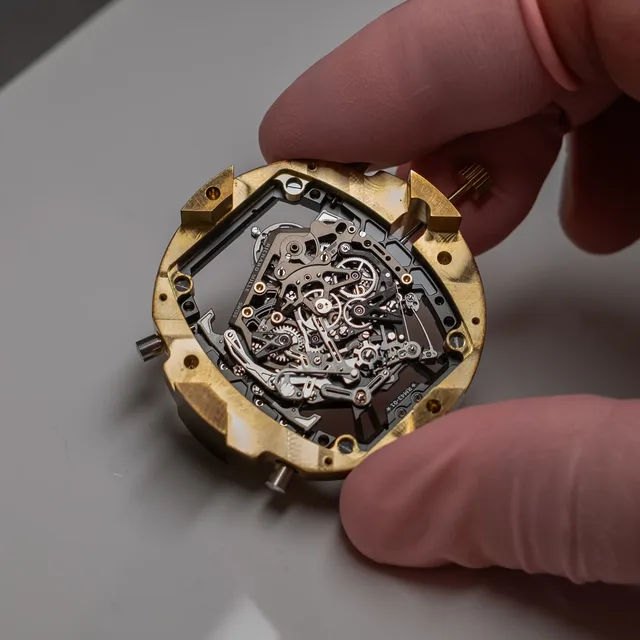
Even more so than the face of the watch, the caseback view of the movement (same name as the watch, "RM43-01") conveys a form-following-function impression. Developed with Audemars Piguet Le Locle over three years, it's genuinely reminiscent of a supercar engine and incorporates 514 components, two column wheels, extensive skeletonization and hand finishing — and, well, countless details, nods and technical features for owners to explore and nerd out upon.
As with nearly any Richard Mille watch, all the conspicuous complexity is intentional, designed to dazzle, and watches such as this are, of course, far beyond pure pragmatism. You wouldn't want to rely on it or try to read the time through a driver's helmet amid road bumps and the vibrations of a V-8 engine, but it naturally isn't made for that. It is, however, made to be highly robust and to withstand said vibrations and bumps.
It's design and tech that are convincingly on the level of Ferrari supercars, rife with nods to automotive elements, and the split-second functionality gives it an appropriate racing connection and purpose. It's light and comfortable despite its considerable size, and an utter marvel to behold and use. In other words, it's classic Richard Mille. The Ferrari connection only adds to it and promises more stunning hyper horology to come.
The Richard Mille RM 43-01 Tourbillon Split-Seconds Chronograph Ferrari is $1,300,000 in Grade 5 titanium or $1,535,000 in Carbon TPT and each is limited to 75 examples.
To learn more, visit Richard Mille here.