Mar 23, 2018
Reading time 4 min.
Rolex GMT-Master II in Oystersteel: For the New Pepsi Generation (Updated with Live Photos)
BASELWORLD 2018:
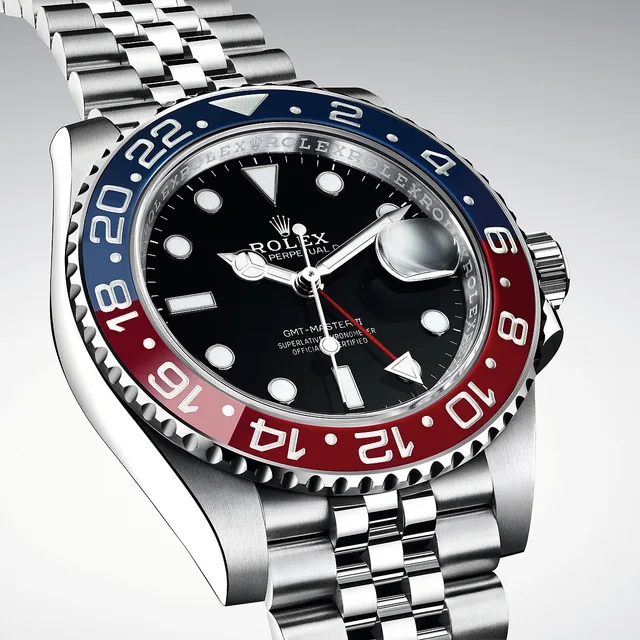
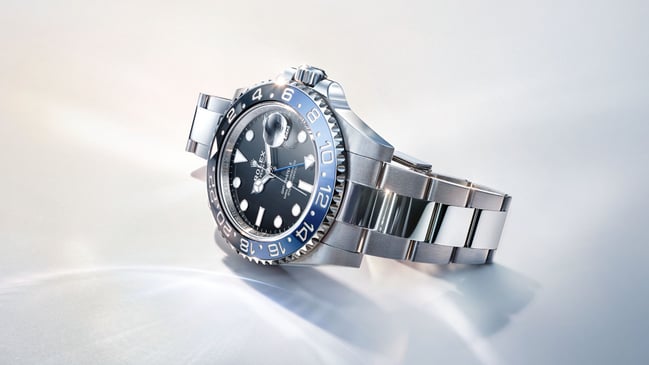
Almost as intriguing as the discovery of new watches every year at Baselworld are the guessing games that precede it, especially as regards Rolex. It's become a cottage industry for online prognosticators to try to predict ahead of time what the Swiss power brand will roll out at the world's biggest watch fair. However, few saw coming the timepiece that led off Rolex's 2018 collection — a new version of the classic "Pepsi" GMT-Master II in "Oystersteel," featuring several significant updates on both the inside and outside. We run through the most significant of them below.
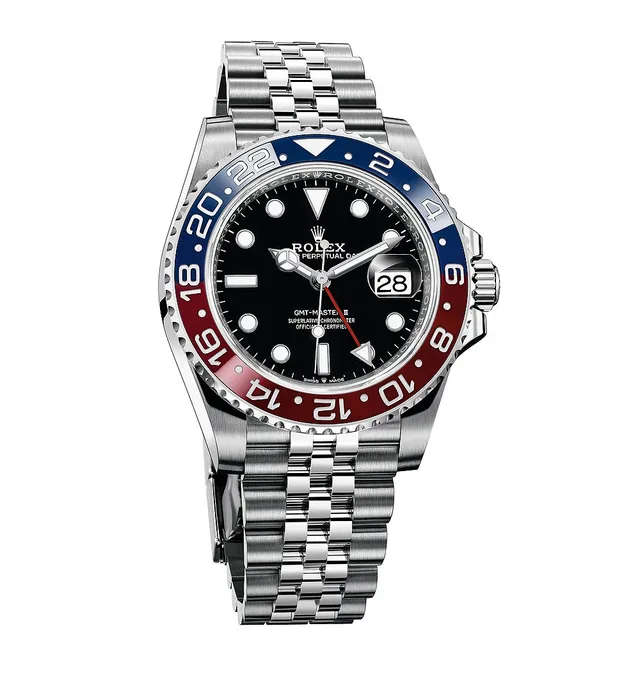
The Rolex GMT-Master II Oystersteel features a new movement and a new Jubilee bracelet.
PR
The 40-mm case made of Oystersteel — Rolex jargon for 904L stainless steel — is guaranteed waterproof to a depth of 300 meters, a robustness aided by a solid steel, fluted-edge caseback that is hermetically screwed down (with a special tool that is exclusive to Rolex) and the integrated crown guards emblematic of the GMT-Master II's Oyster case flanking the screw-down crown. That recognizable Pepsi bezel frames a nearly scratchproof sapphire crystal, with the now-iconic Cyclops lens over the date window at 3 o'clock. For those not in the know, the bicolor bezel's 24-hour scale can be synchronized with the red GMT hand on the dial to quickly and easily read the time in a time zone other than your own, while the hour and minute hands and date all continue to display the local time.
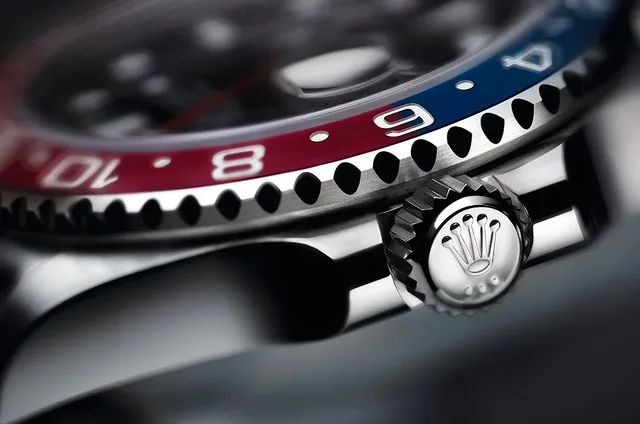
The screw-down crown and its guards help ensure a 100-meter water resistance.
PR
The famous red-and-blue rotating GMT bezel, which appeared on the very first GMT-Master watch in 1955 and which inspired the model's nickname, "Pepsi," is here executed with a Cerachrom bezel insert, with red and blue ceramics that are exceptionally resistant to scratches, corrosion, and the effects of ultraviolet rays, which could otherwise dull the vibrant colors over time. Rolex makes its ceramics in-house, and the red segment of the 24-hour, bidirectionally rotating bezel proved to be exceptionally challenging: red ceramic cannot be created using the standard pigments, so Rolex needed to develop its own internal process, one for which it has filed several patent applications — certainly not a new experience for the company, whose list of watch-industry patents is extensive.
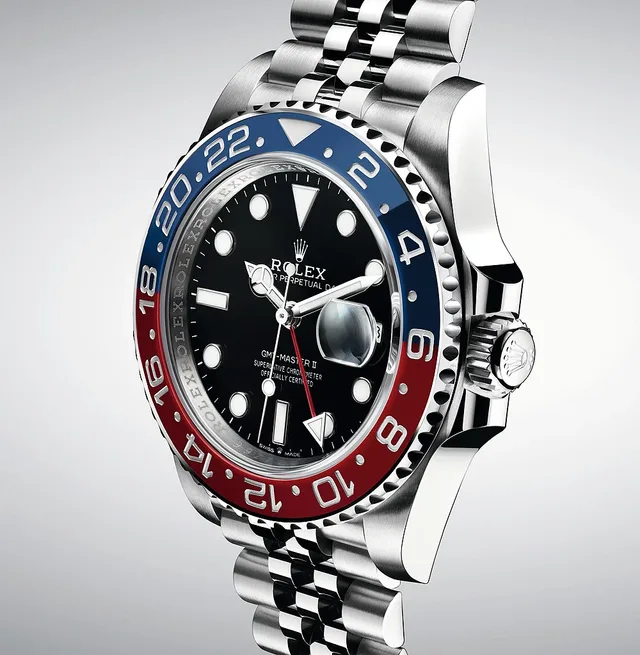
The Cyclops lens enlarges the date at 3 o'clock.
PR
Speaking of patents: Rolex has 10 of them pending for technologies used in this watch's all-new movement, Caliber 3285, which makes its debut in this model (as well as two other variants also launched at Baselworld, one in all-Everose gold, the other in gold-and-steel "Rolesor," both with black-and-brown Cerachrom bezel inserts). Incorporating Rolex's patented, energy efficient, magnetic-resistant Chronergy escapement, the movement is self-winding by means of a bidirectional rotor (hence Rolex's designation of its movements as "Perpetual," as in "will stay wound perpetually as long as you keep wearing it"), equipped with the brand's exclusive blue Parachrom hairspring, which is 10 times more precise than the traditional type, and stores a power reserve of approximately 70 hours. Of course, like all Rolex watches since 2015, this one has aced the series of in-house tests necessary to achieve the "Superlative Chronometer" designation, which it touts on its black lacquered dial, orbited by white gold hands and studded at the hour markers with highly luminescent Chromalight appliqués.
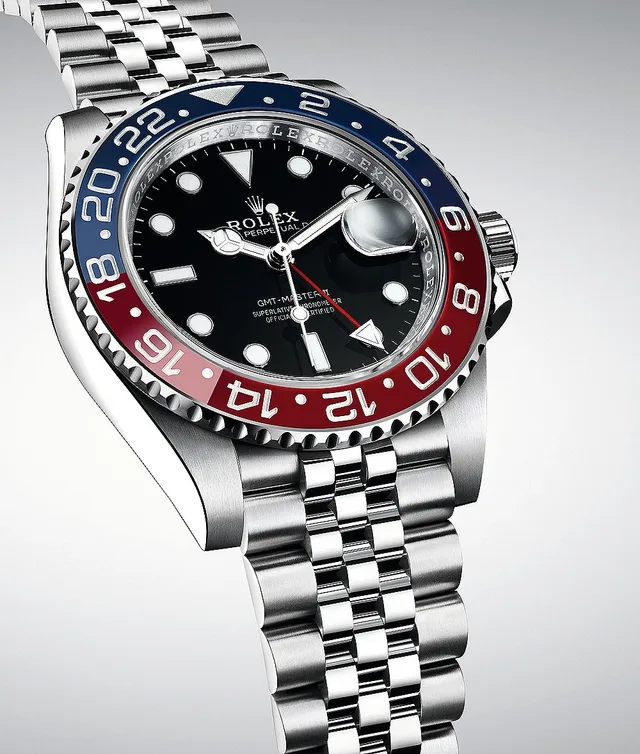
The GMT-Master II is powered by the new manufacture Caliber 3285.
PR
The other significant feature that Rolex fanatics will note right away is the bracelet — in the historical five-link "Jubilee" style rather than the more common three-link "Oyster" style. Created specifically for the first Rolex Datejust in 1945, the Jubilee bracelet was designed to be supple and comfortable, though it remains a subject of debate among serious connoisseurs of vintage and modern Rolex. Here it has engineered to integrate seamlessly into the case with a concealed attachment system. The bracelet is equipped with both the Oysterlock safety clasp (you're seeing the theme here, right?) to prevent accidental opening and the Easylink quick-extension system — another Rolex patent, way back in 1966 —which allows the wearer to increase the bracelet's length by 5 mm.
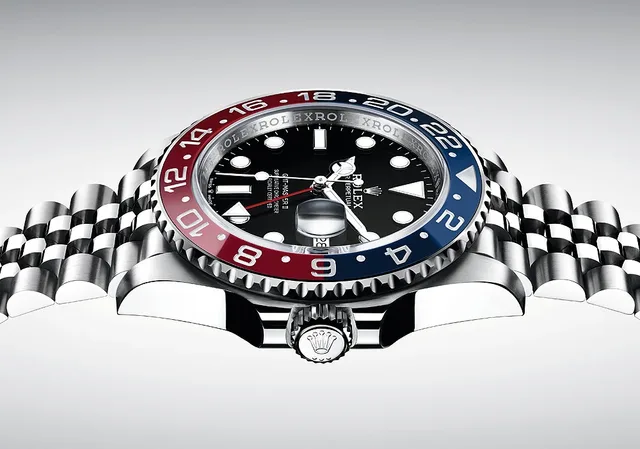
The five-link Jubilee bracelet debuted on the first Datejust in 1945.
PR
The price of this new-generation GMT-Master II comes in just under 10 grand, at $9,250.