A Celebration of the Rare Art of Straw Marquetry: Hands-on with the Isotope Mercury M

Photography by Jeroen Vink.
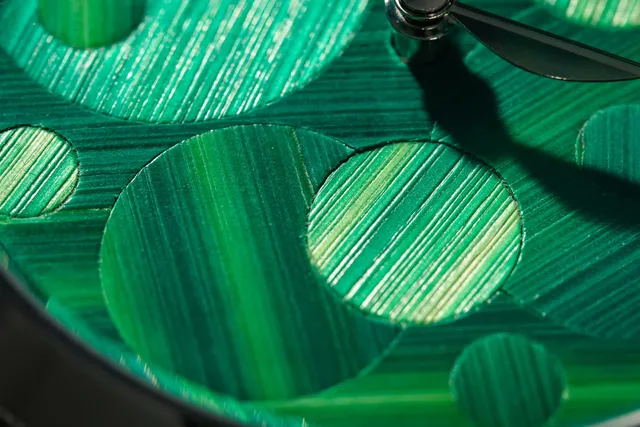
Straw marquetry is a rare decorative art in which rye straws are colored, cut, and arranged in a unique design before being fixed into place by glue. While this art was once widely celebrated, it has become a rarity, as there is only one producer of high-quality straws left in the world and just a few artisans who know how to work with them. It can not come as a surprise that straw marquetry has also been used by esteemed brands such as Cartier and Hermès on dials, with a result that was as mesmerizing as their price tags. It's all the more surprising that British brand Isotope recently launched a version of its Mercury model with a straw marquetry dial at a far more affordable price point.

When it comes to straw marquetry, there is no shortcut to creating these dials. Each straw has to be cut and placed with a steady hand by an artisan with years of training and experience. Then, they all have to be glued into place, which is another step that requires the utmost concentration and attention. The tolerances are less than 0.1mm, and the artisans have to work with a natural product that can easily deform and is very sensitive to humidity. As there is no room for error, this makes the whole process of creating a straw marquetry dial quite daunting and time-consuming. Isotope teamed up with Bernardo d'Orey, an expert in straw marquetry located in Paris. He trained under the legendary Lison de Caunes and currently has Rose Saneuil as his mentor. To d'Orey, watch dials are micro-marquetry, as this decorating technique is often also applied to much larger objects.
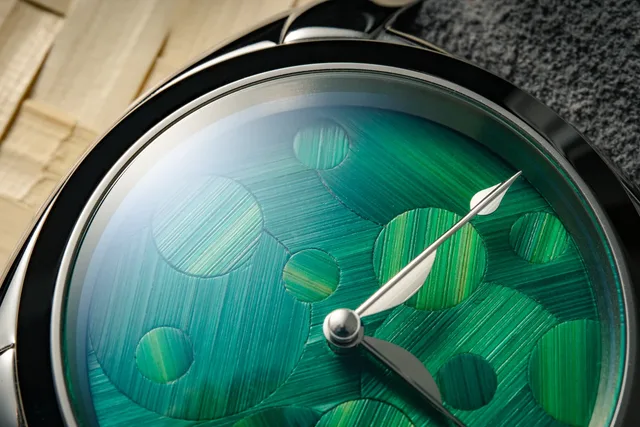
To appeal to d'Orey to be working with straw is to create something spectacular from a very humble material. He not only works with texture but also with hues and reflection, making a composition where the straws become one. The beauty of the Isotope Mercury M is difficult to put into words. The dial resembles that of malachite, the semi-precious gemstone, but now with a unique play of light. The straws have a light, natural sheen over them that reflects light and slightly changes their color when the angle switches. This makes the dial come to life in a very unique way. Thanks to the bubble design, this effect is enhanced, as the straws are placed in different directions as opposed to each other. This also adds a great deal of depth to the dial and really brings it to life.
With such an impressive dial, the rest of the watch needs to have a strong design, as it would be overpowered otherwise. Fortunately, Isotope Mercury's case is just that. It has a slight cushion shape inspired by the streamlined Mercury trains designed by Henry Dreyfuss, from which the watch also got its name. With a diameter of 38mm, its size is on point, while its height of 10mm gives it a slender profile. The case is also slightly curved, underscoring its streamlined design but also adding to its wearing comfort. The mirror polish offers a nice frame for the dial, and even the crown features a special design. While you might not even think about going into the water with such a rare watch, water resistance is a very healthy 10ATM/100 meters. It even has a sapphire insert in the caseback showing the beautifully decorated modified Peseaux 7001 calibers.
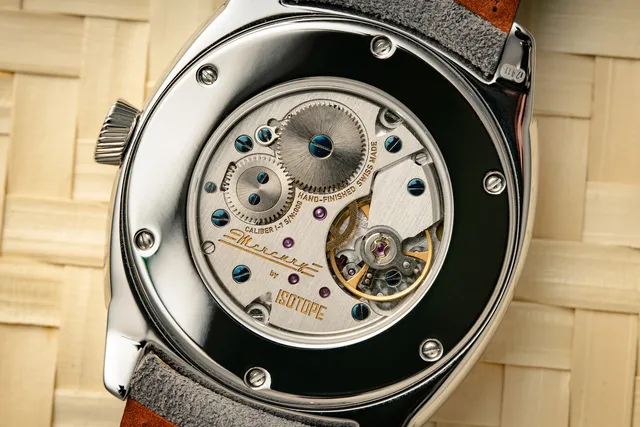
One of the modifications that was made especially for the Isotope Mercury M is deleting the small seconds hand, which used to be at the six o'clock position. This allows for no distractions on the dial side, and no special accommodations to be made in the design of the straw marquetry. Isotope even went through the trouble of having a special hand design, which they call 'Mercury Leaf,' to adorn the watch, ensuring that every little detail breathes the same style. The grey suede strap stays modestly in the background, giving the dial and case room to shine. It is very supple and obviously well-made, well above par on what is normally fitted on watches within this price range.

This particular Isotope Mercury M is a unique piece, made together with a similar one in a slightly different design, which are both sold. As it takes d'Orey several hours to craft a single dial, these straw marquetry versions of the Mercury will never be a regular production model. Instead, Isotope is planning on offering them in limited quantities, each with a different dial design, as well as offering a bespoke option, in which you get a say in the design and use of color of the dial. With the regular Mercury Shadow selling for GBP2,580 (as Isotope is a British brand, its original pricing is in Pound Sterling), the straw marquetry models will start at GBP4,000, which will increase for more complex (and time-consuming) dials or when you opt for a bespoke version. Given the rare craftsmanship needed to create these dials and their spectacular look, combined with the Peseaux 7001-based movement and unique design of the Mercury, it is almost a steal, especially compared to the very few other watches that feature such a dial.
For more info, visit Isotope, here.