How a Mechanical Watch Actually Works
A step by step guide
The fascination of a mechanical wristwatch is rarely apparent at first glance. The dial and hands may seem to display the passing of time effortlessly, but beneath them lies an intricate system of tiny components whose precise interaction determines accuracy, reliability, and longevity. Every movement of the hands is the result of carefully controlled energy, precisely calculated gear ratios, and a rhythmic balance between power and regulation. Viewed as a mechanical system, a watch movement reveals itself as a sophisticated arrangement of clearly defined assemblies working together to form one of the most elegant technical solutions ever devised.
Swiss watchmakers have been building movements according to these principles for centuries. One of the companies that has played a defining role in their development is ETA SA, which has been producing calibers for the international watch industry since 1793. Over generations, the company has made a major contribution to the standardization, evolution, and reliability of mechanical watch movements. Research, continuous development, and a global service network form the foundation of an engineering philosophy focused on precision and long-term functionality. The following sections take a step-by-step look at the basic architecture of an ETA mechanical movement, from winding and energy storage, to power transmission and precise rate regulation explaining the mechanisms that quietly keep time beneath the dial.
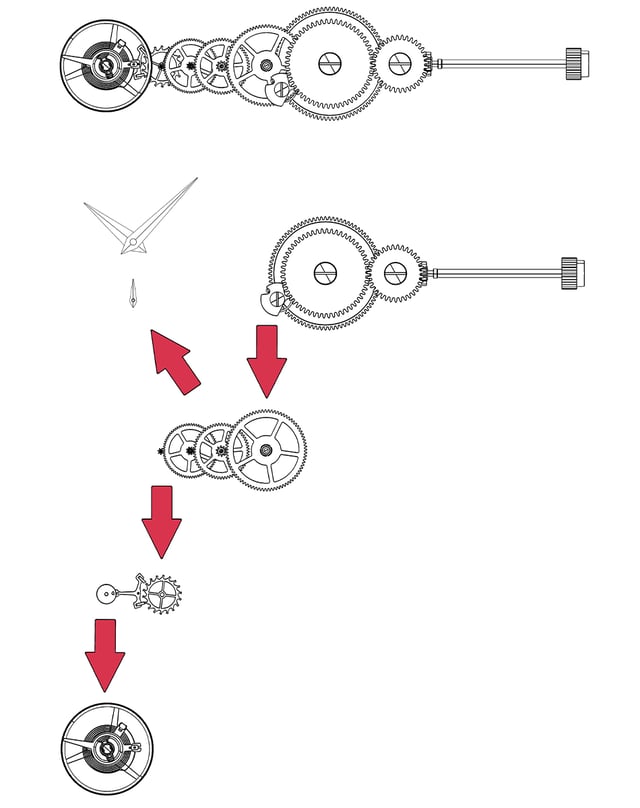
The graphic illustrates the structure of a mechanical movement and the precise interaction of its central components.
ETA SAWinding and Power
Every mechanical watch begins with winding. Before the movement can run, energy must first be supplied and stored. In a manual-wind watch, this is done by turning the crown. In an automatic watch, a rotor driven by the motion of the wearer’s wrist performs the same task. The motion introduced from outside the watch is transmitted through the winding stem and a series of winding wheels to the ratchet wheel mounted on the barrel. Inside this usually enclosed, cylindrical component is an arbor that rotates as the watch is wound, coiling the mainspring around it. The mainspring serves as the watch’s energy reservoir. Depending on its length, construction, and material, it can store enough energy to keep the movement running for many hours and in some cases for several days. The interaction of the ratchet wheel, click, and click spring ensures that this energy remains securely stored and can later be released in a controlled manner. The click prevents the ratchet wheel from turning backward and allowing the mainspring to unwind through the winding mechanism. From there, the stored energy is transmitted through the toothed outer edge of the barrel to the gear train. This marks the beginning of the controlled transfer of power through the movement.
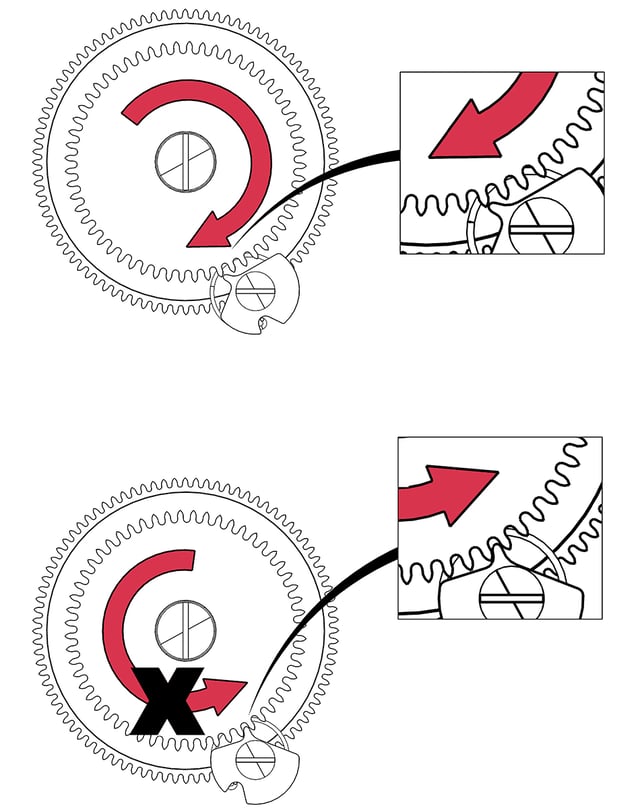
The latch prevents a backward movement of the ratchet wheel.
ETA SAThe Gear Train
Within a mechanical movement, the gear train is responsible for transmitting power. The center wheel, third wheel, and fourth wheel carry the energy stored in the barrel step by step toward the regulating organ, the escapement and balance. As the power moves from the barrel toward the fourth wheel, rotational speed increases while torque decreases. The individual wheels, typically connected through pinions, are often arranged on different levels for reasons of movement architecture. Their gear ratios are precisely matched to the frequency of the balance-and-hairspring system to produce the required rotational speeds. The arbor of the center wheel extends to the dial side of the movement, where the cannon pinion carries the minute hand. The center wheel meshes directly with the third wheel, which transmits power while also providing the necessary changes in rotational speed and direction. Because both the minute and seconds hands must turn clockwise, the third wheel also engages with the fourth wheel. The fourth wheel completes one revolution per minute and, in turn, drives the pinion of the escape wheel.
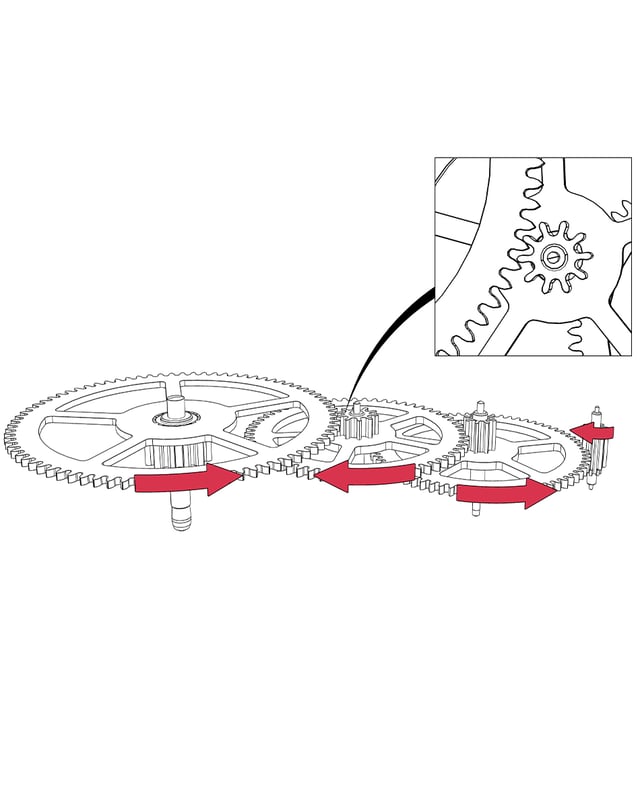
The individual wheels are frequently arranged one above the other for structural reasons.
ETA SAEscapement and Balance Wheel
This is where the heart of the regulating system comes into play: the escapement. Its job is to divide the continuous flow of energy from the gear train into precisely controlled impulses and synchronize them with the oscillations of the balance wheel. Driven by the fourth wheel, the escape wheel is periodically locked by the pallet fork. As the escapement releases, a tooth of the escape wheel slides past a pallet stone, transmitting an impulse through the pallet fork to the balance and keeping it in motion. At the same time, the pallet fork locks the escape wheel again. The balance continues to oscillate until the hairspring slows it and draws it back in the opposite direction. As the balance passes through its neutral position, it unlocks the pallet fork once again and the sequence repeats in the opposite direction. The higher the frequency of the balance, the more rapidly this cycle occurs and the faster the characteristic ticking of the movement. That familiar sound is produced as the pallet stones alternately lock and release the teeth of the escape wheel. In modern mechanical wristwatches, a common frequency is 28,800 vibrations per hour.
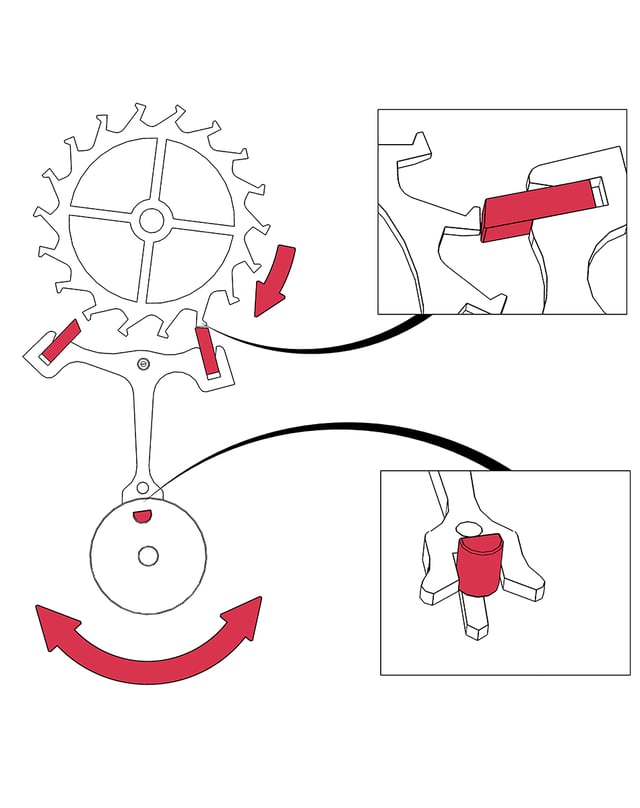
The anchor wheel driven by the second wheel is periodically blocked by the anchor.
ETA SAMotion Works
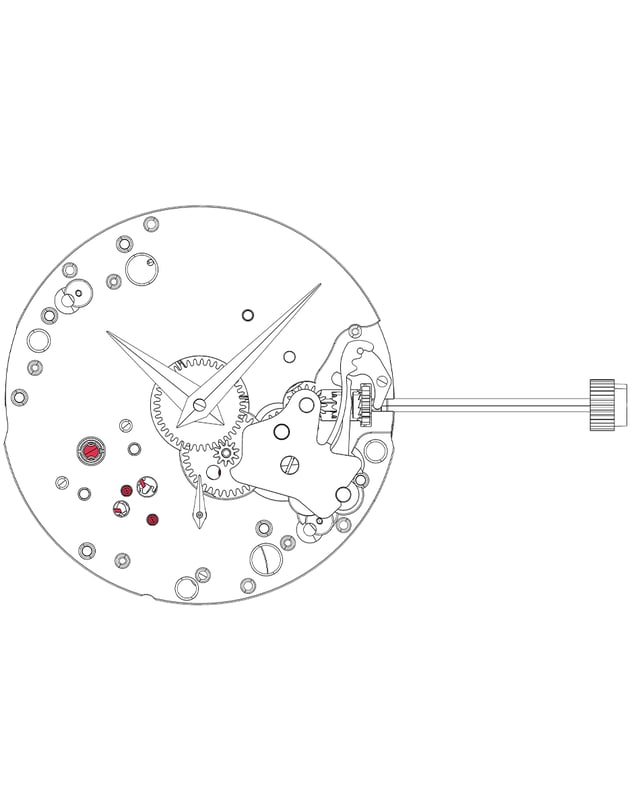
To make the measured time visible, a mechanical watch relies on the motion works, which draw their energy from the gear train through the cannon pinion. Once again, the minute wheel plays a central role. The cannon pinion completes exactly one revolution per hour and engages with the minute wheel, whose pinion drives the hour wheel at one-twelfth that rotational speed. The hour hand is mounted on the hour wheel and typically completes two full revolutions every 24 hours. If the watch has a small-seconds display, the seconds hand is often driven directly by the fourth wheel, providing a visible indication that the movement is running. The hands can be adjusted through the crown. When the crown is pulled out, the setting mechanism engages, allowing the hands to be moved precisely.
Complications
In a mechanical watch with complications, additional wheels — or entire gear trains — can be driven from the motion works or directly from the minute wheel. This makes it possible to power functions such as calendar displays, moon phases, and other mechanical complications.
This article first appeared in the March/April 2026 issue of Watchtime Germany.