Maiden Flight: Spotlight on Breguet Type XX
With the release of the two pièce unique for Only Watch 2019 (Ref. 2055ST/Z5/398) and 2021 (Ref. 2065ST/Z5/398), collectors around the globe quickly started to suspect an upcoming relaunch of what most likely is Breguet’s most commercial collection. What most people did not expect, however, is that Breguet decided to also work on a new chronograph movement for two versions flying in formation, one military inspired (Ref. 2057ST/92/3WU), and the other drawing on the brand’s civilian models (Ref. 2067ST/92/3WU).

Jeffrey Kingston, collector, editor-in-chief of Breguet’s Le Quai de l’Horloge, and a pilot himself, said, As a pilot and a flight instructor with more than 4,000 hours as pilot in command, these new Breguets speak powerfully to me. Many misunderstand what a pilots’ watch should be and, in particular, what functions it needs to offer. The French Air Force’s specification for the Type 20 and later the Type 21, issued during the 1950s, set out vital watch functions needed for flying under instrument conditions: a precise chronograph, an easy-to-read minute counter, flyback function and bidirectional rotating bezel. Beginning in the 1950s, these core attributes have been woven into the DNA of Breguet’s pilot watches. Breguet’s new Type 20 and Type XX plainly show a keen understanding of these criteria. They are real pilots’ watches.
Speaking of pilots, and more generally of aircrew members, keeping track of time on board an aircraft — meaning preserving temporal references within an environment characterized by intense activity and stress — has historically been a vital necessity. Operations such as measuring flight time or intermediate flight times, monitoring fuel consumption, taking bearings and carrying out maneuvers all required instruments that watchmakers would render both more accurate and convenient to handle over the years: onboard chronographs and soon thereafter chronograph wristwatches. For pilots, this also allowed a principle of redundancy. That meant backing up the chronograph on the instrument panel with another chronograph strapped to the wrist. If one became unusable, the other would take over.

A deep dive into the company’s archives revealed that numerous “special” aviation products, i.e., suited to the particular constraints of the aeronautical environment, had already been introduced from the 1930s onwards: 19-line aerodrome chronometers in an anti-magnetic silver case; split-second chronographs; small 24-line on-board chronometers with a heat-insulated case, a thermostat and lighting; or even siderometers. All these highly technical pieces were delivered both to military aviation as well as to the 1933-created French national airline, Air France. Delivery of watchmaking instruments for aircraft instrument panels increased from the early 1950s onward and became one of Breguet’s specialties for three decades. The most widespread models were the Type 11, 11/1 and 12, which were sold to a dozen countries and featured on the instrument panels of numerous aircraft, notably the unforgettable, supersonic Concorde.
The Type XX
According to Breguet’s archives, the history of the Type XX began in the early 1950s when the company learned that the French Air Force was looking to equip its pilots with a chronograph wristwatch meeting the following technical specifications: a black dial with luminescent numerals, luminescent hands, a high-quality movement resistant to changes in pressure and acceleration, a rotating bezel and, of course, a “flyback” function, to mention but the most important. It was the Air Ministry that named the future product “Type XX.” Several companies competed and won contracts, which meant that several brands would produce Type XXs; on the other hand, the brands selected for public contracts could also sell the same product to private customers. This led to the production of military Type XXs and civilian Type XXs.
The first prototypes from Breguet were approved in 1953 by the Service Technique Aéronautique. In 1954, the French Air Force placed an order for 1,100 military Type 20s, which were delivered between 1955 and 1959. They featured a 30-minute totalizer and their dial was unsigned, while the back bears the official inscriptions BREGUET - TYPE 20 - 5101/54. Another customer, the Centre d’Essais en Vol (CEV) for elite French test pilots, ordered 80 timepieces that were delivered in 1956 and 1957. They came with a 15-minute totalizer and 50 of them featured a 12-hour totalizer at 6 o’clock, while the letters CEV followed by a number from 1 to 80 were engraved on the back. In 1958, the French Navy ordered 500 pieces for the pilots and sailors of its airborne wing, the Aéronautique Navale. Delivered in full on Jan. 13, 1960, these Type XX military watches were significantly different from those of the Air Force: Their 15-minute totalizer was housed in a circle with an enlarged diameter, their dial was signed, and their back bears the inscription Breguet - Marine Nationale - Aéronautique Navale - N° X / 500. The reputation of the Type XX quickly spread beyond the military sphere, leading to a situation where the world of civil aviation and chronograph enthusiasts was equally keen to acquire a Type XX from Breguet. Even though the Valjoux 14-line movement was replaced in 1963 by a modernized 13-line movement, and despite certain perceptible variations in terms of dials, hands or the bezel, the Type XX underwent barely any aesthetic modifications until 1970. More than 2,000 “civilian” Type XX models were sold by then.

The second-generation Type XX arrived in 1971 and is recognizable by its enlarged polished steel case, thick lugs and black bezel. Available with or without a 12-hour totalizer, it continued to feature a 15-minute counter. Nearly 800 of these watches were sold, most of them to civilians, while on the military side, 50 pieces were delivered to the Royal Moroccan Air Force. Orders were also placed by Aérospatiale (later Airbus Industries) and purchased by the Presidency of the French Republic as official gifts. The last ones were sold in 1986, spelling the (provisional) end of more than 30 years of a rich history. After a barely 10-year absence, Breguet’s Type XX enjoyed a revival in 1995 with the appearance of the third generation in the form of Reference 3800 Aéronavale (without date) and subsequently Reference 3820 Transatlantique (with date). Aesthetically, it featured a fluted caseband, a somewhat anachronistic legacy of the “historical Breguet” style. It proved so successful that numerous interpretations followed, with a variety of precious metals and dial color changes over the years. The line was even expanded with an alarm watch (Ref. 3860) and a Type XX for ladies (Ref. 4820), before the 2004 arrival of the Type XXI (Ref. 3810) and the 2010 introduction of the impressive Type XXII (Ref. 3880) incorporating high-frequency technology and silicon. Type XXI also saw many variations and some limited series, right through to the models unveiled in recent years (Ref. 3817 and Ref. 3815).
A Return to the Roots of the Type XX
Four years of pre-flight preparation preceded the arrival of the new generation of Breguet’s latest Type XX watches. Taking cues from emblematic first-generation models, Breguet managed to instill a much more utilitarian (gone is the fluted caseband), contemporary and — thanks to the new movement — also technological spirit into these two new watches.
Type XX Chronographe Ref. 2067
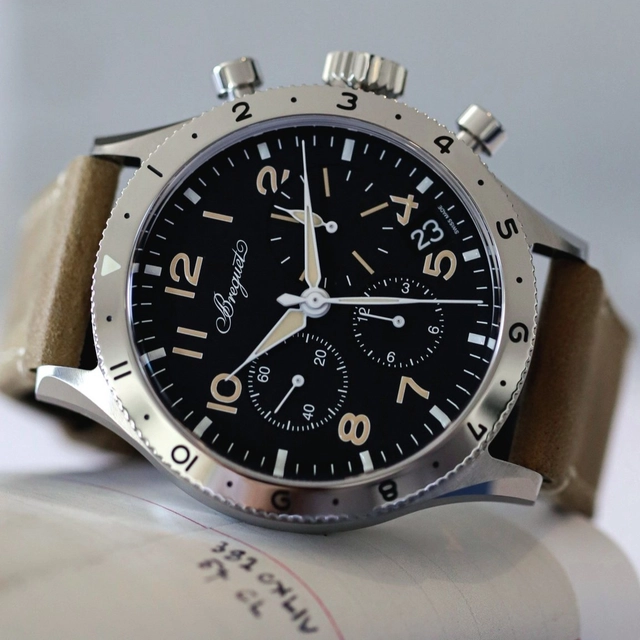
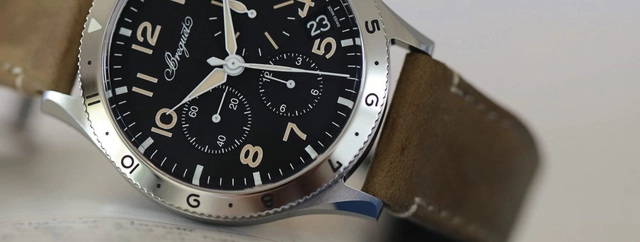
The Ref. 2067ST/92/3WU is a direct descendant of the civilian Type XX from the 1950s and 1960s, notably a model made in 1957 and bearing the individual number 2988. The 15-minute counter is located at 3 o’clock, the 12-hour counter at 6 o’clock, and the permanent second hand is located at 9 o’clock. Just as in the military-inspired version, the counter at 3 o’clock is sized slightly bigger. The Arabic numerals, the hands and the triangle on the bezel are coated with ivory-colored lume; the comparatively large date window is located between 4 and 5 o’clock. The 42-mm steel case is fitted with a fluted bidirectional graduated bezel.
The new chronograph is fitted with a calfskin strap along with an additional black NATO strap contained in its case. The rapid interchange system (RIS) of the bracelets has been designed to enable the easy, independent and tool-free removal of the leather strap.
Type 20 Ref. 2057
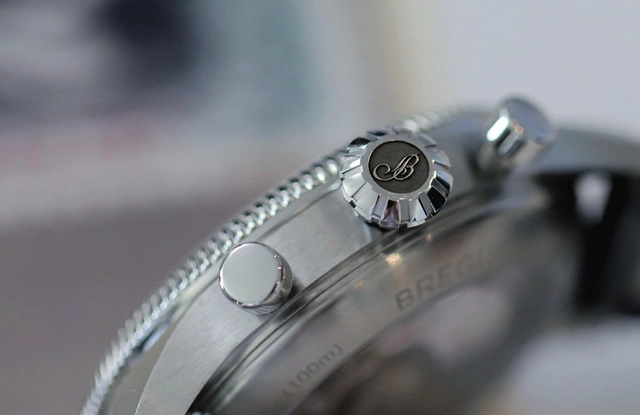
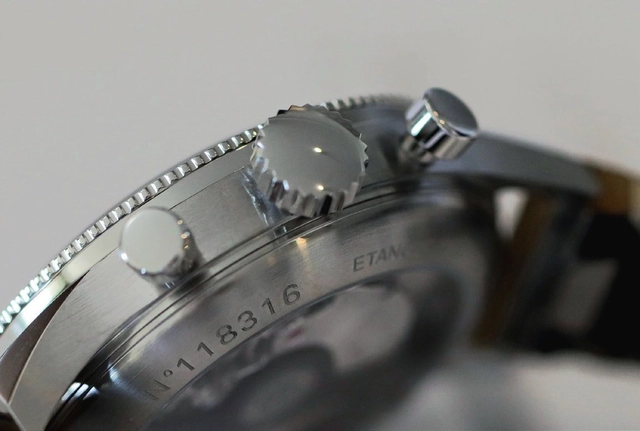
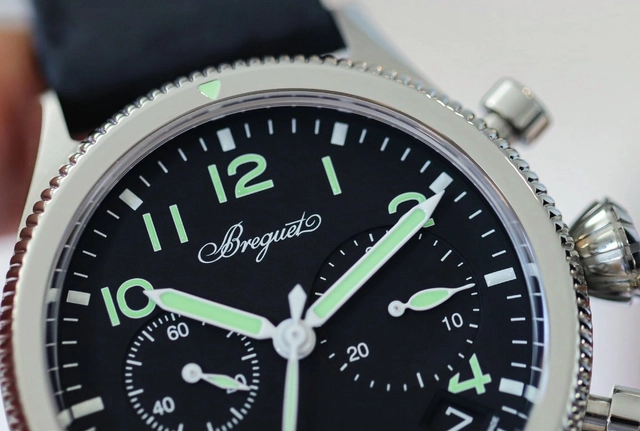
The new Type 20 Chronographe 2057 (Ref. 2057ST/92/3WU), on the other hand, is heavily inspired by Breguet’s 1100 that was delivered to the French Air Force between 1955 and 1959, whose name appeared as ‘Type 20’ in Arabic numerals (unlike all the others, including those of the Aéronautique Navale, whose name was written ‘Type XX’ in Roman numerals). The black dial has been modernized, and the Arabic numerals and the triangle on the bezel are luminescent and feature a mint green shade, as do all the hands. The 30-minute counter located at 3 o’clock is larger than the 60-second counter at 9 o’clock, and a date window has also been added between 4 and 5 o’clock. The 42-mm steel case is fitted with a non-engraved fluted bidirectional bezel and a pear-shaped crown with Breguet logo.

Caliber 728
After four years of development, the brand has also been able to equip both new watches with a new self-winding hi-beat movement: the Caliber 728 (350 parts) for the civilian version and Caliber 7281 for the military version (339 parts), both with flyback function and an impressive power reserve of 60 hours. The movement incorporates all the elements of a modern chronograph, such as a column wheel, vertical clutch, 5 Hz frequency, as well as an innovative zero-resetting activation system (and is, according to Breguet, “protected by several patents”). The balance spring, the escape wheel and the pallet-lever horns are made of silicon. Next to being resistant to corrosion and wear, silicon is insensitive to the influence of magnetic fields and improves the accuracy of the timepiece. In addition to the sunburst pattern, snailing, beveling, circular graining and other visible decorations on the components, Breguet has treated the column wheel to a black DLC treatment; the blackened oscillating weight is shaped like an aircraft wing and engraved with the Breguet logo.

A Date with History
Breguet decided to deliver the first two Type XXs of 2023 with a comparatively large date window located between 4 and 5 o’clock. With the Type 20 Ref. 2057 being the more puristic version of the two, a no-date option here might have been the perfect Swiss way to compromise (an integral part of Swiss culture) and offer both choices to collectors. On the other hand, this also being the maiden flight of a completely new chronograph caliber, removing one of the most popular complications from the beginning, might just have sent out the wrong signal. Plus, Breguet has obviously planned more variants of the Type XX, without question one of the most important pieces for the brand’s perception in the coming years. For more on that topic, also check out the interview with Breguet’s CEO, Lionel a Marca, who was the pilot in command in this project.
To learn more, visit Breguet, here.
This article is from the WatchTime Archives and was originally published in the September/October 2023 Issue. To subscribe to WatchTime Magazine, click here.