Dec 14, 2017
Reading time 6 min.
Borrowed Time: Mido Multifort Chronograph PVD Special Edition
WATCH REVIEW
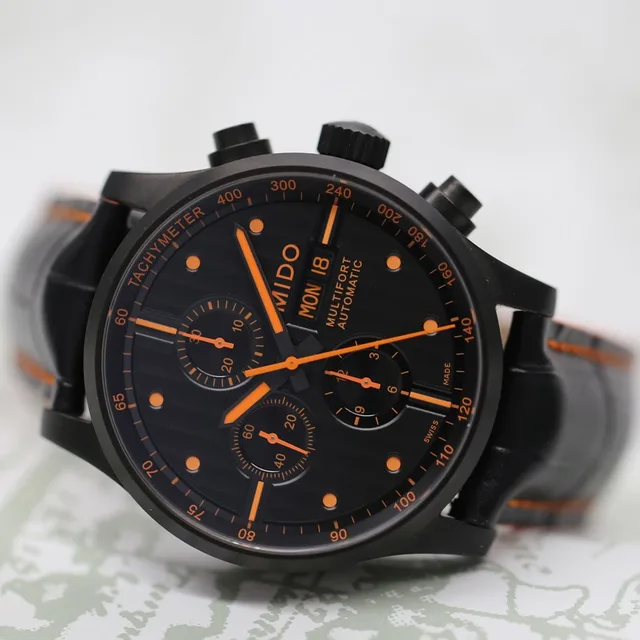
Ensconced in the same general price segment as its “affordable luxury” brethren within the Swatch Group — Hamilton, Tissot, and Rado — the Mido brand has flown largely under the radar of U.S. watch consumers, though it’s long been immensely popular in Latin America — perhaps by design, as its name derives from the Spanish phrase Yo mido, meaning "I measure." The Swiss brand — no slouch in the history department, having been founded way back in 1918 in Bienne — aims to change that this year, with a U.S. push that, according to the company, not only re-establishes Mido’s identity as a brand with architecturally influenced designs but will include special product launches for the U.S. market and a renewed focus on its timekeeping legacy.
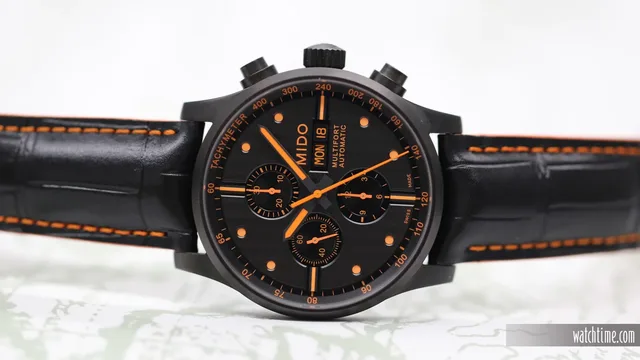
The Mido Multifort Chronograph PVD Special Edition
PR
One of the forerunners of this theme is the Mido Multifort collection, a mainstay of the Mido brand since it was introduced in 1934. In addition to its historical distinction as one of the first anti-magnetic watches with an automatic movement, Mido says, the Multifort incorporates design elements from Australia’s Sydney Harbor Bridge, a structure completed two years before the first Multifort watch was launched — hence its use of a vertical Geneva striped pattern that evokes the famous bridge’s slender, arching forms and dot indices that echo its suspension and rivets. Now in its eighth decade of production, the Multifort is, in fact, one of the longest-produced series in the history of Swiss watchmaking.
How does the Mido Multifort Chronograph PVD Special Edition — released in 2016, dressed in Mido's signature black-and-orange color scheme, and offering a Swiss-made chronograph movement, with a day-date function, no less, for an almost unthinkably low price under $2,500 — hold up in a wrist test?
The watch's black PVD-coated steel case, measuring 44 mm in diameter, has a very appealing, dark matte look; both the sapphire crystal and the surfaces of the simple, black chronograph buttons are flat, while the grooved winding crown (which screws down into the case and extracts easily into two setting positions) has a slightly rounded surface.
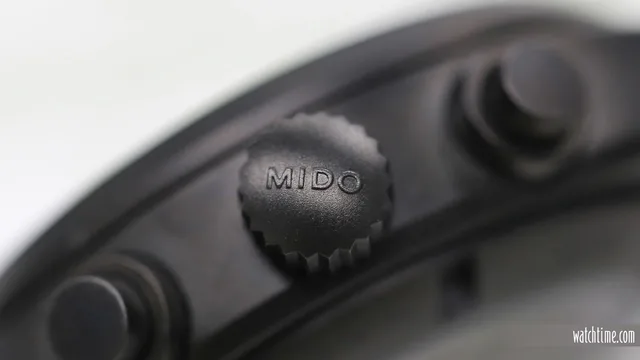
Mido Multifort Chrono Orange - Crown
PR

Mido Multifort Chrono - Crown Open
PR
Setting the day and date is simple: in its first extracted position, turn the crown downward (toward you) to advance the day (in reverse order, oddly, i.e., Monday-Sunday-Saturday, etc.), and upward (away from you) to advance the date (in traditional ascending order). With the crown in its second extracted position, you can set the long pentagonal hour and minute hands to the proper time. These hands — along with the even longer central seconds hand, the hour indices and subdial hands, along with all text and numerals on the day/date display, the subdials, the tachymeter scale, and the MIDO logo and “Multifort Automatic” markings — are executed in bright orange for a nice, high-contrast legibility against the black dial. Treated with orange Super-LumiNova, the hands and dot indices are also quite easy to read in the dark.
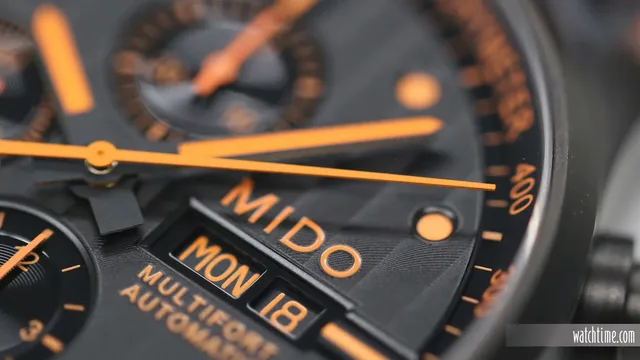
Mido Multifort Chrono Orange - Chrono Hand
PR
Looking more closely at the dial, we discover its architecturally inspired vertical côtes de Genève pattern, which catches the light subtly on the wrist and looks awesome under a loupe. Around the edge, the hour markers are denoted by thin rectangles at the quarter-hours and by round dots at the five-minute marks. Surrounding these indications on the flange is the aforementioned tachymeter scale. The three subdials at 12, 9, and 6 o’clock — for 30 elapsed chronograph minutes, running seconds, and 12 elapsed chronograph hours, respectively — have polished black borders and snailed motifs on their interiors, the latter of which is, again, very subtle at a glance but quite pronounced (and attractive) under a loupe. The tricompax arrangement is balanced out by the day-and-date window, with orange numerals on a black background that seems to bleed right into the black-framed, orange-centered 3 o’clock hour index.
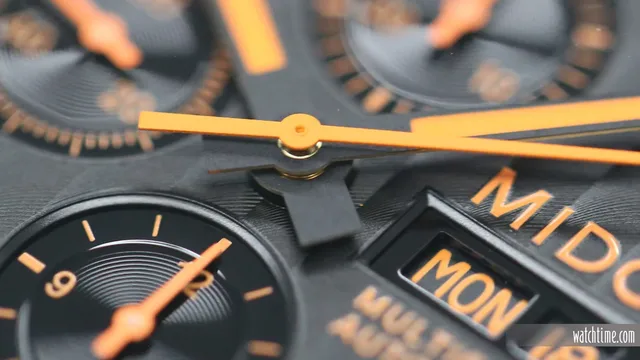
Mido Multifort Chrono - Chrono Hands
PR
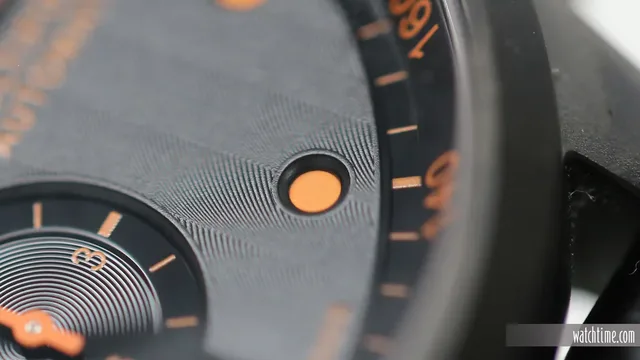
Mido Multifort Chrono - Index
PR
It is a very considered design, and the architectural influence is apparent. If I were to name one aesthetic quibble I have with the Multifort Chrono, it is that at times it can appear almost too symmetrical. When the chronograph is switched off and at rest, the long, thin, orange seconds hand stays poised at 12 o’clock, overlapping the 12 o’clock index and the small 12-hour subdial hand, which is also at rest at its own 12 o’clock position, leaving only a fraction of black space between these vertically aligned hands and the 6 o’clock index, in effect almost bisecting the dial into halves. A very minor quibble, to be sure — and perhaps an excuse to leave the chronograph running more often than not. The pushers that start, stop, and zero the stopwatch are easy to engage, and snap audibly when pushed.
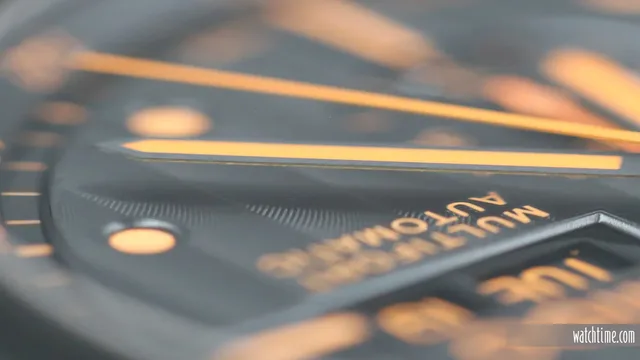
Mido Multifort Chrono - Orange - hands
PR
The movement is on display through the sapphire caseback. Dubbed the Mido 1320, it is a modified, finely decorated version of ETA’s tried-and-true Valjoux 7750 chronograph caliber, with automatic winding, a 28,800-vph frequency, and 48 hours of power reserve. The côtes de Genève pattern on the bidirectional winding rotor echoes the motif used on the dial, and elevates the movement from simpler, less embellished versions of the 7750 that you'd inevitably find on other automatic chronographs in this price segment. Blued screws are also in evidence (including one that appears at the center of the rotor), and a perlage pattern can be discerned on some of the bridges and plates. Also of note: the Valjoux 7750 movement upon which the Mido 1320 caliber is based is the "chronometer grade" version, meaning it carries a COSC certificate for timekeeping precision. (A little-known Mido claim to fame is that the brand regularly finishes in the top 10 or even top 5 of COSC's annual listing of watch companies receiving chronometer certificates, right behind more prestigious, and expensive, brands like Rolex, Omega, and Breitling.)
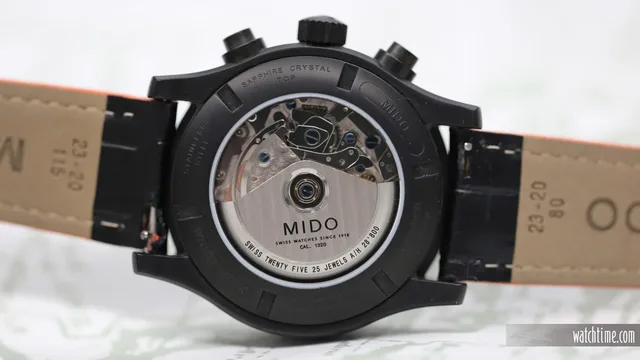
Mido Multifort Chrono - Orange - Back
PR
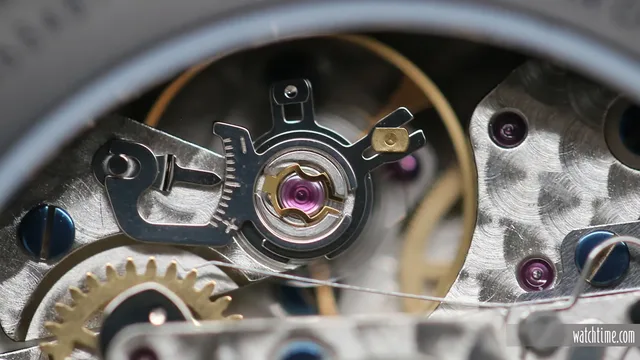
Mido Multifort Chrono - Orange - Movement - Balance
PR
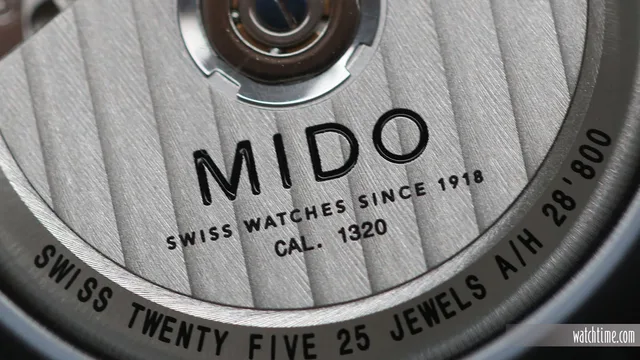
Mido Multifort Chrono - Orange - Movement - Rotor
PR
The watch harmonizes flawlessly with its strap, made of what appears to be shiny black alligator leather (but is actually calfskin leather with a well-executed faux-croc look) with bright orange stitching and orange edges. Mido’s logo is imprinted into the cushiony-soft, light beige-colored inner edge. The matte-black PVD-coated triple-folding clasp holds the watch securely and comfortably on the wrist. A version with a black rubber strap and the same folding clasp is also available.

Mido_Multifort_Mido Multifort Chrono - Orange - Back - Detail
PR
So how does this timepiece from the brand that "measures" measure up to the competition? Depending on your appreciation for the orange-and-black color scheme, and the predominantly black "stealth" look in general, and how large and heavy a watch you are comfortable with on your wrist — the 44-mm diameter felt just right for me but might be a little past the limit for some — there's very little not to recommend. It's eminently legible, self-winding, reliably precise, it accessorizes nicely with both sporty and dressy attire, and it's priced very fairly indeed, at $2,200.