Sep 29, 2015
Reading time 4 min.
Above the Clouds: Testing the Zenith Pilot Big Date Special
In this feature, with original photos by our own Nik Schölzel, we put the Zenith Pilot Big Date Special watch through our rigorous test.
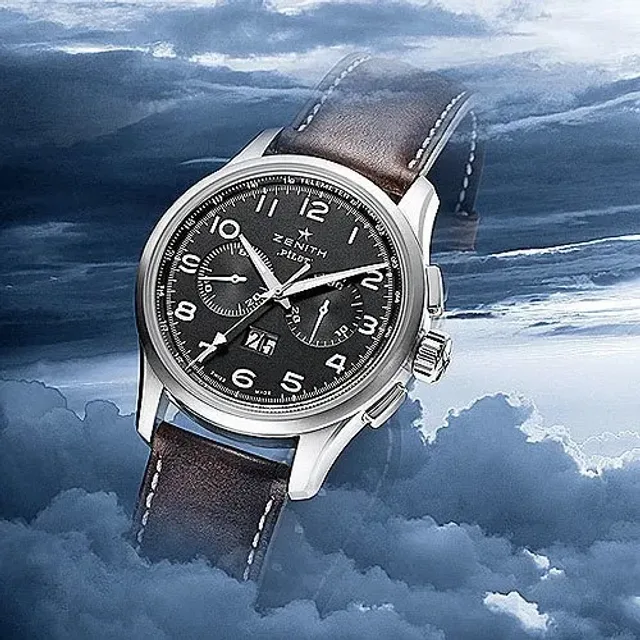
Whether in the air or on the ground, the Zenith Pilot Big Date Special is always at home. In this feature with original photos by our own Nik Schölzel, we put this high flyer through our rigorous test.
At the beginning of the 20th century, pilots’ watches were essential tools for aviators. In 1909, the first aviator to cross the English Channel, Louis Blériot, used a Zenith wristwatch with a rotating minutes marker during his 37-minute flight. Shortly thereafter the first cockpit instruments came into use. Zenith equipped airplanes with altimeters and other aviation instruments that eventually made pilots’ watches unnecessary. Zenith was also a major supplier of temperature-resistant and anti-magnetic aircraft clocks in the 1930s and ’40s. Today, pilots’ watches serve as emergency backup instruments for recreational aviators. But, of course, most pilots’-watch fans aren’t pilots at all, but earthbound types who like the watches’ distinctive styling. The Zenith Pilot Big Date Special combines the historical, functional design of a pilots’ watch with several new elements. The watch has typical pilots’- watch features: a black dial to limit light reflection, luminous displays, satin finishes on the case, and a calfskin strap with contrasting white stitching. However, Zenith has made some interesting changes to the dial. Unlike a classic pilots’- watch dial, the dial of the Zenith Pilot Big Date Special features several finely calibrated tracks and incremental markers between the minutes indices. The numeral 12 appears in place of the usual triangle with two dots.

The Zenith Pilot Big Date Special combines the historical design of a pilots’ watch with several new elements.
PR
The watch has more features than a traditional pilots’ watch. In addition to the time display, the watch has a chronograph, a patented big-date display and a telemeter scale, which calculates distances by using the speed of sound. You can start the chronograph when you see a bolt of lightning and stop it when you hear the thunderclap – the chronograph seconds hand will show how far away the storm is in kilometers. As on many Zenith watches, the date display, rather than the hour counter, is at the 6 o’clock position. To make the two large date disks as compact as possible, Zenith has placed them very close together and uses the right disk for the tens digit rather than the left one (see illustration below). The tens disk has rectangular openings through which the single digits can be seen. The design is clever but it doesn't solve the age-old problem of having the disks on different levels, which allows shadows to fall on the lower disk, making it hard to read. (Several other watches in Zenith's collection use big-date displays in which both numerals are on the same level.)
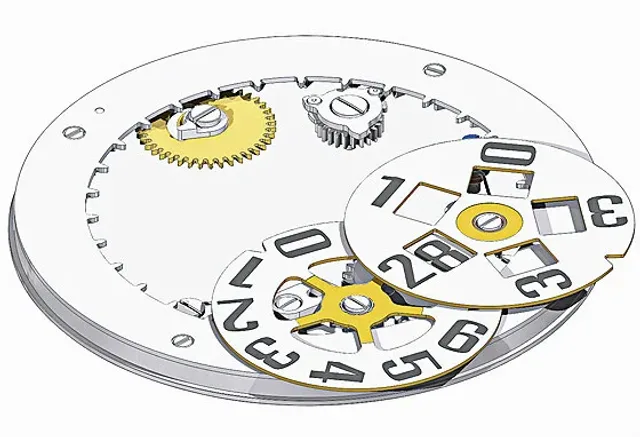
Zenith’s patented big date display has two date disks. The openings for the “ones” digits are visible through the dial aperture.
PR
The date numerals on the Pilot Big Date fill the openings so fully that they almost touch the edges. They tend to blend in with the black dial, which also makes the date difficult to read. In addition, the right digit on our test piece was always slightly misaligned. And purists might find fault with the different styles of type used for the date and the other numerals on the dial. The most important added function this watch offers is a chronograph, which is based on the renowned El Primero caliber. The minutes counter, which is easy to read, is at 3 o’clock. However, it’s harder to read the chronograph seconds hand because the seconds markers and partial-seconds markers are a little difficult to tell apart. This is especially true at the bottom of the dial, where the seconds markers were shortened to accommodate the words “Swiss Made.” The incremental markers are essential for El Primero watches because they show the high oscillating frequency of this movement – 5 hertz, instead of the usual 4 − which enables the watch to measure increments to the 1/10-second. Download the full review here.
This article was originally published on February 5, 2014, and has been updated.
Save