Jun 22, 2021
Reading time 6 min.
Back on Track: Testing the Tissot Heritage 1973
WATCH TEST
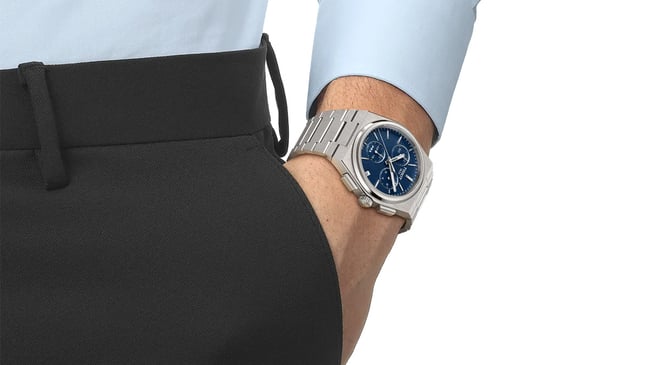
Watch collectors journey through time as soon as they lay their eyes on the new Tissot Heritage 1973, which references a decade when fearless drivers risked their lives on racetracks. We took it for a spin in this test from our September-October 2019 issue.
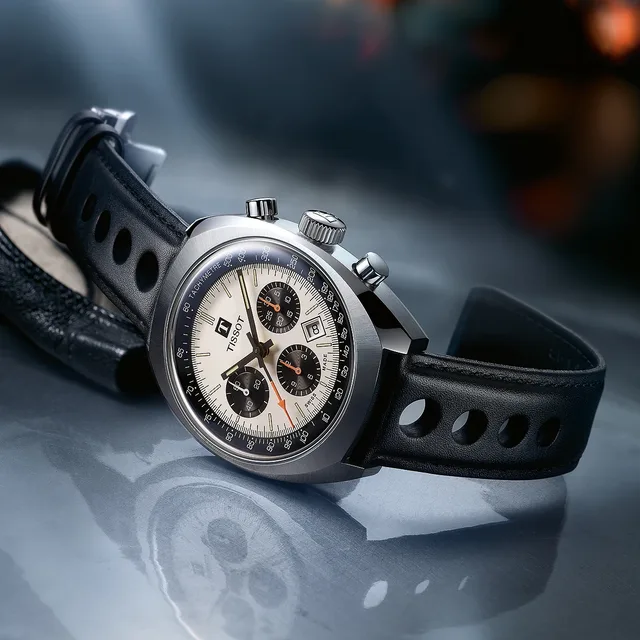
Watch collectors journey through time as soon as they lay their eyes on the new Tissot Heritage 1973, which references a decade when fearless drivers risked their lives on racetracks. We took it for a spin in this test from the WatchTime archives.
While often described as the greatest Formula 1 decade ever, the ’70s, of course, were also a terrible time for accidents. People were hypnotized not by the stats, but by the stories, mainly because drivers were prepared to take a risk. Anyone who ventured onto the racetrack wasn’t just an athlete, but a modern gladiator whom the masses showered with acclaim. The Tissot Heritage 1973 takes us back to F1’s historical high-water mark. This timepiece embodies an attractive combination of retro and racing elements. Historical inspirations are evident in the oval shape of the case, the contrastingly colored subdials and the mushroom-shaped push-pieces. Connections to the world of auto racing are obvious in the stopwatch function, the perforated calfskin strap and the tachymeter scale. The latter component is an analog aid to help drivers calculate the average speed of their vehicles. The wearer starts the chronograph when their car passes a mile marker and stops it again after having driven either one mile or one kilometer. The central chronograph hand now shows the car’s speed (in miles or kilometers per hour) on the scale along the dial’s periphery.
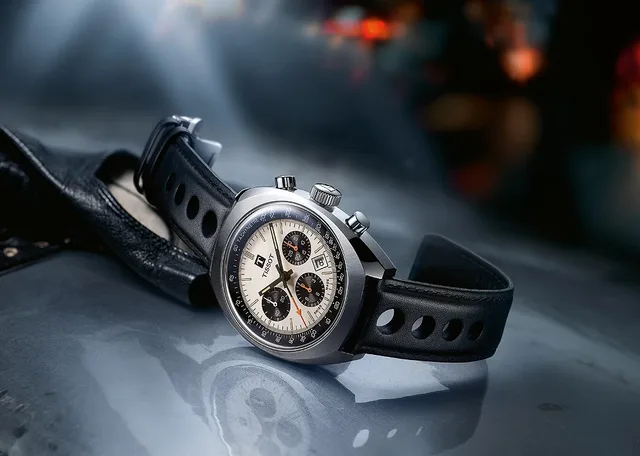
The TIssot Heritage 1973 (Ref. T1244271603100) is limited to 1,973 pieces.
PR
This additional function was already present at the 1973 debut of the Tissot Navigator, which inspired our contemporary model. The ancestral watch also had subdials in different colors, but there were only two of them because the Navigator counted elapsed minutes from the center of its dial. This is the origin of the eye-catching orange arrowhead, which Tissot has now transferred to the central elapsed-seconds hand of the new watch.
Sportier Than Ever
The newcomer is much more dynamic than its historical role model. The watch’s dial, with its symmetrical tricompax arrangement featuring three subdials, is just as visually appealing as its sporty combination of matte black and silver-plated surfaces and orange elapsed-time hands.
The new case size of 43 mm by 46.5 mm corresponds to the spirit of our times, but it doesn’t necessarily fit well on slimmer wrists. Tidy finishing embellishes the surfaces of the impressive steel case. The sunburst on the satin-finished face, polished facets on the strap lugs and a slim polished strip at the lower edge of the middle part of the case are especially praiseworthy. The case thus makes an all-around high-quality impression, which is only slightly clouded by the sharp-edged undersides of the strap lugs. Their sharpness is not perceptible when the watch is worn, but it’s clearly noticeable when you touch the watch with your fingertip.
As is almost always the situation with Tissot, the back of the case is pressed on rather than screwed into place. This is a simple solution for the watch’s construction and it doesn’t adversely affect the case’s watertightness to a depth of 100 meters. The viewing window in the back is made of mineral crystal, so it could theoretically suffer scratches if the back of the watch were not protected by the soft and nonabrasive skin of the wearer’s wrist.
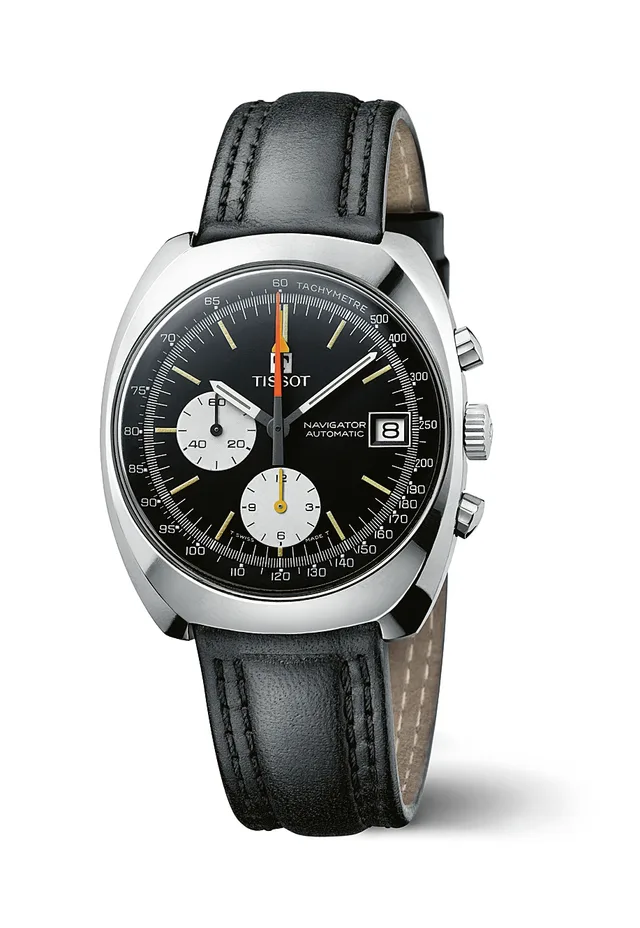
The historical model, the Tissot Navigator from 1973, was not as sporty as its successor.
PR
A Solidly Built Movement
ETA’s automatic Caliber Valjoux 7753 is hard at work behind the glass back. As a variation of Caliber 7750, it naturally supports subdials at 3, 6 and 9 o’clock. Unfortunately, and unlike the 7750, this movement provides no rapid-reset function for the date display via the crown. Instead, the wearer must press a recessed button on the left side of the case to reset the date. This requires a correction stylus or a repurposed tool such as a ballpoint pen or toothpick.
On the other hand, the operation of the crown and push-pieces leaves nothing to be desired. Furthermore, the movement is attractively decorated. Unfortunately, our test watch gained more than 10 seconds per day, as proven both by the timing machine and the wearing test. Moreover, the small elapsed-minutes hand is not 100 percent vertical in its resting position, but leans a tiny bit toward the left. Fans of retro and sports watches will need to accept this imperfection if they opt for the Heritage 1973. But perhaps they’ll interpret this trivial shortcoming as a beauty mark that reminds them of daring exploits in the glory days of auto racing, when success depended less on technology and engineering and far more on a driver’s passion and charisma.
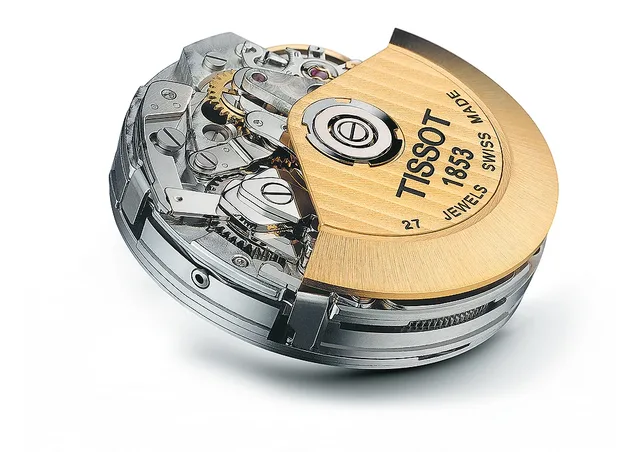
Tissot uses an ETA Valjoux 7753 with circular graining and the brand’s own rotor.
PR
SPECS:
Manufacturer: Tissot SA, Chemin des Tourelles 17, 2400 Le Locle, Switzerland
Reference number: T1244271603100
Functions: Hours, minutes, small seconds; chronograph with counters for 60 seconds, 30 minutes and 12 hours; date display
Movement: ETA Valjoux 7753 “Elaboré,” automatic, 28,800 vph, 25 jewels, stop-seconds function, quick reset for date display, finely adjustable regulator, Incabloc shock absorption, 46-hour power reserve, diameter = 30 mm, height = 7.9 mm
Case: Stainless-steel case with domed sapphire crystal and pressed-on mineral crystal back, water resistant to 100 meters
Strap and clasp: Perforated calfskin strap with stainless-steel safety deployant clasp that opens on both sides
Rate results (Deviation in seconds per 24 hours, with chronograph switched off/on):
Dial up +11 / +9
Dial down +13 / +12
Crown up +7 / +6
Crown down +13 / +11
Crown left +5 / +3
Crown right +13 / +13
Greatest deviation 8 / 10
Average deviation +10.3 / +9
Average amplitude:
Flat positions 304° / 268°
Hanging positions 261° / 237°
Dimensions: 43 mm x 46.5 mm, height = 14.8 mm; weight = 124 g
Limited edition of 1,973
Price: $2,100
SCORES:
Strap and clasp (max. 10 points): The perforated calfskin strap is simple but neatly finished. For the safety deployant clasp, Tissot relies on a standard item that opens and closes somewhat haltingly. 7
Operation (5): The date corrector is recessed into the case and requires a correction stylus, but the crown and push-pieces are easy to operate. 4
Case (10): Complex shapes and tidy surface finishing contrast with sharp- edged inner sides on the strap lugs and a pressed-on caseback with a window of mineral crystal. 7
Design (15): The dial, case and bracelet all share a handsome retro and sports watch design. 13
Legibility (5): The hands’ lengths match the calibrated scales and ample luminous material is used. The only difficulty occurs when the hands are directly above the subdials. 4
Wearing comfort (10): This wristwatch is comfortable to wear despite its large case. 8
Movement (20): Tissot decorates and installs the classic ETA Valjoux 7753 chronograph caliber in basic “Elaboré” quality. 12
Rate results (10): The average daily gain of 10.3 seconds is excessive. 6
Overall value (15): The price/performance ratio is good, although Tissot offers even bigger bargains elsewhere. 12
Total: 73 POINTS