History Lesson: Close Up with the Seiko Prospex SPB333

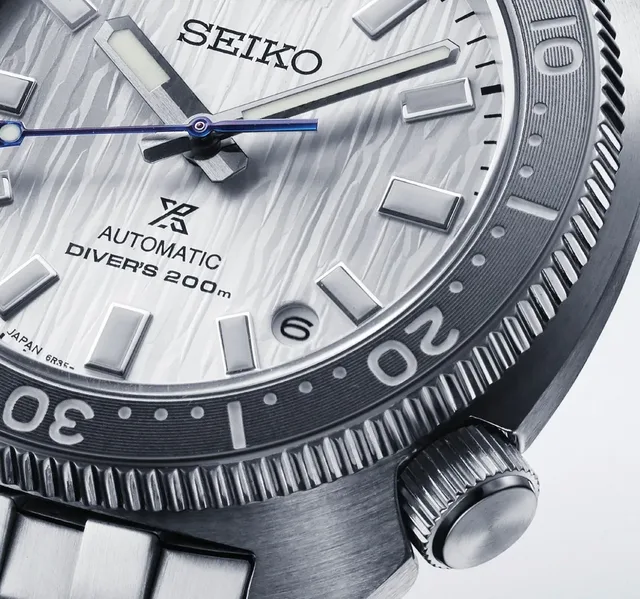
2022 saw the release of Seiko’s most faithful adaptation of the 6105-8000 from 1968 to date, the predecessor of the asymmetrical “Captain Willard” from 1970 with its chunky crown guard at 4 o’clock (Ref. 6105 8110/9). What makes the re-edition of the often-overlooked model from 1968 stand out from other releases is, on the one hand, the new round date window between 4 and 5 o’clock, allowing for a much more balanced dial layout with all 12 indexes left intact, and, on the other hand, its comparatively thin case: At just 12.3 mm in height, it is “the slimmest of all Seiko diver’s watches,” according to the Japanese brand. Water resistance has been increased from 150 meters to a solid 200 (and a screw-down crown added), and the bezel has a similar coin-edge texture as the original, but it now rotates in one direction with 120 clicks.

Seiko initially launched three variants of this “slim turtle” model in 2022: The SPB317 comes with a black dial, white markers and black silicone strap. Priced at $900, it is not only the most affordable version of the three, it also comes by far closest to the original design, including the red circle at the tip of the seconds hand. The slightly more expensive SPB315 comes with a black dial with rose-gold accents (hands, dial and bezel insert) and a five-row steel bracelet with folding clasp — a bracelet that also can be found on the SPB313 with white dial, undoubtedly the most modern-looking variant of the three (and not shown here).
Celebrating Japan's First Wristwatch
In December 2022, Seiko announced a fourth version, the SPB333 with a textured dial that is available in a limited release of 5,000 individually numbered pieces, and a portion of the proceeds supports marine conservation as part of the Seiko “Save the Ocean” campaign. The SPB333 takes inspiration from the glaciers and icebergs of the polar regions, which were extensively explored by Japanese expeditions in the 1960s and 1970s, all of which were equipped with Seiko watches. On top of the more expensive dial, the SPB333 also comes with a different bezel insert in gray with engraved markings and “vinyl record grooves.” Also, the tip of the blue second hand is filled with white lume only (Lumibrite). Next to the new stainless-steel bracelet with five rows, the SPB333 comes with an additional strap made entirely of recycled plastic bottles; its distinctive look is a result of the traditional Japanese braiding technique called “Seichu.” Compared to a regular NATO strap, this type of strap is significantly thicker and more substantial on the wrist.
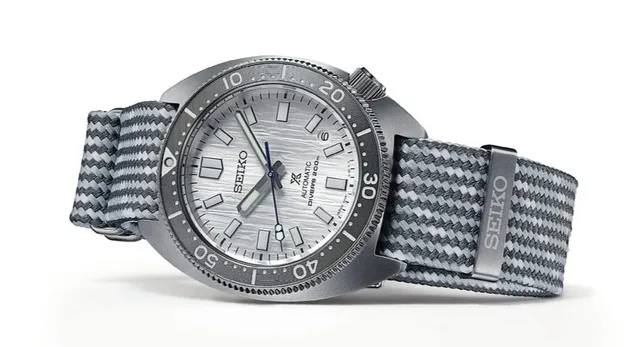
Both the case and bracelet have a superhard coating for increased scratch resistance. While the bracelet introduces a new design, the caseback is identical to other dive watches from the brand in that price area, with the typical wave logo engraved. Behind it is the 6R35 in-house caliber, running at the same 3-Hz rate as the 6105 that can be found in the original version from 1968. Needless to say, the brand’s current version of the 6R movement also comes with a hacking second, it can be manually wound and delivers a power reserve of 70 hours. Unfortunately, Seiko adjusts its mid-range workhorse movement to a relatively wide range of “+25 to -15 seconds per day.”
The SPB333 is part of a series of commemorative watches that celebrate the 110th anniversary of Seiko’s first wristwatch: The Laurel was powered by a 12-ligne movement and introduced around 1913 (often with a red 12 index), and is also considered the first Japanese wristwatch (the first watch called “Seiko” debuted in 1924). The re-edition of the Laurel has been launched in December (SPB359); it is limited to 2,500 pieces and retails for $1,800.
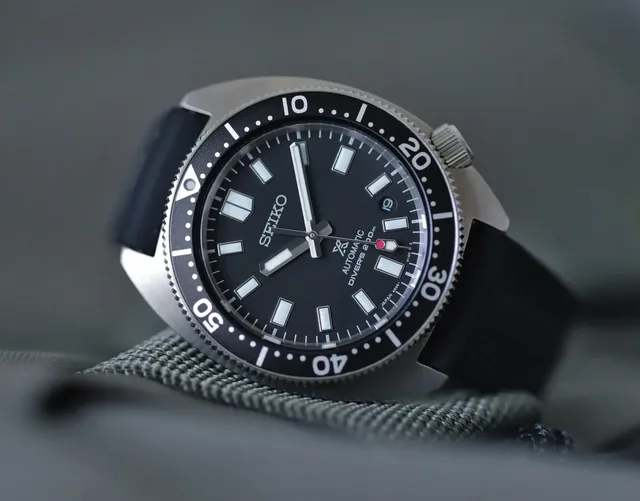
With a price tag of $1,300, the SPB333 is more affordable, but also the most expensive version of the four new Prospex dive watches. Still, it is a value proposition for anyone who is looking for a dive watch with an in-house movement and an impressive dial and set of hands. Its appearance is undoubtedly modern in the case of the SPB333, despite being based on a vintage design. Needless to say, textured dials like the one found here have proven to be extremely popular in the past (one just has to look at the SLGH005G “White Birch” from Grand Seiko), but 5,000 pieces is still a relatively large number, so availability shouldn’t be an issue. Obviously, not everyone is going to be a fan of the smaller date window instead of the traditional customary position at 3 o’clock, and not everyone will look for a dial decoration on a tool watch like this. On the other hand, not everyone has been a fan of the additional index at 3 o’clock that has been gradually implemented on other divers since 2021 in order to still meet ISO requirements either. We believe that the new location of the date window, in combination with a matching date disk, is almost as good as having a no-date execution, even though the font is indeed comparatively small. Speaking of small, the 41-mm watch is not only thin for a diver, with a length (lug-to-lug) of 46.9 mm, the watch should fit most wrist sizes. And, just as in 1968, having the crown at 4 o’clock makes the watch even more comfortable to wear.
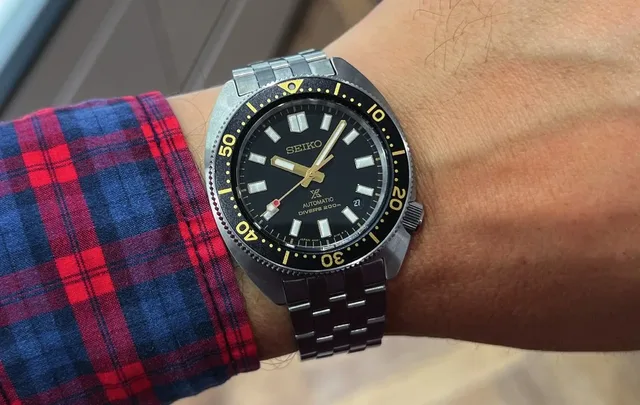
The good news is that with currently four models, there should be something for everyone. And thanks to the drilled lugs, the watch can easily be fitted with a large number of straps. The big question therefore remains if the more modern executions, like the SPB333 and SPB313, or the more vintage-inspired SPB317 and SPB315 will melt a collector’s heart, and how difficult it is going to be to get one of the 5,000 pieces of the limited edition. Regardless of that, the re-edition of the 6105-8000 is one of the most attractive recent releases from the Japanese brand, and definitely worthy to be included in the 110-year anniversary collection.
This article is from the WatchTime Archives and was originally published in the March / April 2023 Issue. To subscribe to WatchTime Magazine, click here.
And to learn more, visit Seiko, here.