The Xeric Timeline Offers a Sleek Double Retrograde for a Microbrand Price
In the 1960s and ‘70s, watchmakers were looking to a "space age" future. That meant thinking outside the box in terms of technologies and design, and it resulted in some now iconic watches. But there were experimental B-sides as well that proved too funky, complicated, impractical, or expensive to remain viable and popular. Or, all of the above.
But those aren't the kind of challenges that ever daunted Mitch Greenblatt, founder of the watch brand Xeric as well as Watches.com. Rather, it’s exactly his wheelhouse. Xeric is now bringing back one such type of watch with a feature known as a “double retrograde.” The new Xeric Timeline offers it at a price point otherwise nearly unheard of, and at its Kickstarter launch, it comes in seven variants, with a pre-sale price starting at USD 699 (later retail of USD 1,199), and we got to test out the model in all silver.
What is “retrograde” in the context of watches? It simply means that, rather than traveling in a circle as typical watch hands do, a hand will only trace a semicircle and then snap back to its starting position when it reaches the end. Practical? Not particularly. And it requires clockwork that’s unconventional and comparatively complicated. But it offers distinctive design possibilities, mechanical interest, and animation.
Retrograde displays today are mostly relegated to high-end watches. At WatchTime New York 2024, I stalked the floor of Gotham hall with the intention of visiting every single exhibitor and photographing their novelties. But there were a couple that confounded the limitations of still photography.
Stopping by the booths of Urwerk, Cyrus, and Hautlence, for instance, brand representatives would eagerly demonstrate setting their watches so I could appreciate that moment in which dial elements would spin, flip and whip back into position. This kind of thing might be borderline gimmicky, but it adds another captivating dimension to a mechanical watch. I did my best to capture it with my iPhone’s video.
Those are examples from very high-end and avant-garde brands. Vacheron Constantin and Breguet, for instance, are also fond of retrograde displays, but usually render them in more classical forms. Some brands have made it a central element of their identity, most notably Gerald Genta, but also the French brand Reservoir. In other words, retrograde displays are mostly a feature of rather haute watchmaking, or at least well into the four figure range as well such as from Reservoir or the recently hyped Japanese watchmaker Otsuka Lotec.
In the budget realm, there are mechanical examples from Japanese brands such as Orient and Seiko. They can offer interesting dial layouts, but the retrograde is often applied to the likes of the date and day of the week. You won’t find many watches with retrograde minutes or hours in the $1,000 range.
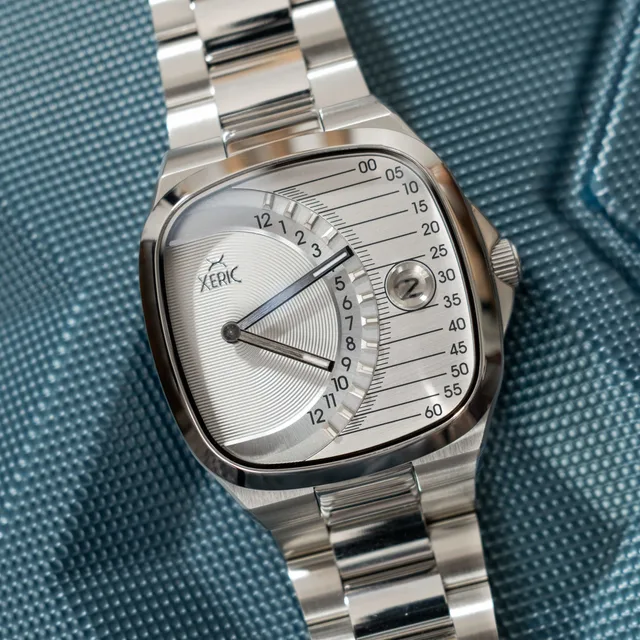
The Xeric Timeline offers both together, and this is why it’s a double retrograde. Moreover, it isn’t just additional displays on a traditional dial. Nor is it something completely far-out (not that Xeric would shy away from that). With a somewhat ‘70s-reminiscent “TV-dial” case shape, simple time-telling and a mix of curves and lines that leans Art Deco, the effect is that of a watch that looks rather unique on the wrist but without being excessively eccentric.
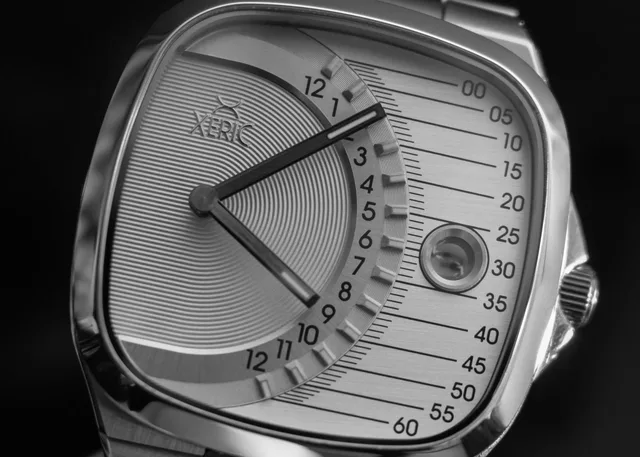
It’s almost as if there’s the vestige of a conventionally round dial on the Xeric Timeline, with the hours and minutes mounted together at the center of it. But it's center is at the left edge of the dial and it's therefore cut off. The hands stretch toward the dial’s center where they travel along the same curved track. There are actually 13 indices because the track both begins and ends with 12 or 00/60, and both hands snap back to the top when they reach the end of it.
The result might be basic two-hand time-telling (plus date), but compared to conventional watches it required mechanical tweaking in a number of ways. First is, of course, the hands’ “flyback” feature. Next, the movement had to be adjusted such that 12 hours was expressed in a semicircle rather than a full circle. Finally, it probably would have been easier to accomplish all this with hands in the movement's center, as is standard, and the scale at the dial’s edge. Instead, the hands’ asymmetric placement allows for the indices to be centered for a rather distinctive look, but it also necessitated yet more complexity.
The the base movement that powers it all is the automatic Miyota 9015 which, of course, normally displays time in the typical, circular way. I’m a big fan of the 9000 series of Miyota movements; to me, they’re as capable and desirable as any Swiss peer such as an ETA2824 or Sellita SW200. Here, Xeric equipped it with a custom-developed module for the Timeline.
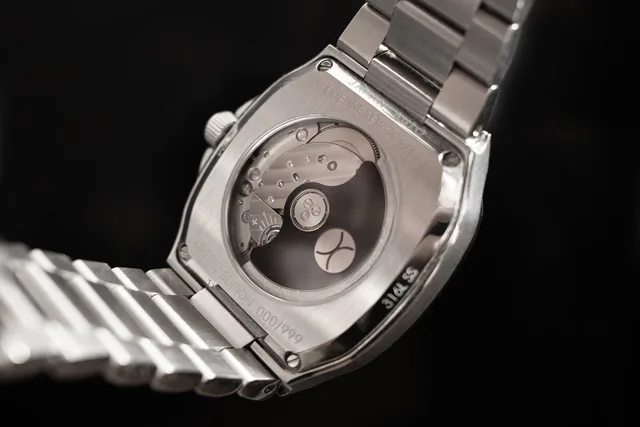
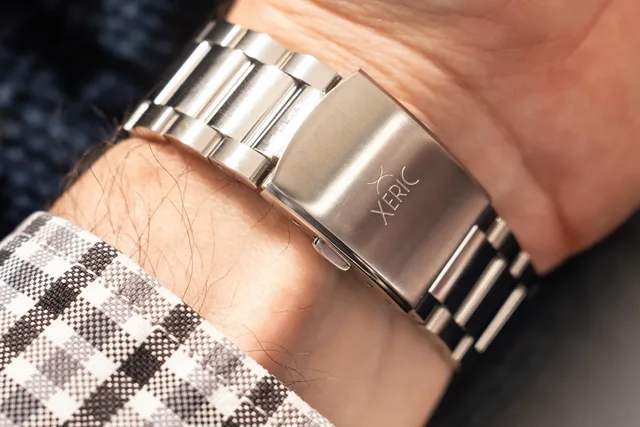
Snail cams are typically central to retrograde displays, and Xeric’s founder Mitch Greenblatt told me about the module and its double snail cams for the hours and minutes. “We went through numerous prototypes and pushed our component factories to elevate their quality and tolerances,” he says. “Perfecting the spring mechanism was one of the most challenging aspects of the process — it required extensive refinement to ensure consistent performance and durability.”
Development began six years prior (with some pauses) when Greenblatt visited his manufacturer in China. “We brought vintage examples of double retrogrades from my personal collection for them to analyze, using them as inspiration for our modern take on this rare complication.”
There’s little mystery to what watches inspired the Xeric Timeline. In 2020, Greenblatt published the book Retro Watches: The Modern Collector’s Guide which is about the titular topic in general but also his own captivatingly funky collection. Open the cover, and facing the title page you’re greeted by a full-page image of the 1969 Wittnauer Futurama. You can read about it more on page 239, and on page 128 you’ll find the similar Lip Secteur from 1972.
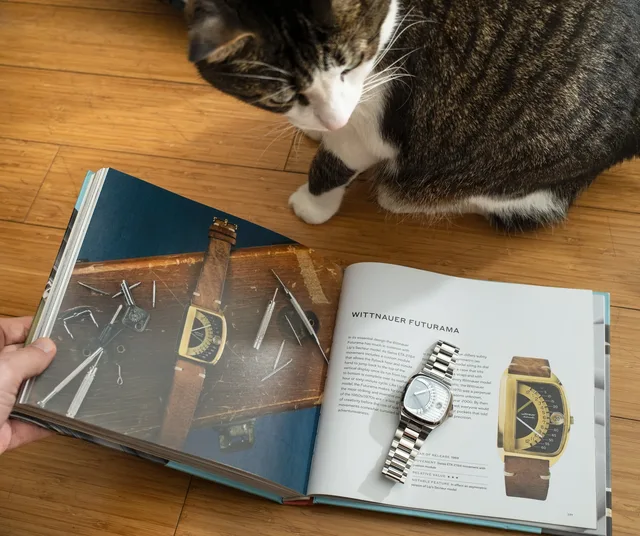
There were other double retrograde watches from the era, but these examples share key features with the Xeric Timeline: the hands’ orientation, the horizontal lines indicating the minutes, and even the round date window in the middle. The Timeline is in some sense a homage to these watches, but no replica — some were round, some were square or rectangular and some were horizontally oriented, but the Timeline’s TV-dial shape helps distinguish it.
Flip through Greenblatt’s book, and you might find examples of this general style as it was popular in the 1960s and ‘70s. It’s overall more palatable and wearable than the large and vertically long, rectangular cases of the Wittnauer and Lip watches. Xeric’s reinterpretation has a comparatively conventional look, and that helps keep the focus on the main attraction: the unique dial layout and its captivating functionality.
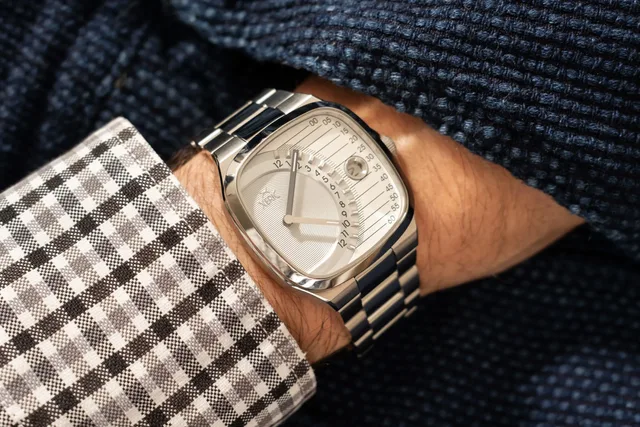
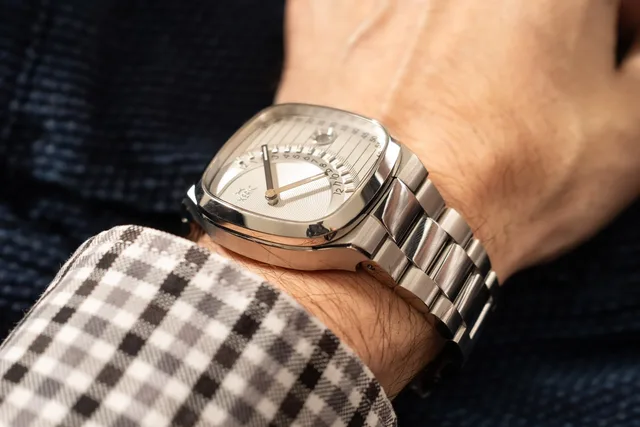
Though easier wearing with a 38mm diameter and 47mm lug-to-lug distance (including the first bracelet links), the Xeric Timeline wears rather more prominently than those specs suggest. That’s in part due to a thickness of 13mm, as the double retrograde module nearly doubles the Miyota 9015’s 3.9mm height measurement by adding 3mm.
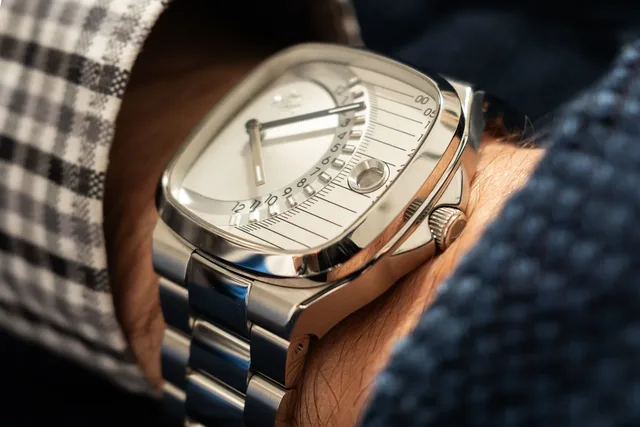
Moreover, the broad dial and thin bezel result in considerable visual presence. Tested here is the silver dial, one of the more classically styled options alongside two-tone and a model in gold PVD-coated steel with a black dial. That latter version probably most evokes the Wittnauer Futurama. If you want an even more eye-catching look, you can get bright dial colors such as teal, orange and blue. One version also features a black dial with rainbow highlights. But this silver version is sufficiently funky for me.
The Xeric Timeline felt bold and chunky the first time I strapped it on, but my brain and wrist adapted to it over a couple days. The more I wore it, the more I liked it. Not only is it a nice break from the usual, but the dial itself is full of depth and texture with applied indices as well as different layers and finishes. The visual interest that achieves is key because without a seconds hand, there’s no animation on the dial — aside from that dramatic one that occurs once per hour.
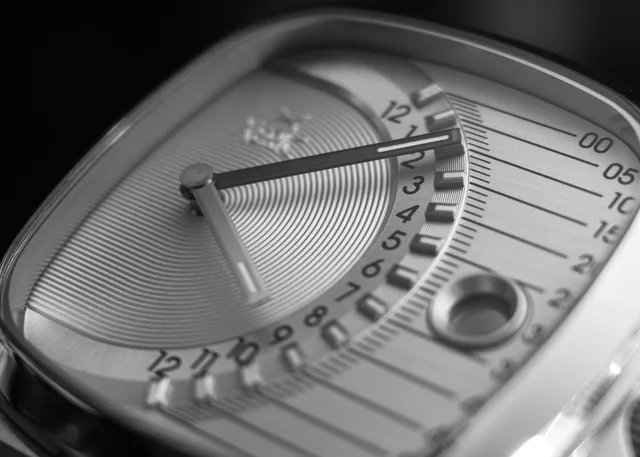
And what about that flyback effect? The best way to experience it is when setting the watch, but in day-to-day wear it’s subtle. Greenblatt says that the cams in his custom module “deliver smooth, precise, and dramatic resets,” and I’d have to agree. There’s a click when that snapback happens, but it’s quiet. I’d often wait for that moment only to get distracted and then be disappointed to find I’d missed it.
My wish for the Xeric Timeline would be for a thinner case and bracelet insofar as it would be possible with the dial depth and the retrograde module. The bracelet is of the “integrated” variety which is apparently a big selling point for many people. That means, however, that you can’t use standard aftermarket straps. Luckily, the bracelet is comfortable and of good quality, so swapping isn’t a major priority.
Ok, so it’s comfortable on the wrist, but what about on the eyes? As you can see, it’s cool-looking. But I’m talking about actually reading the time. All those time-telling elements are legible enough, but a drawback of retrograde displays is that you can’t easily tell the time just by hand position as one is accustomed to on conventional analog watches. You can get a general sense of the time at a glance, but you often have to actually read the numbers. It’s not a dealbreaker, but it’s worth mentioning.
Sure, midcentury watchmakers often had futuristic dreams when they built funky watches like the Wittnauer Futurama or the Lip Secteur, but retrograde displays are much older. We’re talking about clocks and pocket watches of all manner that featured them in centuries past. So to be able to get this kind of feature on a modern wristwatch is cool in a number of ways. But in the low four figures? That’s something that should excite even skeptics of microbrands and affordable watches.
The Xeric Timeline will be limited to 999 examples in each color, and the Kickstarter funding campaign will begin February 25th. With an eventual retail price of USD 1,199, it’s available for preorder on Kickstarter for USD 699-749.
Xeric Timeline
Dimensions: 38mm x 47mm x 13mm
Movement: Xeric Caliber X5.1 (customized Miyota 9015) automatic
Materials: Steel case; sapphire crystal
Water Resistance: 50m
Price: USD 1,199 (Kickstarter preorder: USD 699-749)
To learn more, visit Xeric's Kickstarter campaign, here.