Dynamic Design: Spotlight on Perrelet
How functionality and aesthetics go hand in hand at the unique watchmaker

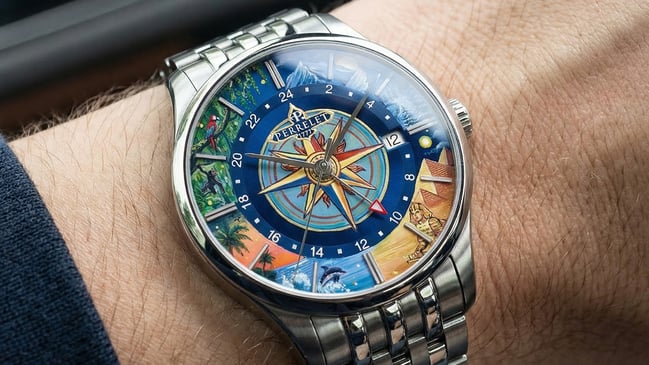
Abraham-Louis Perrelet was a gifted watchmaker with a passion for innovation. While he is credited with many inventions in his field, he will forever be known as one of the trailblazers of automatic winding. This was translated into a prominent design feature when Perrelet was founded as a brand in 1993 in the Swiss town of Neuchâtel, ensuring that the name and legacy of the master himself live on through dynamic design.
When Abraham-Louis Perrelet was born around 1729, it was destined that he would go into watchmaking. His crib was placed in Le Locle, in the canton of Neuchâtel, which is still one of the most prominent places in Swiss watchmaking as it was back then. Perrelet grew up in the workshop his father and grandfather owned and quickly proved himself for his keen eye, steady hand, and great understanding of watchmaking. Aiming for constant improvement, there was not an aspect of the watch that escaped his attention. During his life, he worked on everything from creating complex calendar movements to improving the design of pinions and refining gear trains. He also wanted to do away with the winding key that was back then commonly used to wind a pocket watch. Fixated on the idea that the motion of the watch should be enough to wind the movement, he developed, around 1770, an automatic winding system that did just that.
While this cemented Perrelet’s place in watchmaking history, and he was succeeded by his son and grandson who acquired fame of their own, the dynasty had to wait until 1993 to get another impulse. It was in that year that Perrelet was founded once again, but now as a manufacturer of wristwatches. To highlight the legacy of Abraham-Louis Perrelet in a way that would resonate with modern-day consumers, the company launched the double rotor in 1995. By connecting the oscillating weight located at the back of the movement with the front, a dynamic element was created. It narrated the movements of the wrist and offered a visually intriguing focal point as it is nearly always in motion.
It was initially used in the Dipteros collection. The word “dipteros” comes from Greek and means “two wings,” quite fitting for this Perrelet. With the Dipteros I, the oscillating weight of the back of the watch was mimicked at the front, while with the Dipteros II, it would run around the periphery of the dial.
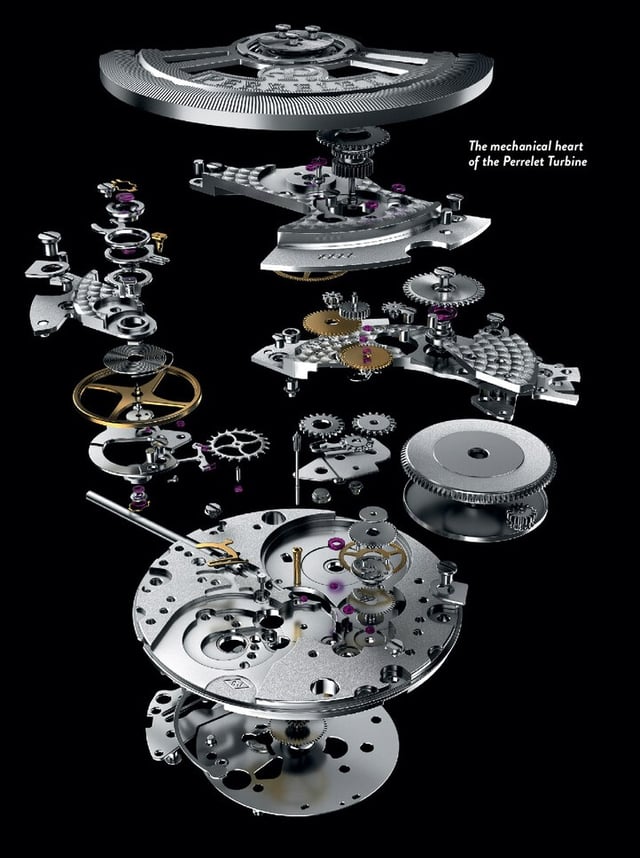
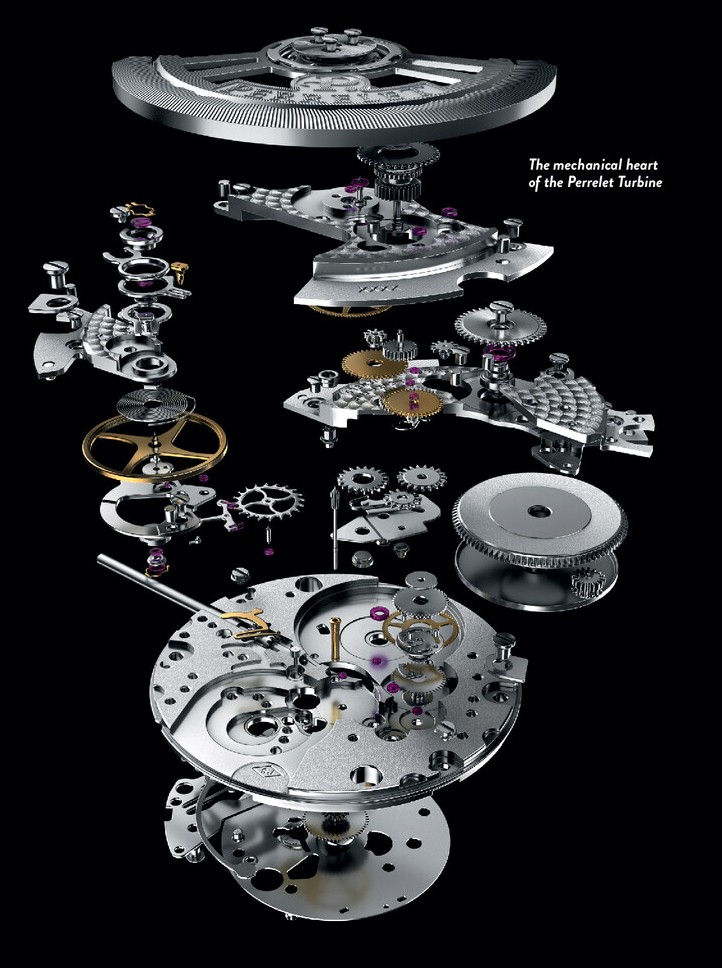
Nearly three decades later, these two concepts, inspired by Perrelet’s original work, have proven to stand the test of time. Perrelet as a brand has grown over the years and, like the master watchmaker himself, has pursued an ever-increasing degree of perfection. In 2012, they launched Caliber P-321, their first in-house movement. This capability gave them even more artistic freedom, which they immediately seized.
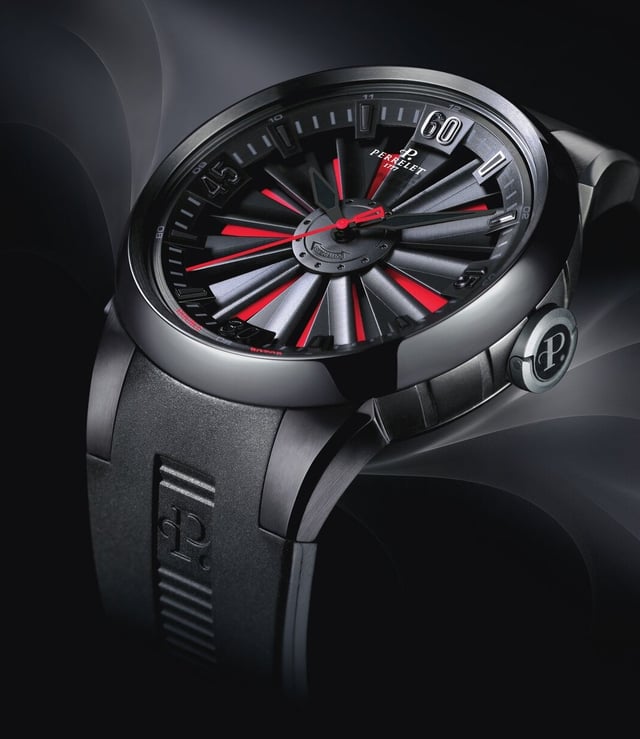
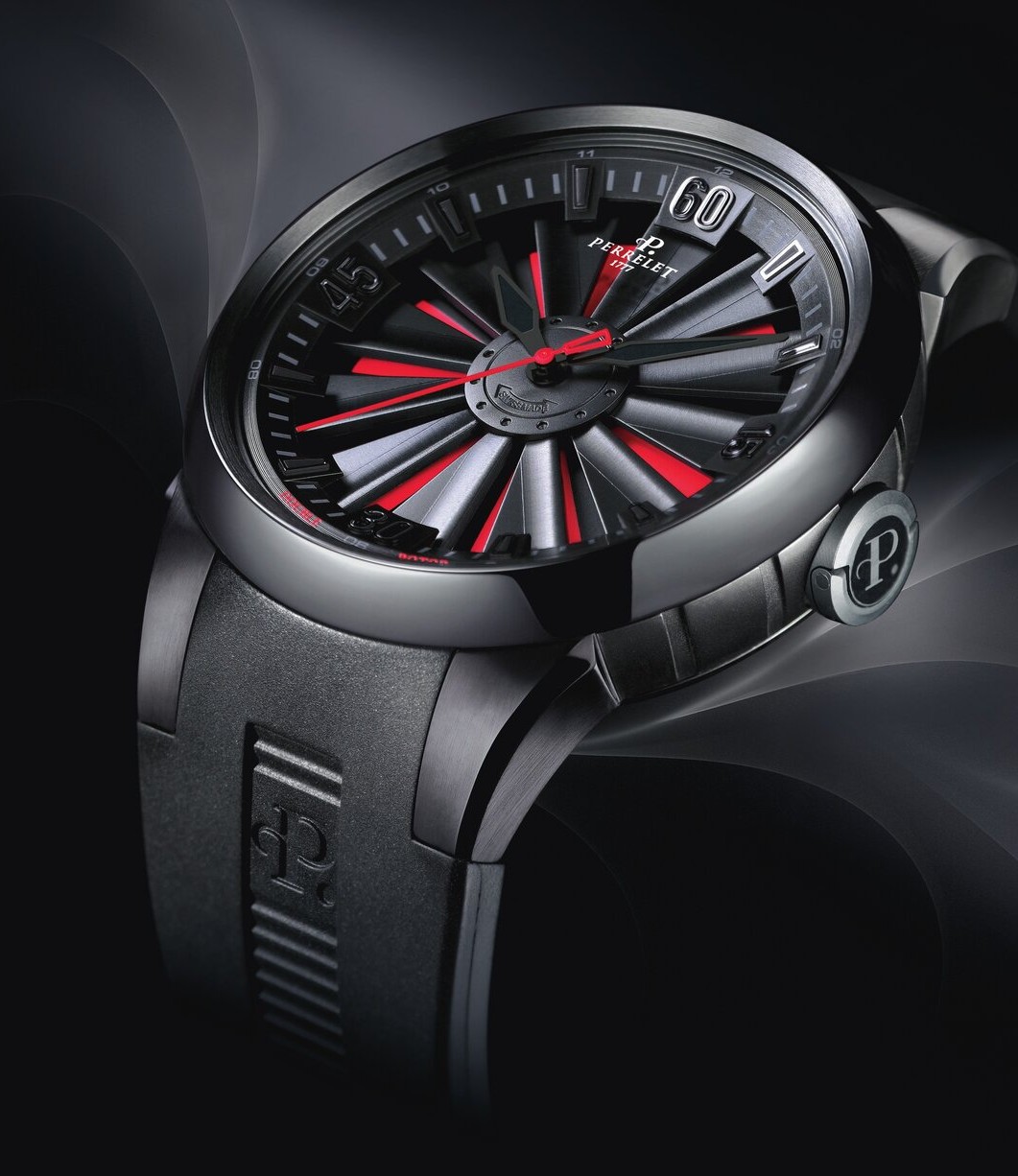
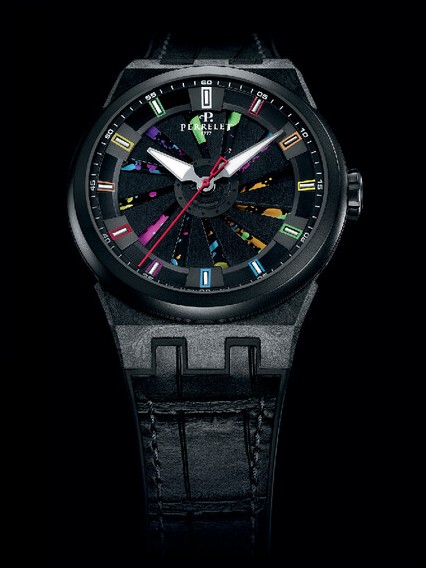
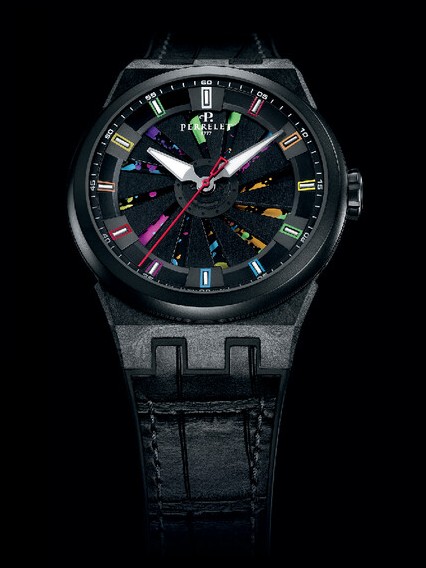
One of the brand’s boldest creations is the Turbine. Here the double rotor system is transformed into a turbine, thanks to 12 titanium blades giving the impression that you are looking straight into a jet engine. Thanks to a special system, a twist of the wrist propels the turbine into a dazzling speed. When that happens, the blades almost become invisible, revealing what’s behind them.
Perrelet used this by playing with the backgrounds to create different effects. This can be rather subtle, such as the Turbine Blue, with its dash of color, while the Turbine Erotic reveals something of a more explicit nature. Other varieties include the Turbine Space Conquest, showing an astronaut in space; the Turbine Hypnotic, where the double rotor is used to create a dazzling effect; and the fun Turbine Splash, which offers a bold contrast of all the colors of the rainbow, housed in a lightweight, 44-mm case crafted from polycarbonate and carbon fiber.
The concept of the Turbine also easily translates into a less bold and more elegant design, as shown by the Turbine Lady. Here, Perrelet showcases the natural beauty of diamonds, which become even more noticeable due to the effect of the turbine. For these watches, Perrelet also opted for a different lug design more suited to their smaller diameter.
While it should be visually appealing, another key element of watches from the brand has always been that the design should also support wearing comfort. This is also the case with the Diamond Flower collection, where Perrelet grants itself full artistic freedom, further utilizing the double rotor design. Combining diamonds and mother-of-pearl, the oscillating weight becomes a dynamic part of the design. As it moves, the design will change with it, making it all the more interesting.
The Dipteros II concept lives on in the LAB Peripheral, where the oscillating weight makes its rounds on the dial side of this tasteful cushion-shaped design. It is more of a classical proposition compared to the Turbine, although a certain family resemblance is undeniable. Color is used to give the different models distinct characters, which Perrelet offers as a time-only, but also with a large date and a second time zone complication.
With his development of the automatic watch, Abraham-Louis Perrelet gave timepieces a more autonomous life, as our movements have the power to run. While this is still the case, his initial invention has also allowed a dynamic design to take shape within the wristwatches that bear his name, giving an even more tangible dimension to automatic winding.
This article was originally published in the 2025 Special Design Issue. To subscribe to the print edition of WatchTime Magazine, click here.