Jun 28, 2009
Reading time 5 min.
A Rose Gold by Any Other Name...

 An oft-discussed topic among watch aficionados - and one that arises for us reporters each year during Basel and Geneva - is what differentiates rose gold from pink gold from red gold. I’ve been looking into how the brands use these terms, and this year, as in the past, the answers I come away with are: Everything. Or nothing. Clear?
Depending on the brand — and often on who writes the marketing materials for the brand, and in what language — pink, rose and red gold are either totally different materials or basically the same one. In the interest of clarifying things for those watch guys who (like your humble correspondent) are not necessarily well-versed in the language of jewelry and precious metals, I did a bit of research and came up with a few relevant factoids.
The first should be fairly obvious: gold, in its natural state, is yellow. White gold and pink/rose/red gold (not to mention such oddities as black gold) do not occur in nature. Any watch ad campaign that touts its wares as having “pure rose gold” is engaging in a bit of marketing hyperbole. Anything other than pure (that is, 24k) yellow gold is not a pure metal at all, but an alloy, defined by Webster’s as “a substance composed of two or more metals or of a metal and nonmetal intimately united.”
In fact, even the yellow gold we see in watches and jewelry is not pure gold, which is too soft and malleable to maintain a rigid shape. The yellow gold in such watches as the Breguet Tradition and A. Lange & Söhne Richard Lange is made up of yellow gold with traces of other base metals thrown in. (The amount of other metals in the mixture depend on the karats:18k gold, which is used in most watch cases, is 75% gold.)
An oft-discussed topic among watch aficionados - and one that arises for us reporters each year during Basel and Geneva - is what differentiates rose gold from pink gold from red gold. I’ve been looking into how the brands use these terms, and this year, as in the past, the answers I come away with are: Everything. Or nothing. Clear?
Depending on the brand — and often on who writes the marketing materials for the brand, and in what language — pink, rose and red gold are either totally different materials or basically the same one. In the interest of clarifying things for those watch guys who (like your humble correspondent) are not necessarily well-versed in the language of jewelry and precious metals, I did a bit of research and came up with a few relevant factoids.
The first should be fairly obvious: gold, in its natural state, is yellow. White gold and pink/rose/red gold (not to mention such oddities as black gold) do not occur in nature. Any watch ad campaign that touts its wares as having “pure rose gold” is engaging in a bit of marketing hyperbole. Anything other than pure (that is, 24k) yellow gold is not a pure metal at all, but an alloy, defined by Webster’s as “a substance composed of two or more metals or of a metal and nonmetal intimately united.”
In fact, even the yellow gold we see in watches and jewelry is not pure gold, which is too soft and malleable to maintain a rigid shape. The yellow gold in such watches as the Breguet Tradition and A. Lange & Söhne Richard Lange is made up of yellow gold with traces of other base metals thrown in. (The amount of other metals in the mixture depend on the karats:18k gold, which is used in most watch cases, is 75% gold.)
What we call white gold is pure yellow gold mixed with another metal, usually nickel, silver or palladium, and sometimes a smattering of copper and/or zinc, to achieve its clean, shiny appearance. Usually, a white-gold case also has rhodium plating applied to minimize the slightly brown tint that results from mixing the metals; gold alloys will never achieve “true” white coloration. A notable exception to this practice is Vacheron Constantin, which in 2007 changed the white-gold recipe on its men’s watches. The traditional equation is 75% gold, 12.5% palladium, 6% copper, 4 % silver, and 2.5% nickel, with rhodium plating, but VC upped the palladium content to 15%, a costly move that adds shine without requiring the rhodium plating, which, the company points out, can wear off over time. The metals in the alloy are quite heavy (pure gold is actually heavier than lead!), which is why the best way to tell the difference between a polished stainless-steel watch and a white-gold watch is to simply feel its weight in your hand.
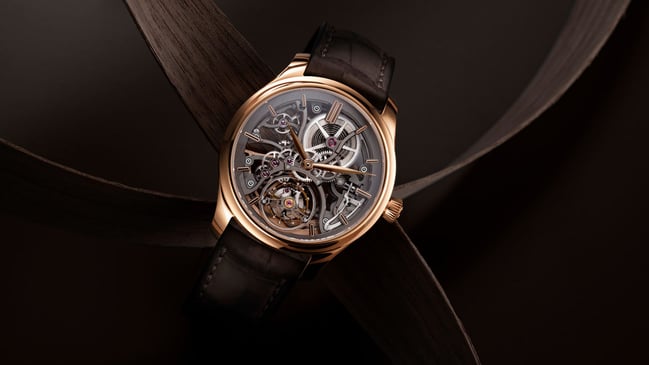
 To get to the central question, what we call rose, pink or red gold is pure yellow gold mixed with varying amounts of copper. (The use of the term “rose gold” may have even started with a simple French-to-English translation: “rose” is the French word for “pink.”) The copper adds a reddish tint to the gold, resulting in the color that is now so popular among watch enthusiasts. The greater the ratio of copper to gold, the richer, more reddish the hue. Ebel uses 4N rose gold (the traditional formula for which is 75% gold, 9% silver and 16% copper) in its 1911 BTR watches, for example. While many watch brands do not specify their gold-alloy formulas, a “rose gold” or “pink gold” watch with a fairly subtle pinkish tone is probably 4N, or even 3N (75% gold, 13% silver, 12% copper) if the tone is closer to yellow. If a case has a noticeably richer, redder tone — like Corum’s new Admiral’s Cup Challenge 44 Black and Gold watch — it is most likely 5N rose gold, often called red gold, traditionally composed of 75% gold, 4.5% silver and 20.5% copper. Some watch brands are embracing the higher-copper alloy of late: IWC, for one, has made a point of noting the richer red tone of its Portuguese Tourbillon Mystère in its marketing for that watch. Put the 2008 model of the Tourbillon Mystère, with the 5N rose-gold case, next to the earlier 4N rose-gold version and the difference is subtle but easily apparent.
To get to the central question, what we call rose, pink or red gold is pure yellow gold mixed with varying amounts of copper. (The use of the term “rose gold” may have even started with a simple French-to-English translation: “rose” is the French word for “pink.”) The copper adds a reddish tint to the gold, resulting in the color that is now so popular among watch enthusiasts. The greater the ratio of copper to gold, the richer, more reddish the hue. Ebel uses 4N rose gold (the traditional formula for which is 75% gold, 9% silver and 16% copper) in its 1911 BTR watches, for example. While many watch brands do not specify their gold-alloy formulas, a “rose gold” or “pink gold” watch with a fairly subtle pinkish tone is probably 4N, or even 3N (75% gold, 13% silver, 12% copper) if the tone is closer to yellow. If a case has a noticeably richer, redder tone — like Corum’s new Admiral’s Cup Challenge 44 Black and Gold watch — it is most likely 5N rose gold, often called red gold, traditionally composed of 75% gold, 4.5% silver and 20.5% copper. Some watch brands are embracing the higher-copper alloy of late: IWC, for one, has made a point of noting the richer red tone of its Portuguese Tourbillon Mystère in its marketing for that watch. Put the 2008 model of the Tourbillon Mystère, with the 5N rose-gold case, next to the earlier 4N rose-gold version and the difference is subtle but easily apparent.
A cursory review of watch brands’ marketing materials from the Swiss watch shows reveals a maddening lack of uniformity in the use of the terms. Panerai, perhaps the most masculine of watch brands, refers to its Radiomir Base case as “pink gold,” the term also used most often by Piaget, Bulgari and Cartier. “Rose gold” is probably the most common term these days, used by Patek Philippe, Breguet, Zenith, Corum, and scores of others. “Red gold” appears in the marketing of Hublot, Blancpain and Gérald Genta, most of which appear to be using chiefly 5N.
Of course, watch companies continue to find new variations on the numerous gold alloys. Louis Moinet, a relative newcomer to the luxury-watch scene, calls attention to the difference between alloys in the most obvious manner possible: by using 5N and 3N side-by-side in the two-tone case of its Tempograph watch. Meanwhile, keeping up with today’s new-material mania, Rolex introduced its 2008 version of the Cosmograph Daytona in an alloy it calls “Everose gold” which mixes gold, copper, and a touch of platinum to create a subtle, dusty pink color that I wouldn’t be surprised to see other brands emulate before long.
What can we glean from all this? Just a few hopefully helpful generalities. To wit: if a watch is “pink gold,” it’s probably 3N or 4N; if it’s “rose gold,” it could be 4N or 5N; and if it’s “red gold,” it is most likely 5N. So, to paraphrase the Bard, does a rose gold by any other name shine as bright? Only you can be the judge.