Aug 20, 2018
Reading time 4 min.
Building the Foundation, Part 5: The In-House Movements of Raymond Weil
FEATURE
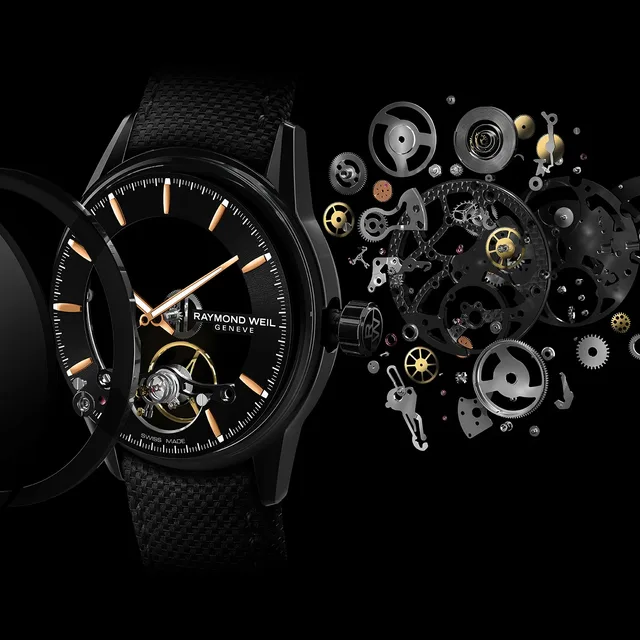
Rome wasn’t built in a day — and neither was Rolex, Patek Philippe, Jaeger-LeCoultre and other watch manufacturers praised for their vertical integration and lauded for their array of in-house calibers. While we all applaud the handful of brands that bring new and increasingly complicated calibers to market virtually every year, we also should take note of other brands, many of them smaller, independently owned, or known throughout their history more for outsourcing their movements, that are taking a more incremental approach. In this series of articles, we look at five brands — three Swiss, two German — that are taking it slow and steady. This week, we wrap up the series with the neophyte in our quintet, at least in terms of movement-making: Geneva’s Raymond Weil.
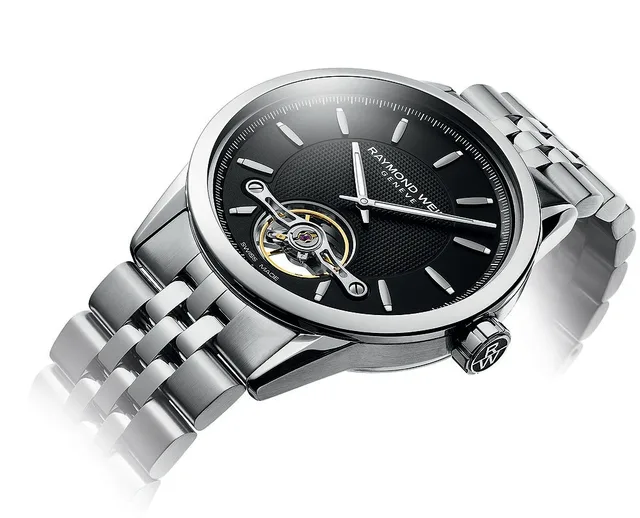
Raymond Weil Freelancer Calibre RW1212
PR
Founded in 1976 and still family-owned, Raymond Weil had until recently maintained its watches’ relatively affordable price points with outsourced calibers from the Swatch Group’s movement-making colossus ETA — which still, at this stage of the game, power the vast majority of the company’s output. In 2017, however, Raymond Weil rolled out its first proprietary movement, developed not entirely in-house from the ground up but in a creative collaboration with Sellita, based in the Swiss Jura, another prolific supplier of movements to various brands and ETA’s major competitor in that field. The resulting automatic movement, Caliber RW1212, is distinguished by the dial-side positioning of its regulating organ, whose balance-and-spring construction — positioned above the mainplate and held by two bridges — peeks out from an aperture at 6 o’clock on the watch’s partially openworked dial, offering a visual effect akin to that offered by a tourbillon. All the elements relating to the regulating system, including the diamond-polished balance wheel and skeletonized bridges, were redesigned and pared down to aid in visibility.
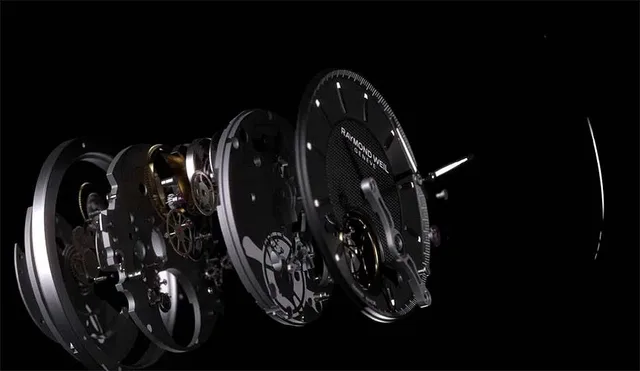
Raymond Weil Freelancer Caliber RW1212 is distinguished by a dial-side regulator.
PR
Raymond Weil debuted the movement in the Freelancer Calibre RW1212, a watch with a round, stainless steel 42.5-mm case, a double-sided antiglare crystal, a screwed, fluted crown; a black galvanic dial with guilloché center, and — for visual balance with the large 6 o’clock aperture — two barrel-shaped luminous hands indicating the time on applied indices. A screw-down caseback features a sapphire window offering a view at the movement’s rear side, including its rotor, adorned with côtes de Genève and a Raymond Weil logo. (For my in-depth review of the Freelancer Calibre RW1212, click here.)
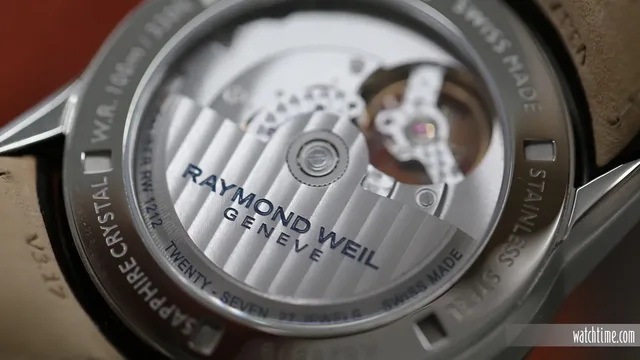
Raymond Weil Freelancer RW1212 - Movement - Rotor
PR
A year later, Raymond Weil rolled out a skeletonized version of Calier RW1212 (the numerals refer to the postal code of Grand-Lancy, the Geneva suburb that is home to the company’s HQ), in another Freelancer model, the Freelancer Calibre RW1212 Skeleton. In this watch, the dial has been openworked and the movement pared down to offer an unobstructed view of not only that telltale front-mounted balance but much of the rest of the mechanism as well; the rotor has also been skeletonized to enhance interest in the rear side of the movement, which is on display through a clear caseback.
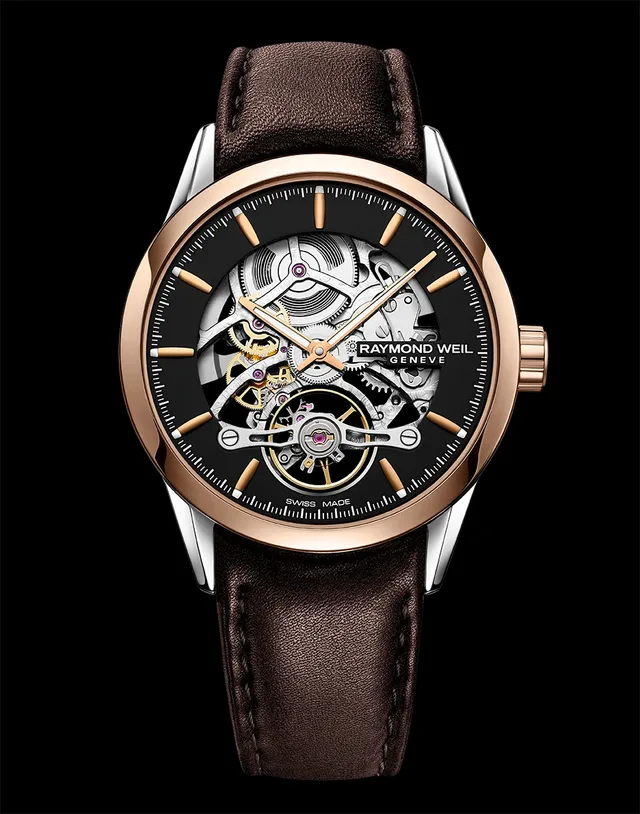
Raymond Weil Freelancer Calibre RW1212 Skeleton in two-tone case and leather strap
PR
Raymond Weil offers three versions of the Freelancer RW1212 Skeleton. One is in stainless steel with black PVD coating, black galvanic dial, and rose-gold PVD on the hands and indices, on a black calf leather strap. Another combines a stainless steel case with a rose-gold-PVD-coated bezel, crown, hands, and indices, on a brown calf leather strap, while a third “all steel” option matches a steel case and bracelet with blued steel hands and indices.
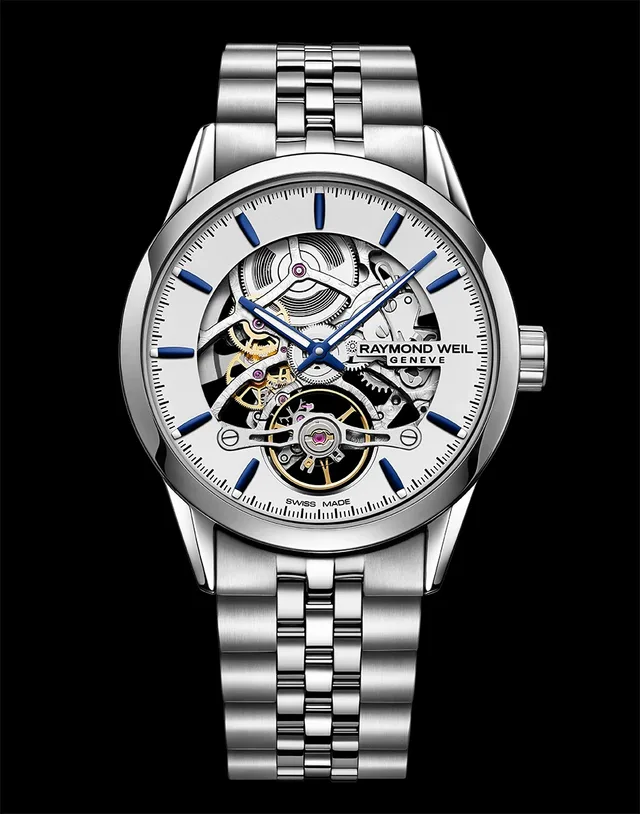
Raymond Weil Freelancer Calibre RW1212 Skeleton in stainless steel case and bracelet
PR
Much like Tudor, Nomos, and Oris — which we have covered in recent weeks in this series — Raymond Weil historically has striven to keep its watches priced under a certain threshold, meaning that its in-house movement development is likely to follow a similar path, with small complications gradually augmenting the faux-tourbillon design of the base movement — though the thought of what a GMT, world timer, or chronograph timepiece might look like in this fledgling collection is an intriguing one indeed.